Contact Us
USA Flag
SUPPORT
SMALL BUSINESS
📦 My Cart
- OR -

SELECT Your Nissan Pickup Year

SELECT Your Nissan Pickup Submodel

SELECT Your Nissan Pickup Body Type

SELECT Your Nissan Pickup Engine

1 SELECT Year
2 SELECT Submodel
3 SELECT Body Type
4 SELECT Part Side
5 SELECT Engine
  1. ID: 1
    ✓ In Stock

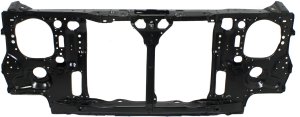
    Radiator Support Assembly for 1995-1997 Nissan Pickup, Steel, Replacement

    OEM Part Number: 62500-1S730

    $215.95

Quick Summary

The radiator support-also called the core support, tie bar, or front radiator frame-is a stamped metal or composite beam that spans the nose of your Nissan pickup. It keeps the radiator, condenser, and headlights in place, ties the left and right frame rails together, and forms a first line of crash energy absorption. When this panel bends, rusts, or cracks, cooling efficiency drops, body gaps shift, and alignment problems appear.

Overview

The radiator support sits just behind the grille and bumper. It bolts to the frame rails and often carries mounts for the hood latch, horns, and wiring clips. In the 1986-1997 Nissan D21 "Hardbody" truck, service manuals list the panel under "front body-radiator core" and show removal from above once the battery and hoses are out of the way .

Location

  • Positioned at the very front of the engine bay so the radiator can catch outside air (Wikipedia).
  • Acts as a bridge between the left and right aprons, sometimes called a "bulkhead" in patents .

Main Jobs

  1. Structural brace-limits flex and helps the cab survive crashes by absorbing initial impact energy .
  2. Cooling mount-holds the radiator, A/C condenser, and fan shroud in precise alignment for airflow .
  3. Panel alignment-sets the gap for fenders, hood, and headlights; even small bends can change body lines .

Materials

  • High-strength steel is common for factory supports because it is stiff and welds easily .
  • Aluminum versions weigh 25-40 % less, a useful weight-saving noted by OEM studies .
  • Some aftermarket "tie bars" combine plastic ends with metal beams to meet energy-absorption targets (Engineering Cheat Sheet).

Failure Signs

  • Upper tank of the radiator sits uneven or vibrates.
  • Hood or fenders no longer line up after a light front hit .
  • Coolant temps climb because the fan shroud loses clearance (C&C Automotive).
  • Visible rust flakes along the lower seam; DIYers often wire-wheel and treat with converter as a stop-gap (Reddit).

Common Causes

  • Low-speed parking crashes that push the bumper into the core support.
  • Chronic rust from road salt pooling in the lower channel.
  • Over-tightening of hood-latch bolts, which can pull the upper bar forward.

Fit & Interchange

Nissan used two basic stampings for the D21: one for 2-row radiators and one for heavy-duty 3-row coolers; both share the same rail bolt pattern . Always match cab style (regular, King Cab) and model year because head-lamp brackets differ.

Install Basics

  1. Disconnect battery and drain coolant.
  2. Remove grille, headlights, and bumper fascia.
  3. Support the radiator, unbolt mounts, then loosen spot-welds or bolts on the support.
  4. Tug the bent panel free; many DIYers use a drill-out and plug-weld method .
  5. Check frame-rail squareness before welding the new core in place.
  6. Reinstall cooling stack, refill coolant, and bleed air.

Alignment Check

After replacement, drive the truck onto a flat surface and verify steering wheel centering. Body shops note that mis-set supports can throw off camber and hood gaps, so they measure X-dimensions from firewall to head-lamp buckets .

Crash & Safety

Front-end modules are engineered to bend in a controlled way, sharing impact loads with bumper beams and side rails . Aluminum cross-members can shave kilos yet still meet crash-test pulse limits thanks to progressive folding . Properly welded supports restore this protection; gaps or thin welds reduce energy absorption (Engineering Cheat Sheet).

Rust & Care

  • Rinse road salt off the lower tray often.
  • Spray cavity wax inside the boxed sections after any repair.
  • Touch-up paint chips before corrosion spreads (Reddit).

Cost Range

Online owner reports show new supports priced around $260-$400, while labor quotes run $800-$1,400 because the front clip must be stripped (Reddit). DIY welding can cut costs but demands solid MIG skills and frame-rail checks.

Green Disposal

Old supports are 100 % recyclable steel or aluminum; scrap yards pay by weight, and recycling keeps heavy metals out of landfills (RecycleNation).

Upgrades & Mods

Some off-road owners add bolt-on tube braces between the upper tie bar and the frame horns to stiffen the nose and protect the radiator during trail hits. Lightweight aluminum supports paired with an aluminum radiator can save roughly 8-10 kg over stock .

  • Upper and lower tie bars
  • Hood latch support
  • Fender aprons
  • Crash-management beam

Frequently Asked Questions

Q: What does a radiator support do?
A: It holds the radiator, condenser, fan shroud, and sometimes headlights while bracing the truck's frame rails and absorbing crash energy (Wikipedia).

Q: Is a "core support" the same thing?
A: Yes. Core support, tie bar, and radiator support are common synonyms for the same front-end panel (Engineering Cheat Sheet).

Q: Can I drive with a cracked support?
A: Short trips might be possible, but vibration can rupture radiator tanks and misalignment can affect steering; replace or repair as soon as you can .

Q: Does replacing it require frame welding?
A: The Nissan D21 uses spot-welds and bolts. Repair usually needs drilling factory welds and MIG-welding the new panel in place .

Q: Will it fix my crooked fender gaps?
A: Often yes-techs use the support to "square" the front clip. If gaps remain, a frame measurement is next .

Q: What material lasts longest?
A: Galvanized high-strength steel resists rust best, while aluminum saves weight but needs proper coatings to avoid corrosion .

Q: How long should the job take?
A: A professional body shop typically needs 6-8 hours including paint; DIY times vary with welding skill (Reddit).

Q: Is alignment needed afterward?
A: Yes. Always perform a 4-wheel alignment once the new support is in place to ensure straight tracking and even tire wear .

Q: Can I recycle the old support?
A: Absolutely-scrap metal yards accept both steel and aluminum supports, keeping them out of landfills (RecycleNation).

References
Wikipedia "Radiator (engine cooling)"
Valeo Front-End Modules overview
C&C Automotive blog on radiator failure signs
Unified Alloys comparison of steel vs. aluminum
RecycleNation guide to recycling radiators
Chevy Tri-Five forum post on alignment issues
MechanicAdvice forum discussion of repair costs
ICS Collision article on frame alignment after crashes
CompositesWorld report on energy-absorbing nose modules
YouTube "How to Straighten a Core Support"
European Aluminium crash-management PDF
EngineeringCheatSheet "Crashworthiness 101"
Kloeckner Metals blog on automotive aluminum
Nissan D21 service manual excerpt (Scribd)
Northwest Auto Collision signs of frame misalignment


Why Millions Choose Go-Parts

Your Go-To Place for Auto Parts!

100% Money-Back Guarantee

Shop with confidence and peace of mind

🏆

Trusted Since 2007

Over 18 years of excellence

🏅

OEM Quality

Meets or exceeds OE standards

🚚 Fast Shipping • ↩️ 90-Day Returns • 🎯 Perfect Fit Guaranteed

Racing Partner Videos

×

Search by Vehicle

1
2
3