

B1000 on 2012-2016 Honda CR-V: SRS Failure or Communication Error?
On a 2012-2016 Honda CR-V, code B1000 is ambiguous. It most often indicates either an internal failure of the SRS (airbag) control unit or a 'Communication Bus Line Error' from the MICU (fuse box). A professional scan is required to see which module set the code; do not buy parts before this step.
- B1000 on a 2012-2016 CR-V is ambiguous. Do not guess or replace parts without a proper diagnosis.
- The first step is to use a high-quality scanner to see if the code is in the SRS (airbag) module or the BCM/MICU (body computer).
- If the SRS light is on, the airbag system is inactive and will not work in an accident. This is a critical safety issue.
- If the cause is a communication error, check the battery and related fuses first, as these are simple and common fixes.
- Due to the complexity of both potential issues (airbags and data networks), professional service is strongly recommended.
What's Unique About the 2012-2016 Honda CR-V
The 4th generation CR-V, like many Hondas of this era, uses a B-CAN communication network for body electronics. While B1000 on some older Hondas like the Civic almost always meant a network communication fault (often the MICU), the 'B' prefix also commonly relates to the SRS (airbag) system. This ambiguity means you cannot assume the cause without a deeper diagnosis. The critical first step is to determine if the code is originating from the SRS module or the main body computer (MICU).
Symptoms You May Notice
- SRS (Airbag) warning light is illuminated on the dashboard.
- Multiple, seemingly unrelated electrical issues (e.g., wipers, lights, or A/C acting erratically).
- Parasitic battery drain, causing a dead battery after sitting.
- Other warning lights may appear on the instrument cluster due to communication loss.
- No communication with multiple control modules when using a standard OBD-II scanner.
- Replacing individual components like the clock spring or a single airbag sensor without confirming the B1000 code points to an internal SRS unit failure.
- Replacing the gauge cluster or climate control unit when the actual fault is in the MICU or the B-CAN wiring.
- Condemning the SRS unit or MICU without first performing a thorough battery and charging system test.
Most Likely Causes
- Internal Failure of the SRS Control Unit 🔴 High Probability → Shop Air Bag Control Module SRS units can fail internally over time due to component degradation or can store permanent crash data after an accident, requiring replacement.
How to confirm: Use a scan tool capable of reading Honda SRS codes (like Honda HDS). If B1000 is stored in the SRS module and power/ground tests to the unit are good, the unit itself is condemned.
Typical fix: Replace the SRS control unit. This must be followed by initialization and, in some cases, programming by a dealer or qualified shop to match the vehicle's VIN and configuration.
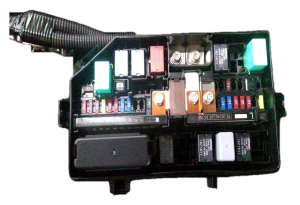
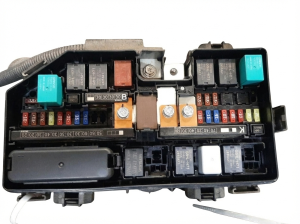
Est. part cost: $650-$920 - Faulty Multiplex Integrated Control Unit (MICU) 🔴 High Probability The MICU, which is integrated into the under-dash fuse box, is a central gateway for the B-CAN network. It is a known failure point that can disrupt communication across the entire network, causing it to log a B1000 'Bus Off' error.
How to confirm: Diagnose using a Honda HDS or equivalent scan tool to confirm a B-CAN communication failure. Follow the official diagnostic procedure of isolating modules on the network. If all other modules and wiring are good, the MICU is the likely cause. A common symptom is multiple unrelated systems failing simultaneously.
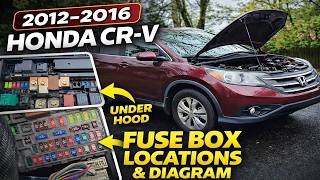
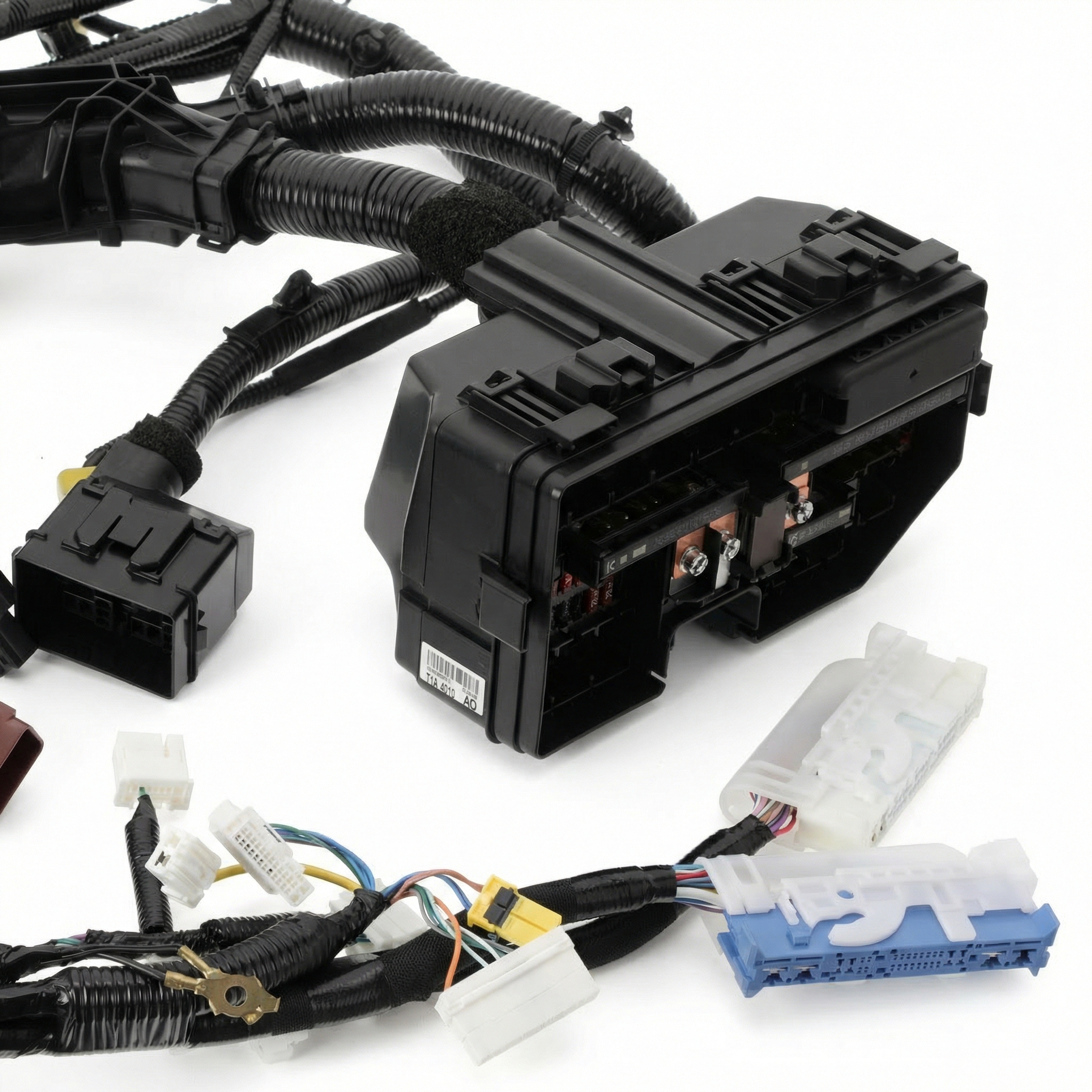
Typical fix: Replace the under-dash fuse/relay box assembly. 🎬 See this 2012-2016 Honda CR-V fuse box location guide This part often needs to be programmed or configured to the vehicle's specific options (e.g., keyless entry).
Est. part cost: $300-$500 - Poor Battery Voltage or Failing Charging System 🟡 Medium Probability → Shop Vehicle Battery Modern vehicle communication networks are highly sensitive to voltage. A weak or dying battery can cause modules to malfunction and log communication codes like B1000 before the car fails to start.
How to confirm: Test the battery with a digital multimeter (should be 12.4-12.6V with engine off) and a load tester. Check the alternator output (should be 13.8-14.4V with engine running). A voltage drop below 10V during cranking is a strong indicator of a bad battery.
Typical fix: Replace the vehicle's 12V battery (Group Size 51R). Ensure terminals are clean and tight.
Est. part cost: $150-$250 - Damaged or Shorted B-CAN Wiring ⚪ Low Probability Wiring can be damaged from previous repairs, rodent intrusion, or corrosion, causing a short or open in the single-wire B-CAN communication line. Common chafe points are behind the dashboard or near aftermarket accessory installations.
How to confirm: This requires advanced diagnostics, including checking for continuity and shorts on the B-CAN wire at various module connectors. An oscilloscope can also be used to check the signal integrity on the bus.
Typical fix: Isolate and repair the damaged section of the wiring harness.
Est. part cost: $20-$100
Rare But Worth Checking
- Aftermarket Electronics Interference:
Diagnosis Steps
- CRITICAL: Identify the Source Module. Connect a professional-grade OBD-II scanner capable of accessing all Honda modules (Engine, Transmission, ABS, SRS, Body). Navigate to the DTC list for each module and determine which one is reporting the B1000 code. This step dictates the entire diagnostic path.
- If B1000 is in the SRS Module: Your problem is with the airbag system.
- a. Check fuses #3 (10A) and #29 (7.5A) in the interior fuse box, which are related to the SRS system.
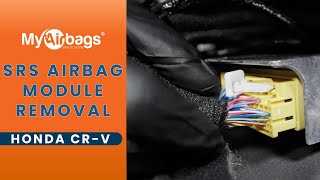
- b. Inspect the SRS control unit connectors for corrosion or damage. The unit is located under the center console, between the front seats. 🎬 Watch: How to remove the SRS airbag module
- c. If fuses and connections are good, the SRS control unit has most likely failed internally and requires replacement.
- If B1000 is in the MICU/BCM (Body Control Module): Your problem is a communication network fault.
- a. Test the battery and charging system thoroughly. Low voltage is a very common cause of communication errors.
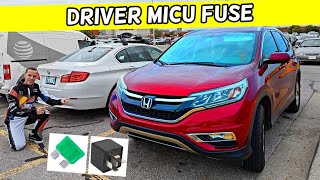
- b. Check fuses related to the MICU. In the interior fuse box, check #5 (7.5A), #20 (7.5A), and #46 (10A). In the under-hood fuse box, check fuse #29 (15A). 🎬 Watch: How to find the driver's MICU fuse
- c. Follow the B-CAN diagnostic procedure (Test Mode A), which involves using the scanner to see which modules are offline and then disconnecting them one-by-one to isolate the fault. This is best left to a professional.
- d. If all other modules and wiring check out, the MICU (under-dash fuse box) is the likely point of failure.
Parts You'll Likely Need
- SRS Control Unit
(OEM #77960-T0A-A11)— This is the most likely part to be replaced if the B1000 code is stored in the SRS module, indicating an internal failure. This part number is specific to 2012-2014 models.
Trusted brands: Honda (Genuine OE)
OEM price range: $650-$920
Aftermarket price range: N/A (Used units are available but may require specialized programming) - Under-Dash Fuse/Relay Box (MICU)
(OEM #38200-TR0-A01 (or similar for 2012-14), 38200-T1W-A02 (or similar for 2015-16))— If the B1000 code is a communication error, the MICU is a common failure point that brings down the entire B-CAN network. Part numbers vary by trim and year.
Trusted brands: Honda (Genuine OE)
OEM price range: $300-$500
Aftermarket price range: $150-$250 (Used/Remanufactured)
Related Codes That Often Appear With This One
- B1008 — This code indicates a 'Lost Communication with Gauge Control Module,' which often appears alongside B1000 when there is a B-CAN network fault.
- B1011 — Another B-CAN communication code ('Lost Communication with Gauge Control Module for VSP/NE message') that points towards a network-wide issue rather than a single component.
- U0155 — A generic 'Lost Communication With Instrument Panel Cluster (IPC) Control Module' code that can be set in various modules when the B-CAN network goes down.
Mechanic-Grade Diagnostic Values
- B-CAN Bus Voltage (Oscilloscope) — expected: A square wave signal that toggles between approximately 0V and 5V. The specific pattern will vary with data transmission.. Failure: A flat line at 0V (short to ground), stuck high at 5V or battery voltage (short to power), or no signal indicates a bus failure.
- F-CAN Bus Resistance (at OBD-II port) — expected: Approximately 60 Ω between Pin 6 (CAN-H) and Pin 14 (CAN-L) with the battery disconnected.. Failure: A reading of 120 Ω indicates one of the two terminating resistors is missing or the circuit is open. A reading near 0 Ω indicates a short between the CAN-H and CAN-L wires.
- CAN Wire Resistance to Ground — expected: Infinite resistance (OL) between CAN-H (Pin 6) and chassis ground, and between CAN-L (Pin 14) and chassis ground (battery disconnected).. Failure: Any low resistance reading indicates a short to ground on that respective wire.
Scan Tool Commands That Help
- Honda HDS / i-HDS: Replace MICU — This special function is used after physically replacing the MICU (under-dash fuse box). It is required to register the new unit with the vehicle's immobilizer system to allow the engine to start.
- Honda HDS / i-HDS: SRS Unit Replacement/Initialization — After installing a new or reset SRS control unit, the HDS must be used to write the vehicle's VIN to the module and perform system initialization. This ensures it communicates correctly with all sensors and the rest of the vehicle.
- Honda HDS / i-HDS: B-CAN System Diagnosis Test Mode — This guided function helps diagnose network problems by showing which modules are and are not communicating, allowing a technician to systematically isolate the faulty component or wiring section.
Wiring & Ground Locations
- SRS Control Unit — Under the center console, between the two front seats. Access requires removing the center console assembly.. This is one of the two primary components that can set a B1000 code. Physical inspection for connector damage or water intrusion is a key diagnostic step.
- MICU (Multiplex Integrated Control Unit) — Integrated into the under-dash fuse/relay box, located on the driver's side, up under the dashboard.. This is the other primary component that can set a B1000 code. It acts as a gateway for the B-CAN network, and its failure can take down communication for multiple systems.
- G401 — A primary interior ground point located under the left side of the dashboard.. This ground is used by several modules, including the Gauge Control Module and potentially the MICU. A poor connection at G401 can cause intermittent communication issues and codes like B1000.
- B-CAN Communication Wire — The B-CAN is a single-wire network. On many Hondas of this era, the wire is Blue or Light Blue. It can be accessed at the connectors for the SRS unit, MICU, and Gauge Control Module.. If the B1000 code is for a communication failure, testing this wire for continuity, shorts to ground, or shorts to power is the main diagnostic task.
Real Owner Repair Stories
- Honda-Tech forum user (2007 Honda CR-V) — SRS light came on unexpectedly. Scan revealed B1032 (MICU lost communication with SRS unit) and B1187 (Gauge control module lost communication with SRS unit).
❌ Tried (didn't work) MES paperclip reset procedure., Clearing codes with a standard scanner., Replacing the battery., Checking all related SRS and MICU fuses., Verifying power and ground continuity to the SRS unit.
✅ What actually fixed it The user suspected a faulty SRS unit was bringing down the communication line. Replacing the SRS unit (part number 77960-SWA-U41 for that model) would be the next logical step, though the story ends before this final confirmation. The diagnostic path strongly points to the SRS unit itself being the source of the communication loss.
Documented NHTSA Reports
While B1000 is often specific to the manufacturer's internal logic, cross-manufacturer records provide context on how this code manifests. For instance, NHTSA ODI #11471720 describes a B1000 code in an airbag control module where the specific fault was "Igniter for Driver's Air Bag, Resistance Too Large," suggesting a clock spring or wiring issue. In other cases, such as NHTSA ODI #11105156, a B1000 ECU malfunction was identified alongside very bad ground conditions at the battery negative to the engine and frame. Furthermore, NHTSA ODI #11687675 notes B1000 appearing with other communication codes like U0100 and U0140, while NHTSA ODI #11660121 highlights instances where Google searches and dealer diagnostics suggested the ECU required replacement or reprogramming to resolve the B1000-00 Electronic Control Unit fault. Finally, NHTSA ODI #11307397 reports a B1000 air bag service light that would illuminate while driving even without a passenger in the seat.
OEM Part Supersession History
77960-T0A-A01, 77960-T0A-C01, 77960-T0A-L01, 77960-T0A-N01→77960-T0A-A11— Standard part revision and consolidation by the manufacturer.
Heads up: These part numbers are generally interchangeable for the 2012-2014 CR-V, but it is always best to confirm with the dealer using the VIN.
Model Year Variations Within This Range
- 2015-2016: The 2015 facelift introduced a new direct-injected engine and CVT, along with other electronic changes. The MICU (under-dash fuse box) part number is different from the 2012-2014 models (e.g., 38200-T1W-A02 for 2015-16 vs. 38200-TR0-A01 for 2012-14). While the B1000 fault logic is the same, the specific replacement part for a MICU-related failure is year-dependent.
Diagnostic Flowchart
Other Known Issues on This Vehicle
Issues unrelated to this code that are worth knowing about as an owner of this generation:
- VTC Actuator Rattle on Cold Start 🟠 Medium — Very common on 2012-2014 models with the K24Z7 engine. A loud, metallic rattle for 1-3 seconds upon cold startup. (Ref: Honda TSB 09-010 addresses this issue for 2012-2013 CR-Vs, and a similar logic applies to 2014s.)
- Starter Motor Failure 🔴 High — Common across the generation, especially on 2012-2014 models. Symptoms include a single click with no crank, or intermittent no-start conditions.
- Idle Vibration (2015-2016 models) 🟡 Low — Widespread on the 2015 model year with the new direct-injected engine and CVT. A noticeable vibration is felt in the cabin when the vehicle is stopped and in gear. (Ref: Honda TSB 15-046 was released with a multi-step fix involving new mounts, dampers, and a PCM software update.)
- Parasitic Battery Drain 🟠 Medium → Shop Vehicle Battery — Reported across multiple years. A common cause is a faulty A/C compressor clutch relay that sticks 'on', draining the battery when the vehicle is parked.
- Harsh Shifting (2012-2014 models) 🟡 Low — The 5-speed automatic transmission can develop rough 1-2 shifts, often due to degraded fluid. Regular drain-and-fills are recommended.
Used vs. New Parts: Buying Guide for This Vehicle
When a used part is the smart pick: A used MICU (under-dash fuse box) can be a cost-effective option. Unlike the SRS module, it does not store crash data. However, it may require programming or component swapping to match the vehicle's immobilizer and options.
Donor-vehicle mileage cap: roughly under 120000 miles for the part to have meaningful remaining life.
What to inspect on the donor part:
- Ensure the donor vehicle was not in a flood or fire.
- Match the part number exactly, as there are variations by trim and year.
- Inspect connectors for any signs of corrosion, melted plastic, or bent pins.
- If possible, source from a vehicle with similar options (e.g., keyless entry, lighting packages).
OEM-only on this vehicle (don't cheap out):
- SRS Control Unit
Aftermarket brands forum-validated for this vehicle:
- For this specific repair, there are no widely forum-validated aftermarket brands for the SRS unit or MICU. OEM is the standard recommendation.
Brands owners have reported issues with on this vehicle:
- Unknown/unbranded SRS modules from online marketplaces should be avoided due to safety and programming concerns.
Real Owner Stories
Aggregated from forums and TSBs cited above. Mileages and costs reflect what owners reported in those sources.
2012 Honda CR-V
Symptoms: SRS light illuminated on the dashboard and a B1000 code was stored.
What fixed it: Replacement of the MICU (under-dash fuse box) by the dealer.
Source hint: CRVOwnersClub.com thread titled 'SRS light on and code B1000'
2012 Honda CR-V
Symptoms: Multiple B-CAN communication loss codes originating from the MICU.
What fixed it: Diagnostic report identified the MICU as the source of communication error.
Source hint: Scribd diagnostic report for 2012 CR-V
Related OBD-II Codes
Frequently Asked Questions
My 2012 CR-V has an SRS light and a B1000 code; could the under-dash fuse box be the problem?
Which fuses should I check on my 2012-2016 CR-V if I suspect an SRS or MICU failure related to B1000?
Is there a TSB for the vibration I feel at idle in my 2015 CR-V along with these electrical codes?
Can a weak battery cause a B1000 'Bus Off' error in a Honda CR-V?
Where is the SRS control unit located in the 2012-2016 CR-V if I need to inspect the connectors?
Does the 2012-2014 CR-V have a known issue with cold start rattles that might appear alongside electrical codes?
Helpful Videos
We Have This Part in Stock

The information in this article is provided for general reference and educational purposes only. Vehicle specifications, procedures, and part compatibility can vary by production date, trim level, and region. Always consult your vehicle's factory service manual and verify part numbers before purchasing or performing repairs. Safety-critical components such as airbags, seat belts, and braking systems should be installed by a qualified professional.
- Honda CR-V:
- 🧭 Diagnostic Flowchart
- 🎬 Helpful Videos
- 🛍️ Shop This Part
- What's Unique About the 2012-2016 Honda CR-V
- Symptoms You May Notice
- Most Likely Causes
- Rare But Worth Checking
- Diagnosis Steps
- Parts You'll Likely Need
- Related Codes That Often Appear With This One
- Mechanic-Grade Diagnostic Values
- Scan Tool Commands That Help
- Wiring & Ground Locations
- Real Owner Repair Stories
- Documented NHTSA Reports
- OEM Part Supersession History
- Model Year Variations Within This Range
- Other Known Issues on This Vehicle
- Used vs. New Parts: Buying Guide for This Vehicle
- Real Owner Stories
- 2012 Honda CR-V
- 2012 Honda CR-V
- Related OBD-II Codes
- Frequently Asked Questions
- 🎟️ Get 5% Off