

C0035 on 2015-2019 Hyundai Sonata: Left Front Wheel Speed Sensor Fault Causes and Fixes
This code indicates a fault with the left front wheel speed sensor or its circuit. The most common fix is replacing the sensor itself, which costs around $40-$100 for the part. This is a DIY-friendly repair for those with basic tools.
- C0035 on a 2015-2019 Sonata means there's a problem with the front-left wheel speed sensor circuit.
- The most likely cause is a failed sensor, followed by damaged wiring.
- Symptoms are critical: your ABS, traction control, and potentially AEB/SCC will be disabled until the fault is fixed.
- Diagnosis is best done with a scanner that can read ABS live data to confirm the faulty wheel.
What's Unique About the 2015-2019 Hyundai Sonata
For the seventh-generation (LF) Sonata, the C0035 code is a straightforward and common fault. While some manufacturers use C0035 for the right-side sensor, on Hyundai it consistently refers to the front left. The wiring harness for the sensor is somewhat exposed in the wheel well, making it susceptible to damage from road debris or corrosion. A failed sensor not only disables ABS and traction control but can also deactivate advanced driver-assistance systems (ADAS) like Autonomous Emergency Braking (AEB) and Smart Cruise Control (SCC) that rely on wheel speed data.
Symptoms You May Notice
- ABS warning light is on
- Traction Control (ESC/VSC) warning light is on
- AEB (Autonomous Emergency Braking) warning light may be on
- Smart Cruise Control (SCC) may be disabled or unavailable
- Cruise control may not work
- ABS system will not activate during hard braking (wheels may lock up)
- Power steering warning light may illuminate in some instances
- Replacing the wheel bearing/hub assembly when only the sensor is bad.
- Replacing the ABS module before thoroughly checking the wiring for intermittent breaks or corrosion near the connector.
- Replacing the wrong wheel speed sensor. Always confirm the fault location with a scan tool.
Most Likely Causes
- Failed Left Front Wheel Speed Sensor 🔴 High Probability → Shop ABS Wheel Speed Sensor The sensor is an electronic component located in a harsh environment behind the wheel, subject to water, salt, and debris, leading to eventual failure from internal shorts or corrosion.
How to confirm: Use an ABS-capable scan tool to monitor live data from all four wheel speed sensors while driving. The left front sensor will show an erratic or 0 MPH reading compared to the others.
Typical fix: Replace the left front wheel speed sensor. The part is often sold in a Hyundai/Kia co-branded box.
Est. part cost: $40-$100 - Damaged Wiring or Connector 🟡 Medium Probability The wiring harness runs along the suspension and is secured by clips. It can be damaged by road debris, improper servicing (like brake jobs), or corrosion at the connector plug where it connects in the fender liner.
How to confirm: Visually inspect the entire length of the sensor's wiring harness from the wheel hub to its connection point. Look for breaks, chafing, stretched wires, or green corrosion on the connector pins. A multimeter can be used to check for continuity from the sensor plug to the ABS module plug.
Typical fix: Repair the damaged section of wire or replace the connector pigtail. In severe cases, the entire sensor and harness assembly is replaced.
Est. part cost: $5-$100 - Contaminated or Damaged Tone Ring / Magnetic Encoder ⚪ Low Probability On this Sonata, the tone ring is a magnetic encoder integrated into the seal of the wheel bearing/hub assembly. It can be damaged during axle or bearing replacement, or become contaminated with metallic debris from a failing bearing, disrupting the sensor's reading.
How to confirm: After removing the wheel speed sensor, inspect the surface of the wheel hub's seal that the sensor reads. Look for physical damage, cracks, or a heavy buildup of metallic shavings.
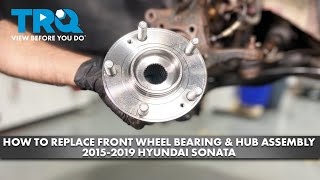
Typical fix: If the encoder ring is damaged, the entire front wheel bearing and hub assembly must be replaced. 🎬 See how to replace the front wheel bearing and hub assembly. Simply cleaning the surface may work if it's only contaminated with loose debris.
Est. part cost: $150-$300
Rare But Worth Checking
- Faulty ABS Control Module: → Shop ABS Control Module This is very rare and should only be considered after the sensor, wiring, and hub/encoder have been definitively ruled out. A faulty module will typically have other codes present as well or show no communication with a scan tool.
Diagnosis Steps
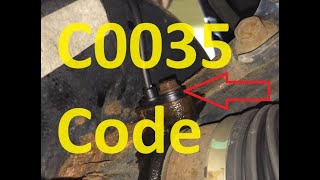
- Connect an ABS-capable OBD-II scanner and confirm C0035 is the active code. Note any other codes. 🎬 Watch: Understanding the common causes and fixes for the C0035 code.
- Access the live data stream on the scanner and monitor the speeds of all four wheels while driving slowly (5-15 MPH).
- Observe the 'Front Left' wheel speed reading. If it is 0, erratic, or significantly different from the other wheels, the issue is confirmed to be in that corner.
- Raise and secure the front of the vehicle. Remove the left front wheel.
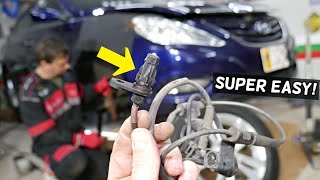
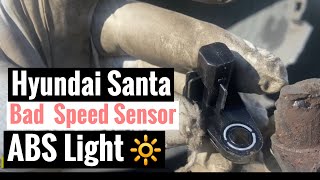
- Visually inspect the wheel speed sensor (bolted to the knuckle with a 10mm bolt) and its wiring harness for any obvious signs of physical damage, chafing, or corrosion. Follow the wire up into the fender liner to the main connector and inspect it.
- Disconnect the sensor and inspect the magnetic encoder ring on the wheel hub for heavy rust, metallic debris, or physical damage.
- If no visual faults are found, use a multimeter to test the sensor. While specific resistance values can vary, an open circuit (infinite resistance) or a dead short (near zero ohms) indicates a failed sensor.
- If the sensor seems okay, test the wiring harness for continuity from the sensor connector to the ABS module connector. Check for shorts to power or ground.
- If the sensor and wiring are confirmed to be good, the fault likely lies with the wheel hub's integrated encoder ring or, in very rare cases, the ABS control module itself.
Parts You'll Likely Need
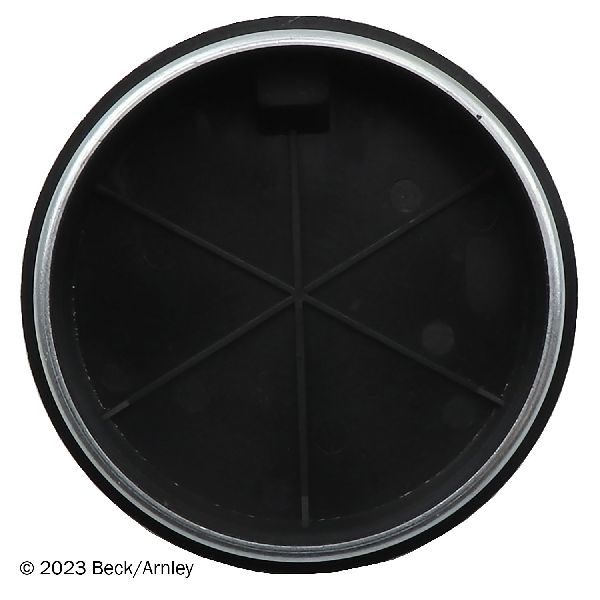
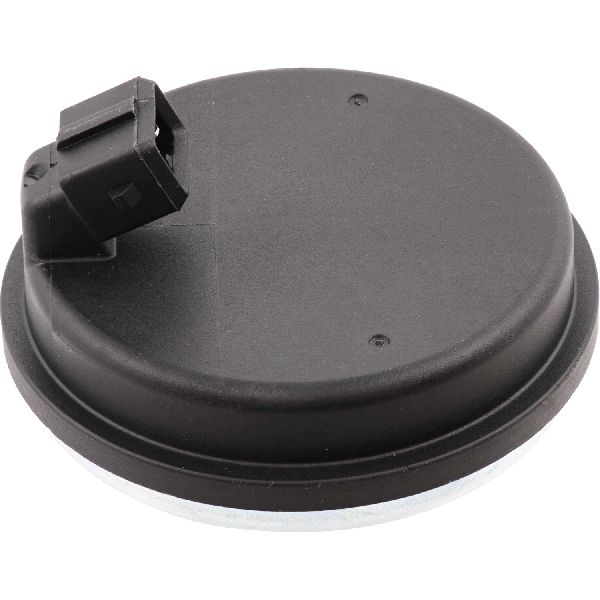
- Front Left ABS Wheel Speed Sensor
(OEM #59810-C1000)— This is the most common failure point for the C0035 code due to its exposed location and electronic nature.
Trusted brands: Hyundai / Kia (Genuine), Mando, Standard Motor Products (SMP), Delphi, NTK
OEM price range: $70-$100
Aftermarket price range: $40-$75
Technical Service Bulletins (TSBs) & Recalls
- TSB 17-ST-002: Details the warranty extension and replacement procedure for the flexible steering coupler, a common non-related issue on this platform.
Platform-Specific Known Issues
- Reddit User Experience with C0035: A user on the r/MechanicAdvice subreddit with a 2017 Sonata reported ABS and Traction lights. While they expected a wheel speed sensor issue, the shop diagnosed a faulty rear hub bearing causing similar codes, highlighting that the magnetic encoder in the bearing is a potential point of failure.
Mechanic-Grade Diagnostic Values
- Sensor Supply Voltage — expected: 4.5 - 5.5 V DC. Failure: A reading below 4.0V indicates a problem with the power supply from the ABS module or wiring.
- Wheel Speed Sensor Internal Resistance — expected: ~800 - 1,500 Ohms (Ω). Failure: An open circuit (infinite resistance), a dead short (near 0 Ω), or a reading significantly outside the expected range (e.g., over 2,000 Ω) indicates a failed sensor.
Scan Tool Commands That Help
- Hyundai GDS (Global Diagnostic System): Actuation Test — After verifying the sensor and wiring are good, a technician can use the GDS to command individual ABS/ESC system components to function, helping to isolate a fault within the ABS hydraulic unit or module.
- Hyundai GDS (Global Diagnostic System): Reset Adaptive Values — After replacing a component like the ABS module or making significant repairs, resetting the adaptive values can be performed to clear learned parameters and ensure the system operates from a baseline state.
Wiring & Ground Locations
- ABS/ESC Power Fuses — In the main engine compartment fuse box.. The entire ABS/ESC system is powered by a set of specific high-amperage fuses. If the module isn't powering on or the sensor has no supply voltage, checking these fuses is critical. Key fuses include ESC1 (40A), ESC2 (30A), and ESC3 (10A). A loss of power here will disable the entire system.
- ABS Module — In the engine bay, attached to the ABS hydraulic block, typically located below and to the side of the brake fluid reservoir.. This is the termination point for the wheel speed sensor harness. All wiring tests for continuity or shorts should be performed between the sensor connector in the wheel well and the main harness connector at this module.
"I Checked Everything" — The Actual Cause
- In the context of a C0035, the equivalent of a 'smoke test clean' is when the wheel speed sensor is tested with a multimeter and shows correct resistance, and the wiring shows good continuity to the ABS module. In these cases, the root cause is often a damaged or contaminated magnetic encoder ring that is integrated into the wheel bearing/hub seal. The sensor and wiring are electrically perfect, but the signal source (the ring) is providing erratic data that the sensor correctly transmits, leading to the fault code. This is confirmed by physically inspecting the hub's encoder ring for metallic debris or subtle cracks.
Model Year Variations Within This Range
- 2015-2018 vs 2019: The dealer-level diagnostic tool may differ. The Hyundai GDS (Global Diagnostic System) is the factory tool for models up to 2018. For 2019 and newer models, dealers transitioned to a newer, tablet-based platform. While aftermarket tools work on all years, the specific functions and interface of the factory tool change.
Diagnostic Flowchart
Other Known Issues on This Vehicle
Issues unrelated to this code that are worth knowing about as an owner of this generation:
- Theta II GDI Engine Failure 🔴 High — Widespread across 2.0L and 2.4L GDI engines. Failure often occurs between 60,000 and 120,000 miles. Caused by manufacturing debris leading to connecting rod bearing failure. (Ref: Multiple recalls and a class-action lawsuit settlement led to a lifetime warranty for the engine short block for original and subsequent owners, contingent on receiving a Knock Sensor Detection System (KSDS) software update.)
- MDPS Steering Coupler Wear 🟠 Medium — Very common. Owners typically notice a clicking or ticking sound from the steering column when turning the wheel, which worsens over time. Usually appears after 50,000 miles. (Ref: Hyundai extended the warranty for the flexible coupler to 10 years/100,000 miles. TSB 17-ST-002 and others detail the replacement procedure for the small, star-shaped rubber coupler (Part # 56315-2K000-FFF).)
- Door Lock Actuator Failure 🟡 Low — Common failure where one or more doors will not lock or unlock with the key fob or interior switch. Often accompanied by a buzzing or grinding noise from the affected door. (Ref: No specific recall for the 2015-2019 generation, but it is a well-documented problem. The entire latch assembly must be replaced to fix it.)
- Excessive Oil Consumption 🟠 Medium — Affects some 2.4L and 2.0T engines, often related to the same issues underlying the main engine failures. Owners report needing to add oil between changes. (Ref: Covered under the extended engine warranty if it leads to failure. Owners are advised to regularly check oil levels.)
Used vs. New Parts: Buying Guide for This Vehicle
When a used part is the smart pick: For this specific repair, using used parts is generally not recommended. The primary failure components are the electronic sensor and the wheel bearing, both of which are wear items with a finite lifespan. The cost savings are minimal compared to the risk of premature failure.
Donor-vehicle mileage cap: roughly under 40000 miles for the part to have meaningful remaining life.
What to inspect on the donor part:
- If forced to use a used hub, inspect the magnetic encoder ring on the seal for ANY signs of damage, rust, or contamination.
- For wiring pigtails, ensure there is no corrosion (green crust) on the pins and the wire insulation is not brittle or cracked.
OEM-only on this vehicle (don't cheap out):
- While not strictly OEM-only, the wheel bearing/hub assembly is a critical component. Using a high-quality, reputable aftermarket brand (like Timken, SKF, or MOOG) or the OEM part is strongly advised to ensure the integrated magnetic encoder is compatible and reliable.
Aftermarket brands forum-validated for this vehicle:
- For Sensors: NTK, Delphi, Mando (often an OEM supplier), Standard Motor Products (SMP).
- For Hub Assemblies: Timken, SKF, MOOG, BCA.
Brands owners have reported issues with on this vehicle:
- Unnamed or 'white box' wheel speed sensors and hub assemblies from online marketplaces should be avoided. These frequently use low-quality magnets and electronics that can fail quickly or be incompatible with the ABS module's expectations, causing the code to return.
Real Owner Stories
Aggregated from forums and TSBs cited above. Mileages and costs reflect what owners reported in those sources.
2017 Hyundai Sonata
Symptoms: ABS and Traction lights illuminated. The owner expected a wheel speed sensor issue.
What fixed it: Replacement of a faulty hub bearing which contained the magnetic encoder ring the sensor reads.
Source hint: Reddit (r/MechanicAdvice) thread titled '2017 Hyundai Sonata - ABS/Traction Lights'
Hyundai Sonata (LF/YF)
Symptoms: ABS/ESC/Auto Hold Warning Lights.
What fixed it: Diagnosing and replacing the failed wheel speed sensor.
Source hint: Hyundai Forums (hyundai-forums.com) thread 'ABS/ESC/Auto Hold Warning Lights'
Related OBD-II Codes
Frequently Asked Questions
Does TSB 17-ST-002 relate to my C0035 ABS light on my 2017 Sonata?
Can I just replace the sensor if the magnetic encoder ring is damaged on my Sonata?
Is there a specific part number for the front left wheel speed sensor shared with the Kia Optima?
Will a C0035 code affect my Smart Cruise Control (SCC) or Braking systems?
Where is the connector for the front left wheel speed sensor located on this vehicle?
What size bolts hold the sensor and harness in place on the Sonata?
Helpful Videos
We Have This Part in Stock


The information in this article is provided for general reference and educational purposes only. Vehicle specifications, procedures, and part compatibility can vary by production date, trim level, and region. Always consult your vehicle's factory service manual and verify part numbers before purchasing or performing repairs. Safety-critical components such as airbags, seat belts, and braking systems should be installed by a qualified professional.
- Hyundai Sonata:
- 🧭 Diagnostic Flowchart
- 🎬 Helpful Videos
- 🛍️ Shop This Part
- What's Unique About the 2015-2019 Hyundai Sonata
- Symptoms You May Notice
- Most Likely Causes
- Rare But Worth Checking
- Diagnosis Steps
- Parts You'll Likely Need
- Technical Service Bulletins (TSBs) & Recalls
- Platform-Specific Known Issues
- Mechanic-Grade Diagnostic Values
- Scan Tool Commands That Help
- Wiring & Ground Locations
- "I Checked Everything" — The Actual Cause
- Model Year Variations Within This Range
- Other Known Issues on This Vehicle
- Used vs. New Parts: Buying Guide for This Vehicle
- Real Owner Stories
- 2017 Hyundai Sonata
- Hyundai Sonata (LF/YF)
- Related OBD-II Codes
- Frequently Asked Questions
- 🎟️ Get 5% Off