

C0035 on 2003-2014 Volvo XC90: Front Wheel Speed Sensor Circuit Fault Guide
On a 2003-2014 Volvo XC90, code C0035 indicates a fault in a front wheel speed sensor circuit, but sources conflict on whether it's the left or right side. Generic definitions often point to the left front, but some manufacturer-specific ones point to the right. The most common fix is replacing the faulty wheel speed sensor and inspecting its wiring harness for damage. A Volvo-specific scanner (like VIDA) is essential for confirming which side is affected before purchasing parts. Expect to pay $
- C0035 disables your Volvo's ABS and stability control systems, so treat it as a serious safety issue.
- The code's definition is ambiguous for Volvo; it could mean a fault with the left OR right front wheel speed sensor. Do not trust a generic code reader's description.
- Before buying parts, you MUST use a scanner's live data feature to confirm which front wheel sensor is failing.
- A cracked or rusted ABS tone ring is as common a cause as a bad sensor on the XC90; inspect it carefully.
- DIY replacement is possible for those comfortable with removing the wheel and brake components, but accurate diagnosis is key to avoiding replacing the wrong part.
What's Unique About the 2003-2014 Volvo XC90
For the first-generation Volvo XC90 (P2 platform), the ABS/DSTC system is a core safety feature. The ambiguity of the C0035 code's definition is a significant challenge. Generic code readers often default to 'Left Front', which can be misleading. It is critical for owners to use a Volvo-specific scanner (like VIDA) or a high-end professional scanner. These tools can read manufacturer-specific fault descriptions and, more importantly, monitor live data from each individual wheel speed sensor to pinpoint the exact source of the failure, avoiding unnecessary parts replacement.
Symptoms You May Notice
- ABS warning light is on
- Stability/Traction Control (DSTC) warning light is on or system is disabled
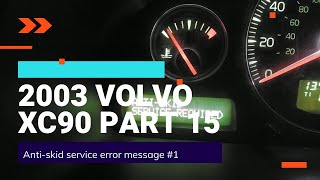
- "Anti-Skid Service Required" message on the instrume 🎬 Watch: Diagnosing the anti-skid service required messagent cluster
- Brake pedal feels firm or different during hard stops
- Loss of anti-lock braking function, wheels may lock up under heavy braking
- In some cases, the speedometer may malfunction if it relies on the failed sensor's data
- Replacing the wrong side wheel speed sensor due to the conflicting general definitions of the C0035 code. Always confirm the faulty sensor using a scanner's live data before purchasing parts.
- Replacing the wheel speed sensor when the actual fault is a cracked or corroded tone ring on the driveshaft.
Most Likely Causes
- Faulty Front Wheel Speed Sensor 🔴 High Probability → Shop ABS Wheel Speed Sensor Sensors are exposed to harsh conditions (water, road salt, debris, heat) at the wheel hub, leading to internal failure or corrosion over time. They are a common wear item.
How to confirm: Use a capable scanner to view live wheel speed data from all four wheels while driving; the faulty sensor will show a zero, erratic, or inconsistent reading compared to the others. Alternatively, disconnect the sensor and measure its internal resistance with a multimeter, comparing the reading to the sensor on the opposite side.
Typical fix: Replace the front wheel speed sensor on the affected side. This involves removing the wheel, unbolting the sensor from the steering knuckle, and routing the new wire.
Est. part cost: $40-$150 - Damaged or Corroded Tone Ring 🟡 Medium Probability The tone ring (or reluctor ring) is press-fit onto the outer CV joint of the driveshaft. Over time, rust can form underneath the ring, causing it to expand, crack, and split open. This changes the gap to the sensor or provides a broken signal, triggering the fault.
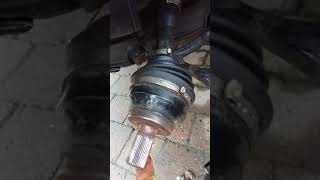
How to confirm: With the wheel removed, visually inspect the toothed ring on the driveshaft. Rotate the axle to check the entire circumference for cracks, heavy rust buildup, missing teeth, or contamination. A split ring is a definitive sign of failure. 🎬 See this easy way to fit new ABS rings
Typical fix: The damaged tone ring must be replaced. This requires removing the driveshaft from the hub. The old ring is chiseled off, the surface is cleaned, and a new ring is heated and tapped into place. Many owners replace the sensor at the same time.
Est. part cost: $20-$50 for the ring, plus labor. - Damaged Wiring or Connector 🟡 Medium Probability The wiring harness runs down the suspension strut and can be damaged by road debris, improper servicing, or chafing against components. The connector itself, located in the wheel well or engine bay, can also suffer from corrosion.
How to confirm: Visually inspect the entire length of the sensor's wiring harness from the wheel hub to its connection point for breaks, chafing, or corrosion. Check the connector pins for corrosion or damage. Perform a continuity test on the wires from the sensor plug to the ABS module plug.
Typical fix: Repair the broken or shorted section of wire. Clean the connector with electrical contact cleaner or replace the corroded connector pigtail.
Est. part cost: $5-$50
Rare But Worth Checking
- Faulty ABS Control Module: → Shop ABS Control Module While less common than sensor or ring failure, the ABS control module itself can fail, causing a sensor circuit code. This is often indicated by multiple sensor codes, communication errors with the module, or if the sensor, ring, and wiring have all been confirmed as good. These modules can often be rebuilt by specialized services for a lower cost than a new unit from the dealer.
Diagnosis Steps
- Scan the vehicle with a Volvo-specific scanner (like VIDA) or a professional-grade OBD-II scanner capable of reading ABS/chassis codes to confirm C0035 is present.
- CRITICAL: Use the scanner's live data function to monitor all four wheel speed sensors while driving slowly (5-15 mph). Identify which sensor (left front or right front) is not reading or provides an erratic/jumpy signal compared to the others. This step is essential to overcome the code's ambiguous definition.
- Raise and secure the vehicle and remove the wheel on the side identified in the previous step.
- Visually inspect the ABS sensor, its connector, and its wiring harness for any obvious signs of damage, corrosion, or chafing from the hub up into the engine bay.
- Carefully inspect the ABS tone ring on the outer CV axle. Rotate the axle by hand and look for cracks (especially at the seam), heavy rust scale, missing teeth, or wobble. A cracked ring is a very common failure on this platform.
- If the tone ring is cracked, it must be replaced. If the ring and wiring look good, the sensor is the next likely culprit.
- To further test, you can measure the sensor's internal resistance with a multimeter (if it's a passive sensor) or check for voltage and ground at the sensor connector coming from the ABS module (for active sensors). A voltage of 4.5-5.5V is typical for the power supply.
- If the sensor is confirmed to be faulty, replace it. It is held by a single 10mm bolt. If the wiring is damaged, repair it. If the tone ring is damaged, replace it.
- After the repair, clear the code and test drive the vehicle, monitoring live data to ensure the new sensor is reading correctly and the ABS/DSTC light stays off.
Parts You'll Likely Need
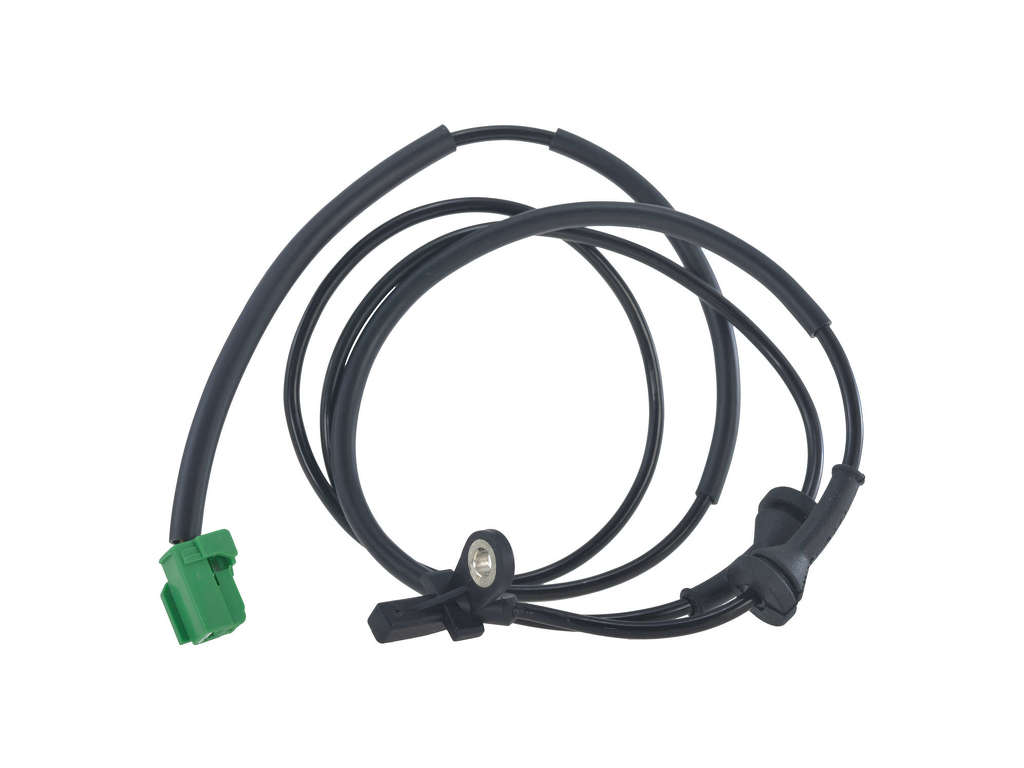
- Front Wheel Speed Sensor (ABS Sensor)
(OEM #Right: 30773739 (superseded by 31423608). Left: 30773738. Part numbers can vary by year and VIN, always verify.)— This is the most common failure point for a C0035 code, either due to internal failure or wiring damage.
Trusted brands: Genuine Volvo, ATE (OEM), Bosch, Delphi
OEM price range: $120-$200
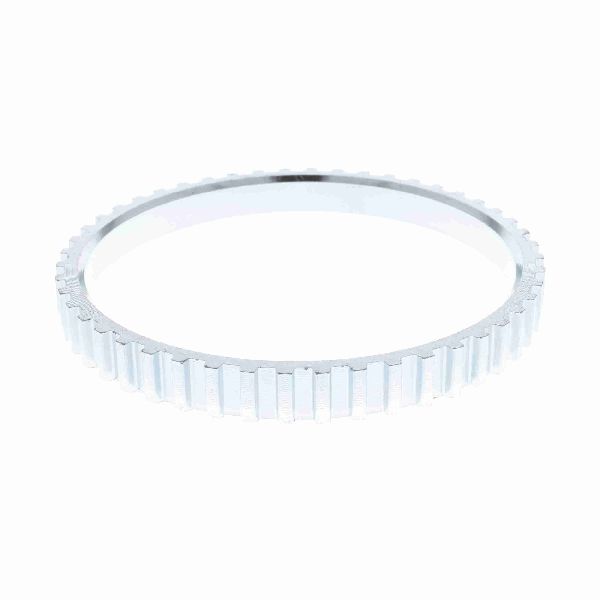
Aftermarket price range: $40-$100 - ABS Tone Ring (Reluctor Ring)
(OEM #30735955)— A very common failure on the XC90 where rust causes the ring to crack and split, giving a bad reading to the sensor.
Trusted brands: Genuine Volvo, Febi Bilstein
OEM price range: $40-$60
Aftermarket price range: $20-$40
Platform-Specific Known Issues
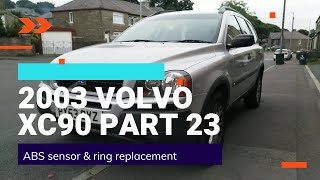
- Cracked ABS Tone Ring: A very frequent issue on the first-gen XC90 is the front ABS tone ring cracking due to rust buildup on the CV joint underneath it. This creates a gap in the ring, which the sensor reads as a fault. A visual inspection for a split in the ring is a key diagnostic step. A YouTube video by user 'Parknest' titled 'I fixed my ABS problmem at the FIRST attempt - 2003 Volvo XC90 Part 23' clearly documents this exact failure and repair. 🎬 Watch: How to fix this common ABS problem
Mechanic-Grade Diagnostic Values
- Wheel Speed Sensor Supply Voltage — expected: 4.5V - 5.5V DC. Failure: A reading below 4.0V indicates a problem with the wiring or the ABS module's power supply.
- Wheel Speed Sensor Signal Output (Active Sensor) — expected: Digital square wave signal that increases in frequency with wheel speed.. Failure: No signal, an irregular waveform, or a signal that does not correspond to wheel rotation when viewed on an oscilloscope or capable scan tool.
Hidden / Shadow Codes Worth Checking
- BCM-C0035: This is how the generic C0035 code is typically displayed in Volvo's VIDA software, specifying the fault is within the Brake Control Module's (BCM) purview. (see via Volvo VIDA diagnostic software.)
- CEM-1A64: A communication fault with the Differential Electronic Module (DEM). This can trigger the 'Anti-Skid Service Required' message and can be confused with a primary ABS fault, but points towards the all-wheel-drive system. (see via Volvo VIDA diagnostic software.)
- BCM-0052: Brake Control Module Internal Fault. If this code is present alongside C0035, it strongly suggests the ABS module itself has failed and needs to be repaired or replaced. (see via Volvo VIDA or a professional-grade scanner.)
Scan Tool Commands That Help
- Volvo VIDA: Fault Trace — After reading codes, selecting a specific code like BCM-C0035 and using 'Fault Trace' will provide a step-by-step guided diagnostic procedure from Volvo.
- Volvo VIDA: BCM Calibration / Reconfiguration — This function is critical after installing a *used* Brake Control Module. It configures the replacement module to the car's specifications. It is crucial *not* to use the 'Reprogram' or 'Load Software' function on a used module, as this will render it unusable.
Wiring & Ground Locations
- Brake Control Module (BCM) — In the engine compartment, mounted to the ABS hydraulic block, located underneath the main fuse box and air intake assembly.. This is the module that powers the wheel speed sensor and interprets its signal. All sensor wiring terminates here. Accessing the connector for testing requires removing the airbox and often unbolting the module to lower it for clearance.
- BCM Ground Points — General area on the chassis near the ABS module location. Specific ground points should be verified with a wiring diagram for the vehicle's specific year.. A poor ground connection for the ABS module can cause a variety of difficult-to-diagnose electrical issues, including sensor supply voltage faults like C0035.
Real Owner Repair Stories
- YouTube user 'Parknest' (2003 Volvo XC90) — "Anti-Skid Service Required" message on the dashboard.
❌ Tried (didn't work) Ruled out Steering Angle Sensor (SAS) via scan tool data., Visually inspected the Yaw Rate Sensor under the seat.
✅ What actually fixed it The investigation pointed to a CEM-1A64 code, indicating a communication failure with the rear Differential Electronic Module (DEM). Testing at the DEM connector revealed correct power and ground, leading to the conclusion that the DEM itself was faulty. The owner chose to live with the fault for the time being rather than replace the expensive module. This story highlights that the 'Anti-Skid' message is not always a wheel speed sensor issue.
When the Usual Fixes Don't Work
- In several documented cases, the 'Anti-Skid Service Required' message, often assumed to be a wheel speed sensor fault, was actually caused by a completely different component. A full system scan with a tool like VIDA is critical. Faults with the Steering Angle Sensor (SAS) or communication errors with the Differential Electronic Module (DEM) can trigger the same warning light but require entirely different diagnostic paths. Replacing a wheel speed sensor for a SAS or DEM fault will not fix the issue.
OEM Part Supersession History
30773739, 30682478, 8634238→31423608— Standard part revision and consolidation by Volvo.
Heads up: The new part number (31423608) is the correct replacement for the previous numbers for the front right sensor.
Model Year Variations Within This Range
- 2003-2006 vs 2007-2014: The XC90 received a facelift for the 2007 model year, which included cosmetic updates. However, for the purposes of diagnosing code C0035, the core ABS components (ATE control module, sensor design, tone ring) and common failure points (cracked ring, bad sensor, faulty module) remained consistent across the entire first generation.
Diagnostic Flowchart
Other Known Issues on This Vehicle
Issues unrelated to this code that are worth knowing about as an owner of this generation:
- T6 Transmission Failure (GM 4T65EV) 🔴 High — Very common on 2003-2005 T6 models, often failing before 100,000 miles.
- Angle Gear / Bevel Gear Collar Sleeve Failure 🔴 High — Common on all AWD models. The splined sleeve connecting the transmission to the angle gear strips out, resulting in loss of all-wheel drive. Often occurs between 80,000-150,000 miles.
- Central Electronic Module (CEM) Failure 🟠 Medium — Can occur on any model year. Often caused by water intrusion from clogged sunroof drains. Leads to bizarre, intermittent electrical problems like non-working gauges, wipers, or starting issues.
- Premature Wheel Bearing Failure 🟠 Medium — Front and rear wheel bearings can fail earlier than expected, sometimes before 80,000 miles, causing a humming or grinding noise that changes with speed.
- Uneven/Premature Tire Wear 🟡 Low — Many owners report difficulty maintaining alignment, leading to rapid and uneven tire wear, especially on early models.
Used vs. New Parts: Buying Guide for This Vehicle
When a used part is the smart pick: A used Brake Control Module (BCM) from a salvage yard can be a cost-effective option, provided the part number is an exact match. A complete used driveshaft assembly is also viable if the tone ring is visually confirmed to be in perfect condition (no cracks or heavy rust).
Donor-vehicle mileage cap: roughly under 100000 miles for the part to have meaningful remaining life.
What to inspect on the donor part:
- For a BCM: Part number on the sticker must be an identical match to the original.
- For a Tone Ring/Driveshaft: Visually inspect the entire ring for any cracks, especially at the seam. Reject any part with visible splits, missing teeth, or significant rust scaling that could cause it to swell.
OEM-only on this vehicle (don't cheap out):
- Brake Control Module (BCM): While a used part can work if reconfigured correctly, a new Genuine Volvo or professionally rebuilt unit (e.g., from XeMODeX) is the most reliable repair to avoid complex software issues.
Aftermarket brands forum-validated for this vehicle:
- ATE: This is the Original Equipment Manufacturer (OEM) for the Volvo ABS system, so their parts are equivalent to Genuine Volvo.
- Bosch: A highly reputable OEM supplier for many European vehicle electronics and a reliable choice for the wheel speed sensor.
Brands owners have reported issues with on this vehicle:
- Unnamed 'white-box' sensors from online marketplaces. While cheap, their internal electronics and build quality can be inconsistent, leading to premature failure or incorrect readings.
Real Owner Stories
Aggregated from forums and TSBs cited above. Mileages and costs reflect what owners reported in those sources.
2003 Volvo XC90
Symptoms: The owner experienced an ABS fault and suspected a sensor failure.
What fixed it: Upon disassembly and visual inspection, a cracked front ABS tone ring was discovered. Replacing the split ring resolved the ABS problem.
Source hint: YouTube video by user 'Parknest' titled 'I fixed my ABS problmem at the FIRST attempt - 2003 Volvo XC90 Part 23'
Related OBD-II Codes
Frequently Asked Questions
My 2003 XC90 has an 'Anti-Skid Service Required' message; is this related to code C0035?
I suspect a cracked tone ring on my XC90. How can I confirm this without a shop diagnostic?
Can I just replace the sensor, or do I need to replace the whole CV axle if the tone ring is bad?
Why does my XC90 speedometer malfunction when the ABS light comes on?
Is there a specific scanner I should use for my 2003-2014 XC90 to diagnose this?
Helpful Videos

We Have This Part in Stock


The information in this article is provided for general reference and educational purposes only. Vehicle specifications, procedures, and part compatibility can vary by production date, trim level, and region. Always consult your vehicle's factory service manual and verify part numbers before purchasing or performing repairs. Safety-critical components such as airbags, seat belts, and braking systems should be installed by a qualified professional.
- Volvo XC90:
- 🧭 Diagnostic Flowchart
- 🎬 Helpful Videos
- 🛍️ Shop This Part
- What's Unique About the 2003-2014 Volvo XC90
- Symptoms You May Notice
- Most Likely Causes
- Rare But Worth Checking
- Diagnosis Steps
- Parts You'll Likely Need
- Platform-Specific Known Issues
- Mechanic-Grade Diagnostic Values
- Hidden / Shadow Codes Worth Checking
- Scan Tool Commands That Help
- Wiring & Ground Locations
- Real Owner Repair Stories
- When the Usual Fixes Don't Work
- OEM Part Supersession History
- Model Year Variations Within This Range
- Other Known Issues on This Vehicle
- Used vs. New Parts: Buying Guide for This Vehicle
- Real Owner Stories
- 2003 Volvo XC90
- Related OBD-II Codes
- Frequently Asked Questions
- 🎟️ Get 5% Off