

C0045 on 2007-2014 GMC Yukon: Left Rear Wheel Speed Sensor Circuit Causes and Fixes
Code C0045 on a 2007-2014 GMC Yukon means there is a fault in the left rear wheel speed sensor circuit. The most common fix is replacing the left rear wheel speed sensor, which is a simple, inexpensive part held by one bolt. Before replacing, inspect the wiring harness for damage, as this is another frequent cause.
- C0045 on a 2007-2014 Yukon is a fault with the Left Rear Wheel Speed Sensor circuit.
- The most likely cause is a failed sensor, which is an easy and inexpensive DIY replacement (one T30 bolt). Using a genuine GM part is highly recommended.
- Before buying parts, inspect the wiring for damage and consider swapping the left and right rear sensors to confirm the fault.
- Do not replace the wheel hub; the sensor is a separate, bolt-in part on the rear of these trucks.
- Driving with this code means your ABS and StabiliTrak are inactive, so drive with extra caution until it is fixed.
What's Unique About the 2007-2014 GMC Yukon
On the GMT900 platform, which includes the 2007-2014 Yukon, the rear wheel speed sensors are individual components that are bolted into the rear axle housing, separate from the wheel hub assembly. This is a key difference from many other vehicles where the sensor is integrated into the hub and requires replacing the entire hub to fix. This design makes the repair for code C0045 on these trucks significantly cheaper and easier, as you only need to replace the small sensor itself, which is held in by a single T30 Torx bolt.
🎬 Watch: A step-by-step walkthrough for replacing the rear sensor.Symptoms You May Notice
- ABS warning light illuminated on the dashboard.
- "Service StabiliTrak" or "Service Traction Control" message displayed.
- Traction Control System (TCS) warning light illuminated.
- Cruise control may be disabled
- Unwanted ABS activation or brake pedal pulsation at low speeds.
- A "Service Trailer Brake" message may appear on the Driver Information Center in some instances.
- Replacing the wheel hub bearing assembly. On these specific trucks, the rear sensor is not part of the hub. Replacing the hub will not fix a C0045 code.
- Replacing the EBCM without proper diagnosis. This is an expensive part that is rarely the cause of a single wheel speed sensor code.
- Using cheap aftermarket sensors. Many forum users report that non-OEM sensors fail quickly or don't work at all, leading to a repeat diagnosis.
Most Likely Causes
- Failed Left Rear Wheel Speed Sensor 🔴 High Probability → Shop ABS Wheel Speed Sensor The sensor is exposed to harsh conditions like water, dirt, road salt, and vibrations, which can lead to internal failure or corrosion over time. They are considered a common maintenance item on these trucks.
How to confirm: Use a scan tool to monitor live data from all four wheel speed sensors while driving. If the left rear sensor shows 0 MPH or an erratic reading while the others read correctly, the sensor is likely bad. An effective method is to swap the left and right rear sensors (they are identical); if the code changes to C0050 (Right Rear), the sensor is confirmed faulty. Resistance can also be measured; a typical range for a good sensor is 850-1350 ohms.
Typical fix: Replace the left rear wheel speed sensor. The sensor is held in by a single T30 Torx bolt. Many owners on forums strongly recommend using a genuine GM/ACDelco part, as aftermarket sensors have a reputation for failing quickly or being dead on arrival.
Est. part cost: $50-$90 - Damaged Wiring or Connector 🟡 Medium Probability The wiring harness runs along the frame and axle, where it can be damaged by road debris, improper routing after previous repairs, or suspension movement. The harness connector on top of the frame rail is also a common spot for corrosion or for pins to become loose.
How to confirm: Visually inspect the wiring harness from the sensor up to the main connector on the frame rail. Look for any signs of chafing, breaks, melting, or corrosion in the connector pins. Wiggle the wiring harness while observing live wheel speed data on a scan tool to see if the signal cuts out.
Typical fix: Repair the damaged section of wire or replace the pigtail connector if it is corroded or damaged. In some cases, the pins inside the connector lose tension and can be carefully re-tensioned or supplemented to ensure a good connection.
Est. part cost: $15-$50 - Debris or Corrosion on Sensor or Reluctor Ring ⚪ Low Probability Metallic debris from normal brake wear or rust can accumulate on the magnetic tip of the sensor. Additionally, rust can build up on the sensor's mounting surface ('rust jacking'), increasing the air gap between the sensor and the reluctor ring, which weakens the signal.
How to confirm: Remove the wheel speed sensor and inspect its magnetic tip for metal shavings or heavy rust buildup. Inspect the reluctor ring (tone ring) inside the axle housing through the sensor hole for visible damage, heavy rust, or debris.
Typical fix: Clean the magnetic tip of the sensor and thoroughly clean the mounting surface on the axle housing with a wire brush or file before installing the new sensor. The reluctor ring can be cleaned with a cloth or brush through the sensor hole.
Est. part cost: $0-$10
Rare But Worth Checking
- Failed Electronic Brake Control Module (EBCM): → Shop ABS Control Module This is very rare and should be the last item to consider. Before condemning the EBCM, all other possibilities (sensor, wiring, reluctor ring) must be exhaustively ruled out. An EBCM failure typically sets multiple codes, not just a single sensor code. A manufacturer service bulletin, TSB Bulletin #PIT5499B, notes that technicians should specifically inspect the EBCM connector for water intrusion when C0045 is present.
- Damaged Reluctor Ring: The reluctor ring (or tone ring) is located inside the axle housing. While durable, it can be damaged during other axle work (like a differential rebuild) or can crack due to rust. This would typically cause an erratic signal rather than a complete loss of signal.
Diagnosis Steps
- Connect a professional scan tool capable of reading ABS codes and live data.
- Confirm that C0045 is the active code. Note any other codes or symptom bytes (e.g., 5A, 0F).
- View the live data stream for all four wheel speed sensors. Drive the vehicle slowly or spin the left rear wheel by hand (with the vehicle safely supported). Compare the reading from the left rear sensor to the others.
- If the left rear sensor reads 0 or is erratic, proceed with a physical inspection.
- Lift and safely support the rear of the vehicle. Removing the wheel provides better access.
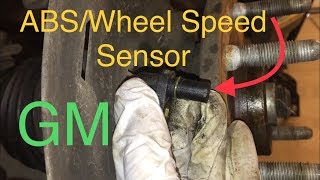
- Locate the wheel speed sensor on the rear axle housing, inboard of the brake rotor. It is held by a single T30 Torx bolt.
- Thoroughly inspect the wiring harness and connector leading to the sensor for any visible damage, corrosion, or loose connections. Follow the harness up to the main connector on the frame rail and inspect it as well.
- Remove the T30 Torx bolt and pull the sensor out of the axle housing. It may be stuck and require gentle prying. The bolt can also be very tight due to thread locker.
- Inspect the sensor's magnetic tip for metal debris or corrosion. Clean as needed.
- If a visual inspection reveals no issues, the most effective next step is to swap the left and right rear sensors. They are identical parts. Clear the codes and drive the vehicle. If the code returns as C0050 (Right Rear), the original sensor is faulty and should be replaced.
- If the code remains C0045 after the swap, the issue is in the wiring or the EBCM. A multimeter should then be used to test the wiring harness for continuity, shorts to ground, and shorts to power between the sensor connector and the EBCM connector.
- Before installing a new sensor, thoroughly clean the mounting surface on the axle to ensure 🎬 See how to properly clean and install your new sensor. the sensor sits flush and has the correct air gap.
Parts You'll Likely Need
- Rear Wheel Speed Sensor
(OEM #20938122)— This is the most common failure point for code C0045. The sensor fails internally from age and exposure to the elements. This part is the same for the left and right rear positions.
Trusted brands: ACDelco (GM Genuine), Dorman, Standard Motor Products (SMP)
OEM price range: $60-$90
Aftermarket price range: $30-$50
Related Codes That Often Appear With This One
- C0050 — This is the code for the Right Rear Wheel Speed Sensor. If both C0045 and C0050 are present, it strongly points towards a common wiring issue (like a chafe point affecting both harnesses) or a problem with the EBCM, rather than two sensors failing simultaneously.
- C0045 5A, C0045 0F, C0045 18 — These are manufacturer-specific symptom bytes that can be read with a high-end scan tool. '5A' (Plausibility Failure) or '0F' (Erratic Signal) often point to a contaminated or damaged reluctor ring, while '18' (Signal Amplitude Low) could indicate a large air gap from rust jacking or a failing sensor.
Technical Service Bulletins (TSBs) & Recalls
- PIC5428E / PIT5428F: While not specific to the Yukon, this TSB addresses wheel speed sensor codes (C0035-C0050) with symptom bytes 18, 5A, or 0F on many GM vehicles. It notes that these codes can often be caused by metallic debris accumulating on the magnetic encoder ring and can be fixed by cleaning the ring without replacing parts.
- PI0934: Pertains to 2013 Equinox/Terrain but describes a similar issue where C0045/C0050 is caused by harness terminals not being fully seated in the connector, leading to an intermittent connection. The fix is to replace the connector, not just re-seat the terminal.
- TSB Bulletin #PIT5427B: This bulletin notes that C0045 can be stored alongside other chassis codes and suggests that technicians should inspect the X411 connector for damage.
- TSB Bulletin #PIT5499B: Describes a scenario where C0045 is found with a "Service Trailer Brake" message; it advises technicians to inspect the Electronic Brake Control Module connector for water intrusion or corrosion.
Platform-Specific Known Issues
- Aftermarket Sensor Quality Issues: Multiple owner forums have threads where users report immediate or premature failure of aftermarket (non-OEM) wheel speed sensors. The consensus is to spend the extra money on a genuine ACDelco/GM part to avoid having to do the job twice.
Mechanic-Grade Diagnostic Values
- Wheel Speed Sensor Internal Resistance — expected: 850-1350 Ω (Ohms) across the two pins of the disconnected sensor.. Failure: A reading of OL (Open Loop/infinite resistance) or 0 Ω (short circuit) indicates a failed sensor.
- Wheel Speed Sensor AC Voltage Generation — expected: Greater than 100mV AC while spinning the wheel by hand. Voltage should increase with speed.. Failure: No AC voltage produced, or an erratic/unstable voltage, indicates a failed sensor or a problem with the reluctor ring.
- Wiring Harness Continuity — expected: Less than 2.0 Ω from the sensor connector pin to the corresponding pin at the EBCM connector.. Failure: A reading greater than 2.0 Ω indicates high resistance or an open circuit in the harness.
Hidden / Shadow Codes Worth Checking
- C0045 06: Indicates 'Low Voltage/Open' in the sensor circuit. This points specifically to a broken wire, poor connection, or a short to ground. (see via GM Tech2, GDS2, or equivalent professional scan tool that can read ABS symptom bytes.)
- C0045 0F: Indicates an 'Erratic Signal'. This often points to a damaged or debris-contaminated reluctor ring, electrical interference, or a failing sensor creating a noisy signal. (see via GM Tech2, GDS2, or equivalent professional scan tool that can read ABS symptom bytes.)
- C0045 18: Indicates 'Signal Amplitude Low'. This suggests the signal from the sensor is too weak, often caused by an excessive air gap (from rust buildup on the mounting surface) or an internally failing sensor. (see via GM Tech2, GDS2, or equivalent professional scan tool that can read ABS symptom bytes.)
- C0045 5A: Indicates a 'Plausibility Failure'. The EBCM is receiving a signal, but it doesn't make sense compared to the other wheel speed signals (e.g., three wheels at 30 MPH, one at 0 MPH). (see via GM Tech2, GDS2, or equivalent professional scan tool that can read ABS symptom bytes.)
Scan Tool Commands That Help
- GM Tech2 / GDS2: Live Data Display > Chassis > Wheel Speed Sensors — This is the primary diagnostic step to compare the signal from the faulty left rear sensor against the other three known-good sensors in real-time while driving or spinning the wheel.
- GM Tech2 / GDS2: DTC Information > Display Codes with Symptom Bytes — Used to retrieve the specific failure type (e.g., 0F, 18, 5A) after the C0045 code is set. This provides crucial direction, distinguishing between an open circuit, an erratic signal, or a weak signal.
- GM Tech2 / GDS2: Clear DTC Information — Used to clear ABS-specific codes after a repair. Some generic OBD-II scanners cannot clear codes from the EBCM, making this necessary to turn off the warning lights and re-check if the fault returns.
Wiring & Ground Locations
- G110 — On the outside of the frame rail, located beneath the driver's side door.. This is the main ground point for the Electronic Brake Control Module (EBCM). A poor connection here due to rust or looseness can cause a variety of ABS faults, including false sensor codes and communication errors. A GM TSB specifically addresses cleaning this ground to resolve such issues.
- WSS Harness Connector — The wiring harness runs from the sensor on the axle tube, up along the frame rail, to a connector typically located above the axle.. This harness is a common failure point. The section along the axle is exposed to debris and suspension movement, and the connector itself can accumulate moisture and corrode. A visual and physical inspection of this entire run is critical.
Real Owner Repair Stories
- CorvetteForum user 'powercorvette' (2008 Chevrolet Corvette (different vehicle, but same GM diagnostic principle)) — Service ABS, Service Traction Control, Service Active Handling lights with code C0045.
❌ Tried (didn't work) Cleaning the sensor connector., Replacing the entire wheel hub assembly (which included a new sensor).
✅ What actually fixed it The actual cause was a corroded intermediate harness connector (C184 on the Corvette) located near the battery on the passenger side firewall. Cleaning the pins of this connector with electronic cleaner resolved the code. - Tahoe Yukon Forum user 'Geotrash' (2007-2014 GM SUV) — C0045 code after hitting a hard dip in the road.
❌ Tried (didn't work) Initially suspected wiring damage.
✅ What actually fixed it Swapped the left and right rear wheel speed sensors. The code changed to C0050 (Right Rear), confirming the original sensor was faulty. Replacing the sensor with a new OEM GM part fixed the issue. The user explicitly warns against using cheaper aftermarket sensors.
When the Usual Fixes Don't Work
- In a documented case on a similar GM platform, a persistent C0045 code was not resolved by replacing the sensor/hub assembly. The ultimate fix was tracing the wiring harness to an intermediate connector located in the engine bay near the battery, which had become corroded from moisture. Cleaning this connector resolved the fault, highlighting that the problem can be far from the wheel itself.
OEM Part Supersession History
15121067, 20763147→20938122— Part has been updated or revised by the manufacturer for improved reliability or to consolidate inventory.
Model Year Variations Within This Range
- 2007-2014: No significant variations for this specific fault have been identified within the 2007-2014 GMT900 platform. The repair procedure, part number, and common causes are consistent across these model years.
Diagnostic Flowchart
Used vs. New Parts: Buying Guide for This Vehicle
When a used part is the smart pick: For this specific repair, a used part is NOT recommended. The wheel speed sensor is a relatively inexpensive electronic component that fails due to age, heat cycles, and exposure to elements. A used sensor has unknown remaining life and carries a high risk of premature failure.
What to inspect on the donor part:
- Not applicable as used part is not recommended.
OEM-only on this vehicle (don't cheap out):
- Wheel Speed Sensor: Forum consensus and mechanic experience strongly recommend using a genuine GM / ACDelco sensor. Aftermarket sensors for this application have a high reported failure rate, often failing immediately or within a few months, leading to repeat repairs.
Aftermarket brands forum-validated for this vehicle:
- None are consistently recommended over OEM. While brands like Dorman and Standard Motor Products (SMP) are widely available, the safest and most cost-effective long-term solution is the OEM part.
Brands owners have reported issues with on this vehicle:
- Generic, unbranded sensors from online marketplaces should be avoided due to very high failure rates. Even reputable aftermarket brands have mixed reviews for this specific part on this platform.
Real Owner Stories
Aggregated from forums and TSBs cited above. Mileages and costs reflect what owners reported in those sources.
2007+ GMC Yukon/Chevrolet Tahoe
Symptoms: Owner experienced DTC C0045-00, which illuminates the ABS and StabiliTrak/Traction Control warning lights.
What fixed it: Replacing the faulty left rear wheel speed sensor. Other users in the same discussion confirmed that using a cheap aftermarket sensor led to a quick repeat failure, and strongly recommended using a genuine OEM part.
Source hint: tahoeyukonforum.com - Thread: 'DTC C0045-00 Left Rear Wheel Speed Sensor'
Related OBD-II Codes
Frequently Asked Questions
I have a C0045 code on my Yukon. Is it okay to use a cheaper aftermarket wheel speed sensor?
What's the most reliable way to confirm the left rear wheel speed sensor is actually bad on my 2007-2014 Yukon?
I replaced the sensor, but the C0045 code and 'Service StabiliTrak' light are still on. What should I check next?
Does the TSB mentioned in the article (PIC5428E) apply to my C0045 code?
What tool do I need to remove the rear wheel speed sensor on my GMC Yukon?
Could rust be the cause of my C0045 code?
Helpful Videos
We Have This Part in Stock


The information in this article is provided for general reference and educational purposes only. Vehicle specifications, procedures, and part compatibility can vary by production date, trim level, and region. Always consult your vehicle's factory service manual and verify part numbers before purchasing or performing repairs. Safety-critical components such as airbags, seat belts, and braking systems should be installed by a qualified professional.
- GMC Yukon:
- 🧭 Diagnostic Flowchart
- 🎬 Helpful Videos
- 🛍️ Shop This Part
- What's Unique About the 2007-2014 GMC Yukon
- Symptoms You May Notice
- Most Likely Causes
- Rare But Worth Checking
- Diagnosis Steps
- Parts You'll Likely Need
- Related Codes That Often Appear With This One
- Technical Service Bulletins (TSBs) & Recalls
- Platform-Specific Known Issues
- Mechanic-Grade Diagnostic Values
- Hidden / Shadow Codes Worth Checking
- Scan Tool Commands That Help
- Wiring & Ground Locations
- Real Owner Repair Stories
- When the Usual Fixes Don't Work
- OEM Part Supersession History
- Model Year Variations Within This Range
- Used vs. New Parts: Buying Guide for This Vehicle
- Real Owner Stories
- 2007+ GMC Yukon/Chevrolet Tahoe
- Related OBD-II Codes
- Frequently Asked Questions
- 🎟️ Get 5% Off