

C0050 on 2008-2017 Honda Accord: Right Rear Wheel Speed Sensor Fault Causes and Fixes
Code C0050 on a Honda Accord means there's a problem with the right rear wheel speed sensor circuit. This will disable your ABS and VSA systems. The most common fix is replacing the faulty wheel speed sensor itself, which is a manageable DIY job with an affordable part. Before replacing parts, check for debris on the hub's magnetic ring and inspect the wiring.
- C0050 means the right rear wheel speed sensor circuit has a fault, which will turn on your ABS and VSA lights.
- The most likely cause is a failed wheel speed sensor, which is relatively inexpensive and simple to replace.
- Before replacing parts, use a scan tool to confirm the right rear wheel is the one with no signal.
- Always inspect the wiring for damage and check the wheel hub for metallic debris before buying a new sensor or hub.
- Driving with this code is possible but not recommended, as critical safety features are inactive.
What's Unique About the 2008-2017 Honda Accord
For the 8th and 9th generation Honda Accord, the C0050 code is a straightforward fault. The key difference from older vehicles is that the magnetic encoder ring (or tone ring) is integrated into the rear wheel bearing and hub assembly. This means that if the ring is damaged, the entire hub must be replaced. However, it also means the ring is better protected from the elements compared to externally toothed rings, making sensor or wiring failure a more common cause than ring damage. A critical installation error on this platform is installing the new wheel bearing backward, which will cause an immediate C0050 code as the sensor will not be aligned with the magnetic ring.
Generation note: This guide covers the 8th generation (2008-2012) and 9th generation (2013-2017) Honda Accord. The function of the wheel speed sensor and the meaning of the code are identical. The primary difference is the specific part numbers. For 8th gen, the rear sensor is part #57470-TA0-A03 and the hub is #42200-TA0-A51. For 9th gen, the rear sensor is #57470-T2F-A01 and the hub is #42200-T2A-A51. The repair procedure is functionally the same for both.
Symptoms You May Notice
- ABS light is on
- VSA (Vehicle Stability Assist) warning light is on
- A triangle with an exclamation mark may be lit on the dashboard
- Power Steering warning light may be on (as it relies on wheel speed data)
- ABS and VSA systems are disabled
- Cruise control may be inoperative
- FCW (Forward Collision Warning) and LDW (Lane Departure Warning) systems may show an error, as they also use wheel speed data.
- Replacing the wheel hub/bearing when only the sensor was bad.
- Replacing the sensor when the only issue was a broken wire or debris on the hub.
- Condemning the ABS module before thoroughly checking the sensor, wiring, and hub.
- Replacing the wrong wheel's sensor; always confirm the location (Right Rear) from the code.
Most Likely Causes
- Failed Right Rear Wheel Speed Sensor 🔴 High Probability → Shop ABS Wheel Speed Sensor The sensor is exposed to water, dirt, and road salt in the wheel well, which can lead to internal electronic failure or corrosion over time. This is the most common point of failure.
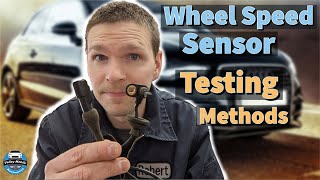
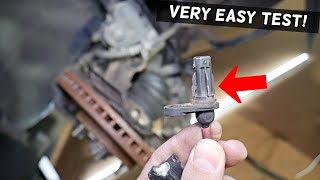
How to confirm: Use a scan tool capable of reading ABS live data. 🎬 Watch: How to use a scanner to check ABS data. Observe the speed reading from the right rear sensor while driving. If it reads 0 mph or is erratic while other wheels show speed, the sensor is likely bad. You can also test the sensor's internal resistance with a multimeter and compare it to the sensor on the other side; a significant difference indicates a fault.
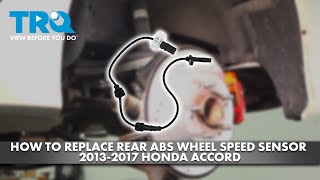
Typical fix: Replace the right rear wheel speed sensor. The sensor is typically held in by a single 10mm bolt, but can become seized in the knuckle, requiring force to remove.
Est. part cost: $25-$70 - Damaged Wiring or Corroded Connector 🟡 Medium Probability The wiring harness runs down to the wheel hub and is susceptible to damage from road debris, moisture intrusion, improper servicing, or suspension work that overstretches the wire. The connector itself can also corrode.
How to confirm: Visually inspect the entire length of the sensor's wiring harness from the sensor to its connection point in the chassis. Look for breaks, chafing, or melting. Unplug the connector and check for green or white corrosion on the pins. A continuity test with a multimeter can find breaks in the wire that aren't visible.
Typical fix: Repair the damaged section of wire using solder and heat shrink tubing. If the connector is corroded, it may need to be cleaned or replaced with a new pigtail.
Est. part cost: $10-$40 - Debris on or Damage to the Magnetic Encoder Ring ⚪ Low Probability Metallic debris from brakes or road grime can accumulate on the magnetic ring inside the wheel hub, distorting the sensor's reading. While less common than sensor failure, it is a known issue across many vehicles with this design.
How to confirm: After removing the wheel speed sensor, use a flashlight and a small mirror to inspect the brown, rubberized surface of the wheel hub that the sensor reads. Look for a build-up of metallic dust or rust. Also, check for cracks or damage to the hub's seal where the ring is located.
Typical fix: Carefully clean the debris from the magnetic encoder ring using a rag or soft brush. Do not use harsh solvents or magnetic tools. If the ring itself is cracked or damaged, the entire wheel hub/bearing assembly must be replaced.
Est. part cost: $0-$5 for cleaning, $80-$150 for a new hub assembly
Rare But Worth Checking
- Failed VSA/ABS Control Module: → Shop ABS Control Module This is rare. Before condemning the module, all other possibilities (sensor, wiring, hub) must be exhaustively ruled out. A faulty module will often trigger multiple wheel speed sensor codes or other internal failure codes, not just one. Some owners on forums have reported needing module repair for a persistent light.
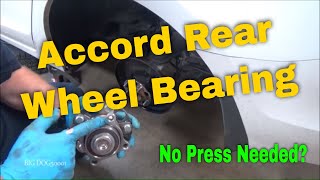
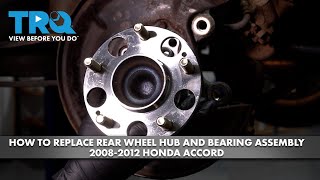
- Incorrect Wheel Bearing Installation: If the code appeared immediately after replacing the rear wheel bearing, it is highly likely the bearing was installed backward. The magnetic encoder ring must face inward toward the sensor. The only fix is to press the bearing out and install a new one in the correct orientation.
Diagnosis Steps
- Connect an OBD-II scanner capable of reading ABS/VSA codes to confirm C0050 is present.
- Access the live data stream for the wheel speed sensors. Drive the vehicle slowly (above 5 mph) and observe the readings from all four wheels. Confirm that the Right Rear (RR) sensor reads 0 mph or shows an erratic/illogical speed compared to the others.
- Safely raise and support the vehicle and remove the right rear wheel.
- Visually inspect the wheel speed sensor and its wiring harness for any obvious damage, such as cuts, melting, or corrosion at the connector. Pay close attention to where the harness is clipped to the suspension.
- If the wiring appears intact, remove the 10mm bolt holding the sensor in the wheel hub. Carefully twist and pull the sensor out. It may be seized with rust; gentle prying or even destructive removal may be necessary.
- With the sensor removed, inspect the magnetic encoder ring on the wheel hub for any accumulated metallic debris or rust. Clean it thoroughly with a soft brush or rag.
- If cleaning the ring doesn't solve the issue, test the sensor. You can check its resistance with a multimeter (if specifications are known) or simply replace it, as it is the most common failure point and relatively inexpensive.
- If a new sensor does not fix the problem, perform a continuity test on the wiring harness between the sensor connector and the VSA control module to find any hidden breaks or shorts.
- If the sensor and wiring are confirmed to be good, and the code appeared after a recent repair, suspect an incorrectly installed wheel bearing. Otherwise, the issue may be with the wheel hub/bearing assembly itself or, in rare cases, the VSA control module.
Parts You'll Likely Need
- Right Rear ABS Wheel Speed Sensor
(OEM #57470-TA0-A03 (2008-2012) / 57470-T2F-A01 (2013-2017))— This is the most frequent point of failure for the C0050 code due to its exposed location and electronic nature.
Trusted brands: Honda (OEM), NTK, Bosch, Standard Motor Products (ALS2209), Dorman
OEM price range: $40-$70
Aftermarket price range: $25-$50 - Rear Wheel Hub and Bearing Assembly
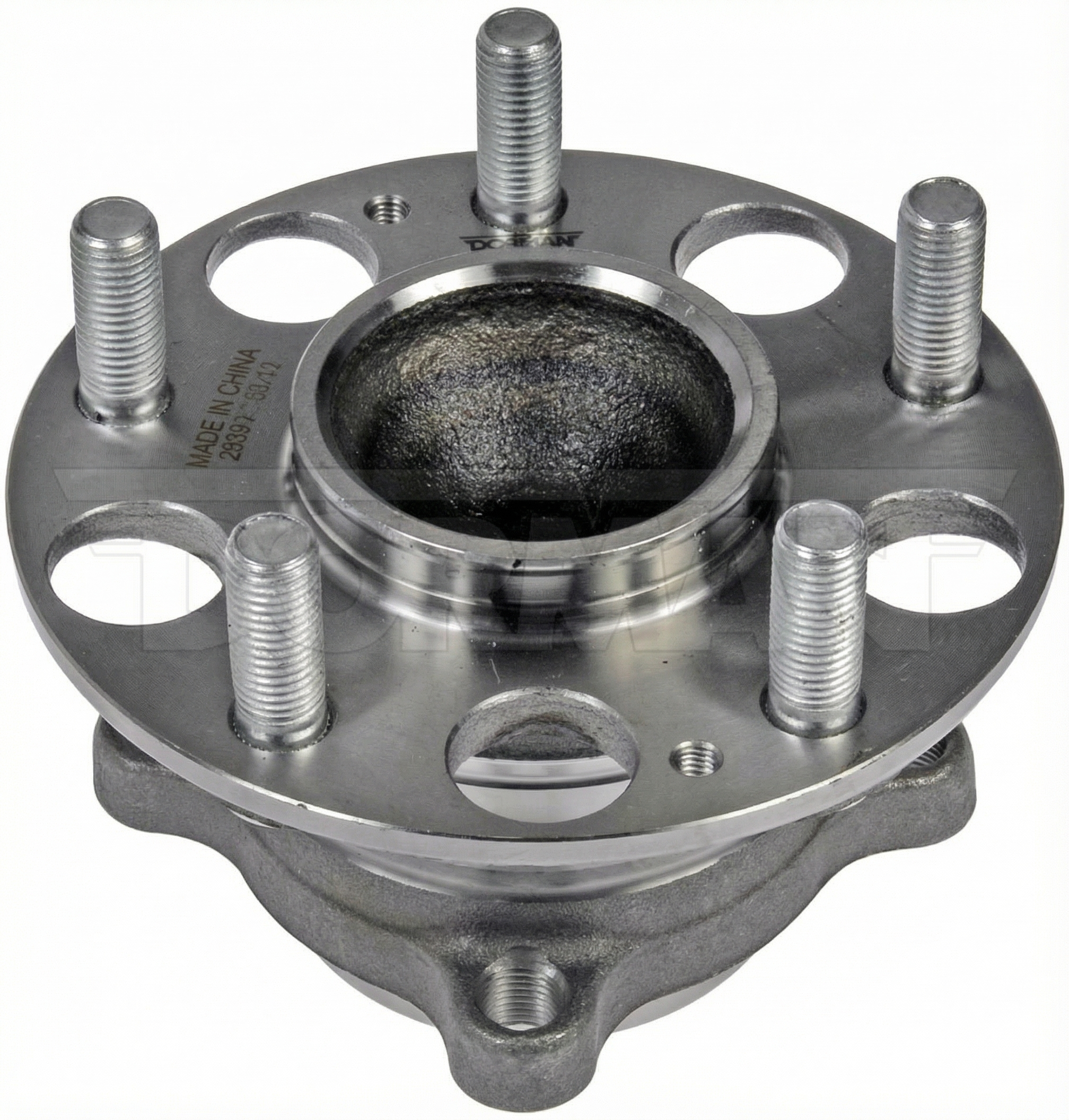
(OEM #42200-TA0-A51 (2008-2012) / 42200-T2A-A51 (2013-2017, non-hybrid))— Needed if the integrated magnetic encoder ring is damaged, if the bearing has failed causing excessive play, or if the bearing was installed backward during a previous repair.
Trusted brands: Honda (OEM), Timken, SKF, MOOG, WJB (WA512516)
OEM price range: $140-$250
Aftermarket price range: $80-$150
Related Codes That Often Appear With This One
- U0415 — This code indicates 'Invalid Data Received From Electronic Brake Control Module.' It can be set by other modules (like power steering or the ECU) when they lose the wheel speed signal they rely on from the ABS/VSA system.
Technical Service Bulletins (TSBs) & Recalls
- GM TSB #PIC5428G: While not a Honda bulletin, it provides an excellent explanation of how ferrous metallic debris on the magnetic encoder ring of a wheel bearing can cause wheel speed sensor codes like C0050. The diagnostic principle of cleaning the hub face is directly applicable to the Honda Accord.
Documented NHTSA Reports
- NHTSA ODI #11228687: An owner reported that the ABS light illuminated and a diagnostic check revealed multiple codes including C0035, C0040, C0050, and U0415. This illustrates how C0050 often appears alongside other communication and sensor codes.
- NHTSA ODI #11649367: A technician noted that after performing brake service, the vehicle disabled the ABS and supporting systems, setting codes C0050 and C2227. The report suggests that the extra brake fluid required to return caliper piston contact after service may be related to the fault.
- NHTSA ODI #11693418: A diagnostic showed code C0050-00 in a case where the rear brake pads, rotors, and adapter plate required replacement, highlighting the code's association with rear brake system components.
- NHTSA ODI #10763888: In a cross-manufacturer example, a dealership diagnosed a persistent error with code C0050, which in that specific architecture identified a fault in the power steering control module (PSCM) and steering column.
Platform-Specific Known Issues
- Incorrect Wheel Bearing Installation: A common and costly mistake on this platform is installing a new rear wheel hub/bearing assembly backward. The bearing has a magnetic encoder ring on only one side. This side MUST be installed facing inward, toward the ABS sensor. If installed facing outward, the sensor will have nothing to read, and code C0050 will set immediately. This requires purchasing another new bearing as they are damaged upon removal.
Mechanic-Grade Diagnostic Values
- Wheel Speed Sensor Resistance (Passive Sensor) — expected: 800 - 2,000 Ohms (general specification). Failure: A reading of OL (open circuit) or significantly outside the expected range. The most practical test is comparing the resistance of the suspect sensor to the known-good sensor on the opposite side; they should be very close.
- Wheel Speed Sensor Circuit Continuity — expected: < 2.0 Ohms. Failure: A reading of OL (Over Limit) or high resistance indicates a break in the wiring between the sensor connector and the VSA module.
- Wheel Speed Sensor Circuit Short to Ground — expected: OL (Over Limit / No Continuity). Failure: A low resistance reading indicates the signal or power wire is shorted to the vehicle's chassis.
Hidden / Shadow Codes Worth Checking
- C0050-00: General circuit malfunction, which can indicate an open circuit, short to ground, or high resistance. (see via Advanced scan tools like the Honda HDS (Honda Diagnostic System) or equivalent professional-grade scanners.)
- C0050-18: Low signal amplitude, indicating a weak, erratic, or intermittent signal from the sensor. This can be caused by excessive air gap, debris on the encoder ring, or a failing sensor. (see via Advanced scan tools like the Honda HDS (Honda Diagnostic System) or equivalent professional-grade scanners.)
- C0050-5A: Signal not plausible. The VSA module compares the signal from this wheel to the other three, and this code sets if the reading is illogical (e.g., showing 0 mph while others show 60 mph). (see via Advanced scan tools like the Honda HDS (Honda Diagnostic System) or equivalent professional-grade scanners.)
Scan Tool Commands That Help
- Honda HDS (or equivalent): VSA Sensor Neutral Position Memorization — This calibration is required after replacing the VSA modulator control unit to ensure it correctly interprets data from the yaw rate and steering angle sensors. While not directly for a C0050, it is a critical step if the module is ever replaced during diagnosis.
- Paperclip / Jumper Wire: Manual ABS/VSA Light Reset — If the warning lights persist after a confirmed repair, a manual reset can be performed. This involves jumping specific pins (e.g., 4 and 9) on the OBD-II port and following a sequence of key turns and brake pedal presses. This procedure should only be used when you are certain the underlying fault is resolved, as it can clear codes that are helpful for diagnosis.
Wiring & Ground Locations
- VSA Modulator Control Unit — In the engine compartment, typically mounted near the firewall on the passenger side. It is a rectangular aluminum block with multiple brake lines and a large electrical connector attached.. This is the destination for the wheel speed sensor wiring. The connector on this module is the endpoint for performing continuity and short-to-ground tests on the sensor harness.
- OBD-II Connector Pins 4 & 9 — Under the driver's side dashboard.. Pin 4 is chassis ground and Pin 9 is used for SCS (Service Check Signal). Jumpering these pins is part of a manual procedure to reset the ABS and VSA warning lights after a repair if they do not extinguish automatically.
Real Owner Repair Stories
- Honda-Tech forum user (2008 Honda Accord) — ABS, VSA, and Traction Assist lights were on, disabling the systems.
❌ Tried (didn't work) Initial diagnosis pointed towards a sensor or wiring issue.
✅ What actually fixed it The owner had installed two new Raybestos brand rear wheel hub/bearing assemblies. The issue was traced to the magnetic encoder rings on the aftermarket bearings having an incorrect number of magnetic poles (too many pulses per revolution). The VSA computer could not calibrate to the faulty signal. Replacing the aftermarket hubs with Timken brand hubs, which had the correct OEM-spec encoder ring pattern, resolved all the warning lights. - Drive Accord forum user 'Sebag75' (2015 Honda Accord) — After replacing the rear passenger side bearing, the ABS, TPMS, traction control, and power steering lights all came on.
❌ Tried (didn't work) Replacing the aftermarket bearing a second time., Replacing the wheel speed sensor., Clearing codes with a scanner (they returned immediately)., Disconnecting the battery.
✅ What actually fixed it The problem was the aftermarket wheel hub/bearing assembly. The owner purchased an OEM Honda bearing from a dealer and installed it. After a short drive, all the warning lights turned off and the systems returned to normal. The conclusion was that the aftermarket part's magnetic encoder was incompatible with the Honda's VSA system.
OEM Part Supersession History
57470-TA0-A02→57470-TA0-A03— Standard part revision by the manufacturer.
Heads up: The parts are interchangeable for the 2008-2012 Honda Accord.
Diagnostic Flowchart
Other Known Issues on This Vehicle
Issues unrelated to this code that are worth knowing about as an owner of this generation:
- VTC Actuator Rattle at Cold Startup (4-Cylinder) 🟠 Medium — Very common on 8th gen (2008-2012) and early 9th gen 4-cylinder engines. A loud, brief rattle lasting ~2 seconds occurs after the car has been sitting for several hours. (Ref: Honda TSB 09-010 (multiple revisions).)
- Excessive Oil Consumption (V6 with VCM) 🔴 High — Common on 2008-2012 V6 models with Variable Cylinder Management (VCM). Can lead to fouled spark plugs and engine misfires. (Ref: Subject of a class-action lawsuit settlement (Eagen v. American Honda Motor Co.). Honda extended the powertrain warranty.)
- Starter Grinds or Fails to Engage (9th Gen V6) 🟠 Medium — A well-known issue on 2013-2016 V6 models where the starter grinds or spins without engaging the engine, particularly as the vehicle ages. (Ref: Honda TSB 16-002. The fix involves replacing the starter and rotating the torque converter one bolt hole to engage an unworn section of the ring gear.)
Used vs. New Parts: Buying Guide for This Vehicle
When a used part is the smart pick: A used OEM wheel speed sensor from a low-mileage donor vehicle can be a cost-effective and reliable option, as they are simple electronic components. A used VSA/ABS modulator is a viable last-resort option to save significant money over a new unit, but it must be from an identical model and may require professional programming.
Donor-vehicle mileage cap: roughly under 50000 miles for the part to have meaningful remaining life.
What to inspect on the donor part:
- For sensors, ensure the wiring pigtail is not cut short and the connector is free of corrosion.
- For VSA modulators, check for any signs of external damage, corrosion, or fluid leaks. Ensure the part number matches exactly.
- Avoid parts from vehicles in heavy salt-belt regions due to increased risk of corrosion.
OEM-only on this vehicle (don't cheap out):
- Wheel Hub/Bearing Assembly: Due to multiple documented cases of aftermarket bearings having incorrect magnetic encoder rings, it is strongly recommended to use OEM Honda parts or top-tier OEM-supplier brands like Timken or SKF to avoid immediate C0050 codes.
Aftermarket brands forum-validated for this vehicle:
- NTK (often an OEM supplier for Honda electronics)
- Bosch
- Timken (for wheel bearings)
- SKF (for wheel bearings)
Brands owners have reported issues with on this vehicle:
- Raybestos (for wheel bearings, due to a documented case of incorrect magnetic encoder patterns)
- Ultra-cheap, unbranded sensors from online marketplaces, as they have a high failure rate.
Real Owner Stories
Aggregated from forums and TSBs cited above. Mileages and costs reflect what owners reported in those sources.
2013-2017 Honda Accord
Symptoms: The owner experienced a full array of warning lights including ABS, FCW, and LDW while on a road trip.
What fixed it: The discussion identified the common failure of the wheel speed sensor, though the VSA/ABS modulator was noted as a less common possibility.
Source hint: Reddit r/accord - 'Took a road trip and this happened.' (2023)
2008-2017 Honda Accord
Symptoms: Multiple dashboard lights (ABS, VSA, Power Steering) appeared after the owner performed suspension work.
What fixed it: The ABS sensor wire was damaged during the suspension work, requiring repair or replacement of the sensor harness.
Source hint: Reddit r/accord - 'Can a simple ABS sensor throw all of these lights?' (2023)
2008-2017 Honda Accord
Symptoms: Code C0050 set immediately after a repair; the sensor was unable to get a reading from the wheel hub.
What fixed it: The rear wheel hub/bearing assembly had to be replaced again because it was originally installed backward, with the magnetic encoder ring facing the wrong way.
Source hint: vehicle_specific_issues - 'Incorrect Wheel Bearing Installation'
Related OBD-II Codes
Frequently Asked Questions
Why are my ABS, VSA, and Power Steering lights all on at the same time on my 2013 Accord?
I just replaced my rear wheel bearing and now I have a C0050 code. What happened?
Can I just clean the sensor, or do I need to spend $25-$70 on a new one?
Does my 2012 Acura TSX have this same issue?
Will a C0050 code affect my Forward Collision Warning (FCW)?
My V6 Accord has a rattle at startup; is that related to the C0050 code?
Helpful Videos
Used OEM Parts in Stock
New Aftermarket Parts Available


The information in this article is provided for general reference and educational purposes only. Vehicle specifications, procedures, and part compatibility can vary by production date, trim level, and region. Always consult your vehicle's factory service manual and verify part numbers before purchasing or performing repairs. Safety-critical components such as airbags, seat belts, and braking systems should be installed by a qualified professional.
- Honda Accord:
- 🧭 Diagnostic Flowchart
- 🎬 Helpful Videos
- 🛍️ Shop This Part
- What's Unique About the 2008-2017 Honda Accord
- Symptoms You May Notice
- Most Likely Causes
- Rare But Worth Checking
- Diagnosis Steps
- Parts You'll Likely Need
- Related Codes That Often Appear With This One
- Technical Service Bulletins (TSBs) & Recalls
- Documented NHTSA Reports
- Platform-Specific Known Issues
- Mechanic-Grade Diagnostic Values
- Hidden / Shadow Codes Worth Checking
- Scan Tool Commands That Help
- Wiring & Ground Locations
- Real Owner Repair Stories
- OEM Part Supersession History
- Other Known Issues on This Vehicle
- Used vs. New Parts: Buying Guide for This Vehicle
- Real Owner Stories
- 2013-2017 Honda Accord
- 2008-2017 Honda Accord
- 2008-2017 Honda Accord
- Related OBD-II Codes
- Frequently Asked Questions
- 🎟️ Get 5% Off