

C0050 on 2000-2006 Honda Insight: Right Rear Wheel Speed Sensor Causes and Fixes
Code C0050 on a first-generation Honda Insight means there's a fault in the right rear wheel speed sensor circuit. This will disable your ABS. The most common fix is replacing the faulty sensor, but always inspect the wiring for damage first, given the vehicle's age. The OEM sensor (part #57470-S3Y-003) is reported as discontinued by Honda, so aftermarket options are the most likely solution.
- C0050 means a problem with the right rear wheel speed sensor circuit, which will disable your ABS.
- The most likely cause is a failed sensor, but always inspect the wiring harness for damage before buying parts.
- The correct OEM part number for the sensor is 57470-S3Y-003, but it has been discontinued by Honda, requiring an aftermarket part.
- Diagnosis requires an ABS-capable scan tool to read live wheel speed data.
- This is a safety-related repair; if you are not comfortable with brake system diagnostics, seek professional service.
What's Unique About the 2000-2006 Honda Insight
For the first-generation (ZE1) Honda Insight, this code is a straightforward ABS fault. Given the age of these vehicles (now over 20 years old), the wiring harness leading to the sensor is a common point of failure due to brittleness, heat cycling, and exposure to the elements. While the sensor itself is a frequent culprit, a thorough inspection of the wiring and connector is a critical first step to avoid misdiagnosis. The unique, lightweight aluminum construction of the Insight means care should be taken with fasteners, as the sensor's retaining bolt can seize in the knuckle.
Symptoms You May Notice
- ABS warning light is illuminated on the dashboard
- Anti-lock braking system is disabled
- Replacing the wheel bearing/hub when only the sensor or wiring is bad.
- Replacing the sensor when the wiring harness is chafed or broken further up the line.
- Assuming the sensor is bad without first confirming the lack of a signal using an ABS-capable scan tool.
Most Likely Causes
- Failed Right Rear Wheel Speed Sensor 🔴 High Probability → Shop ABS Wheel Speed Sensor These sensors are exposed to harsh conditions (water, dirt, vibration) and fail over time due to internal electronic faults. Given the vehicle's age, sensor failure is very common.
How to confirm: Use an ABS-capable scan tool to monitor live data. The right rear wheel speed should read 0 or be erratic while the other wheels show a correct speed. You can also test the sensor's internal resistance with a multimeter, though specific ohm values for the Insight are not widely published; comparing to the working left-side sensor is a practical alternative. A good passive sensor typically reads between 800 and 2,000 ohms.
Typical fix: Replace the right rear wheel speed sensor assembly. Before installing the new sensor, thoroughly clean the mounting hole in the knuckle with sandpaper or a wire brush and apply a thin layer of non-silicone grease to prevent future seizing.
Est. part cost: $90-$260 - Damaged Wiring or Corroded Connector 🟡 Medium Probability On older vehicles, the wiring harness becomes brittle and can crack or chafe, especially where it flexes with suspension travel or is secured by clips. The connector pins can also corrode, leading to a poor or lost signal.
How to confirm: Visually inspect the entire length of the wiring harness from the sensor to where it enters the cabin. Check for cracks, chafing, or breaks. Unplug the connector and check for green or white corrosion on the pins. A multimeter can be used to check for continuity (no open circuits) and shorts to ground along the harness.
Typical fix: Repair the damaged section of wire with solder and heat shrink tubing, or replace the connector pigtail if it is corroded.
Est. part cost: $10-$50 - Damaged or Dirty Tone Ring ⚪ Low Probability The tone ring (or reluctor ring) is integrated into the rear wheel hub/bearing assembly. While durable, severe corrosion or impact can damage the ring, or an accumulation of metallic debris can confuse the sensor.
How to confirm: After removing the sensor, visually inspect the tone ring through the sensor mounting hole while rotating the hub. Use a flashlight and look for broken teeth, heavy rust scale, or metallic debris stuck to the ring.
Typical fix: If the tone ring is damaged, the entire rear wheel hub/bearing assembly must be replaced.
Est. part cost: $100-$250
Rare But Worth Checking
- Faulty ABS Control Module: → Shop ABS Control Module This is very rare. Before condemning the module (Honda Part # 57110-S3Y-023), all other possibilities (sensor, wiring, tone ring) must be exhaustively ruled out. A failure here would typically require sending the module for specialized repair or replacement, as new units are expensive.
Diagnosis Steps
- Connect an ABS-capable scan tool to the OBD-II port.
- Confirm that C0050 is present and note any other codes. Some scanners may show sub-codes (e.g., '00' for general malfunction, '5A' for implausible signal) which can help narrow the diagnosis.
- Access the live data stream for the wheel speed sensors.
- Safely drive the vehicle above 5 MPH or raise the rear wheels and spin them by hand. Observe the readings for all four wheels.
- Confirm if the right rear sensor reading is 0 MPH, erratic, or does not change while the others respond correctly.
- If the signal is faulty, raise and secure the vehicle. Remove the right rear wheel.
- Visually inspect the wheel speed sensor and its wiring harness for any obvious damage, such as cracks, melting, or chafing, paying close attention to harness clips and suspension flex points.
- Disconnect the sensor and inspect the electrical connector for corrosion or bent pins.
- If the wiring appears intact, test the sensor. If specifications are available, use a multimeter to check its resistance. A practical test is to compare the resistance reading to the sensor on the opposite (left rear) side.
- If the sensor and wiring test good, remove the sensor and inspect the tone ring on the wheel hub for damage or debris through the mounting hole.
- If a fault is found, replace the corresponding component. Note that the OEM sensor is likely discontinued.
- After replacement, clear the code with the scan tool and perform a test drive to confirm the ABS light stays off and the sensor reports speed correctly.
Parts You'll Likely Need
- Right Rear ABS Wheel Speed Sensor
(OEM #57470-S3Y-003)— This is the most common component to fail in the circuit, triggering code C0050. Multiple Honda parts sources confirm this part number for the 2000-2006 Insight. Note: This part is listed as discontinued by Honda, making aftermarket parts the primary option.
Trusted brands: Honda (Genuine OEM) [Discontinued], Standard Motor Products, Beck/Arnley, WVE/NTK
OEM price range: $240-$280
Aftermarket price range: $90-$150
Platform-Specific Known Issues
- The 10mm bolt holding the ABS sensor into the aluminum rear knuckle is prone to seizing and breaking upon removal. Applying penetrating oil beforehand and using caution is highly recommended. If it breaks, careful extraction will be necessary.
- The original OEM sensor, part number 57470-S3Y-003, is widely reported as discontinued by Honda, so sourcing a quality aftermarket replacement is the standard repair path.
Documented NHTSA Reports
While C0050 is a standard ABS code for the Honda Insight, it is important to note that other manufacturers may use this identifier differently. For instance, NHTSA ODI #10763888 describes a case where a technician identified C0050 as a faulty Power Steering Control Module (PSCM) on a different make, requiring a steering column replacement. Additionally, NHTSA ODI #11228687 shows C0050 appearing alongside a cluster of other wheel speed codes like C0035 and C0040 on a different vehicle platform. On some newer systems, as noted in NHTSA ODI #11649367, the code may trigger after brake service if extra fluid is required to return caliper piston contact to the brake pad, disabling the ABS and supporting systems. Another report, NHTSA ODI #11693418, mentions C0050-00 appearing when rear rotors, pads, and adapter plates required replacement. Always verify the specific Honda definition for your scan tool readings.
Mechanic-Grade Diagnostic Values
- Passive Wheel Speed Sensor Resistance — expected: 800 - 2,000 Ohms. Failure: A reading of infinity (open circuit), zero (short circuit), or a value significantly outside the expected range indicates a failed sensor.
- Passive Wheel Speed Sensor AC Voltage Output — expected: Greater than 100mV (0.1V) AC when spinning the wheel by hand.. Failure: No AC voltage generated while the wheel is spinning points to a dead sensor.
Scan Tool Commands That Help
- Manual Procedure (No Scan Tool): ABS/VSA Fault Code Clearing Procedure — After a repair is completed, if a capable scan tool is not available, this manual procedure can be used to clear stored ABS codes. It involves shorting pins 4 and 9 of the OBD-II connector and following a specific sequence of pressing and releasing the brake pedal while turning the ignition on.
Wiring & Ground Locations
- Engine Bay Ground Strap (Front) — In the front of the engine bay, a ground strap connects the chassis to the engine or transmission. On the Insight, one is located near the coolant reservoir.. While not directly in the ABS sensor circuit, poor or corroded main ground straps can cause a host of intermittent and difficult-to-diagnose electrical issues, including sensor faults. Ensuring all main grounds are clean and tight is a good practice on older vehicles.
- Engine Bay Ground Strap (Firewall) — Another key ground strap is often located on the firewall, connecting the engine/transmission to the chassis.. As with other main grounds, corrosion here can lead to floating ground issues and unpredictable electronic behavior across the vehicle.
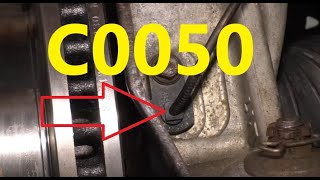
- ABS Sensor Connector — At the right rear wheel hub, connecting the sensor to the main vehicle harness.. This is the most common location for wiring issues. The connector itself can corrode, and the wires leading into it can break internally from repeated suspension movement and vibration. A 'wiggle test' of this harness while monitoring live data can often pinpoint the fault.
Diagnostic Flowchart
Other Known Issues on This Vehicle
Issues unrelated to this code that are worth knowing about as an owner of this generation:
- IMA Battery Pack Failure 🔴 High — Extremely common as vehicles age. The original NiMH battery packs have a finite lifespan, often failing after 10-15 years. Symptoms include the IMA warning light, frequent charge level recalibrations ('re-cals'), reduced power assist, and failure of the DC-DC converter to charge the 12V battery.
- EGR System Clogging 🟠 Medium — Very common, often occurring after 100,000 miles. Carbon buildup in the EGR valve and intake manifold passages causes engine hesitation, bucking ('herky-jerkies'), and potential stalling.
- Manual Transmission Input Shaft Bearing Failure 🟠 Medium — A known issue on 5-speed manual models, typically presenting as a whining or grinding noise that changes with clutch engagement. Can lead to transmission failure if not addressed. (Ref: One of the required bearings (Honda p/n 91004-PHR-003) is reportedly no longer produced by Honda, complicating repairs.)
- Failure of 12V DC-to-DC Converter 🔴 High — This is usually a direct consequence of a failing IMA battery. The converter, which functions like an alternator, relies on the high-voltage IMA system. When the IMA system fails, the converter can stop charging the 12V battery, leading to a no-start condition and stranding the driver.
Used vs. New Parts: Buying Guide for This Vehicle
When a used part is the smart pick: For this repair, a used part is generally not recommended for the sensor itself due to its age and electronic nature. However, sourcing a used connector pigtail with a few inches of wire from a junkyard car can be a very cost-effective solution if your connector is corroded or damaged and a new pigtail is not available.
Donor-vehicle mileage cap: roughly under 150000 miles for the part to have meaningful remaining life.
What to inspect on the donor part:
- For a wiring pigtail, inspect for any signs of cracking, brittleness, or previous repairs.
- Check the connector pins to ensure they are straight and free of green or white corrosion.
- If possible, choose a donor vehicle from a dry climate to minimize the risk of corrosion.
OEM-only on this vehicle (don't cheap out):
- ABS Control Module (if required, though failure is rare)
Aftermarket brands forum-validated for this vehicle:
- Beck/Arnley (Often re-boxes OEM parts or sources from OEM suppliers)
- Standard Motor Products (SMP)
- WVE/NTK
Brands owners have reported issues with on this vehicle:
- Unbranded, 'white-box' parts from online marketplaces should be avoided, as their quality and longevity can be highly inconsistent. Forum users often report issues with the cheapest available sensors failing prematurely.
Real Owner Stories
Aggregated from forums and TSBs cited above. Mileages and costs reflect what owners reported in those sources.
2000-2006 Honda Insight (ZE1) — ~115000 miles
Symptoms: Engine hesitation, bucking, and 'herky-jerkies' while driving.
What fixed it: Cleaning and actuating the EGR valve to remove carbon buildup.
Source hint: InsightCentral.net - EGR Valve Repair
Related OBD-II Codes
Frequently Asked Questions
Can I still buy the original Honda ABS sensor (part number 57470-S3Y-003) for my Insight?
Is there a specific resistance value I should look for when testing the right rear sensor on a 2000-2006 Insight?
Why is the 10mm bolt on the rear ABS sensor so difficult to remove on this car?
My Insight has the 'herky-jerkies' and an ABS light; are these related?
Can I use a wheel speed sensor from a Honda Civic or Fit to fix my C0050 code?
Is it worth buying a used sensor from a salvage yard?
Helpful Videos
We Have This Part in Stock


The information in this article is provided for general reference and educational purposes only. Vehicle specifications, procedures, and part compatibility can vary by production date, trim level, and region. Always consult your vehicle's factory service manual and verify part numbers before purchasing or performing repairs. Safety-critical components such as airbags, seat belts, and braking systems should be installed by a qualified professional.
- Honda Insight:
- 🧭 Diagnostic Flowchart
- 🎬 Helpful Videos
- 🛍️ Shop This Part
- What's Unique About the 2000-2006 Honda Insight
- Symptoms You May Notice
- Most Likely Causes
- Rare But Worth Checking
- Diagnosis Steps
- Parts You'll Likely Need
- Platform-Specific Known Issues
- Documented NHTSA Reports
- Mechanic-Grade Diagnostic Values
- Scan Tool Commands That Help
- Wiring & Ground Locations
- Other Known Issues on This Vehicle
- Used vs. New Parts: Buying Guide for This Vehicle
- Real Owner Stories
- 2000-2006 Honda Insight (ZE1) — ~115000 miles
- Related OBD-II Codes
- Frequently Asked Questions
- 🎟️ Get 5% Off