

C0050 on 2005-2010 Kia Sportage: Right Rear Wheel Speed Sensor Fault Causes and Fixes
Code C0050 on a 2005-2010 Kia Sportage means there's a problem with the right rear wheel speed sensor circuit. The most common fix is replacing the faulty sensor itself, which costs about $40-$100 for an aftermarket part. Other causes include damaged wiring, a corroded connector, or a bad magnetic ring on the wheel hub assembly.
- Code C0050 on your Sportage means your ABS and stability control are offline; drive with extra caution.
- The most likely cause is a bad right rear wheel speed sensor, which is a relatively inexpensive and accessible DIY replacement.
- Before replacing parts, always inspect the wiring and connector for corrosion or damage, as this is a common secondary cause.
- If a new sensor doesn't fix the code, the magnetic ring on the wheel hub is the next likely culprit, requiring replacement of the entire hub assembly.
What's Unique About the 2005-2010 Kia Sportage
For the second-generation Kia Sportage (2005-2010) and its platform-mate, the Hyundai Tucson (2005-2009), the C0050 code is a straightforward indicator of an issue in the ABS wheel speed sensing system. Unlike some vehicles where this code can be ambiguous, on this platform, it almost always points to the sensor, its wiring, or the tone ring on the wheel hub. While no major recalls directly cite C0050, several service campaigns (SC04, SA120) were issued for this generation to apply additional anti-corrosion materials to the underbody, highlighting the platform's susceptibility to rust which can damage wiring and subframes. An earlier recall (SC044) for 2005 models involved reprogramming the Electronic Stability Program (ESP) for being overly sensitive, underscoring the importance of this system's correct function on the Sportage.
Symptoms You May Notice
- ABS warning light is on
- Traction Control or ESC/ESP warning light is on
- ABS system does not activate during hard braking (wheels may lock up)
- Cruise control may be disabled
- Brake pedal may feel different or pulsate unexpectedly at low speeds
- Replacing the ABS module when the actual fault is a simple wiring break or a dirty tone ring.
- Replacing the wheel hub/bearing when only the sensor itself has failed.
- Replacing the sensor when the wiring connector is corroded or the harness is broken further up the line.
Most Likely Causes
- Failed Right Rear Wheel Speed Sensor 🔴 High Probability → Shop ABS Wheel Speed Sensor The sensor is exposed to harsh conditions like water, road salt, and debris, leading to electronic failure or corrosion over time. It's a very common failure point for this code.
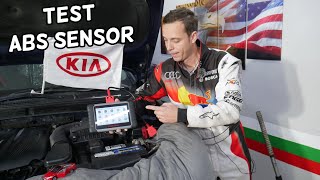
How to confirm: Use a multimeter to test the sensor's internal resistance; if it reads as an open or short circuit (compared to manufacturer specs), it has failed. 🎬 Watch: How to test your ABS sensor with a multimeter. A more advanced scanner can show live data, and if the right rear wheel reads 0 MPH or an erratic signal while others show speed, the sensor is the primary suspect.
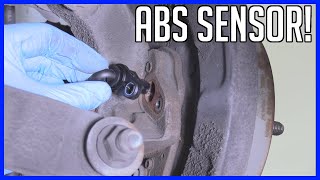
Typical fix: Replace the right rear wheel speed sensor. It is typically held in by a single 10mm bolt and is a plug-and-play part. 🎬 See this walkthrough of a rear wheel speed sensor fix.
Est. part cost: $40-$100 - Damaged Wiring or Connector 🟡 Medium Probability The wiring harness leading to the wheel hub is subject to damage from road debris, corrosion from moisture (especially in rust-prone areas), or stress from suspension movement. The connector pins can also corrode, causing an open or short circuit.
How to confirm: Visually inspect the wiring harness from the sensor to where it enters the vehicle body. Look for frayed wires, cracked insulation, or green/white corrosion inside the connector plug. A continuity test with a multimeter from the ABS module connector to the sensor connector can confirm a wire break.
Typical fix: Repair the broken section of wire with solder and heat-shrink tubing or replace the pigtail connector if it is corroded. In some cases, a section of the ABS harness may need to be replaced.
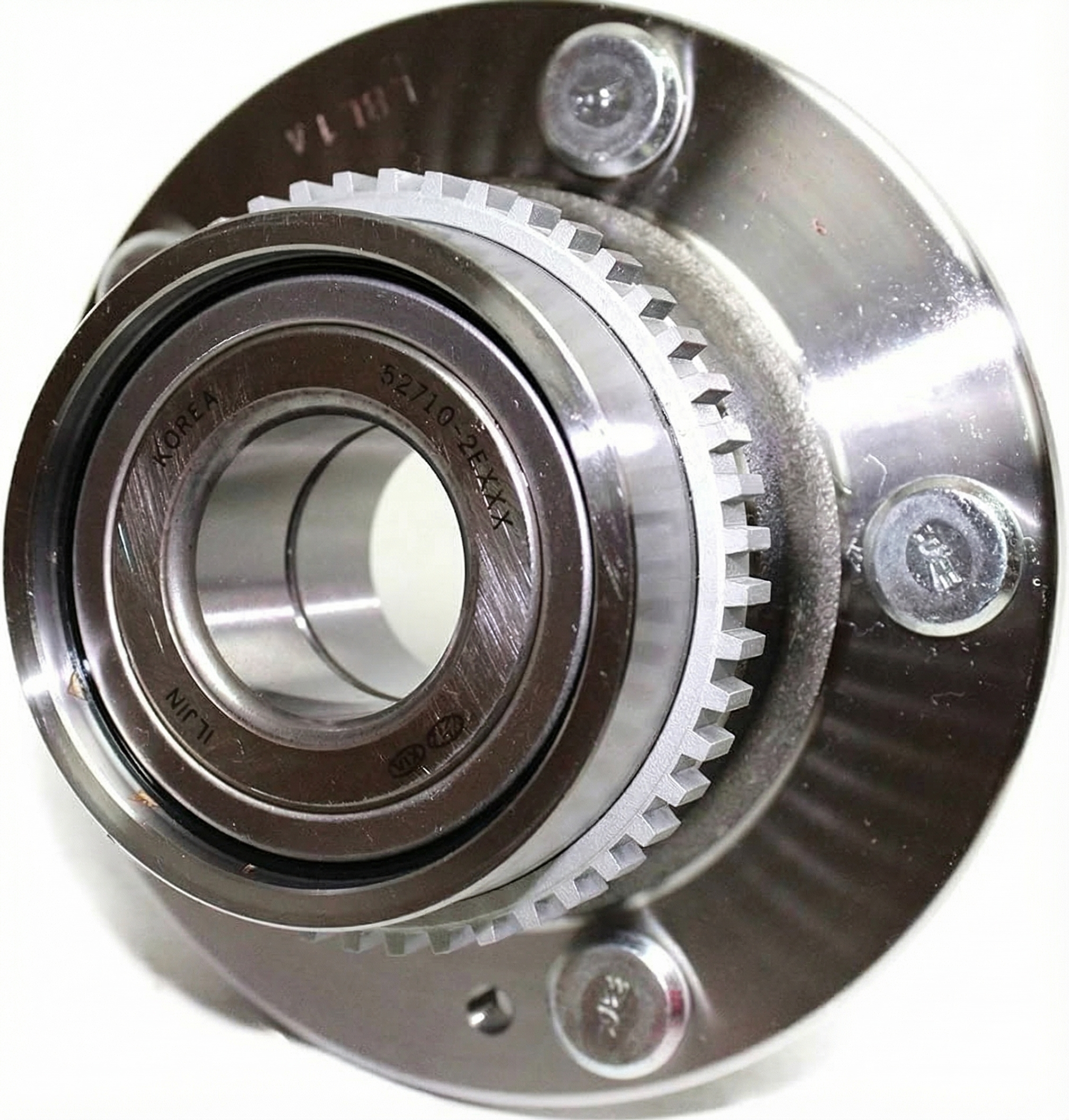
Est. part cost: $15-$50 - Damaged or Debris-Covered Tone Ring ⚪ Low Probability The magnetic encoder ring is integrated into the rear wheel hub bearing assembly. Rust can cause the ring to crack, delaminate, or swell, and metallic brake dust can stick to it, disrupting the sensor's reading. This is a known failure pattern on similar systems.
How to confirm: Remove the wheel speed sensor and use a flashlight and mirror to inspect the magnetic ring on the hub while spinning it. Look for cracks, missing chunks, or a heavy buildup of metallic dust. Excessive play in the wheel bearing can also cause an inconsistent signal.
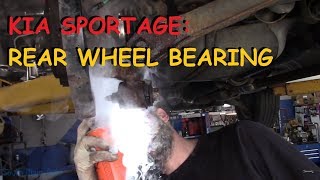
Typical fix: If the tone ring is just dirty, it can be cleaned with a brake cleaner and a soft brush. However, if the ring is cracked or damaged, the entire rear wheel hub and bearing assembly must be replaced 🎬 Watch: Step-by-step guide to replacing the rear wheel bearing. as the ring is integrated.
Est. part cost: $100-$250
Rare But Worth Checking
- Faulty ABS Control Module: → Shop ABS Control Module This is the least likely cause. Before condemning the module, all other possibilities (sensor, wiring, hub) must be exhaustively ruled out. A failed module will often trigger multiple wheel speed sensor codes or communication codes, not just one.
Diagnosis Steps
- Connect an OBD-II scanner capable of reading ABS codes to confirm C0050 is the primary code. Note any other codes.
- Use the scanner's live data function to monitor the speed of all four wheels while driving slowly (above 5-10 mph) in a straight line. Confirm that the Right Rear (RR) sensor reads 0 MPH, has an erratic signal, or lags compared to the other three.
- Safely raise and support the vehicle. Remove the right rear wheel.
- Visually inspect the wheel speed sensor and its wiring harness for any obvious signs of damage, such as cracks, fraying, melting, or corrosion. Pay close attention to the connector.
- Disconnect the sensor. Check for 5V reference voltage and a good ground at the vehicle-side harness connector with the ignition on, using a multimeter.
- With the sensor disconnected, measure its resistance. Compare the reading to the manufacturer's specification (typically in the k-ohm range). An infinite reading (open) or zero reading (short) indicates a bad sensor.
- If the sensor and wiring voltage test good, remove the sensor (usually one 10mm bolt) and inspect the magnetic encoder ring on the wheel hub for heavy rust, metallic debris, or physical damage like cracks or delamination.
- If the ring is damaged or the wheel bearing has excessive play, the entire hub assembly needs replacement.
- If all components test good, the fault may be intermittent (often a wiring issue) or, in rare cases, within the ABS control module itself.
Parts You'll Likely Need
- Right Rear ABS Wheel Speed Sensor
(OEM #95680-2E500)— This is the most common failure point for a C0050 code due to its exposed location and electronic nature.
Trusted brands: Mando, Delphi, NTK, Standard Motor Products (SMP), Holstein, Febi
OEM price range: $150-$230
Aftermarket price range: $40-$100 - Rear Wheel Hub Bearing Assembly
(OEM #52710-2E500 (AWD), 52710-2E100 (FWD))— This part is needed if the integrated magnetic tone ring is found to be cracked or damaged, as it cannot be replaced separately from the hub. It is critical to order the correct part for FWD or AWD models.
Trusted brands: Timken, SKF, MOOG, Beck/Arnley, GSP
OEM price range: $200-$300
Aftermarket price range: $80-$180
Technical Service Bulletins (TSBs) & Recalls
- SC044: A recall campaign for some 2005 Sportage models to reprogram the Electronic Stability Program (ESP) logic due to over-sensitivity. While not a direct fix for C0050, it relates to the vehicle's stability system.
- SA120: A service action for 2005-2010 Sportage models to apply additional anti-corrosion protection to the rear floor side members and crossmembers, acknowledging the platform's rust issues.
- SC04: A service campaign for Sportage (KM) vehicles to apply preventative anti-corrosion material to various underbody components.
Platform-Specific Known Issues
- Wiring Corrosion: Owners on forums for both the Sportage and its platform-mate, the Hyundai Tucson, frequently report that the wiring harness connector for the rear speed sensors is a common point of failure due to water intrusion and corrosion, sometimes being the issue even when the sensor itself tests good.
- Underbody Rust: The JE/KM platform is known for significant underbody rust, particularly on the rear subframe and crossmembers, especially in the salt belt. This can lead to collateral damage to ABS wiring and mounting points, and in severe cases, structural failure. Kia issued service actions like SA120 to apply additional anti-corrosion treatment.
Mechanic-Grade Diagnostic Values
- Passive Wheel Speed Sensor Internal Resistance — expected: Approximately 1.3 to 1.7 kΩ (kilo-ohms). This can vary slightly, so comparison with the known-good sensor on the other side is a valid test.. Failure: A reading of infinity (OL) indicates an open circuit, while a reading near zero indicates a short circuit. Either means the sensor has failed.
- AC Voltage Output (while spinning wheel) — expected: A passive sensor should generate a small AC voltage that increases with wheel speed, typically starting around 100mV AC when spun by hand.. Failure: No AC voltage generation while the wheel is spinning points to a dead sensor.
- Voltage at Harness Connector (Key On, Sensor Unplugged) — expected: You should see a reference voltage (often 5V or 12V depending on system type) on one pin and a good ground on the other.. Failure: Absence of reference voltage or a poor ground indicates a problem in the wiring harness or the ABS module, not the sensor itself.
Hidden / Shadow Codes Worth Checking
- C0050 00: General circuit malfunction, which can mean an open circuit, short to ground, or high resistance. (see via A professional-grade scanner with manufacturer-specific software (like Kia's GDS) is often needed to see these sub-codes.)
- C0050 5A: Signal not plausible, meaning the signal is present but doesn't make sense compared to the other wheel speed sensors (e.g., it's erratic or inconsistent). (see via Requires an advanced scanner capable of interpreting manufacturer-specific fault data.)
- C0050 18: Low signal amplitude, indicating a weak signal from the sensor. This often points to an excessive air gap, a damaged tone ring, or a failing sensor. (see via Visible on advanced diagnostic tools that provide detailed fault code information.)
Scan Tool Commands That Help
- Kia GDS (Global Diagnostic System) or equivalent advanced scanner: Live Data / Data Stream for Wheel Speed Sensors — This is the primary diagnostic step after reading the code. It allows you to view the speed reported by all four sensors in real-time while driving or spinning the wheels. A C0050 fault will typically show the right rear sensor at 0 km/h or with a wildly fluctuating signal compared to the other three.
- Kia GDS or equivalent: Clear Fault Codes (DTCs) — After the physical repair (e.g., replacing the sensor or fixing wiring) has been completed, this function must be used to erase the stored C0050 code and turn off the ABS/ESC warning lights. The light will likely return if the underlying fault was not properly fixed.
Wiring & Ground Locations
- ABS Control Module (EBCM) — In the engine bay, typically located on the driver's side, attached to the hydraulic block with multiple metal brake lines running into it. It's a metal block with a large electrical connector.. This is the 'brain' that receives the signal from the right rear wheel speed sensor. All wiring eventually leads here, so it's the final point for continuity testing if a wiring break is suspected.
- ABS Module Connector — The large electrical plug connecting to the ABS Control Module.. This is the ideal location to perform a continuity test on the wires running to the right rear sensor. By checking for continuity between the pins here and the pins at the sensor connector, you can confirm if the harness is intact without tearing it apart.
- Sensor Harness Connector — Typically located in the right rear wheel well, where the sensor's pigtail connects to the main vehicle harness. It is often clipped to the frame or subframe.. This is the most common location for corrosion and wiring damage due to its exposure to water, salt, and debris. A visual inspection and voltage test should be performed here first.
Real Owner Repair Stories
- Reddit user on r/HyundaiTucson (2019 Hyundai Tucson (later generation, but demonstrates a relevant failure mode)) — ABS shaking in brake pedal, followed by ABS, traction control, and front collision warning lights.
❌ Tried (didn't work) Initial suspicion was the ABS sensor itself.
✅ What actually fixed it The root cause was a bad driver-side drive shaft. The mechanic determined the car was misinterpreting the drive shaft issue as an ABS sensor malfunction. Replacing the drive shaft resolved all warning lights. - Ron Ananian The Car Doctor™ on YouTube (2013 Hyundai Tucson (demonstrates a common diagnostic trap)) — Problematic left rear wheel speed sensor with an erratic signal on a scope.
❌ Tried (didn't work) Replacing the wheel speed sensor. The new sensor still showed a bad signal.
✅ What actually fixed it Upon removing the entire wheel bearing assembly, debris from a disintegrated internal part of the bearing was found plugging the sensor hole. This debris was blocking the sensor from reading the tone ring. Replacing the entire wheel bearing assembly fixed the issue.
Documented NHTSA Reports
- An owner reported in NHTSA ODI #11228687 that their vehicle displayed C0050 along with several other sensor and communication codes (C0035, C0040, U0077, U0126) while the ABS light was illuminated.
- While C0050 is typically a wheel speed code, NHTSA ODI #10763888 notes that on some manufacturer platforms, this code has been associated with a faulty power steering control module (PSCM) requiring replacement of the steering column.
- In NHTSA ODI #11649367, a technician noted that the vehicle disabled ABS and set code C0050 after brake service, suggesting that extra brake fluid required to return caliper piston contact can sometimes trigger system faults.
- NHTSA ODI #11693418 describes a diagnostic showing code C0050-00 where the eventual repair required replacing the rotors, rear brake pads, and adapter plate.
Diagnostic Flowchart
Other Known Issues on This Vehicle
Issues unrelated to this code that are worth knowing about as an owner of this generation:
- Severe Underbody and Rear Subframe Rust 🔴 High — Very common, especially in regions that use road salt. Can become structurally unsafe. (Ref: SA120, SC04 (Anti-corrosion application))
- Faulty Stop Lamp Switch 🟠 Medium — Common enough to trigger a recall. Affects brake light operation and can prevent shifting out of Park. (Ref: NHTSA Recall 13V114000)
- Crankshaft Pulley Bolt Failure (2.7L V6) 🔴 High — A known issue where the bolt can back out or break, causing the pulley to wobble or detach, leading to loss of power steering and charging.
- Premature Timing Belt Wear (2.7L V6) 🔴 High — The V6 is an interference engine, and failure to replace the timing belt at the recommended interval (typically 60,000 miles) can lead to catastrophic engine damage.
- HECU (ABS Module) Fire Risk 🔴 High — Affects 2008-2009 models. A short circuit in the Hydraulic Electronic Control Unit can cause an engine compartment fire, even when parked. (Ref: NHTSA Recall 16V815000)
Used vs. New Parts: Buying Guide for This Vehicle
When a used part is the smart pick: A used rear wheel hub assembly from a low-mileage, non-corroded donor vehicle can be a cost-effective alternative to a new OEM hub if the integrated tone ring is the cause of the failure. It is generally not recommended to buy a used electronic sensor like the wheel speed sensor itself.
Donor-vehicle mileage cap: roughly under 60000 miles for the part to have meaningful remaining life.
What to inspect on the donor part:
- Check for zero play or roughness when spinning the bearing by hand.
- Inspect the magnetic encoder ring for any visible cracks, chips, or heavy rust.
- Ensure the donor vehicle is from a region with minimal road salt to avoid pre-existing corrosion issues.
- Verify the ABS sensor mounting hole is clean and undamaged.
Aftermarket brands forum-validated for this vehicle:
- Mando (often the Original Equipment supplier for Hyundai/Kia).
- Delphi
- NTK
- Standard Motor Products (SMP)
- Holstein
- Beck/Arnley
Brands owners have reported issues with on this vehicle:
- Unbranded, no-name sensors from online marketplaces can have high failure rates, poor fitment, or incorrect electronic specifications, leading to the code returning shortly after repair. While tempting due to low price, they often cost more in the long run due to repeat labor.
Real Owner Stories
2005-2010 Kia Sportage
Symptoms: ABS warning light is on and the consensus on the forums is that the sensor is the most common fix, but some users emphasize checking the connector for corrosion first.
What fixed it: Replacing the sensor is the most common fix, though some required cleaning corrosion from the wiring connector.
Source hint: kia-forums.com
2005-2009 Hyundai Tucson
Symptoms: Identical symptoms to the Sportage C0050 code, including ABS light and potential signal loss from the rear wheel.
What fixed it: Replacing the sensor or the hub's magnetic ring.
Source hint: hyundai-forums.com
Related OBD-II Codes
Frequently Asked Questions
Does the anti-corrosion service action SA120 apply to my 2005-2010 Kia Sportage?
My 2005 Sportage has an over-sensitive ESP system; is there a fix for this?
Could a faulty brake light switch be related to my ABS and ESC warning lights?
Is there a fire risk associated with the ABS system on my 2008 Sportage?
Can I just replace the tone ring on the rear wheel if it is cracked?
Why is my ABS light on even though the sensor itself tested fine with a multimeter?
Helpful Videos
Used OEM Parts in Stock
New Aftermarket Parts Available



The information in this article is provided for general reference and educational purposes only. Vehicle specifications, procedures, and part compatibility can vary by production date, trim level, and region. Always consult your vehicle's factory service manual and verify part numbers before purchasing or performing repairs. Safety-critical components such as airbags, seat belts, and braking systems should be installed by a qualified professional.
- Kia Sportage:
- 🧭 Diagnostic Flowchart
- 🎬 Helpful Videos
- 🛍️ Shop This Part
- What's Unique About the 2005-2010 Kia Sportage
- Symptoms You May Notice
- Most Likely Causes
- Rare But Worth Checking
- Diagnosis Steps
- Parts You'll Likely Need
- Technical Service Bulletins (TSBs) & Recalls
- Platform-Specific Known Issues
- Mechanic-Grade Diagnostic Values
- Hidden / Shadow Codes Worth Checking
- Scan Tool Commands That Help
- Wiring & Ground Locations
- Real Owner Repair Stories
- Documented NHTSA Reports
- Other Known Issues on This Vehicle
- Used vs. New Parts: Buying Guide for This Vehicle
- Real Owner Stories
- 2005-2010 Kia Sportage
- 2005-2009 Hyundai Tucson
- Related OBD-II Codes
- Frequently Asked Questions
- 🎟️ Get 5% Off