

P0010 on 2011-2023 Dodge Challenger 3.6L: 'A' Camshaft Actuator Circuit Causes and Fixes
On a 3.6L Pentastar Challenger, code P0010 is most often caused by low or dirty engine oil, or a faulty Bank 1 (passenger side) intake VVT solenoid. An oil change with full synthetic 5W-20 oil is the first step. If that fails, the solenoid is the likely culprit, costing between $25 for an aftermarket part and $90 for the OEM Mopar part. This code points to an electrical circuit fault, not a mechanical timing issue.
- Always check your engine oil level and condition first. Low, dirty, or incorrect oil is the number one cause of P0010 on the 3.6L Pentastar.
- The most likely failed part is the Bank 1 (passenger side) intake VVT solenoid. A simple diagnostic is to swap it with the exhaust solenoid on the same bank to see if the code changes to P0013.
- Do not replace the camshaft position sensor; this code points to the actuator solenoid circuit, not the sensor.
- Be aware of other common Pentastar issues. An oil leak at the back of the engine could be a cracked oil filter housing, and a ticking noise could be failing rocker arms—both of which can cause this code.
What's Unique About the 2011-2023 Dodge Challenger
The 3.6L Pentastar V6 is well-regarded but its Variable Valve Timing (VVT) system is notoriously sensitive to oil level, quality, and viscosity. Many P0010 codes on this engine are a direct result of oil-related issues, which can clog the small passages and screens in the VVT solenoids. Furthermore, two common Pentastar engine flaws—failing rocker arms ('Pentastar Tick') and cracked oil filter housings—can lead to oil contamination or low oil pressure, which often manifest as VVT-related codes like P0010. The rocker arm failure, in particular, sheds metallic debris into the oil, which is a primary cause of solenoid screen clogging and subsequent failure.
Generation note: The 2011-2023 Dodge Challenger is a single generation (LC), but the 3.6L Pentastar engine was updated in 2016 with changes to the VVT system and a higher compression ratio. The VVT system's core principles and sensitivity to oil remain the same. However, the plastic oil filter housing, a common failure point leading to oil pressure loss, is a known issue across all years but is frequently reported on models from 2014 onwards.
Symptoms You May Notice
- Check Engine Light is on
- Rough or unstable idle
- Engine hesitates or stumbles on acceleration
- Stalling, especially at low speeds or when stopping
- Reduced fuel economy
- Rattling noise from the engine
- Difficulty starting the engine
- Replacing the Camshaft Position Sensor. P0010 is a circuit code for the VVT actuator solenoid, not the position sensor that reads the camshaft's speed. Replacing the sensor will not fix this code.
Most Likely Causes
- Low or Dirty Engine Oil 🔴 High Probability The Pentastar's VVT system is hydraulic and requires clean oil at the correct pressure to function. Sludge from extended oil change intervals or using the wrong oil viscosity (5W-20 is specified) can clog the VVT solenoid screens. This is often the first and easiest thing to check.
How to confirm: Check the engine oil dipstick. If the level is below the 'add' line or the oil is dark, sludgy, and past its service life, this is the first suspect. Check service records for the last oil change.
Typical fix: Perform an engine oil and filter change using a quality full synthetic 5W-20 oil that meets Chrysler's MS-6395 specification. Clear the code and drive to see if it returns. Many owner accounts confirm this simple fix can resolve the code.
Est. part cost: $40-$80 - Faulty Intake VVT Solenoid (Bank 1) 🔴 High Probability These solenoids are a common failure item. They can fail electrically (internal coil breaks, causing the circuit code) or become clogged with oil sludge or metallic debris from engine wear (like failing rocker arms).
How to confirm: Swap the Bank 1 intake solenoid (passenger side, inner) with the Bank 1 exhaust solenoid (passenger side, outer). They are identical parts. Clear the codes and drive. If the code changes to P0013 ('B' Camshaft Position Actuator Circuit), the solenoid is confirmed bad. This is a definitive, no-cost diagnostic step.
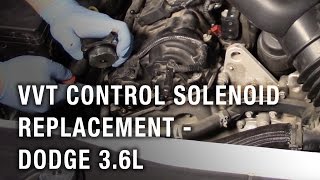
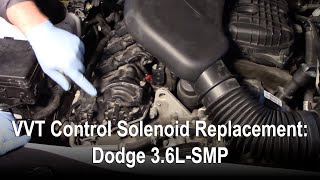
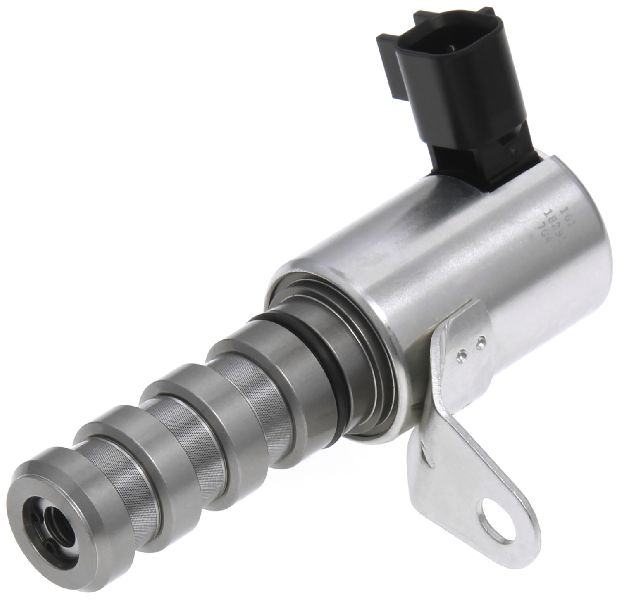
Typical fix: Replace the Bank 1 intake VVT solenoid. It is located on the front of the passenger-side 🎬 Watch: Locate the VVT solenoids on your Challenger cylinder head and held in by three small bolts (typically E8 external Torx). The OEM Mopar part is recommended for reliability.
Est. part cost: $25-$90 - Cracked Oil Filter Housing / Cooler Assembly 🟡 Medium Probability The plastic oil filter housing, located in the 'V' of the engine, is known to crack with age and thousands of heat cycles, especially on 2014+ models. This causes a significant oil leak, leading to low oil pressure that starves the VVT system and can trigger P0010.
How to confirm: Inspect the engine valley (under the intake manifold) for pooled engine oil using a flashlight. An oil leak that drips down the back of the engine onto the transmission bell housing is a classic sign.
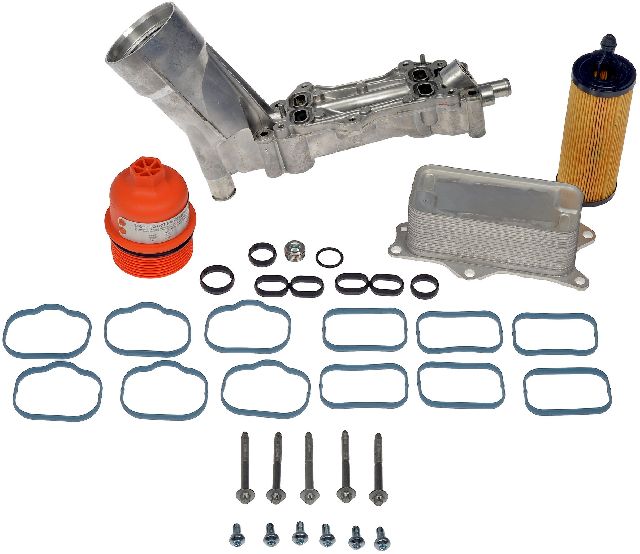
Typical fix: Replace the entire oil filter housing and cooler assembly. This is an involved repair requiring removal of the upper and lower intake manifolds. Many owners opt for an upgraded aftermarket aluminum housing (like Dorman P/N 926-959) for a more permanent solution.
Est. part cost: $100-$250 - Damaged Wiring or Connector ⚪ Low Probability The wiring harness near the engine can become brittle from heat. The connector for the VVT solenoid can also get contaminated with oil or dirt, and the locking tab can break, causing a poor connection. Some owners report using a zip tie to secure a loose connector as a temporary fix.
How to confirm: Unplug the electrical connector for the Bank 1 intake VVT solenoid. Inspect for corrosion, oil contamination, pushed-out pins, or damaged wires. Use a multimeter to check for 12V power and ground at the connector with the key on.
Typical fix: Clean the connector with electrical contact cleaner. If the wiring or connector is damaged, a pigtail connector replacement may be needed.
Est. part cost: $5-$50
Rare But Worth Checking
- Failing Rocker Arms ('Pentastar Tick'): A widely documented issue with the Pentastar engine is rocker arm bearing failure, which creates a loud ticking sound. 🎬 See how to diagnose and fix the Pentastar engine tick This failure introduces metallic debris into the oil, which can clog the VVT solenoid screens and cause P0010. If you hear a tick, this is a more serious mechanical issue that needs to be addressed, as it can lead to camshaft damage.
- Poor Engine Ground: TSB 08-111-21 was issued for some 2021 models where a poor engine ground caused multiple VVT circuit codes (P0010, P0013, P0020, P0023) to appear at once. The fix involves splicing in a new ground pigtail (P/N 68552801AA). While specific to 2021, a corroded or loose ground could theoretically affect any year.
- Faulty Powertrain Control Module (PCM): This is extremely rare. The PCM should only be considered after all other possibilities (oil, solenoid, wiring, grounds) have been exhaustively ruled out.
Diagnosis Steps
- Check Engine Oil: Before any other steps, verify the oil level is full and the oil is clean. If low, top it off. If old or dirty, perform an oil and filter change with full synthetic 5W-20 oil.
- Scan for Codes: Confirm P0010 is the active code and note any other codes present, as they can provide clues (e.g., multiple VVT codes pointing to a ground issue).
- Inspect the Connector: Unplug the Bank 1 (passenger side) intake VVT solenoid. Check the connector and harness for any signs of damage, corrosion, oil contamination, or a broken locking tab.
- Swap the Solenoids: A simple and definitive test is to swap the intake solenoid with the exhaust solenoid on the same bank (passenger side). They are identical parts. Clear the codes and drive the vehicle.
- Re-Scan for Codes: If the code changes to P0013 (Exhaust Camshaft Actuator Circuit), the solenoid you moved is faulty and needs to be replaced. If P0010 returns, the problem is in the wiring or PCM.
- Test the Circuit (if P0010 returns): Use a multimeter to check for 12-volt power and a good ground at the solenoid's electrical connector with the ignition on. This will confirm if the wiring is intact.
- Test Solenoid Resistance: With the solenoid unplugged, use a multimeter to measure the resistance between its two pins. A good solenoid should read between 6.9 and 7.9 ohms. 🎬 Watch: How to test a VVT solenoid with a multimeter An open circuit (infinite resistance) or a short (near zero) indicates a failed solenoid.
Parts You'll Likely Need
- Variable Valve Timing (VVT) Solenoid / Oil Control Valve
(OEM #5184101AH)— This is the most common part to fail, either electrically or by becoming clogged with debris, directly causing the P0010 circuit code. The original part number 5184101AG has been superseded by 5184101AH. - Engine Oil Filter Housing and Cooler Assembly — Needed if a crack in the housing is found to be the root cause of low oil pressure triggering the VVT code. This is a common issue on Pentastar engines.
Related Codes That Often Appear With This One
- P0011 — This code indicates a timing performance issue (over-advanced) on the same camshaft. Seeing P0010 and P0011 together strongly points to a faulty VVT solenoid or a severe oil flow problem.
- P06DD — This code means 'Engine Oil Pressure Control Solenoid Stuck Off'. Since the VVT system is dependent on oil pressure, a problem with the oil pump's dual-stage system will often trigger VVT codes.
- P0013, P0020, P0023 — These are the circuit codes for the other three VVT solenoids. If multiple VVT circuit codes appear at once, suspect a common problem like a bad engine ground (per TSB 08-111-21) or a widespread electrical issue rather than multiple failed solenoids.
Technical Service Bulletins (TSBs) & Recalls
- TSB 08-111-21: Issued for 2021 Jeep Wrangler and Gladiator models, this TSB addresses multiple VVT circuit codes (P0010, P0013, P0020, P0023) caused by a poor engine ground. The fix involves splicing in a pigtail, part number 68552801AA.
Platform-Specific Known Issues
- The plastic oil filter housing located in the engine valley is a notorious failure point that leads to oil leaks and low pressure, directly causing VVT system codes.
- Rocker arm failure ('Pentastar Tick') can contaminate the engine oil with metallic debris, which then clogs the VVT solenoid screens and causes them to fail.
Mechanic-Grade Diagnostic Values
- VVT Solenoid Coil Resistance — expected: 6.9 to 7.9 ohms. Failure: A reading of infinity (Open Loop) or near-zero ohms (short circuit) indicates a failed solenoid.
- VVT Solenoid Harness Connector Voltage (Key On, Engine Off) — expected: Approximately 12V (Battery Voltage) on one of the two pins.. Failure: No voltage suggests a problem with the power supply from the PCM or a related fuse.
- VVT Solenoid Control Circuit Voltage (Key On, Engine Off, Solenoid Disconnected) — expected: Approximately 8.6 - 8.8 volts (PWM circuit). Failure: Significant deviation from this voltage can indicate a wiring issue or a faulty PCM driver.
- VVT Solenoid Driver Circuit Continuity to PCM — expected: Less than 5.0 Ohms. Failure: Resistance above 5.0 Ohms points to an open or high resistance in the wiring between the solenoid connector and the PCM.
Scan Tool Commands That Help
- wiTECH or other professional scan tool: VVT Solenoid Activation Test — This command allows the technician to manually activate the VVT solenoid while the engine is running to observe changes in engine performance or listen for the solenoid's click. If activating the solenoid has no effect, it confirms a problem with the solenoid, its circuit, or oil flow. This is used to verify functionality after confirming the electrical circuit is intact.
Wiring & Ground Locations
- VVT Solenoid Connector (Bank 1 Intake) — On the front of the passenger-side cylinder head. There are two solenoids; the intake solenoid is the inner one, closer to the engine centerline.. This is the primary connection point for the component flagged by code P0010. The connector and its wiring are subject to engine heat and vibration, making them a potential point of failure.
- G905A — A primary engine ground point, often located on the lower right side of the engine compartment or on the engine block itself.. A corroded or loose main engine ground can introduce electrical noise and voltage offsets. While TSB 08-111-21 points to a specific ground pigtail issue on 2021 models, any poor ground at a primary point like G905A can cause erratic behavior in sensor-driven systems like VVT.
OEM Part Supersession History
5184101AG→5184101AH— Standard part revision by the manufacturer for improved reliability or manufacturing process changes.
Model Year Variations Within This Range
- 2016-2023: The Pentastar engine was significantly updated in 2016. Changes included a new two-step variable valve lift (VVL) system, a higher compression ratio (11.3:1 vs 10.2:1), and an increased VVT range of authority (70° vs 50°). While the P0010 code's root cause (VVT solenoid circuit) remains the same, the VVL system adds complexity with its own set of solenoids, though these are separate from the VVT phaser solenoids that cause P0010.
- 2021: A specific Technical Service Bulletin (TSB 08-111-21) was issued for 2021 models where a poor engine ground could cause multiple VVT circuit codes (including P0010) to appear simultaneously. This highlights a potential manufacturing variance in the wiring harness for this model year.
Diagnostic Flowchart
Other Known Issues on This Vehicle
Issues unrelated to this code that are worth knowing about as an owner of this generation:
- Cracked Oil Filter Housing / Cooler Assembly 🔴 High — Extremely common, often occurs after 60,000-100,000 miles. The original plastic housing warps and cracks from heat cycles, causing significant oil leaks into the engine valley.
- Rocker Arm Bearing Failure ('Pentastar Tick') 🔴 High — Widespread issue, particularly on 2011-2016 models, but can occur at various mileages. Often presents as a distinct ticking noise from the top of the engine, which can lead to camshaft damage if ignored. (Ref: Subject of class-action lawsuits.)
- Left Cylinder Head Defect (Early Models) 🔴 High — Affected a significant number of early Pentastar engines (2011-2013), causing misfires and requiring cylinder head replacement. (Ref: Covered by an extended warranty (X69) from Chrysler for affected VINs.)
- Cooling System Failures (Water Pump/Thermostat) 🟠 Medium — Failures of the water pump and thermostat housing are commonly reported, leading to overheating or coolant leaks.
- Alternator Failure (EHPS-equipped models) 🟠 Medium — Common on 2011-2014 models with electro-hydraulic power steering (EHPS). The alternator can fail suddenly. (Ref: Recall N57 / NHTSA 14V-634 for certain 2011-2014 models.)
Used vs. New Parts: Buying Guide for This Vehicle
When a used part is the smart pick: For this repair, a used part is generally not recommended for the VVT solenoid itself due to its high failure rate and sensitivity to oil contamination. However, if the cause is a damaged connector, a used pigtail from a junkyard harness is a cost-effective and reliable repair.
Donor-vehicle mileage cap: roughly under 60000 miles for the part to have meaningful remaining life.
What to inspect on the donor part:
- For a wiring pigtail, ensure the plastic isn't brittle and the locking tab is intact.
- Check for any signs of corrosion or pushed-out pins in the connector.
- If considering a used solenoid against advice, inspect the screens for any metallic debris or heavy sludge, which would be a definite red flag.
OEM-only on this vehicle (don't cheap out):
- Powertrain Control Module (PCM) - Aftermarket or used PCMs often create more problems with VIN mismatch and security system lockouts.
Aftermarket brands forum-validated for this vehicle:
- Dorman (for oil filter housing assembly)
- Standard Motor Products (for VVT solenoids)
Brands owners have reported issues with on this vehicle:
- No-name, unbranded VVT solenoids from online marketplaces are frequently cited on forums as being dead-on-arrival or failing within a few months.
Real Owner Stories
Aggregated from forums and TSBs cited above. Mileages and costs reflect what owners reported in those sources.
2019 Dodge Challenger SXT 3.6L — ~100000 miles
Symptoms: Leaking oil filter housing with oil pooling in the engine valley.
What fixed it: Replacement of the plastic oil filter housing with an aluminum Dorman part (P/N 926-959).
Source hint: https://www.reddit.com/r/Challenger/comments/18z023x/oil_filter_housing_advice/
2021 Jeep Wrangler 3.6L (Pentastar)
Symptoms: Multiple VVT circuit codes including P0010, P0013, P0020, and P0023.
What fixed it: Splicing in a pigtail (part number 68552801AA) to resolve a poor engine ground issue as per TSB 08-111-21.
Source hint: TSB 08-111-21
2011-2023 Dodge Challenger 3.6L
Symptoms: P0010 code triggered by low or dirty engine oil; VVT solenoid screens clogged by sludge.
What fixed it: Engine oil and filter change using full synthetic 5W-20 oil meeting Chrysler MS-6395 specification.
Source hint: Article Context - Common Causes
Related OBD-II Codes
Frequently Asked Questions
I have a 2021 Challenger with P0010; is there a specific TSB I should know about?
Can I use any oil in my Pentastar 3.6L to clear this code?
My 2019 Challenger SXT has oil pooling under the intake; could this cause P0010?
Is there a way to test if the Bank 1 intake solenoid is actually bad without buying parts?
I hear a ticking noise and now have a P0010 code. Are they related?
Is there a more permanent fix for the leaking oil filter housing on my Challenger?
Helpful Videos


We Have This Part in Stock


The information in this article is provided for general reference and educational purposes only. Vehicle specifications, procedures, and part compatibility can vary by production date, trim level, and region. Always consult your vehicle's factory service manual and verify part numbers before purchasing or performing repairs. Safety-critical components such as airbags, seat belts, and braking systems should be installed by a qualified professional.
- Dodge Challenger:
- 🧭 Diagnostic Flowchart
- 🎬 Helpful Videos
- 🛍️ Shop This Part
- What's Unique About the 2011-2023 Dodge Challenger
- Symptoms You May Notice
- Most Likely Causes
- Rare But Worth Checking
- Diagnosis Steps
- Parts You'll Likely Need
- Related Codes That Often Appear With This One
- Technical Service Bulletins (TSBs) & Recalls
- Platform-Specific Known Issues
- Mechanic-Grade Diagnostic Values
- Scan Tool Commands That Help
- Wiring & Ground Locations
- OEM Part Supersession History
- Model Year Variations Within This Range
- Other Known Issues on This Vehicle
- Used vs. New Parts: Buying Guide for This Vehicle
- Real Owner Stories
- 2019 Dodge Challenger SXT 3.6L — ~100000 miles
- 2021 Jeep Wrangler 3.6L (Pentastar)
- 2011-2023 Dodge Challenger 3.6L
- Related OBD-II Codes
- Frequently Asked Questions
- 🎟️ Get 5% Off