

P0012 on 2007-2024 Lexus ES350: Camshaft Timing Over-Retarded Causes and Fixes
For a Lexus ES350, code P0012 is almost always caused by low/dirty engine oil or a failing Bank 1 (rear) intake Oil Control Valve (OCV). An oil change is the first step. If that fails, replacing the OCV is the most likely fix, costing around $50-$150 for the part. Accessing the rear Bank 1 OCV is more difficult than the front Bank 2 valve.
- First, check your oil. P0012 on a Lexus ES350 is very sensitive to oil level and cleanliness. An oil change might fix it.
- The most likely failed part is the Bank 1 (rear) intake Oil Control Valve (OCV). You can diagnose it for free by swapping it with the Bank 2 (front) OCV.
- Bank 1 is the cylinder bank against the firewall. It is more difficult to access than Bank 2.
- Do not replace the camshaft position sensor for this code; it is almost certainly not the cause.
- Ignoring this code can lead to serious drivability problems and potential engine damage, so it should be addressed promptly.
What's Unique About the 2007-2024 Lexus ES350
The Lexus ES350 uses two versions of the famously reliable 2GR V6 engine, but they have different VVT systems. The 2007-2018 models with the 2GR-FE engine use a purely oil-pressure-driven VVT-i system. The 2019-2024 models with the 2GR-FKS engine use a more advanced VVT-iW (Wide) system on the intake cams, which adds an electric motor for a greater range of adjustment and can switch between Otto and Atkinson cycles. While the root cause of P0012 on both is often oil-related, the specific hardware differs, especially the VVT actuator itself. Regardless of generation, this code is very frequently traced back to either oil condition or the Oil Control Valve (OCV).
Generation note: This guide covers two main generations of the ES350 engine: - 2007-2018 (XV40, XV60 generations): Uses the 2GR-FE 3.5L V6 engine with a standard hydraulic VVT-i system. - 2019-2024 (XZ10 generation): Uses the 2GR-FKS 3.5L V6 engine with the more complex VVT-iW system on the intake camshafts. While the primary causes are similar, the part numbers for the VVT components are different.
Symptoms You May Notice
- Check Engine Light is on
- "Check VSC" light may also illuminate
- Rough or unstable idle
- Engine hesitation or stumbling on acceleration
- Reduced engine power or vehicle entering 'limp mode'
- Decreased fuel economy
- Engine stalling in some cases
- Hard starting, especially on the first start of the day
- Rattling noise from the engine on startup.
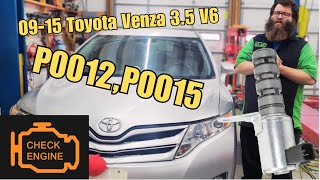
- Replacing the Camshaft Position Sensor. The sensor is doing its job by correctly reporting the bad timing. The fault usually lies with the mechanical or hydraulic parts that control the timing (OCV, phaser), not the sensor itself. 🎬 See a mechanic explain the common causes of the P0012 code. The code is triggered because the timing reported by the cam sensor does not match the timing commanded by the ECM.
Most Likely Causes
- Low or Dirty Engine Oil 🔴 High Probability The VVT system is entirely dependent on clean oil at the correct pressure to function. Sludge, low levels, or a clogged oil filter are the most common reasons for VVT-related codes. Some owners have fixed the code simply with an oil and filter change.
How to confirm: Check the oil dipstick. The oil level should be between the marks, and the oil should not be black, sludgy, or gritty. A user on a YouTube comment thread reported that a very dirty, clogged oil filter triggered the code even with a proper oil level.
Typical fix: Perform an engine oil and filter change using the manufacturer-specified oil weight (e.g., 0W-20 or 5W-30, check your owner's manual). Using a high-quality full synthetic oil can reduce occurrences.
Est. part cost: $40-$80 - Faulty Bank 1 Intake Oil Control Valve (OCV) / VVT Solenoid 🔴 High Probability → Shop Engine Variable Valve Timing (VVT) Solenoid These solenoids are a common failure item. They can get clogged with debris from the oil or fail electrically over time, preventing them from properly directing oil flow to the cam phaser.
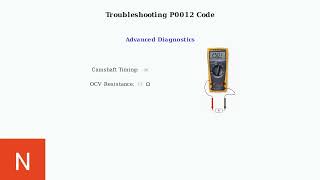
How to confirm: After checking the oil, the easiest test is to swap the Bank 1 (rear) intake OCV with the Bank 2 (front) intake OCV. Clear the codes and drive. If the code returns as P0022 (Bank 2), the OCV is confirmed bad. You can also test the solenoid's resistance with a multimeter; it should be between 6.9 and 7.9 ohms at 68°F (20°C).
Typical fix: Replace the faulty Oil Control Valve. Bank 1 is on the rear of the engine and is significantly harder to access than Bank 2.
Est. part cost: $50-$150 - Clogged OCV Filter Screen 🟡 Medium Probability Each OCV has a small, thimble-like filter screen below it to catch debris. If oil changes are neglected, this screen can become completely blocked, starving the OCV and VVT phaser of oil.
How to confirm: When removing the OCV for inspection or replacement, remove the bolt-plug for the filter (located near the OCV port) and inspect the screen for sludge or metal particles. Accessing the Bank 1 filter can be very difficult and may require removing other components like the power steering pump on some 2GR-FE models.
Typical fix: Carefully remove, clean with brake cleaner, and reinstall the filter. If it is damaged or cannot be cleaned, replace it. It is a very inexpensive part.
Est. part cost: $5-$15
Rare But Worth Checking
- Failing VVT Actuator (Cam Phaser): This is the gear on the end of the camshaft. It can become stuck internally due to wear or debris. This is a much more expensive and labor-intensive repair than an OCV. Noises from the gear upon startup can be an indicator. Early 2GR-FE engines were known for VVT gear issues, and running the engine low on oil can cause rapid damage to this part.
- Stretched Timing Chain: → Shop Engine Timing Chain While the 2GR engine's timing chain is designed to last the life of the engine, extreme mileage or poor maintenance can cause it to stretch, leading to timing correlation codes. This is usually accompanied by rattling noises on startup.
Diagnosis Steps
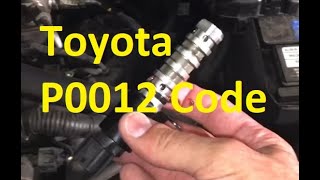
- Verify the code with an OBD-II scanner. 🎬 Watch this video for a step-by-step guide to fixing P0012. Note any other codes present and check freeze frame data.
- Check Engine Oil Level and Condition. This is the most critical first step. If the oil is low or dirty, change the oil and filter, clear the code, and drive the vehicle to see if the code returns.
- If the oil is fine, locate the intake Oil Control Valves (OCVs) for Bank 1 (rear, by firewall) and Bank 2 (front, by radiator).
- Swap the OCVs. Unplug and unbolt the Bank 1 and Bank 2 intake OCVs. This may be difficult for Bank 1. Swap their positions (put the Bank 1 OCV in the Bank 2 spot and vice-versa).
- Clear the codes and test drive the vehicle, trying to replicate the conditions from the freeze frame data.
- Re-scan for codes. If the code is now P0022 ('A' Camshaft Position Timing Over-Retarded Bank 2), the OCV that is now in the Bank 2 position is faulty and needs to be replaced.
- If the code P0012 returns, the OCV is likely not the issue. The problem may be a clogged OCV filter, a wiring issue to the solenoid, or a mechanical problem with the VVT actuator (cam phaser) or timing chain.
- Inspect and clean the small OCV filter screen for Bank 1. Be aware this may require removing other components for access.
- If the problem persists, a more in-depth mechanical diagnosis is needed, which may require professional assistance to check timing chain alignment and VVT actuator function using tools like Toyota's Techstream software.
Parts You'll Likely Need
- Engine Oil Control Valve (VVT Solenoid)
(OEM #15330-0P020 (supersedes 15330-31020) for 2007-2018 2GR-FE; 15370-0P020 for 2019-2024 2GR-FKS (Intake))— This is the most common part to fail for this code after ruling out oil issues. It controls the oil flow that adjusts cam timing.
Trusted brands: Denso (OEM supplier), Aisin, Genuine Toyota/Lexus
OEM price range: $100-$180
Aftermarket price range: $50-$100 - VVT Solenoid Filter Screen
(OEM #15678-31020 (for 2GR-FE, verify with VIN))— Can get clogged with sludge, blocking oil flow to the OCV and causing timing issues. It's cheap and wise to replace or clean when servicing the OCV.
Trusted brands: Genuine Lexus/Toyota
OEM price range: $5-$15
Aftermarket price range: $5-$10 - Engine Oil and Filter — The VVT system requires clean oil to function. This should always be the first step in addressing a P0012 code.
Trusted brands: Mobil 1, Castrol, Pennzoil
OEM price range: $60-$100 (for oil and OEM filter)
Aftermarket price range: $40-$70
Related Codes That Often Appear With This One
- P0011 — P0011 is for Bank 1 timing over-advanced. If the OCV is sticking intermittently, it could cause both over-retarded and over-advanced conditions at different times.
- P0022 — This is the same over-retarded code but for Bank 2 (front bank). Seeing both P0012 and P0022 together points towards a systemic issue like extremely low/dirty oil or low oil pressure affecting the entire engine.
Technical Service Bulletins (TSBs) & Recalls
- T-SB-0094-11: While this TSB is officially for excessive oil consumption on the 4-cylinder 2AZ-FE engine, it is often brought up in discussions about oil-related issues in Toyota engines from this era. It highlights Toyota's acknowledgment of problems (piston rings) that can lead to poor oil condition, which is a primary cause of VVT codes like P0012.
Platform-Specific Known Issues
- Difficulty Accessing Bank 1 (Rear) OCV: On the transverse 2GR-FE engine, the Bank 1 OCV and its filter are located on the rear cylinder head against the firewall. Access is very tight. While the front (Bank 2) OCV is easily accessible, the rear one may require removal of the intake manifold plenum or other components to gain enough clearance to unbolt and remove the solenoid. This significantly increases the labor time and difficulty compared to working on Bank 2.
Mechanic-Grade Diagnostic Values
- Oil Control Valve (VVT Solenoid) Resistance — expected: 6.9 to 7.9 Ohms at 68°F (20°C). Failure: A reading outside this range, or an open/short circuit (no reading or zero ohms), indicates a failed solenoid coil.
- Techstream Live Data: Intake VVT Target vs. Actual Angle (at idle) — expected: Target and Actual angles should be within a few degrees of each other. For example, on some Toyota engines, the idle value is around 25 degrees.. Failure: A persistent difference of more than 5-8 degrees between the target and actual angle indicates the camshaft is not moving as commanded, triggering the code.
Hidden / Shadow Codes Worth Checking
- Pending DTC: Before a permanent DTC like P0012 is stored and the Check Engine Light is illuminated, the ECM may store a 'pending' or 'maturing' code if the fault is detected but hasn't met the full criteria for a hard fault. This can indicate an intermittent problem. (see via Most modern OBD-II scanners, and specifically Toyota's Techstream software, can display pending codes. This allows for early diagnosis before the light comes on.)
Scan Tool Commands That Help
- Toyota Techstream: Active Test: Control the VVT System (Bank 1) — This is a critical bidirectional test to perform after checking oil. The command allows the technician to manually activate the Bank 1 intake OCV. By commanding the solenoid on and off while monitoring live data for camshaft angle, you can determine if the solenoid is responding and if the VVT phaser is capable of moving. If the angle changes with the command, the OCV and phaser are likely working; if not, it points to a failure in the OCV, wiring, or the phaser itself.
- Toyota Techstream: Data List: VVT Initial Position Learning Value — This value is a calibration based on the cam and crank position at idle. If the learned value at idle is out of specification, it can indicate a base timing issue, such as a stretched timing chain or a problem with the VVT phaser's locking pin, even before a correlation code is set.
Wiring & Ground Locations
- Engine Harness Ground (Bank 1 side) — On the 2GR-FE, a critical engine harness ground bundle attaches to a boss on the side of the rear cylinder head (Bank 1), located underneath the throttle body assembly.. Improper grounding at this point can cause erratic sensor readings and incorrect operation of solenoids controlled by the ECM. While not a common cause for P0012, it can lead to misdiagnosis if sensors and actuators appear to be failing when the issue is a poor ground connection.
- Valve Cover Grounds — The 2GR-FE engine grounds to the chassis in two primary spots on top of the valve covers. Wires run from studs on the valve covers to attachment points on the strut towers.. These are the main engine-to-chassis grounds. A loose or corroded connection here can cause a host of electrical issues, including problems with the ECM and its ability to accurately control the VVT system.
Real Owner Repair Stories
- ClubLexus forum user (2013 Lexus ES350, ~117k miles) — Check Engine Light with code P0012.
❌ Tried (didn't work) The code appeared, but then the light turned off on its own after a short stop and restart.
✅ What actually fixed it The issue was intermittent. The owner checked the oil, found it clean and full, and the light did not immediately return. The community advised that if it returned, the next step would be to inspect/replace the Bank 1 (rear) OCV, confirming the standard diagnostic path. - ClubLexus forum user (Lexus GS450h (with 2GR family engine)) — P0012 code, some power loss.
❌ Tried (didn't work) Clearing the code.
✅ What actually fixed it The owner had recently switched to a lighter 0W-20 oil and found the oil level was near the lower mark on the dipstick. Topping off the oil to the full mark and clearing the code resolved the issue permanently. This highlights the system's sensitivity to both oil level and viscosity. - YouTube video by 'speedkar99' (2007 Lexus ES350 with 213,000 km) — Difficulty starting, horrible engine noise, running on 3 cylinders.
❌ Tried (didn't work) N/A - catastrophic failure.
✅ What actually fixed it This was an extreme case where the P0012 was a symptom of a catastrophic failure. The bolts for the rear intake VVT gear (phaser) had backed out completely, causing the camshaft to lose timing and resulting in piston-to-valve collision (bent valves). The engine had to be replaced. This is a rare but documented failure mode for the 2GR-FE. - Lexus LS Owner (NHTSA ODI #11386326) — An owner reported that a P0012 VSC error resolved after clearing the memory, though the vehicle also exhibited other codes related to gasket issues.
When the Usual Fixes Don't Work
- While an oil change or OCV replacement fixes P0012 in the vast majority of cases, there are documented instances where the problem was far more severe. In one case involving a 2007 ES350, the root cause was the bolts on the VVT phaser gear backing out, leading to catastrophic engine failure requiring a full engine replacement. In other cases, a persistent startup rattle accompanying the code pointed to an internal failure of the VVT phaser gear itself, a much more involved repair. These examples show that if the simple fixes don't work, the underlying cause can be a significant mechanical issue with the timing system.
OEM Part Supersession History
15330-31020→15330-0P020— Standard part revision and update by Toyota/Lexus for the 2GR-FE engine's OCV.
Heads up: None. The new part number is a direct replacement for the old one.
Model Year Variations Within This Range
- 2019-2024 (2GR-FKS engine): The intake camshaft uses a VVT-iW (Wide) system, which is different from the standard VVT-i on the 2007-2018 2GR-FE. The VVT-iW actuator includes an electric motor in addition to the hydraulic passages. A failure of this electric motor or its control circuit can cause P0012, a failure mode not present on the earlier, purely hydraulic system.
Diagnostic Flowchart
Used vs. New Parts: Buying Guide for This Vehicle
When a used part is the smart pick: A used OEM Oil Control Valve (VVT solenoid) from a reputable salvage yard with a known low-mileage donor car can be a smart choice. It is often more reliable than a cheap, new, non-OEM part from an unknown brand.
Donor-vehicle mileage cap: roughly under 80000 miles for the part to have meaningful remaining life.
What to inspect on the donor part:
- Check for any physical damage to the solenoid body or connector.
- Ensure the small filter screens on the solenoid body are intact and free of metallic debris (some sludge is cleanable).
- If possible, ask for the VIN of the donor car to verify it wasn't from a vehicle with a sludge or major engine failure.
- Test the resistance with a multimeter before purchase; it should be between 6.9 and 7.9 ohms.
OEM-only on this vehicle (don't cheap out):
- VVT Actuator (Cam Phaser/Gear): This is a critical timing component. A used part carries a high risk of having the same wear or sludge issues as the part being replaced. Given the high labor cost to access it, using a new OEM part is strongly recommended to ensure longevity.
Aftermarket brands forum-validated for this vehicle:
- Denso (often the original OEM supplier)
- Aisin
- Hitachi
- NTK / WVE / Wells
Brands owners have reported issues with on this vehicle:
- Unbranded, 'white-box' solenoids from online marketplaces like Amazon or eBay are a gamble; many forum users report premature failures or out-of-box defects.
Real Owner Stories
Aggregated from forums and TSBs cited above. Mileages and costs reflect what owners reported in those sources.
2010 Toyota Camry 2GR-FE
Symptoms: The vehicle had codes P0012 and P0016, a rattle noise on startup, and the engine was stalling.
What fixed it: Replacing the Bank 1 oil control valve stopped the stalling, but the P0012 code persisted, indicating a deeper issue. The OCV replacement was a diagnostic dead end for clearing the code itself.
Source hint: CARspec Blog - 2010 Toyota Camry – P0012, P0016, cold start rattle
Lexus ES350
Symptoms: Check Engine Light was on with code P0012, even though the engine oil level on the dipstick was correct.
What fixed it: An oil and filter change resolved the issue. The cause was determined to be a very dirty, clogged oil filter that was restricting oil flow to the VVT system.
Source hint: YouTube comment thread
Lexus ES350
Symptoms: Check Engine Light with P0012, rough idle, and rattling noise from the engine on startup.
What fixed it: The owner swapped the Bank 1 and Bank 2 intake Oil Control Valves (OCVs). The code then changed to P0022, confirming the original Bank 1 OCV was faulty. Replacing the bad OCV fixed the problem.
Source hint: Synthesized from diagnostic steps and common causes
Related OBD-II Codes
Frequently Asked Questions
Why is my 'Check VSC' light on along with the Check Engine Light for P0012?
How difficult is it to replace the VVT solenoid (OCV) for P0012 on my ES350?
I just changed my oil, but the P0012 code came back. What is the recommended next step?
What is an OCV filter screen and could it cause P0012?
Does the oil consumption TSB (T-SB-0094-11) apply to my ES350's V6 engine?
My mechanic is swapping the VVT solenoids to diagnose P0012. What code should we look for to confirm a bad solenoid?
Helpful Videos

The information in this article is provided for general reference and educational purposes only. Vehicle specifications, procedures, and part compatibility can vary by production date, trim level, and region. Always consult your vehicle's factory service manual and verify part numbers before purchasing or performing repairs. Safety-critical components such as airbags, seat belts, and braking systems should be installed by a qualified professional.
- Lexus ES350:
- 🧭 Diagnostic Flowchart
- 🎬 Helpful Videos
- What's Unique About the 2007-2024 Lexus ES350
- Symptoms You May Notice
- Most Likely Causes
- Rare But Worth Checking
- Diagnosis Steps
- Parts You'll Likely Need
- Related Codes That Often Appear With This One
- Technical Service Bulletins (TSBs) & Recalls
- Platform-Specific Known Issues
- Mechanic-Grade Diagnostic Values
- Hidden / Shadow Codes Worth Checking
- Scan Tool Commands That Help
- Wiring & Ground Locations
- Real Owner Repair Stories
- When the Usual Fixes Don't Work
- OEM Part Supersession History
- Model Year Variations Within This Range
- Used vs. New Parts: Buying Guide for This Vehicle
- Real Owner Stories
- 2010 Toyota Camry 2GR-FE
- Lexus ES350
- Lexus ES350
- Related OBD-II Codes
- Frequently Asked Questions
- 🎟️ Get 5% Off