

P0013 on 2007-2017 Ford Expedition 5.4L: Exhaust VCT Solenoid Circuit Fixes
P0013 on a 5.4L Triton V8 usually points to a bad exhaust VCT solenoid on the passenger side (Bank 1). Before replacing it, check your engine oil and look for a blown fuse, especially if other circuit codes are present. A new Motorcraft solenoid costs ~$50-80, but requires removing the valve cover to replace.
- P0013 points to an electrical fault in the passenger-side exhaust VCT solenoid or its circuit.
- Before buying parts, check your engine oil level and condition, as this is critical for the 5.4L Triton's VCT system.
- If you have other circuit codes (P0010, P0020, P0023, etc.), check your fuses first. A single blown fuse is a common cause.
- The most likely part to fail is the VCT solenoid itself. OEM part number is 8L3Z-6M280-B.
- Replacing the solenoid is a moderately difficult DIY job because it is located under the valve cover.
What's Unique About the 2007-2017 Ford Expedition
The 5.4L 3V Triton V8 engine is well-known for having a sensitive Variable Camshaft Timing (VCT) system that is highly dependent on oil pressure and cleanliness. Unlike many engines where VCT solenoids are easily accessible, on the 2007+ 5.4L 3V they are located underneath the valve covers, making replacement a more involved job requiring a few hours of labor. These engines are prone to issues from dirty oil or low oil pressure, which can clog the small passages and screens in the VCT solenoids, causing them to fail and trigger circuit codes like P0013.
Symptoms You May Notice
- Check Engine Light is on
- Rough or unstable idle, especially when the engine is warm
- Engine hesitation or loss of power during acceleration
- Reduced fuel mileage
- Engine may stall at idle
- Rattling or ticking noise from the engine bay
- Replacing the camshaft position sensor. P0013 is a circuit code for the VCT solenoid (actuator), not the sensor that reads the camshaft's position.
- Replacing the cam phaser. While cam phaser failure is common on the 5.4L 3V engine, it typically produces rattling noises and mechanical timing performance codes (like P0012/P0022), not a primary electrical circuit code like P0013.
Most Likely Causes
- Faulty Bank 1 Exhaust VCT Solenoid 🔴 High Probability The solenoids contain fine mesh screens that can become clogged by oil sludge, and the electronic coil can fail over time, causing an open or short circuit. Ford has updated the part multiple times to improve durability.
How to confirm: After confirming wiring is intact, the easiest way to confirm a bad solenoid is to swap it with the exhaust solenoid from Bank 2 (driver's side). If the code changes to P0023, the solenoid is faulty. You can also test the solenoid's resistance with a multimeter; a typical reading is between 5-15 ohms, with a more precise spec being 6.9-7.9 Ohms at 68°F (20°C). An open circuit (infinite resistance) confirms failure.
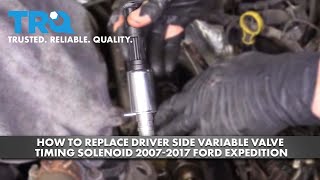
Typical fix: Replace the VCT solenoid and the valve cover seal. 🎬 Watch: Step-by-step guide to replacing the passenger side solenoid. It is often recommended to replace both solenoids (intake and exhaust) on the same bank at the same time, and many owners do all four. Always use the latest revised OEM part.
Est. part cost: $50-$100 - Blown Fuse 🟡 Medium Probability On many Ford trucks, the VCT solenoids share a power circuit with other components like O2 sensor heaters. A short in any of these components can blow the shared fuse, causing multiple 'circuit open' codes at once.
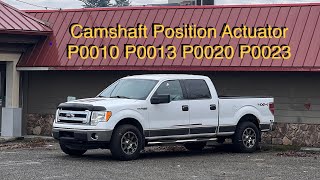
How to confirm: Check the fuse box in the engine compartment. On the nearly identical F-150 platform, fuse #76 (20A) is the common culprit for powering the VCT solenoids and O2 heaters. Check your owner's manual for the specific fuse number, but if you have multiple circuit codes (P0010, P0013, P0020, P0023, P0135, P0155), a blown fuse is almost certain. 🎬 See how a simple fuse can fix multiple actuator codes.
Typical fix: Find the source of the short (often a wire rubbing on the engine block or A/C lines) and replace the blown fuse.
Est. part cost: $1-$5 - Dirty, Low, or Incorrect Viscosity Engine Oil 🟡 Medium Probability The 5.4L 3V VCT system is highly dependent on clean oil and correct pressure. Using oil other than the recommended 5W-20 or extending oil change intervals can lead to sludge that clogs the solenoid screens and passages.
How to confirm: Check the oil level and condition on the dipstick. If the oil is dark, gritty, or low, this could be the root cause. An oil change is the cheapest first step.
Typical fix: Perform an engine oil and filter change using the correct OEM-specified 5W-20 oil and a quality filter like Motorcraft.
Est. part cost: $40-$80 - Damaged Wiring or Connector ⚪ Low Probability
How to confirm: Visually inspect the wiring harness leading to the Bank 1 exhaust VCT solenoid. Check for breaks, melting, or corrosion on the connector pins. A known chafing point is where the harness may rub against the front corner of the cylinder head or nearby A/C lines. Use a multimeter to test for continuity and shorts in the circuit from the PCM to the solenoid connector.
Typical fix: Repair the damaged section of the wiring harness or replace the connector pigtail (Ford part WPT-1251).
Est. part cost: $15-$40
Rare But Worth Checking
- Failing Powertrain Control Module (PCM): This is very rare. The PCM's internal driver for the VCT circuit can fail. This should only be considered after all other possibilities (solenoid, wiring, fuses, oil) have been definitively ruled out.
Diagnosis Steps
- Check the engine oil level and condition. If low or dirty, correct this first, clear the code, and see if it returns. This is the cheapest and easiest first step.
- Scan for any other trouble codes. The presence of codes like P0010, P0020, P0023, or O2 sensor heater codes (P0135, P0155, etc.) points towards a likely fuse issue.
- Inspect the fuses in the engine compartment fuse box. Specifically check the fuse for the VCT and O2 heater circuits (often fuse #76 on related platforms). Verify it is not blown.
- If only P0013 is present, locate the Bank 1 (passenger side) exhaust VCT solenoid. Inspect its electrical connector and nearby wiring for any signs of damage, melting, or corrosion. Pay attention to areas where the harness might rub against the engine.
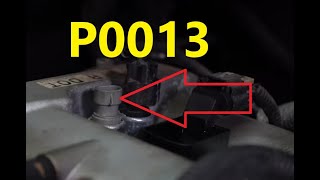
- If the wiring looks good, you can test the solenoid. Unplug it and measure the resistance between the two pins. It should be between 6-12 Ohms. If it's open (infinite resistance) or shorted (zero resistance), the solenoid is bad. 🎬 Watch this breakdown of P0013 causes and diagnostic fixes.
- A definitive but more labor-intensive test is to swap the Bank 1 exhaust solenoid with the Bank 2 (driver's side) exhaust solenoid. This requires removing both valve covers.
- Clear the codes and drive the vehicle. If the code returns as P0023 ('B' Camshaft Position - Actuator Circuit Open Bank 2), the solenoid you moved is faulty and needs to be replaced.
- If the code remains P0013 after the swap, the problem is in the wiring to the Bank 1 solenoid or, rarely, the PCM itself.
Parts You'll Likely Need
- Variable Camshaft Timing (VCT) Solenoid
(OEM #8L3Z-6M280-B)— This is the component that fails most frequently, either electrically or by getting clogged with oil debris. This is the updated part number from Ford, superseding earlier versions.
Trusted brands: Motorcraft, Standard Motor Products, Dorman
OEM price range: $50-$80
Aftermarket price range: $30-$60 - VCT Solenoid Seal / Valve Cover Gasket
(OEM #3L3Z-6C535-AA)— The VCT solenoid seal is almost always brittle and breaks during removal. Since the valve cover must be removed to access the solenoid on 2007+ models, replacing the valve cover gasket at the same time is required to prevent oil leaks.
Trusted brands: Motorcraft, Fel-Pro, Mahle
OEM price range: $40-$70
Aftermarket price range: $20-$40 - VCT Solenoid Connector Pigtail
(OEM #WPT-1251)— The original plastic connector can become brittle from heat cycles and break during removal, or the wiring can be damaged from chafing. This pigtail is used to splice in a new connector.
Trusted brands: Motorcraft, Standard Motor Products (S2496), Dorman
OEM price range: $20-$35
Aftermarket price range: $15-$25
Related Codes That Often Appear With This One
- P0010 — Intake VCT solenoid circuit fault on the same bank (Bank 1). Often appears with P0013 if there is a shared wiring or fuse issue.
- P0020 / P0023 — VCT solenoid circuit faults on Bank 2 (driver's side). If all four VCT circuit codes (P0010, P0013, P0020, P0023) appear at once, it strongly suggests a single blown fuse that powers all solenoids.
- P0135 / P0155 — O2 sensor heater circuit faults for Bank 1 and Bank 2. These components often share a power supply fuse with the VCT system. Seeing these codes together with VCT circuit codes is a very strong indicator of a blown fuse or a wiring short to ground, not individual component failures.
Technical Service Bulletins (TSBs) & Recalls
- TSB 14-0114: This bulletin supersedes TSB 12-7-10 and applies to 2007-2013 Expeditions. It addresses intermittent rattle, rough idle, and DTCs including P0021, P0022, P0340, and P0341 by recommending the replacement of both VCT solenoids. While not for P0013 specifically, it highlights the known failure of these components as a root cause for VCT system issues.
Platform-Specific Known Issues
- On a 2008 Expedition with P0013, an owner on expeditionforum.com confirmed that after checking fuses and wiring, the ultimate fix was replacing the Bank 1 VCT solenoids. The user noted the job was tedious due to the valve cover removal but solved the rough idle and check engine light.
Mechanic-Grade Diagnostic Values
- VCT Solenoid Coil Resistance — expected: 5-15 Ohms (general); 6.9 - 7.9 Ohms @ 68°F (20°C) (precise spec).. Failure: 0 Ohms (short), infinite/OL (open), or significantly outside the range.
- VCT Solenoid Connector Voltage (Key On, Engine Off) — expected: Battery voltage (~12V) on the power supply wire.. Failure: No voltage indicates a problem with the power supply circuit (fuse, wiring).
- Engine Oil Pressure at Hot Idle — expected: Minimum 15 PSI, but ideally >25 PSI.. Failure: Pressure below 15-20 PSI can starve the VCT system and cause various timing codes.
- Scan Tool PID: VCT Advance Error (VCT_ERROR1) — expected: Should hover around 0° (+/- 5°) at idle and in closed loop.. Failure: Large, persistent error values indicate the PCM's commanded cam angle is not being met, pointing to a mechanical or hydraulic issue rather than just an electrical circuit fault.
Scan Tool Commands That Help
- Ford IDS (Integrated Diagnostic System) or equivalent high-end scanner: VCT Solenoid Output State Control — This is a bidirectional test that allows the technician to command the VCT solenoid on and off while the engine is running at idle. Activating the solenoid should cause a noticeable change in idle quality or stall the engine. If there is no change, it confirms a problem with the solenoid, its circuit, or oil flow.
- Ford IDS (Integrated Diagnostic System): Datalogging VCT PIDs (VCT_ADV_ERR, VCT_DUTY) — When diagnosing intermittent issues, logging the VCT advance error and duty cycle PIDs during a test drive can reveal if the PCM is commanding excessive duty cycle to compensate for a sticking solenoid or low oil pressure, which can precede a full circuit code.
Wiring & Ground Locations
- Engine-to-Firewall Ground Strap — Typically a braided strap running from the back of the passenger side cylinder head/engine block to a stud on the firewall.. A corroded or loose main engine ground can cause floating voltages and erratic behavior in multiple sensor and actuator circuits, including the VCT solenoids, leading to false circuit codes.
- G103 / G104 — On the related F-150 platform, these primary engine grounds are located on the frame near the front of the engine, often near the oil pan or bellhousing area.. These are critical ground points for the PCM and engine harness. Corrosion or damage here can cause a wide range of difficult-to-diagnose electrical issues, including circuit codes for components that are actually functional.
- VCT Solenoid Connector — Under the valve cover, connected to the top of the VCT solenoid. The harness passes through a seal in the valve cover.. The connector itself can become brittle, and the wires can chafe where they pass through the valve cover or rub against other components, causing the open or short that triggers P0013.
OEM Part Supersession History
3L3Z-6M280-EA→8L3Z-6M280-A, then 8L3Z-6M280-B— The original solenoids were prone to clogging and electrical failure. The design was updated multiple times to improve oil flow, screen durability, and coil longevity.
Heads up: Using older stock (pre-'B' revision) or non-OEM parts is a very common cause of repeat failures. The latest OEM part (8L3Z-6M280-B) is strongly recommended for this repair.
Model Year Variations Within This Range
- 2007-2014: The user prompt specifies 2007-2017, but the 5.4L 3V Triton V8 was only available in the Ford Expedition up to the 2014 model year. The 2015-2017 models use the 3.5L EcoBoost V6 and have a completely different VCT system.
- 2007 vs. 2008+: Some sources suggest a minor change in VCT solenoid design around 2007/2008 with a different connector housing, though the updated 8L3Z-6M280-B part is backward compatible and fits all 2007-2014 5.4L 3V engines.
Diagnostic Flowchart
Other Known Issues on This Vehicle
Issues unrelated to this code that are worth knowing about as an owner of this generation:
- Cam Phaser Failure ('Triton Rattle') 🔴 High — Very common, especially on higher mileage (75k+ miles) engines or those with infrequent oil changes. Causes a diesel-like clatter at idle. (Ref: TSB 14-0114)
- Two-Piece Spark Plug Breakage 🔴 High — Primarily affects engines built before late 2007. The original spark plugs have a two-piece design that tends to separate during removal, leaving the lower portion seized in the cylinder head. (Ref: TSB 08-7-6)
- Timing Chain Tensioner and Guide Failure 🔴 High → Shop Engine Timing Chain — Common over 100,000 miles. The plastic timing chain guides break, and the tensioner seals can blow out, leading to low oil pressure, chain slap, and eventually catastrophic engine failure if ignored.
- Fuel Pump Driver Module (FPDM) Failure 🟠 Medium — Common across many Ford trucks. The module is mounted to the frame crossmember and its aluminum body corrodes due to contact with the steel frame, leading to no-start or stalling conditions.
- Cracked Exhaust Manifold 🟠 Medium — Fairly common, causing a ticking noise that is loudest on a cold start and may quiet down as the engine warms up and the metal expands.
- Ignition Coil Failure 🟡 Low — The coil-on-plug boots can deteriorate, allowing moisture in and causing the spark to arc to the cylinder head, resulting in misfires under load.
Used vs. New Parts: Buying Guide for This Vehicle
When a used part is the smart pick: For this specific repair, using a used part is almost never a smart choice. The VCT solenoid is a high-failure item that is sensitive to oil contamination and wear. The labor required to remove the valve cover makes it impractical to risk installing a used solenoid of unknown history.
What to inspect on the donor part:
- Not applicable. Do not use a used VCT solenoid for this repair.
OEM-only on this vehicle (don't cheap out):
- Variable Camshaft Timing (VCT) Solenoid - Due to high failure rates of aftermarket units and the labor involved, using a genuine Motorcraft solenoid (part 8L3Z-6M280-B) is strongly recommended by master techs and forum veterans.
Aftermarket brands forum-validated for this vehicle:
- While OEM is heavily preferred, Standard Motor Products (SMP) is generally considered a reputable Tier 1 supplier if an aftermarket option must be used.
Brands owners have reported issues with on this vehicle:
- Unbranded, 'white box' parts from online marketplaces are frequently cited as failing quickly, sometimes within days or weeks of installation, forcing the owner to repeat the labor-intensive repair.
Real Owner Stories
Aggregated from forums and TSBs cited above. Mileages and costs reflect what owners reported in those sources.
2008 Ford Expedition 5.4L 3V
Symptoms: The owner experienced a rough idle and the Check Engine Light was illuminated.
What fixed it: After checking the fuses and wiring, the owner replaced the Bank 1 VCT solenoids. The owner noted the job was tedious due to valve cover removal but it resolved the issues.
Source hint: expeditionforum.com mentioned in vehicle_specific_issues
2004-2010 Ford F-150 5.4L 3V
Symptoms: P0013 appeared simultaneously with other circuit-related codes.
What fixed it: The issue was identified as a blown fuse in the engine compartment fuse box.
Source hint: f150forum.com threads cited in forum_citations
2004-2010 Ford F-150 5.4L 3V
Symptoms: Circuit open codes for the VCT system.
What fixed it: Replaced fuse #76 (20A) in the engine compartment, which powers the VCT solenoids and O2 heaters.
Source hint: youtube.com video for F-150 with similar engine architecture
Related OBD-II Codes
Frequently Asked Questions
Does TSB 14-0114 apply to my 2007-2013 Ford Expedition?
I have P0013 along with P0135 and P0155; could this be a simple fuse on my Expedition?
What is the specific resistance spec for the VCT solenoid on the 5.4L 3V engine?
Can I just swap the solenoids to test if the Bank 1 Exhaust VCT solenoid is bad?
Is there a specific oil I should be using to prevent VCT issues like P0013?
What is the Ford part number for a damaged VCT solenoid connector?
Helpful Videos

We Have This Part in Stock

The information in this article is provided for general reference and educational purposes only. Vehicle specifications, procedures, and part compatibility can vary by production date, trim level, and region. Always consult your vehicle's factory service manual and verify part numbers before purchasing or performing repairs. Safety-critical components such as airbags, seat belts, and braking systems should be installed by a qualified professional.
- Ford Expedition:
- 🧭 Diagnostic Flowchart
- 🎬 Helpful Videos
- 🛍️ Shop This Part
- What's Unique About the 2007-2017 Ford Expedition
- Symptoms You May Notice
- Most Likely Causes
- Rare But Worth Checking
- Diagnosis Steps
- Parts You'll Likely Need
- Related Codes That Often Appear With This One
- Technical Service Bulletins (TSBs) & Recalls
- Platform-Specific Known Issues
- Mechanic-Grade Diagnostic Values
- Scan Tool Commands That Help
- Wiring & Ground Locations
- OEM Part Supersession History
- Model Year Variations Within This Range
- Other Known Issues on This Vehicle
- Used vs. New Parts: Buying Guide for This Vehicle
- Real Owner Stories
- 2008 Ford Expedition 5.4L 3V
- 2004-2010 Ford F-150 5.4L 3V
- 2004-2010 Ford F-150 5.4L 3V
- Related OBD-II Codes
- Frequently Asked Questions
- 🎟️ Get 5% Off