

P0021 on 2003-2009 Audi S4 4.2L V8: Cam Timing Causes and Fixes
On the B6/B7 S4, P0021 is a serious warning. While you should check the oil and the Bank 2 camshaft adjuster solenoid first, this code is very frequently a symptom of failing timing chain guides or a worn mechanical cam adjuster—a major, engine-out repair costing thousands.
- P0021 on a B6/B7 S4 is not a code to ignore; it is a strong indicator of potentially severe and expensive mechanical engine issues.
- Always check the engine oil level and condition first, as it's the easiest and cheapest step.
- The 'startup rattle' from the rear of the engine is the key symptom of timing chain guide failure. If you hear this, a major repair is imminent.
- Due to the engine-out nature of the repair, if you are fixing the timing guides or adjusters, it is critical to replace all related wear items at the same time to avoid another massive labor bill in the future.
- Do not be surprised if replacing the easily accessible camshaft adjuster solenoid does not fix the code; the problem is often deeper within the mechanical timing system.
What's Unique About the 2003-2009 Audi S4
The BBK 4.2L V8 in the B6 and B7 generation S4 is legendary for its timing system challenges. Unlike most engines, the timing chains are located at the rear of the engine against the firewall. This design means almost any significant timing service, including replacing the guides or adjusters that commonly cause P0021, requires the entire engine to be removed from the car. This turns a component failure into one of the most expensive and labor-intensive repairs for this platform. The plastic timing chain guides are known to become brittle and fail, and the mechanical cam adjusters are a known weak point, making this code a particularly ominous sign for S4 owners.
Generation note: This guide covers both the B6 (2003-2005) and B7 (2005.5-2009) generations of the Audi S4. Both generations use the same BBK 4.2L V8 engine and share the identical, notoriously failure-prone timing chain system design. There is a minor VIN-specific change to some timing components during the 2004 model year, but the fundamental failure points are the same.
Symptoms You May Notice
- Check Engine Light (CEL) illuminated
- Rough or unstable idle
- Noticeable loss of engine power
- Engine stalling or hesitating
- A distinct metallic rattling noise from the rear of the engine, especially during cold starts, lasting 1-3 seconds (classic sign of guide/tensioner failure).
- Increased fuel consumption
- Engine misfires, particularly on Bank 2 (cylinders 5-8).
- Replacing only the camshaft adjuster solenoid when the fault is the mechanical adjuster unit itself.
- Replacing the camshaft position sensor without diagnosing the underlying mechanical timing issue.
- Assuming the code is a minor issue without recognizing it as a primary symptom of the infamous 'timing chain guide' problem requiring engine removal.
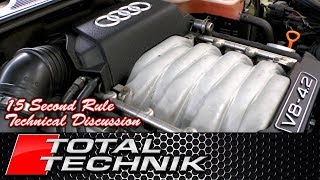
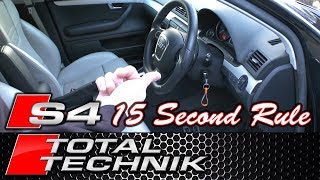
- Mistaking the startup rattle for a normal characteristic, when a rattle lasting more than a second 🎬 Watch: Learn the 15-second rule for diagnosing startup rattle. is a clear sign of tensioner or guide failure.
Most Likely Causes
- Worn or Failed Mechanical Cam Adjuster 🔴 High Probability The internal locking pin mechanism on the stock adjuster is a known design weakness. The hole for the pin wears into an oval shape, allowing the camshaft to be in an advanced position at idle when it should be locked. This is a primary cause of P0021 when no startup rattle is present.
How to confirm: After ruling out oil and solenoid issues, this is the next logical suspect. Confirmation requires engine removal and physical inspection of the adjuster unit. A VCDS scan showing a large deviation between requested and actual cam phase at idle on Bank 2 is a strong indicator. This often requires a full timing job to access and replace.
Typical fix: Replace the mechanical cam adjuster unit on Bank 2. Due to the labor involved, it is highly recommended to replace both Bank 1 and Bank 2 adjusters, along with the full timing chain service (all guides, chains, and tensioners).
Est. part cost: $400-$800 per adjuster - Broken or Worn Plastic Timing Chain Guides 🔴 High Probability → Shop Engine Timing Chain The original plastic timing chain guides become brittle over time from heat cycles and age, causing them to crack and break apart. This is a very well-documented failure on the BBK engine. Pieces can fall into the oil pan, potentially clogging the oil pickup tube.
How to confirm: The definitive symptom is a loud rattling or 'clatter' from the back of the engine on cold starts that lasts for a few seconds until oil pressure builds. Finding pieces of black or brown plastic in the engine oil during an oil change is a sure sign. Final confirmation requires engine removal and visual inspection.
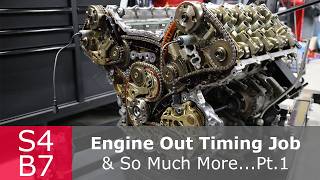
Typical fix: A full timing chain service is required. This involves replacing all timing chains, tensioners, and especially all the plastic guides with updated parts. Some kits offer upgraded metal guides from the RS4 for key components. This is an engine-out procedure. 🎬 See this walkthrough of a major V8 timing chain service.
Est. part cost: $1200-$2800 for a complete OEM or high-quality aftermarket kit. - Low, Incorrect, or Dirty Engine Oil 🟡 Medium Probability The entire variable valve timing (VVT) system is dependent on oil pressure and cleanliness. Sludge, low levels, or incorrect viscosity oil will starve the cam adjusters and solenoids, preventing them from operating correctly. Using oil that does not meet Audi's VW 502 00 specification can accelerate wear.
How to confirm: Check the oil level via the dipstick and inspect its condition. If it's low, black, or past its service interval, this is the first and easiest step.
Typical fix: Perform a complete oil and filter change using a high-quality full synthetic oil that meets Audi's VW 502 00 specification. Clear the code and see if it returns.
Est. part cost: $90-$160 - Failed Camshaft Adjuster Solenoid (VVT Solenoid) ⚪ Low Probability → Shop Engine Camshaft While less common than mechanical failures on this platform, the solenoid can fail electronically or become clogged with debris.
How to confirm: Swap the Bank 2 (driver's side) intake solenoid with the Bank 1 (passenger's side) intake solenoid. They are located on the front of the valve covers. Clear the codes and drive. If the code changes to P0011 (the Bank 1 equivalent), the solenoid is faulty. You can also test its resistance with a multimeter; it should be between 10 and 18 ohms. Some service literature specifies a tighter range of 6.9-7.9 ohms.
Typical fix: Replace the faulty solenoid. This is a relatively simple DIY job.
Est. part cost: $100-$250
Rare But Worth Checking
- Stretched Timing Chain: → Shop Engine Timing Chain While the guides and adjusters usually fail first, high-mileage engines can experience chain stretch, which will also cause timing deviations and can be checked via VCDS measuring blocks.
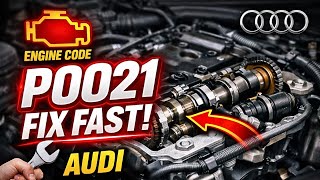
- Failed Camshaft Position Sensor (G163): → Shop Engine Camshaft Position Sensor It is possible for the sensor itself to fail and send incorrect data, but this is far less common than the mechanical issues. This would be one of the last things to check after swapping solenoids yields no result. 🎬 Watch: A helpful breakdown of P0021 causes and DIY fixes.
- Clogged Oil Passages or Check Valves: Engine sludge or debris from failing guides can clog the small oil passages that feed the VVT system, leading to pressure issues and timing faults. There are two oil check valves located under the intake manifold that can fail or clog.
Diagnosis Steps
- Verify Oil Level and Condition: Ensure the engine oil is full, clean, and of the correct VW 502 00 specification. If in doubt, change the oil and filter.
- Scan for All Codes: Use an OBD-II scanner (VCDS/VAG-COM is highly recommended) to read all stored trouble codes. Note any misfire or other timing-related codes.
- Analyze Live Data (VCDS): Use a capable scan tool to monitor Measuring Value Blocks (MVB) 091, 092, and 093. Block 093 shows the cam phase angle for Bank 1 and Bank 2. At idle, a healthy engine should be close to 0°. Values exceeding -4° are a yellow flag, and values exceeding -8° are a strong indicator of chain stretch or guide/tensioner issues.
- Listen for Noise: Start the engine from cold and listen carefully for a 1-3 second metallic rattle from the rear of the engine bay, near the firewall. This is a strong indicator of guide/tensioner failure.
- Swap Camshaft Adjuster Solenoids: Swap the Bank 2 intake solenoid with the Bank 1 intake solenoid. If the code moves to P0011, the solenoid is bad.
- Inspect Solenoid and Sensor Wiring: Check the connectors and wiring for the Bank 2 camshaft position sensor and adjuster solenoid for any damage or oil contamination.
- Prepare for Major Service: If the above steps do not resolve the issue, the cause is almost certainly internal and mechanical (guides, tensioners, or adjusters). This requires engine removal for a full timing system inspection and service.
Parts You'll Likely Need
- Timing Chain Service Kit — This is the comprehensive fix for the most common cause: failed guides and tensioners. A full kit should include all chains, guides, tensioners, and necessary gaskets for an engine-out service.
Trusted brands: Iwis (Chains), JHMotorsports (Full Kits, Upgraded Adjusters), FCP Euro (Kits), AMTuned (Kits, Upgraded components)
OEM price range: $1800-$2800
Aftermarket price range: $1200-$2000 - Mechanical Camshaft Adjuster
(OEM #079109088M)— The second primary failure point. The internal mechanism wears out, causing incorrect timing at idle. Often replaced during a full timing service as a preventative measure.
Trusted brands: OEM, JHMotorsports (Upgraded Repair Kit)
OEM price range: $750+
Aftermarket price range: $400-$600 (for repair kits/rebuilt units) - Camshaft Adjuster Solenoid — Replaced if it fails diagnostic tests (swap test or resistance test). A much less common failure point than the mechanical components.
Trusted brands: Bosch, OEM
OEM price range: $200-$250
Aftermarket price range: $100-$180 - Camshaft Position Sensor — Replaced if it's determined to be faulty, though it's a rare cause for this code on its own. Often misdiagnosed.
Trusted brands: Bosch, OEM
OEM price range: $150-$185
Aftermarket price range: $30-$90
Related Codes That Often Appear With This One
- P0011 — If both banks are having issues, or if you swap a faulty component from Bank 2 to Bank 1 for diagnosis, you will see the equivalent code for Bank 1.
- P1347 — This code indicates an incorrect correlation between the Bank 2 camshaft position sensor and the engine speed sensor, often triggered by the same mechanical timing faults that cause P0021.
- P0300, P0305, P0306, P0307, P0308 — Random or specific misfire codes for Bank 2 (cylinders 5, 6, 7, 8) can occur because the incorrect cam timing is disrupting the combustion process in that cylinder bank.
Platform-Specific Known Issues
- The timing chain system is located at the rear of the engine, meaning the engine and transmission must be removed to service the chains, guides, or adjusters. This is the primary driver of the extremely high repair cost.
- The original equipment plastic timing chain guides are known to degrade and fail, causing chain slack, noise, and timing errors. This is considered the single biggest design flaw of the BBK engine.
Mechanic-Grade Diagnostic Values
- VCDS Measuring Value Block 093 (Cam Phase Angle) — expected: At idle, a healthy engine should show values between 0° and -4° for both Bank 1 and Bank 2.. Failure: Values consistently greater than -8° (e.g., -9°, -10°) on Bank 2 strongly indicate significant chain stretch, guide failure, or a faulty mechanical adjuster, necessitating an engine-out service.
- Camshaft Adjuster Solenoid Resistance — expected: 10 to 18 Ohms is the general specification. Some sources provide a more specific range of 6.9 to 7.9 Ohms.. Failure: A reading outside the specified range, or an open/short circuit, indicates a faulty solenoid.
- Camshaft Position Sensor (Hall Sender) Voltage Check — expected: When testing the harness connector with the ignition on, there should be battery voltage between the power and ground pins.. Failure: If voltage is present at the connector and a sensor-related code (like P0345) is active, the sensor itself is likely faulty. If no voltage is present, the issue is in the wiring or a fuse.
Scan Tool Commands That Help
- VCDS (VAG-COM): Output Diagnostic Test Mode (DTM) — This function can be used to directly activate the solenoid valve for the camshaft adjuster. The user should hear an audible 'click' from the solenoid. If no click is heard, it suggests a problem with the solenoid itself or its wiring/power supply.
- VCDS (VAG-COM): Read Measuring Value Block (MVB) 091, 092, 093 — This is the primary diagnostic step for checking the health of the timing system. It compares the specified vs. actual camshaft position. Large deviations in Block 093 are the key indicator of mechanical timing problems like guide failure or adjuster wear.
Wiring & Ground Locations
- Bank 2 Camshaft Position Sensor (G163) — Located on the rear of the driver's side (Bank 2) cylinder head/valve cover, held by a single T30 Torx bolt.. This sensor provides the primary signal for camshaft position on Bank 2. A faulty sensor or bad connection can theoretically cause timing codes, although it's less common than mechanical failure.
- Bank 2 Camshaft Adjuster Solenoid — Located on the front of the driver's side (Bank 2) valve cover.. This solenoid controls the oil flow to the mechanical adjuster. Its wiring is critical for the VVT system to function as commanded by the ECU.
- Engine Ground Strap — A main engine ground cable connects from the passenger side frame rail to the engine mount bracket, visible from underneath the engine.. A poor main engine ground can cause a multitude of electrical issues and erratic sensor readings, potentially contributing to false codes. It's a foundational check for any electrical diagnosis.
- Ground Connection Point 12 — In the engine compartment on the left side.. This is a key grounding point for various engine components and sensors. Corrosion or looseness here can cause electrical gremlins.
Real Owner Repair Stories
- AudiWorld Forums user 'dimoman' (Audi S4 4.2 V8 (Year not specified, but B6/B7 platform)) — P0021 code was present, but with no noticeable difference in engine sound, performance, or fuel consumption.
❌ Tried (didn't work) Visual inspection of sensor connections., Swapping the camshaft adjuster solenoids from Bank 1 to Bank 2 (the code returned for Bank 2).
✅ What actually fixed it The final fix was replacing the mechanical cam adjuster on Bank 2. The code disappeared after this repair. - NHTSA ODI #10262201 — An owner reported that their vehicle displayed P0021 (cam timing adjust Bank 2 not reached) along with misfire codes for cylinders 4, 5, 6, and 7.
OEM Part Supersession History
079109088 (various early revisions like F, L)→079109088M— Revisions to the mechanical camshaft adjuster to improve durability and address the locking pin wear issue.079109469AC (Main Upper Guide)→059109469E (Early B7 RS4 alternative/upgrade)— The original plastic guide for early BBK engines is known to be a major failure point. The RS4 part is a more durable metal-backed design. The original part is now obsolete.
Heads up: This upgrade is specifically for early BBK engines (VIN up to 8E-4-200 000). Later engines use a different guide system.
Model Year Variations Within This Range
- 2003 - early 2004 (up to VIN 8E-4-200 000): Early BBK engines have a different design for lubricating some timing chain components. It is critical to order timing kits based on the vehicle's VIN to ensure the correct guides and parts are used.
- Late 2004 - 2009 (from VIN 8E-4-200 001 onwards): Uses a revised set of timing components, particularly related to oiling. For example, the main upper guide rail part number is different from the early models.
Diagnostic Flowchart
Other Known Issues on This Vehicle
Issues unrelated to this code that are worth knowing about as an owner of this generation:
- Carbon Buildup on Intake Valves 🟠 Medium — Common on all BBK engines, typically requires cleaning every 50k-70k miles. Causes rough idle and power loss.
- Oil Cooler Pipe/Seal Leak 🟠 Medium — The O-rings for the oil cooler, located deep in the 'V' of the engine, are known to fail, causing significant oil leaks. Replacement is labor-intensive.
- Auxiliary Radiator Leaks 🟡 Low — The two small radiators located in the front bumper corners are prone to leaking from corrosion or road debris impact.
- High Oil Consumption 🟠 Medium — Many BBK engines consume oil due to piston ring and valve seal design. Frequent oil top-offs are common.
- Valve Cover Gasket Leaks 🟡 Low → Shop Engine Valve Cover — Gaskets become hard and brittle, leading to oil leaking onto the exhaust manifolds, causing a burning smell. A common issue on higher-mileage cars.
Used vs. New Parts: Buying Guide for This Vehicle
When a used part is the smart pick: For this specific repair, using used parts is almost never a smart choice. The primary failure components (timing guides, tensioners, adjusters) are all wear items. A used part from a donor vehicle will have unknown wear and could fail shortly after the costly engine-out installation.
What to inspect on the donor part:
- Not applicable. Do not use used timing components for this repair.
OEM-only on this vehicle (don't cheap out):
- Timing Chain Tensioners
- Timing Chains
- Mechanical Camshaft Adjusters (or a reputable remanufactured/upgraded unit)
Aftermarket brands forum-validated for this vehicle:
- JHMotorsports (Considered an upgrade over OEM for adjusters and full kits)
- AMTuned (Kits with upgraded components)
- Iwis (Often the OEM supplier for chains)
- Febi (For some components like tensioners)
Brands owners have reported issues with on this vehicle:
- Unnamed, no-brand kits from eBay or Amazon. The quality of the plastic guides and tensioner hydraulics is critical, and failure of a cheap part will lead to catastrophic engine damage, making the initial savings insignificant.
Real Owner Stories
Aggregated from forums and TSBs cited above. Mileages and costs reflect what owners reported in those sources.
2005 Audi S4 4.2L V8
Symptoms: Intermittent P0021 code. The owner noted the car felt like it had a slight loss of power but no obvious rattle on startup.
What fixed it: Physical inspection of the mechanical cam adjuster unit after engine removal. The internal locking pin mechanism had worn the hole into an oval shape, preventing it from locking at idle.
Source hint: Audi Revolution - Intermittent P0021 - Timing issue?
2004 Audi S4 4.2L V8
Symptoms: Loud clatter from the back of the engine on cold starts that lasted for a few seconds until oil pressure built up. Finding pieces of black or brown plastic in the engine oil during a change.
What fixed it: Full timing chain service including replacement of all plastic timing chain guides, chains, and tensioners. Some guides were found to be cracked and brittle.
Source hint: A Non-Definitive Guide to Audi B6 / B7 S4 Timing Chains
NHTSA ODI #10262201
Symptoms: An owner reported the vehicle displayed P0021 (cam timing adjust Bank 2 not reached) along with misfire codes for cylinders 4, 5, 6, and 7.
What fixed it: The mechanic cleared the codes for further testing, but the fault returned during a test drive, indicating a persistent timing issue.
Related OBD-II Codes
Frequently Asked Questions
I have a metallic rattling noise for about 2 seconds when I start my S4 cold. Is this related to P0021?
Can I fix P0021 on my BBK engine by just replacing the VVT solenoid?
Why is the repair for P0021 so expensive on the 2003-2009 Audi S4?
What VCDS values should I look for to diagnose a failing cam adjuster on Bank 2?
Does the type of oil I use affect the P0021 code on my S4?
Is it true that the internal locking pin in the cam adjuster is a common failure point?
Helpful Videos
![How to Fix AUDI P0021 Engine Code in 4 Minutes [1 DIY Method / Only $19.45]](https://img.youtube.com/vi/5TWXXaQhUKs/mqdefault.jpg)
We Have This Part in Stock

The information in this article is provided for general reference and educational purposes only. Vehicle specifications, procedures, and part compatibility can vary by production date, trim level, and region. Always consult your vehicle's factory service manual and verify part numbers before purchasing or performing repairs. Safety-critical components such as airbags, seat belts, and braking systems should be installed by a qualified professional.
- Audi S4:
- 🧭 Diagnostic Flowchart
- 🎬 Helpful Videos
- 🛍️ Shop This Part
- What's Unique About the 2003-2009 Audi S4
- Symptoms You May Notice
- Most Likely Causes
- Rare But Worth Checking
- Diagnosis Steps
- Parts You'll Likely Need
- Related Codes That Often Appear With This One
- Platform-Specific Known Issues
- Mechanic-Grade Diagnostic Values
- Scan Tool Commands That Help
- Wiring & Ground Locations
- Real Owner Repair Stories
- OEM Part Supersession History
- Model Year Variations Within This Range
- Other Known Issues on This Vehicle
- Used vs. New Parts: Buying Guide for This Vehicle
- Real Owner Stories
- 2005 Audi S4 4.2L V8
- 2004 Audi S4 4.2L V8
- NHTSA ODI #10262201
- Related OBD-II Codes
- Frequently Asked Questions
- 🎟️ Get 5% Off