

P0031 on 2015-2020 Jeep Renegade 2.4L: O2 Heater Circuit Causes and Fixes
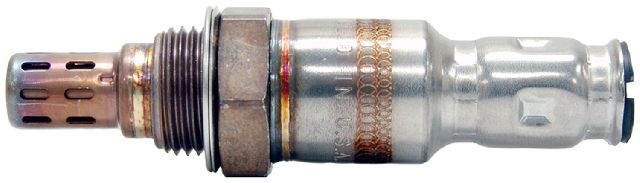
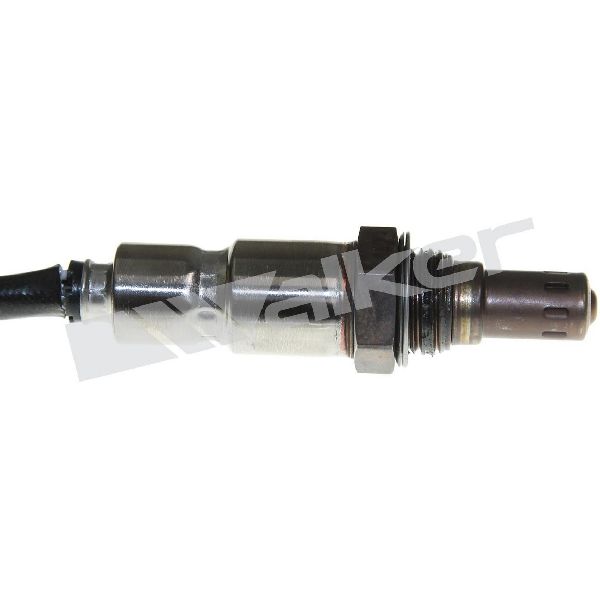
P0031 on a 2.4L Jeep Renegade almost always means the upstream oxygen sensor (Bank 1, Sensor 1) has failed. The internal heater element burns out, which is a very common failure. Replacing the sensor is the most common fix, costing between $50 for an aftermarket part and $150 for an OEM Mopar part. It is a DIY-friendly repair. Before replacing, check the O2 sensor fuse (F17, 15A in the engine bay fuse box) and inspect the wiring near the exhaust for melting.
- P0031 on the 2.4L Renegade is almost always a bad upstream (Bank 1, Sensor 1) oxygen sensor.
- Before replacing the sensor, check the F17 (15A) fuse and visually inspect the wiring for any melting or damage, as this is a cheap and easy first step.
- The 2.4L engine's tendency to consume oil can shorten the life of the O2 sensor; check your oil level regularly.
- Use a quality replacement sensor from a brand like Mopar, Denso, or NTK for best results.
- The correct OEM part number for the upstream sensor is 68195741AA, which is shared with many other FCA vehicles.
What's Unique About the 2015-2020 Jeep Renegade
The 2.4L MultiAir 'Tigershark' engine, used in the Renegade and other FCA vehicles like the Fiat 500X and Jeep Compass, has a well-documented issue with excessive oil consumption. This can cause oil to contaminate the oxygen sensor, leading to premature failure of the sensor's heater element and triggering the P0031 code. While the sensor itself is the most common failure point, Jeep has also issued software updates (like TSB 18-004-23 for the related Compass) to correct false P0031 codes, so it's a known issue on the platform that can sometimes have software-related causes or fixes.
Symptoms You May Notice
- Check Engine Light is on
- Reduced fuel economy
- Rough idle on a cold start
- Failing an emissions test
- Hesitation or low power feeling
- Replacing the downstream (Bank 1, Sensor 2) oxygen sensor instead of the upstream (Bank 1, Sensor 1).
- Replacing the PCM when the fault is a simple wiring issue or a failed sensor.
- Replacing the O2 sensor without first checking for a blown fuse or melted wiring.
Most Likely Causes
- Failed Upstream Oxygen Sensor (Bank 1, Sensor 1) 🔴 High Probability → Shop Oxygen Sensor The 2.4L MultiAir engine is known for oil consumption issues that can contaminate and destroy the O2 sensor. The heater element is also a common failure point due to constant, rapid heat cycles. This is the most frequent cause of P0031 across all platform mates.
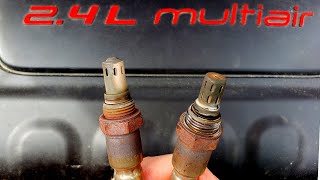
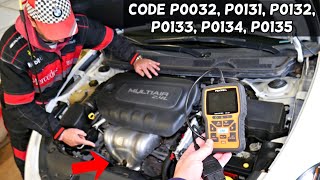
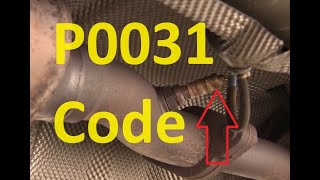
How to confirm: Disconnect the sensor and use a multimeter to test the resistance between the two heater circuit pins (often the two wires of the same color). A reading of infinite resistance (OL or open circuit) confirms a failed heater element. A healthy sensor typically has a low resistance, often between 4-10 ohms. 🎬 Watch: How to diagnose and fix P0031 on the 2.4L engine.
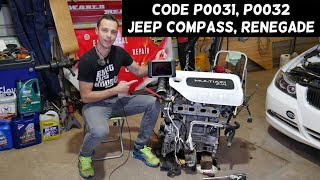
Typical fix: Replace the upstream oxygen sensor (Bank 1, Sensor 1). A specialized 7/8" (or 22mm) O2 sensor socket is highly recommended for removal. 🎬 Watch this step-by-step guide to replacing the upstream sensor.
Est. part cost: $50-$150 - Damaged Wiring or Connector 🟡 Medium Probability The sensor wiring is routed close to the hot exhaust system, making it susceptible to melting, chafing, or physical damage. This is a known issue on the platform.
How to confirm: Visually inspect the wiring harness leading to the upstream O2 sensor for any signs of melting, burns, frayed wires, or loose pins in the connector. Trace the harness as far back as possible.
Typical fix: Repair the damaged section of the wiring harness or replace the connector pigtail.
Est. part cost: $15-$50 - Blown Fuse ⚪ Low Probability
How to confirm: Check the fuse for the O2 sensor heater circuit in the engine bay fuse box. On the related Fiat 500X platform, this is often fuse F17 (15A). If the fuse is blown, the circuit has a short that must be found before replacing the fuse.
Typical fix: Replace the blown fuse. If it blows again, diagnose the short circuit in the wiring or sensor.
Est. part cost: $1-$5
Rare But Worth Checking
- Powertrain Control Module (PCM) Software Issue: Jeep issued TSB 18-097-22 for the 2021 Renegade and TSB 18-004-23 for the 2022 Compass for this exact code, fixed by a software update. While slightly outside the specified year range, it indicates a history of software-related triggers for this code on the platform. It's worth checking for available updates if a new sensor doesn't fix the issue, especially if other codes are present.
- Failing Powertrain Control Module (PCM): While very rare, the driver circuit within the PCM that controls the O2 sensor heater can fail. This should only be considered after all other possibilities (sensor, wiring, fuses, software) have been exhaustively ruled out.
Diagnosis Steps
- Read the code with an OBD-II scanner to confirm P0031 is present.
- Check the fuse for the O2 sensor heater circuit. On the related Fiat 500X, this is the 15A fuse in position F17 in the engine bay fuse box. Replace if blown.
- Perform a thorough visual inspection of the upstream O2 sensor's wiring harness and connector. Look for any signs of melting, chafing, or corrosion, as it runs close to the exhaust.
- If the wiring looks good, disconnect the sensor. Use a multimeter to measure the resistance of the heater circuit on the sensor side (usually between the two same-colored wires). A healthy sensor will have low resistance (typically 4-10 ohms), while a failed one will show an open circuit (infinite resistance).
- If the sensor's heater circuit is open, replace the Bank 1, Sensor 1 oxygen sensor. Using an O2 sensor socket will make this much easier.
- If the sensor tests good, check for 12V power and a good ground at the harness connector (with the key on, engine off). The heater circuit should have 12V power.
- If power or ground is missing, trace the circuit back to the PCM to find the break in the wire.
- Before replacing expensive parts like the PCM, check for any available software updates (TSBs) at a dealership, as this can sometimes be the root cause.
- After repair, clear the code and perform a drive cycle to ensure the fix was successful.
Parts You'll Likely Need
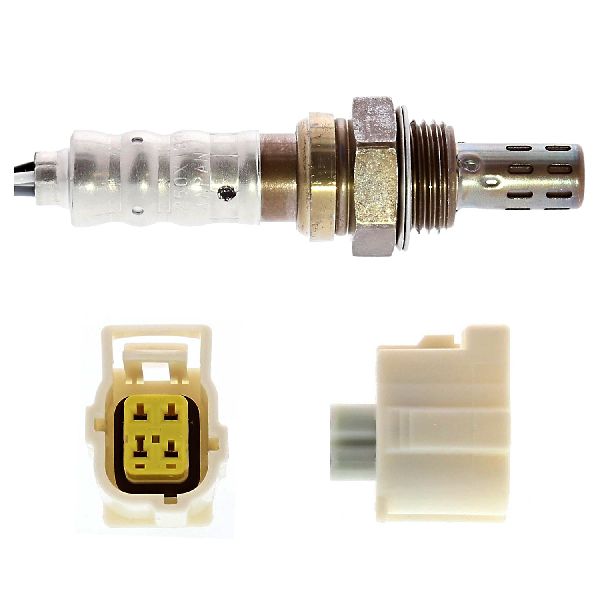
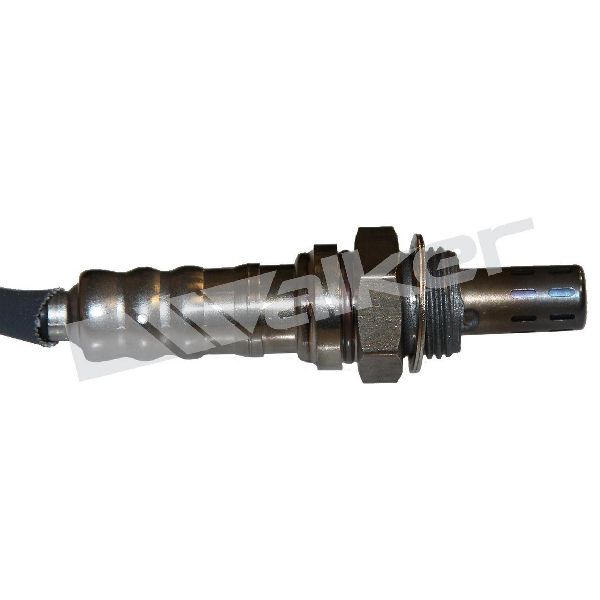
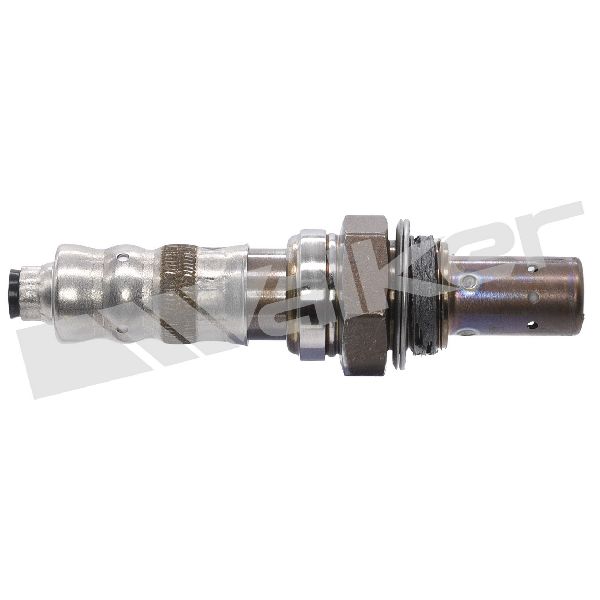
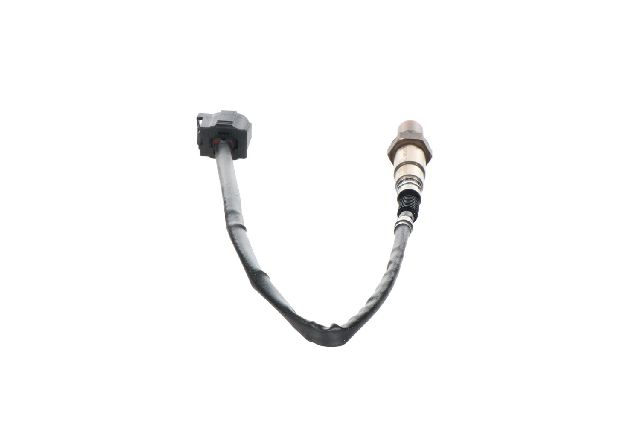
- Upstream Oxygen Sensor (Bank 1, Sensor 1)
(OEM #68195741AA)— This is the sensor identified by the P0031 code. Its internal heater element is the most common failure point.
Trusted brands: Mopar, Denso (e.g., 234-5150), NTK, Bosch
OEM price range: $95-$180
Aftermarket price range: $50-$100
Related Codes That Often Appear With This One
- P0032 — This code is for 'HO2S Heater Control Circuit High' for the same sensor. Seeing both P0031 and P0032 can point to an intermittent short in the wiring or a failing sensor.
- P1128 — This code for 'Closed Loop Fueling Not Achieved' can be triggered when the O2 sensor isn't heating up properly, preventing the PCM from entering its efficient closed-loop mode. A faulty O2 sensor heater is a primary cause for P1128.
- P2251 — This code for 'O2 Sensor Negative Current Control Circuit/Open' can be triggered alongside P0031. A TSB for the related 2014 Jeep Cherokee with the 2.4L engine addresses a PCM flash for both P0031 and P2251 occurring together.
Technical Service Bulletins (TSBs) & Recalls
- TSB 18-097-22: While for the 2021 model, this TSB addresses P0031 specifically and calls for a PCM software update, indicating a potential software fix.
- TSB 23-001-23 (XB1 Warranty Extension): Covers excessive oil consumption for 2015-2018 models, a known root cause of O2 sensor failure on this engine.
- CSN W20: A customer satisfaction notification to reprogram the PCM to address issues related to oil consumption.
- TSB 18-004-23: For the 2022 Jeep Compass with the same 2.4L engine, this TSB involves a PCM flash to fix several codes, including P0031.
Platform-Specific Known Issues
- The 2.4L MultiAir engine has a known oil consumption problem covered by warranty extension XB1 (NHTSA TSB 23-001-23) for 2015-2018 models. This issue can foul the O2 sensor, causing it to fail and trigger P0031.
- A class-action lawsuit was filed regarding the 2.4L Tigershark oil consumption issue, alleging it can lead to stalling and engine shutdown. This underlying engine problem is a major contributor to repeated O2 sensor failures.
Mechanic-Grade Diagnostic Values
- Upstream O2 Sensor Heater Element Resistance — expected: 4-10 Ohms at room temperature. Some sources consider up to 25 Ohms acceptable, but many Chrysler/Jeep sensors are tighter, in the 5-7 Ohm range.. Failure: Infinite resistance (OL - Open Loop) or near-zero resistance (short circuit).
- Voltage at O2 Sensor Harness Connector (Heater Power Pin) — expected: ~12 Volts (battery voltage) with Key On, Engine Off (KOEO).. Failure: No voltage or significantly less than 12V indicates a problem with the fuse, relay, or wiring from the power distribution center.
- Live Data: Upstream O2 Sensor Voltage (Engine Warm, at Idle) — expected: Rapidly fluctuating between ~0.1V and ~0.9V.. Failure: A static voltage, slow response, or voltage stuck high or low indicates a faulty sensor.
Hidden / Shadow Codes Worth Checking
- Mode $06, TID/CID for O2 Heater: Advanced scan tools can access Mode $06 data, which shows results from non-continuous onboard diagnostic tests. A failing O2 sensor heater may fail the Mode $06 test before it's bad enough to set a continuous P0031 code. (see via A professional-grade OBD-II scan tool that supports Mode $06 data display.)
Wiring & Ground Locations
- Upstream O2 Sensor Connector — Clipped to a bracket at the top-rear of the engine. It can be found by following the wire from the sensor itself, which is screwed into the front of the exhaust manifold.. This connector is the primary test point for checking voltage, ground, and sensor resistance. Its location in a hot, tight area makes it prone to damage.
- G109 (Sensor Ground) — A wiring diagram for a 2016 Renegade 2.4L shows G109 as a shared sensor ground point. Its exact physical location is not detailed but is part of the engine harness.. A compromised shared ground can cause erratic readings from multiple sensors, including the O2 sensor, leading to incorrect codes.
- G002B (PCM Ground) — Located in the left front of the engine compartment, underneath the battery tray.. This is a main ground point for the Powertrain Control Module (PCM). A poor connection here can cause a wide range of phantom electrical issues and fault codes, including P0031, as the PCM may not get a stable reference voltage.
Real Owner Repair Stories
- JeepRenegadeForum.com (General Consensus) (2015-2020 Jeep Renegade 2.4L) — Check Engine Light with code P0031.
❌ Tried (didn't work) Using cheap, unbranded aftermarket O2 sensors, which sometimes fail quickly or don't resolve the code.
✅ What actually fixed it Replacing the upstream (Bank 1, Sensor 1) oxygen sensor with an OEM Mopar or a reputable aftermarket brand like Denso or NTK consistently resolves the issue.
OEM Part Supersession History
68195741AA→No known supersession.— This part number appears to be the consistent and current OEM part for the entire 2015-2020 model range with the 2.4L engine.5149180AA→5149180AB— This is the part number for the DOWNSTREAM (Bank 1, Sensor 2) sensor. It was superseded.
Heads up: This is not the correct part for a P0031 code. This information is provided to prevent mis-ordering the downstream sensor by mistake.
Model Year Variations Within This Range
- 2015-2018: The 2.4L engine was optional on lower trims, while a 1.4L Turbo was standard. The underlying P0031 issue on the 2.4L engine remains the same.
- 2019-2020: Following a facelift, the 2.4L engine became the standard engine, replacing the 1.4L Turbo on base models. The parts and diagnosis for code P0031 on the 2.4L engine did not change.
Diagnostic Flowchart
Other Known Issues on This Vehicle
Issues unrelated to this code that are worth knowing about as an owner of this generation:
- Excessive Oil Consumption 🔴 High — Very common across all model years with the 2.4L engine. Can start at any mileage. A class-action lawsuit was filed for this issue. (Ref: TSB 23-001-23 (XB1 Warranty Extension))
- ZF 9-Speed Transmission Problems 🔴 High — Widespread on earlier models (especially 2015-2016). Symptoms include hard/jerky shifts, lurching, hesitation, and unexpectedly shifting to neutral. (Ref: Recall for potential shift to neutral due to wire harness crimp. Multiple software update TSBs exist.)
- Service Electronic Parking Brake (EPB) Warning 🟠 Medium — Common issue. Can be caused by software glitches, a weak battery, or failure of the actuator motors or switch. (Ref: TSB 05-00001-24 mentioned for software issues on 2020-2023 models.)
- MultiAir Actuator ('Brick') Failure 🟠 Medium — Less common than oil consumption, but a known failure point. Often preceded by codes like P1066. Failure requires replacement of the entire expensive actuator assembly. (Ref: Software updates were released to prevent false codes and improve system longevity.)
- Dirty Electronic Throttle Body 🟡 Low — Commonly causes low/stalling idle and code P0506. Carbon buildup restricts airflow. Usually fixed with a simple cleaning.
Used vs. New Parts: Buying Guide for This Vehicle
When a used part is the smart pick: For this repair, a used part is almost never recommended. The only exception might be sourcing a used wiring harness connector pigtail from a junkyard if the original is melted or damaged, as this is just wire and plastic.
Donor-vehicle mileage cap: roughly under 20000 miles for the part to have meaningful remaining life.
What to inspect on the donor part:
- For a connector pigtail, ensure the plastic is not brittle, the locking tab is intact, and there are several inches of clean, unmelted wire attached.
Aftermarket brands forum-validated for this vehicle:
- Denso (often cited as an OEM supplier)
- NTK (often cited as an OEM supplier)
- Bosch
Brands owners have reported issues with on this vehicle:
- Unbranded, 'white-box' sensors from online marketplaces are frequently reported on forums as being unreliable, failing quickly, or not meeting the PCM's specific resistance requirements, causing the code to return.
Real Owner Stories
Aggregated from forums and TSBs cited above. Mileages and costs reflect what owners reported in those sources.
2015-2018 Jeep Renegade 2.4L
Symptoms: Excessive oil consumption leading to fouled sensors and eventually triggering the P0031 code.
What fixed it: Reprogramming the PCM via CSN W20 and addressing the oil consumption issue under the XB1 warranty extension.
Source hint: TSB 23-001-23 (XB1 Warranty Extension) and CSN W20
2016 Jeep Renegade 2.4L MultiAir
Symptoms: Check engine light with P0031; owner noted the repair was a simple DIY process.
What fixed it: Replacing the upstream O2 sensor with a quality Mopar or Denso part.
Source hint: JeepRenegadeForum.com
2017 Jeep Renegade 2.4L
Symptoms: P0031 and P0032 codes present; visual inspection of the sensor and heater circuit confirmed failure.
What fixed it: Replacement of the upstream O2 sensor using a 7/8" O2 sensor socket and applying anti-seize lubricant.
Source hint: YouTube - 'Oxygen sensor replacement Jeep Renegade...' by 'Car & Truck' channel
Related OBD-II Codes
Frequently Asked Questions
Is there a warranty extension for the oil consumption issue that keeps fouling my O2 sensor?
My Renegade has P0031; which fuse should I check first?
Is there a software update to fix P0031 on the 2.4L MultiAir engine?
What specific part should I use to replace the upstream O2 sensor?
Do I need any special tools to fix P0031 on my Renegade?
Helpful Videos
We Have This Part in Stock

The information in this article is provided for general reference and educational purposes only. Vehicle specifications, procedures, and part compatibility can vary by production date, trim level, and region. Always consult your vehicle's factory service manual and verify part numbers before purchasing or performing repairs. Safety-critical components such as airbags, seat belts, and braking systems should be installed by a qualified professional.
- Jeep Renegade:
- 🧭 Diagnostic Flowchart
- 🎬 Helpful Videos
- 🛍️ Shop This Part
- What's Unique About the 2015-2020 Jeep Renegade
- Symptoms You May Notice
- Most Likely Causes
- Rare But Worth Checking
- Diagnosis Steps
- Parts You'll Likely Need
- Related Codes That Often Appear With This One
- Technical Service Bulletins (TSBs) & Recalls
- Platform-Specific Known Issues
- Mechanic-Grade Diagnostic Values
- Hidden / Shadow Codes Worth Checking
- Wiring & Ground Locations
- Real Owner Repair Stories
- OEM Part Supersession History
- Model Year Variations Within This Range
- Other Known Issues on This Vehicle
- Used vs. New Parts: Buying Guide for This Vehicle
- Real Owner Stories
- 2015-2018 Jeep Renegade 2.4L
- 2016 Jeep Renegade 2.4L MultiAir
- 2017 Jeep Renegade 2.4L
- Related OBD-II Codes
- Frequently Asked Questions
- 🎟️ Get 5% Off