

P0088 on 2001-2004 Chevrolet Silverado 3500 6.6L LB7 Duramax: High Fuel Pressure Causes and Fixes
On a 2001-2004 LB7 Duramax, P0088 is almost always caused by a failing Fuel Pressure Regulator (FPR) on the CP3 injection pump. This causes high fuel rail pressure, limp mode, and a rough idle. Replacing the FPR is the most common fix, costing around $150-$250 for an OEM Bosch part. Less common causes include a faulty fuel rail pressure sensor or chafed wiring.
- P0088 on your LB7 Duramax means fuel rail pressure is too high, which will trigger a 'Reduced Engine Power' (limp mode) warning.
- The most likely cause by a wide margin is a failed Fuel Pressure Regulator (FPR) on the CP3 injection pump.
- Use a scan tool to compare desired vs. actual fuel rail pressure; if actual is much higher, the FPR is almost certainly the problem.
- When replacing the FPR, it is highly recommended to use a quality OEM part from Bosch or ACDelco to avoid repeat failures.
- This is a serious code; do not continue driving as you risk damaging other expensive fuel system components.
What's Unique About the 2001-2004 Chevrolet Silverado 3500
The 2001-2004 Silverado HD with the LB7 engine uses the highly reliable Bosch CP3 high-pressure fuel pump. Unlike later Duramax engines (2011+) with the CP4 pump, a catastrophic pump failure is not a common cause for P0088 on the LB7. The issue is almost always isolated to the Fuel Pressure Regulator (FPR) that is mounted on the CP3 pump. This makes the diagnosis and repair more straightforward and significantly less expensive than on later models.
Symptoms You May Notice
- Check Engine Light is on.
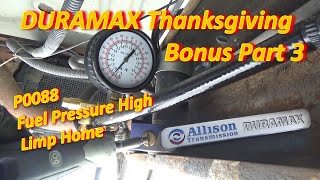
- Vehicle enters 'Reduced Engine Power' or 'limp mode', often limited to 25 mph. 🎬 Watch: Diagnosing a Duramax stuck in P0088 limp mode.
- Rough, surging, or loping idle, sometimes revving between 500 and 2000 RPM on its own.
- Engine may stall or be hard to start.
- Black smoke from the exhaust, especially during idle surges.
- Poor acceleration and overall engine performance.
- Excessive fuel pump or engine noise (fuel knock).
- Replacing the entire CP3 injection pump. While the FPR is mounted on the pump, the pump itself is very robust on the LB7 and rarely the cause of high pressure; it's more likely to cause low pressure (P0087) when it wears out.
- Replacing fuel injectors. Injector issues on an LB7 are a very common platform problem, but they typically cause low rail pressure codes (P0087) due to excessive return flow (leaking), not high pressure codes.
Most Likely Causes
- Failed Fuel Pressure Regulator (FPR) 🔴 High Probability → Shop Fuel Injection Pressure Regulator The FPR (also called a Fuel Control Actuator or MPROP) is a solenoid that meters fuel entering the high-pressure pump. It is a very common failure point on the LB7's CP3 pump. It can get stuck internally due to wear or fuel contamination, leading to uncontrolled pressure.
How to confirm: Use a scan tool to monitor 'Desired Fuel Rail Pressure' vs. 'Actual Fuel Rail Pressure'. If Actual is significantly higher than Desired at idle, the FPR is the prime suspect. Unplugging the FPR electrical connector with the engine running may cause no change in the rough idle; since the default (unplugged) state is maximum pressure, this indicates the part was already stuck in that position.
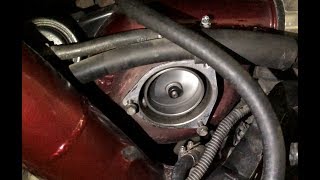
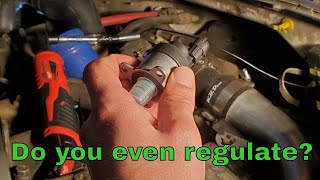
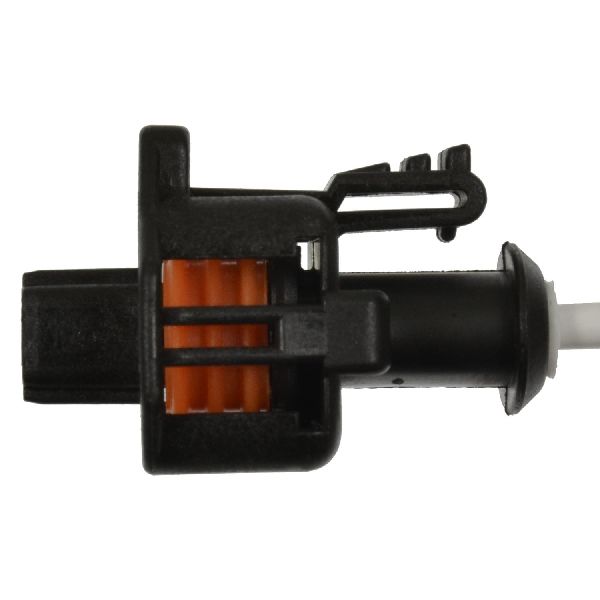
Typical fix: Replace the Fuel Pressure Regulator on the back of the CP3 injection pump. 🎬 Watch: See how a new FPR makes this LB7 run smooth again. It is held by three T25 Torx screws and can be accessed by removing the air intake horn. 🎬 See this step-by-step walkthrough of the regulator installation process.
Est. part cost: $150 - $250 - Faulty Fuel Rail Pressure Sensor 🟡 Medium Probability → Shop Fuel Pressure Sensor The sensor can fail and send an erroneously high pressure reading to the ECM, triggering the code and limp mode even if the mechanical pressure is normal. This can happen due to internal failure or corrosion in the connector.
How to confirm: With the Key On, Engine Off (KOEO), use a scan tool to check the fuel rail pressure reading. It should be near 0 PSI. If it shows a very high reading (e.g., 26,000 PSI), the sensor or its wiring is faulty. A skewed sensor may also read a plausible, but incorrect, pressure like 1,500 PSI with the engine off.
Typical fix: Replace the fuel rail pressure sensor, which is located on the passenger side fuel rail.
Est. part cost: $80 - $200 - Wiring Harness Issue ⚪ Low Probability The engine harness can chafe over time. Common chafe points are against the ECM/TCM bracket, the alternator bracket, the upper control arm, and shock tower bolts. This can cause an intermittent short or open circuit to the FPR or pressure sensor.
How to confirm: Visually inspect the wiring harness for chafing, especially near brackets. Check for 12V at the purple/white wire on the FPR connector with the key on. A manufacturer service bulletin, TSB Bulletin #PIP5119, suggests that if P0088 appears specifically after a repair, technicians should inspect for the Fuel Rail Pressure 1 and 2 connectors being swapped.
Typical fix: Repair the damaged section of the wiring harness. In some cases, the short pigtail connector to the FPR or sensor may need to be replaced.
Est. part cost: $20 - $70
Rare But Worth Checking
- Blocked Fuel Return Line: A kink or blockage in the fuel return line can prevent the system from relieving excess pressure, mechanically causing the pressure to spike. This is less common than an electronic or regulator failure but should be checked with a visual inspection of the fuel lines.
- Aftermarket Lift Pump with Excessive Pressure: The stock LB7 does not have a lift pump. If an aftermarket lift pump is installed and its output pressure is too high (e.g., over 10 PSI), it can overwhelm the CP3 pump's ability to regulate pressure during deceleration, causing a momentary spike that triggers P0088. A diagnostic YouTuber documented this exact scenario, fixing it by lowering the lift pump's output pressure from 14 PSI down to 9 PSI.
Diagnosis Steps
- Connect a quality OBD-II scan tool capable of reading live data for GM diesel vehicles.
- Check for any other accompanying codes, paying special attention to P0090 or P0193. Manufacturer bulletin TSB Bulletin #PIP4949E notes that P0088 may appear alongside P0087 or P0191 during a hard start or no start condition.
- With the Key On, Engine Off (KOEO), observe the 'Actual Fuel Rail Pressure' reading. It should be at or near 0 PSI. If it reads high (e.g., thousands of PSI), the Fuel Rail Pressure Sensor or its wiring is likely faulty.
- Start the engine and let it idle. Observe 'Desired Fuel Rail Pressure' and 'Actual Fuel Rail Pressure'.
- If Actual pressure is significantly and consistently higher than Desired pressure (e.g., actual is 20,000+ PSI while desired is ~5,000 PSI at idle), the Fuel Pressure Regulator (FPR) is the most likely cause.
- If the engine idles rough, unplug the electrical connector to the FPR. If there is no change in idle behavior, the FPR has likely failed internally.
- Inspect the wiring harness to the FPR and the Fuel Rail Pressure Sensor. Check for chafing near the alternator bracket, ECM/TCM bracket, and fender well. Use a multimeter to confirm 12V on the purple/white wire at the FPR connector with the key on.
- Visually inspect all fuel lines, especially the return lines, for any kinks or damage that could cause a restriction. TSB Bulletin #PIP5151F notes that rough running and P0088 can be caused by fuel system contamination, requiring a complete system inspection.
Parts You'll Likely Need
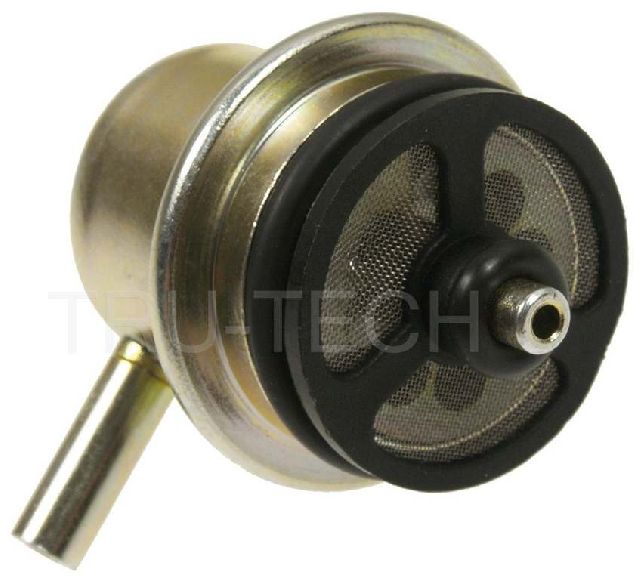
- Fuel Pressure Regulator (FPR) / Fuel Control Actuator (FCA)
(OEM #97728979)— This is the most common failure point for code P0088 on the LB7 Duramax. It gets stuck and fails to properly regulate fuel pressure in the common rail.
Trusted brands: Bosch (OEM supplier, part #0928400535), ACDelco (reboxed Bosch, #97728979), Dorman (904-570)
OEM price range: $200-$250
Aftermarket price range: $100-$180 - Fuel Rail Pressure Sensor
(OEM #97371618)— This sensor can fail and send incorrect high-pressure signals to the ECM, causing the code and symptoms even if the mechanical pressure is normal.
Trusted brands: Bosch (OEM supplier, part #0281002504), ACDelco
OEM price range: $150-$200
Aftermarket price range: $80-$120
Related Codes That Often Appear With This One
- P0090 — This code indicates a fault in the Fuel Pressure Regulator control circuit. If you see P0088 and P0090 together, it strongly points to a problem with the FPR itself or its wiring. The factory service manual recommends diagnosing P0090 first when both are present.
- P0193 — This code means 'Fuel Rail Pressure Sensor Circuit High Input'. It often appears with P0088 and points towards a faulty sensor or a wiring issue causing the ECM to see an impossibly high voltage signal.
Technical Service Bulletins (TSBs) & Recalls
- GM Bulletin 16-NA-102: This bulletin provides a procedure to inspect and replace fuel components to correct concerns of hard start or no start when DTC P0088 is set due to the fuel system being contaminated with debris.
- GM Bulletin 21-NA-149: Details common engine wiring harness chafe points on GM trucks, including the ECM/TCM bracket, upper control arm, and shock tower bolt, which are relevant potential causes for electrical faults triggering P0088.
- TSB Bulletin #PIP5151F: Advises technicians that vehicles exhibiting rough running or hard start conditions with P0088 may require a complete fuel system cleaning if contamination is discovered during inspection.
- TSB Bulletin #PIP4949E: Provides diagnostic information for hard start or no start conditions where P0088 is present, directing technicians to follow specific service information to rule out mechanical vs. electronic faults.
Platform-Specific Known Issues
- A user on DuramaxDiesels.com with P0088 and P0193 ultimately found the cause to be a bad wire connection at the Fuel Rail Pressure Sensor, not the FPR.
- Another user on DuramaxDiesels.com with P0088 and P0090 traced their issue to a previously repaired section of the FPR wiring harness, highlighting the need to check for 12V power at the connector.
- A YouTube video from user '2002 Duramax LB7' documented a long battle with P0193 and P0088 that was ultimately caused by a broken wire on the FPR connector and a faulty (original) Fuel Pressure Sensor, even after trying multiple aftermarket FPRs. This emphasizes checking wiring thoroughly and using quality parts.
Mechanic-Grade Diagnostic Values
- Actual Fuel Rail Pressure at hot idle — expected: 30-35 MPa (4,351-5,076 PSI). Failure: Significantly higher than desired pressure, or pressure that is erratic and loping.
- FPR Solenoid Coil Resistance — expected: 2.0 - 3.5 Ohms. Failure: A reading of 0 ohms indicates a short, while an infinite reading (OL) indicates an open circuit. Values significantly outside the expected range suggest a failing coil.
- FPR Connector Voltage (Key On, Engine Off) — expected: 12 Volts at Pin 1 (Purple/White wire). Failure: No voltage or significantly low voltage indicates a problem with the wiring or the ECM's power supply to the regulator.
- Actual vs. Desired Fuel Pressure Deviation (Scan Tool Test) — expected: Within 5 MPa (725 PSI) of each other across the commanded range.. Failure: If the actual pressure deviates from the desired pressure by more than 5 MPa (725 PSI) while commanding pressure changes with a scan tool, it points to a faulty regulator or a restriction.
Scan Tool Commands That Help
- Tech2 or equivalent professional scan tool: Fuel Pressure Control / Command Fuel Pressure — This bidirectional command is used to actively test the Fuel Pressure Regulator. The technician can command the ECM to set a specific fuel pressure, then observe if the 'Actual Fuel Rail Pressure' PID responds and holds steady within 5 MPa (725 PSI) of the commanded value. This directly tests the FPR's ability to respond to ECM commands.
Wiring & Ground Locations
- FPR Connector — On the Fuel Pressure Regulator, located on the back of the CP3 high-pressure pump, under the intake horn.. This is the connection point for the regulator. Pin 1 (Purple/White wire) should have 12V with the key on. A bad connection or damaged wire here will cause P0090 and can lead to P0088.
- G103 — Varies slightly by source and specific model year, but is generally located on the passenger side (right) cylinder head or on the cowl above the brake booster.. This is a primary ground for the Engine Control Module (ECM). A poor connection at G103 can cause erratic ECM behavior, potentially affecting the control signals sent to the Fuel Pressure Regulator and other sensors, leading to various codes including P0088.
- G101 — Located at the left front of the engine, on the lower block.. This ground point serves the Engine Control Module (ECM) and Transmission Control Module (TCM). A loose or corroded G101 can interrupt stable power to the ECM, impacting its ability to accurately control the fuel system.
Real Owner Repair Stories
- Pine Hollow Auto Diagnostics (YouTube) (Duramax truck with an aftermarket lift pump installed.) — P0088 code setting, but only during long periods of deceleration or coasting downhill.
❌ Tried (didn't work) Initial diagnosis was confusing as the pressure was normal under load and at idle.
✅ What actually fixed it The aftermarket lift pump's supply pressure was too high (14 PSI). During deceleration, the injectors shut off but the lift pump continued to push fuel, overwhelming the CP3's ability to regulate and causing a pressure spike. The fix was to adjust the lift pump's output pressure down to ~9 PSI. - DuramaxDiesels.com forum user (2002 LB7 Duramax) — P0088 and P0090 codes, high fuel pressure, and circuit fault.
❌ Tried (didn't work) Replacing the Fuel Pressure Regulator (FPR).
✅ What actually fixed it The user discovered a previous, poorly done splice repair on the wiring harness leading to the FPR. After tracing the wires from the ECM and finding no voltage at the connector, they properly repaired the damaged wiring, which restored power to the FPR and resolved both codes. - Reddit user in r/Duramax (LMM Duramax (later model, but same P0088 principle)) — P0088 code, rough running, and limp mode immediately after replacing fuel lines and sending unit.
❌ Tried (didn't work) Replacing the fuel filter after finding rusty metal bits inside.
✅ What actually fixed it The user suspected contaminants were stuck in the system. After adding injector cleaner, they let the truck idle for about 30 minutes. The engine sputtered, and then the fuel pressure suddenly dropped to normal, clearing the code. The final cause was likely a small piece of debris from the fuel system work that temporarily stuck the FPR open.
OEM Part Supersession History
97318439→97728979— Standard part revision and update by GM.LB7 Fuel Pressure Regulator→LBZ Fuel Pressure Regulator— Some owners upgrade to the later model regulator for performance builds.
Heads up: Using an FPR from a later engine (like an LBZ) in an LB7 is physically possible but will cause performance issues and likely codes unless the ECM is custom-tuned with the correct fuel pressure tables for the new regulator.
Model Year Variations Within This Range
- 2001-2004: There is a significant difference between Federal (49-state) and California (CA) emissions models. California-spec LB7s were equipped with an Exhaust Gas Recirculation (EGR) system, which Federal trucks did not have. This includes a different Y-bridge, an EGR cooler, a butterfly valve in the intake, and different cylinder heads with smaller ports. While this doesn't change the primary cause of P0088 (the FPR), it can complicate access to components and introduces different parts in the intake area that a technician must be aware of.
Diagnostic Flowchart
Other Known Issues on This Vehicle
Issues unrelated to this code that are worth knowing about as an owner of this generation:
- Fuel Injector Failure 🔴 High — Very common, often occurring between 100,000 and 150,000 miles. GM issued an extended warranty (200,000 miles/7 years) due to the high failure rate. Symptoms include fuel in oil, rough idle, and white smoke. (Ref: Special Policy/Extended Warranty (now expired))
- Fuel Filter Housing O-Ring Leaks 🟠 Medium → Shop Fuel Filter — A very common age-related failure. The O-rings deteriorate, causing fuel leaks and allowing air into the system, which leads to hard starting or stalling.
- Overheating 🟠 Medium — More common on LB7/LLY engines than later generations, especially when towing. Often caused by a failed water pump, fan clutch failure, or a clogged radiator.
- Water Pump Failure 🟠 Medium — A known failure point, typically due to leaking seals on the coolant side, which contributes to overheating.
- Head Gasket Failure 🔴 High — More prone to this than later Duramax engines, though not as frequent as injector failure. Often occurs after 100,000 miles, and can be precipitated by overheating or performance modifications.
Used vs. New Parts: Buying Guide for This Vehicle
When a used part is the smart pick: For this specific repair, a used part is not recommended. The Fuel Pressure Regulator is a wear-prone electro-mechanical part. The risk of getting a part that is already near the end of its service life is high, and the labor to replace it makes gambling on a used part a poor value proposition.
Donor-vehicle mileage cap: roughly under 150000 miles for the part to have meaningful remaining life.
What to inspect on the donor part:
- Not applicable as used parts are not recommended.
OEM-only on this vehicle (don't cheap out):
- Fuel Pressure Regulator (FPR)
Aftermarket brands forum-validated for this vehicle:
- Bosch (OEM supplier)
- ACDelco (often a reboxed Bosch part)
- Dorman (generally considered a reliable OE-quality replacement)
Brands owners have reported issues with on this vehicle:
- Cheap, unbranded regulators found on sites like eBay or Amazon. Forum users and technicians strongly advise against these, as they often fail quickly or are dead on arrival. A user trying a $43 'Okay Motor' brand noted it was a gamble.
Real Owner Stories
Aggregated from forums and TSBs cited above. Mileages and costs reflect what owners reported in those sources.
2002 Chevrolet Silverado 3500 6.6L LB7 Duramax
Symptoms: Long battle with P0193 and P0088 codes; owner tried multiple aftermarket Fuel Pressure Regulators (FPRs) without success.
What fixed it: The issue was ultimately traced to a broken wire on the FPR connector and a faulty original Fuel Pressure Sensor.
Source hint: YouTube video from user '2002 Duramax LB7'
2001-2004 Chevrolet Silverado 3500 6.6L LB7 Duramax
Symptoms: High pressure codes P0088 and P0193 appeared after changing injectors.
What fixed it: A bad wire connection at the Fuel Rail Pressure Sensor was found to be the cause, rather than a mechanical failure of the FPR.
Source hint: DuramaxDiesels.com thread 'P0088 P0193 LB7 after changing injectors' (2014)
2001-2004 Chevrolet Silverado 3500 6.6L LB7 Duramax
Symptoms: Codes P0090 and P0088; owner replaced the Fuel Pressure Regulator but the problem persisted.
What fixed it: Traced the issue to a previously repaired section of the FPR wiring harness; confirmed by checking for 12V power at the connector.
Source hint: DuramaxDiesels.com thread 'P0090 And P0088' (2019)
2001-2004 Chevrolet Silverado 3500 6.6L LB7 Duramax
Symptoms: P0088 occurred immediately following a fuel filter failure.
What fixed it: Suspected debris from the failed fuel filter entered and damaged the fuel pressure regulator.
Source hint: DuramaxDiesels.com thread 'Insights into Fuel Problem' (2026)
Related OBD-II Codes
Frequently Asked Questions
My 2002 Duramax LB7 is in 'Reduced Engine Power' mode and won't go over 25 mph. Is this common for P0088?
I've heard the LB7 injectors are a major problem. Could they be causing my P0088 code?
Is there a TSB for wiring issues that might cause high fuel pressure codes on my Silverado 3500?
Can I test the Fuel Pressure Regulator (FPR) myself without a scan tool?
Where is the Fuel Rail Pressure Sensor located on the 6.6L LB7 engine?
Helpful Videos
We Have This Part in Stock


The information in this article is provided for general reference and educational purposes only. Vehicle specifications, procedures, and part compatibility can vary by production date, trim level, and region. Always consult your vehicle's factory service manual and verify part numbers before purchasing or performing repairs. Safety-critical components such as airbags, seat belts, and braking systems should be installed by a qualified professional.
- Chevrolet Silverado 3500:
- 🧭 Diagnostic Flowchart
- 🎬 Helpful Videos
- 🛍️ Shop This Part
- What's Unique About the 2001-2004 Chevrolet Silverado 3500
- Symptoms You May Notice
- Most Likely Causes
- Rare But Worth Checking
- Diagnosis Steps
- Parts You'll Likely Need
- Related Codes That Often Appear With This One
- Technical Service Bulletins (TSBs) & Recalls
- Platform-Specific Known Issues
- Mechanic-Grade Diagnostic Values
- Scan Tool Commands That Help
- Wiring & Ground Locations
- Real Owner Repair Stories
- OEM Part Supersession History
- Model Year Variations Within This Range
- Other Known Issues on This Vehicle
- Used vs. New Parts: Buying Guide for This Vehicle
- Real Owner Stories
- 2002 Chevrolet Silverado 3500 6.6L LB7 Duramax
- 2001-2004 Chevrolet Silverado 3500 6.6L LB7 Duramax
- 2001-2004 Chevrolet Silverado 3500 6.6L LB7 Duramax
- 2001-2004 Chevrolet Silverado 3500 6.6L LB7 Duramax
- Related OBD-II Codes
- Frequently Asked Questions
- 🎟️ Get 5% Off