

P0089 on 2013-2018 Ford Focus ST: Causes and Fixes for Fuel Pressure Regulator Performance
On a 2013-2018 Focus ST, P0089 is almost always a faulty fuel rail pressure sensor or a failing high-pressure fuel pump (HPFP). The sensor is the most common culprit and the cheaper part to replace first, costing around $50-$100. The OEM sensor is a Bosch unit, and replacing it often resolves the issue without needing to touch the more expensive pump.
- P0089 on a Focus ST indicates a performance problem in the high-pressure fuel system.
- The most likely and cost-effective first step is to replace the Fuel Rail Pressure Sensor.
- If replacing the sensor doesn't work, the High-Pressure Fuel Pump (HPFP) is the next probable cause.
- Use a scan tool to watch live fuel pressure data; it's the best way to diagnose the problem before buying parts.
- Be aware of the symptoms of the unrelated Canister Purge Valve recall (18S32), which can mimic fuel pressure issues.
What's Unique About the 2013-2018 Ford Focus ST
The Focus ST's 2.0L EcoBoost engine uses a high-pressure fuel system that is sensitive to component degradation. Unlike traditional port injection systems, this code almost always points to an issue on the high-pressure side. The two most frequent failure points are the electronic fuel rail pressure sensor and the mechanical high-pressure fuel pump (HPFP) it monitors. Owner experiences overwhelmingly point to the sensor failing more often than the pump itself, making it the logical first part to replace.
Symptoms You May Notice
- Check Engine Light is on
- Hesitation or stumbling during acceleration
- Significant loss of engine power
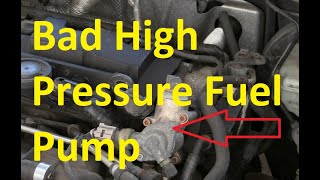
- Engine enters 'limp mode,' limiting RPMs (often to 3,000) 🎬 Watch: Common symptoms of a failing high-pressure fuel pump.
- Rough or unstable idle
- Engine stalling, sometimes without warning
- Hard starting or extended cranking time
- Decreased fuel economy
- Replacing the entire High-Pressure Fuel Pump when only the much cheaper Fuel Rail Pressure Sensor was faulty.
- Assuming the problem is fuel injectors when the pressure supply is the actual root cause.
- Confusing the symptoms with the separate, but common, Canister Purge Valve (CPV) issue (Recall 18S32). A bad CPV can cause stalling, rough idle, and hard starting, especially after refueling, which can mimic fuel pressure problems.
Most Likely Causes
- Faulty Fuel Rail Pressure Sensor 🔴 High Probability → Shop Fuel Pressure Sensor The sensor is exposed to high pressure and temperature cycles and is a widely documented failure point on this platform. The original part is a Bosch sensor, and its failure is the most common reason for a P0089 code.
How to confirm: Using a scan tool, monitor 'Fuel Rail Pressure (Desired)' and 'Fuel Rail Pressure (Actual)'. If the actual pressure is erratic (e.g., jumping between 0 and 2500+ psi), reads 0, or does not respond logically to changes in engine RPM while the desired pressure does, the sensor is highly suspect.
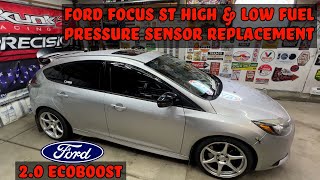
Typical fix: Replace the fuel rail pressure sensor located on the high-pressure fuel rail. It is accessible after removing the engine cover. 🎬 Watch: Step-by-step guide to replacing the fuel pressure sensors.
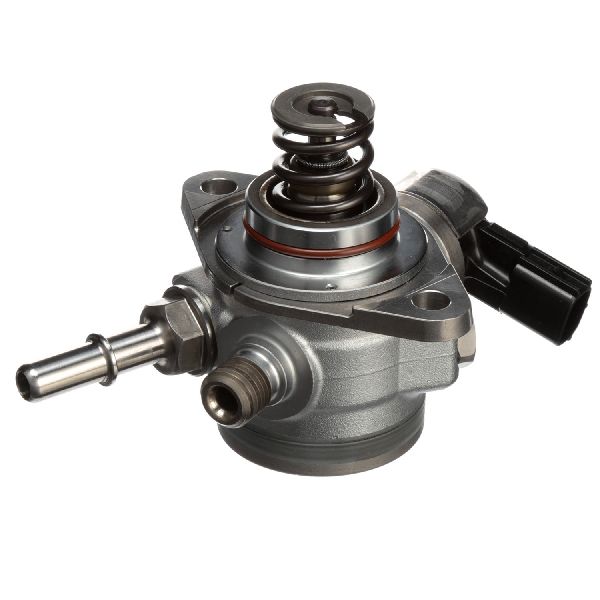
Est. part cost: $50-$120 - Failing High-Pressure Fuel Pump (HPFP) 🟡 Medium Probability → Shop Fuel Pump The HPFP is a mechanical component driven by a camshaft lobe. Wear on the internal components or the integrated regulator can lead to an inability to generate or maintain the commanded pressure, especially under high load.
How to confirm: If the fuel rail pressure sensor has been replaced and the issue persists, the HPFP is the next likely cause. A diagnostic tool showing actual pressure consistently below desired pressure under load, without the erratic behavior typical of a bad sensor, points to a weak pump.
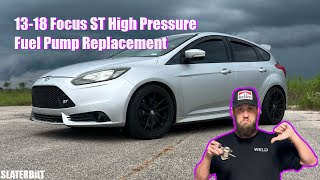
Typical fix: Replace the high-pressure fuel pump. This is more labor-intensive and expensive than the sensor. 🎬 See this walkthrough for replacing the high-pressure fuel pump.
Est. part cost: $200-$500 - Wiring Harness Issues ⚪ Low Probability Ford issued TSB 13-09-07 and later Recall 14S17 for 2013-2014 models due to insufficient compression in engine wiring harness splices, which could cause high resistance and provide incorrect signals from sensors like the MAP sensor to the PCM. This could lead to a range of drivability issues including stalling and hesitation.
How to confirm: Visually inspect the wiring and connectors for the fuel rail pressure sensor and HPFP for damage, corrosion, or looseness. Check the vehicle's VIN to see if recall 14S17 or 18S32 has been performed. The recall involved dealers replacing the faulty crimped splices.
Typical fix: Repair the damaged section of the wiring harness or clean the connectors. If related to the recall, a dealer service is required to re-splice the harness.
Est. part cost: $0-$150
Rare But Worth Checking
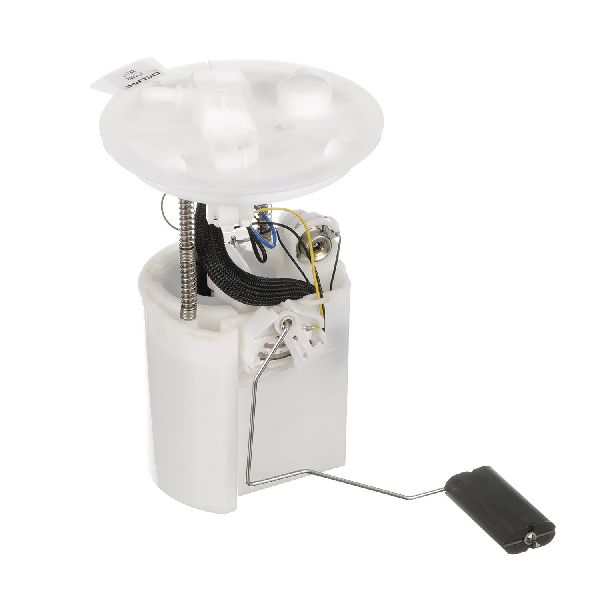
- Failing In-Tank Low-Pressure Fuel Pump: → Shop Fuel Pump If the high-pressure pump is starved of fuel from the tank, it cannot perform correctly. This can be caused by a weak in-tank pump or a clogged integrated fuel filter.
- Worn Camshaft Lobe or HPFP Follower: → Shop Engine Camshaft The HPFP is driven by a lobe on the camshaft via a 'follower'. If the lobe or follower wears down, the pump's stroke is reduced, leading to insufficient pressure. This is less common but possible on higher-mileage or modified engines.
Diagnosis Steps
- Connect an OBD-II scanner and confirm the P0089 code. Check for any other related fuel system codes like P0087, P0088, or P0193.
- Use the scanner's live data function to monitor 'Desired Fuel Rail Pressure' and 'Actual Fuel Rail Pressure'.
- At idle and while revving the engine, compare the two readings. If the 'Actual' pressure is erratic, stuck at one value (e.g., 0 psi or max psi), or significantly lags behind the 'Desired' pressure, the sensor is the most likely culprit.
- Visually inspect the wiring and connector at the fuel rail pressure sensor for any signs of damage, corrosion, or loose connections.
- If the sensor is suspect, replace the Fuel Rail Pressure Sensor. This is the most common fix and a relatively inexpensive part. OEM is Bosch P/N 0261230093.
- After replacing the sensor, clear the codes and perform a test drive. If P0089 returns, the issue likely lies with the High-Pressure Fuel Pump (HPFP) or its supply.
- Check the vehicle's service history for recalls 14S17 (wiring) and 18S32 (purge valve) to rule out related issues.
- If no other issues are found and the code persists after sensor replacement, the HPFP is the next component to replace.
Parts You'll Likely Need
- Fuel Rail Pressure Sensor
(OEM #CM5229 (Motorcraft), 3F2Z-9G756-AC (Ford), 0261230093 (Bosch - Original OEM))— This sensor is the most frequent failure point for the P0089 code on the Focus ST. It provides the data that the PCM uses to trigger the code.
Trusted brands: Motorcraft, Bosch
OEM price range: $80-$120
Aftermarket price range: $50-$90 - High-Pressure Fuel Pump (HPFP)
(OEM #AG9Z9350A, EJ7Z-9350-A)— This is the second most common cause. If the sensor replacement does not fix the issue, the mechanical pump itself has likely failed.
Trusted brands: Motorcraft, Bosch
OEM price range: $350-$500
Aftermarket price range: $200-$350
Related Codes That Often Appear With This One
- P0087 — Indicates 'Fuel Rail/System Pressure - Too Low,' which can occur if the regulator performance issue results in a low-pressure state.
- P0193 — Indicates 'Fuel Rail Pressure Sensor 'A' Circuit High,' pointing more specifically to an electrical fault with the sensor itself, which is a primary cause of P0089.
- P0088 — Indicates 'Fuel Rail/System Pressure - Too High,' which can occur if the regulator performance issue results in a high-pressure state.
Technical Service Bulletins (TSBs) & Recalls
- 13-09-07 - Wiring harness splices causing drivability issues on 2013-2014 models.
Platform-Specific Known Issues
- Recall 18S32 / 14S17: Affects 2012-2018 models. A malfunctioning Canister Purge Valve (CPV) can create excessive vacuum in the fuel tank, leading to deformation, inaccurate fuel gauge readings, and engine stalling. While a separate issue, its symptoms can overlap with P0089. Ford's fix involves a PCM reprogram and potential replacement of the CPV and fuel tank if deformed.
- TSB 13-09-07: Specifically for 2013-2014 models, this TSB addressed faulty wiring harness splices (S132, S133) that could cause a variety of drivability problems, including rough idle and stalling, which are symptoms of P0089. This was later superseded by Recall 14S17.
Mechanic-Grade Diagnostic Values
- Low-Pressure Fuel System Pressure (Scan Tool) — expected: ~70-85 PSI, should be stable under load.. Failure: Pressure is significantly below 70 PSI, is unstable, or is stuck at a fixed value.
- High-Pressure Fuel System Pressure (Scan Tool at Idle) — expected: ~250-350 PSI; Actual pressure should closely track Desired pressure.. Failure: Actual pressure is significantly different from desired, is erratic, or fails to rise with RPM.
- High-Pressure Fuel System Pressure (Scan Tool at Wide-Open Throttle) — expected: Rises to over 2000+ PSI.. Failure: Actual pressure fails to reach commanded pressure, causing hesitation or power loss. A healthy stock HPFP may max out around 2900 PSI.
- Fuel Rail Pressure Sensor Signal Voltage (KOEO) — expected: Approximately 0.5V.. Failure: Voltage is stuck at 0V or 5V, indicating a sensor or wiring circuit failure.
Wiring & Ground Locations
- G104 — Left side of the engine compartment, sometimes described as being on the left front of the motor compartment or near the battery junction box.. This is a primary ground point for the Powertrain Control Module (PCM) and various engine sensors. A corroded or loose G104 can cause erratic sensor readings and phantom codes.
- G105 — Left side of the engine compartment, near the cowl, sometimes behind cooling fan relays.. Grounds various components in the engine bay. While not a direct PCM ground, poor grounding here can introduce electrical noise that may affect sensitive sensor signals.
- Fuel Rail Pressure Sensor Connector — On the high-pressure fuel rail at the front of the engine.. This is the direct electrical connection for the sensor that triggers P0089. The connector and its pins should be inspected for corrosion, damage, or looseness.
Real Owner Repair Stories
- Fiesta ST Forum User (2015 Ford Fiesta ST (similar 1.6L EcoBoost engine with HPFP)) — Persistent P0087 (Fuel Rail Pressure Too Low) code for over 20,000km, despite other repairs.
❌ Tried (didn't work) Replacing the in-tank (low pressure) fuel pump.
✅ What actually fixed it The HPFP cam follower (bucket) was found to be severely worn and indented. Replacing the cam follower resolved the fuel pressure issue. - YouTube Creator 'SlaterBilt' (2013 Ford Focus ST) — Car went into limp mode while driving at highway speeds. Scan showed fuel pressure at the rail was only 85-90 PSI, consistent with low-pressure pump output only.
❌ Tried (didn't work) Direct diagnosis pointed to HPFP.
✅ What actually fixed it Replacing the High-Pressure Fuel Pump (HPFP) restored full fuel pressure and normal engine operation. The video provides a detailed walkthrough of the replacement process.
OEM Part Supersession History
3F2E-9G756-AD→3F2Z-9G756-AC, which is serviced as Motorcraft CM5229 or Bosch 0261230093.— Standard part evolution and updates.
Model Year Variations Within This Range
- 2013-2014: Pre-facelift models (PFL) were more susceptible to HPFP failures at lower mileages according to owner forums. They were also the specific subject of TSB 13-09-07 and Recall 14S17 for wiring harness splice issues that could mimic fuel system problems.
Diagnostic Flowchart
Other Known Issues on This Vehicle
Issues unrelated to this code that are worth knowing about as an owner of this generation:
- Manual Transmission Synchronizer Failure 🔴 High — Common, especially on pre-facelift (2013-2014) models. Can occur at moderate mileage (e.g., 45k-60k miles), often affecting 2nd or 3rd gear.
- Canister Purge Valve (CPV) Failure 🟠 Medium — Extremely common across all model years, leading to a recall. Symptoms include stalling after refueling, rough idle, and erratic fuel gauge readings. (Ref: Recall 18S32 / NHTSA 18V735)
- Weak Rear Motor Mount (RMM) 🟡 Low — The OEM mount is notoriously soft and fails frequently, causing a loud bang or clunk on aggressive shifts (especially 1-2). Most owners replace it with a stiffer aftermarket unit as a preventative measure.
- Low-Speed Pre-Ignition (LSPI) 🔴 High — A risk for all direct-injection turbo engines, including the 2.0L EcoBoost. It's an uncontrolled combustion event at low RPM/high load that can cause catastrophic engine damage. Mitigated by using high-quality premium fuel, the correct API SN Plus (or newer) oil, and avoiding 'lugging' the engine.
- Cracked Cylinder Head 🟠 Medium — Less common than other issues, but a known potential failure. The integrated exhaust manifold ('headifold') design can develop cracks over time due to heat cycles, leading to coolant loss or exhaust leaks. (Ref: A similar issue prompted a recall on the 1.6L EcoBoost, but not officially for the 2.0L ST.)
Used vs. New Parts: Buying Guide for This Vehicle
When a used part is the smart pick: A used High-Pressure Fuel Pump (HPFP) can be a cost-effective temporary fix, especially if planning a future upgrade to a higher-performance unit. It is not recommended as a long-term solution due to the unknown wear and tear. Used wiring harness connectors (pigtails) are also a viable option if the original is damaged.
Donor-vehicle mileage cap: roughly under 60000 miles for the part to have meaningful remaining life.
What to inspect on the donor part:
- For a used HPFP, try to source from a vehicle with the lowest possible mileage.
- Ask for the VIN of the donor car to check its service history for any related recalls or repairs.
- Inspect the part for any signs of external damage, corrosion, or leaking.
- If possible, get a pump from a post-facelift car (2015+) as they anecdotally have fewer issues.
OEM-only on this vehicle (don't cheap out):
- Fuel Rail Pressure Sensor
- High-Pressure Fuel Pump (for long-term reliability)
Aftermarket brands forum-validated for this vehicle:
- Bosch (Original OEM supplier for sensor and pump)
- Xtreme-DI (For high-performance HPFP upgrades)
- Nostrum (For high-performance HPFP upgrades)
Brands owners have reported issues with on this vehicle:
- Generic, unbranded fuel pressure sensors from online marketplaces are frequently cited as unreliable or failing shortly after installation.
- Some owners have reported reliability issues and poor warranty support with certain high-performance aftermarket HPFP brands, emphasizing the need to choose established companies.
Real Owner Stories
Aggregated from forums and TSBs cited above. Mileages and costs reflect what owners reported in those sources.
2014 Ford Focus ST 2.0L EcoBoost
Symptoms: Car went into limp mode and threw the P0089 code.
What fixed it: Replaced the fuel pressure sensor on the fuel rail.
Source hint: reddit.com/r/FocusST - P0089 Code, car went into limp mode
2013 Ford Focus ST 2.0L EcoBoost
Symptoms: Experienced P0089 along with P0087 (Fuel Rail Pressure Too Low) and limp mode.
What fixed it: Replaced the fuel rail pressure sensor.
Source hint: focusst.org - P0089 - Fuel Pressure Regulator Performance
2013 Ford Focus ST 2.0L EcoBoost
Symptoms: Reported getting P0089 and P0087 codes, causing the car to go into limp mode.
What fixed it: Replace the fuel rail pressure sensor first as it is the most common and cheapest fix.
Source hint: Real-World Repair Story: focusst.org thread 'P0089 and P0087 codes and limp mode'
Related OBD-II Codes
Frequently Asked Questions
Does TSB 13-09-07 apply to my 2013 Ford Focus ST?
What is the most common part to replace for a P0089 on the Focus ST?
Could my stalling and P0089 code be related to the fuel tank recall?
How can I tell if my High-Pressure Fuel Pump (HPFP) is failing instead of just the sensor?
Is there a specific recall for the wiring issues causing drivability problems on 2014 models?
Where is the fuel rail pressure sensor located on the 2.0L EcoBoost?
Helpful Videos
Used OEM Parts in Stock
New Aftermarket Parts Available


The information in this article is provided for general reference and educational purposes only. Vehicle specifications, procedures, and part compatibility can vary by production date, trim level, and region. Always consult your vehicle's factory service manual and verify part numbers before purchasing or performing repairs. Safety-critical components such as airbags, seat belts, and braking systems should be installed by a qualified professional.
- Ford Focus ST:
- 🧭 Diagnostic Flowchart
- 🎬 Helpful Videos
- 🛍️ Shop This Part
- What's Unique About the 2013-2018 Ford Focus ST
- Symptoms You May Notice
- Most Likely Causes
- Rare But Worth Checking
- Diagnosis Steps
- Parts You'll Likely Need
- Related Codes That Often Appear With This One
- Technical Service Bulletins (TSBs) & Recalls
- Platform-Specific Known Issues
- Mechanic-Grade Diagnostic Values
- Wiring & Ground Locations
- Real Owner Repair Stories
- OEM Part Supersession History
- Model Year Variations Within This Range
- Other Known Issues on This Vehicle
- Used vs. New Parts: Buying Guide for This Vehicle
- Real Owner Stories
- 2014 Ford Focus ST 2.0L EcoBoost
- 2013 Ford Focus ST 2.0L EcoBoost
- 2013 Ford Focus ST 2.0L EcoBoost
- Related OBD-II Codes
- Frequently Asked Questions
- 🎟️ Get 5% Off