

P0102 on 2007-2012 Hyundai Santa Fe: MAF Sensor Causes and Fixes
For a 2007-2012 Hyundai Santa Fe, code P0102 is most often caused by a dirty Mass Air Flow (MAF) sensor. Try cleaning it with dedicated MAF cleaner for about $15. If that doesn't work, a replacement sensor costs between $50 for aftermarket and $150 for an OEM part. In some cases, a failing MAF sensor will also cause the ESC OFF light to illuminate.
- P0102 on your Santa Fe almost always points to an issue with the Mass Air Flow sensor or airflow.
- Before buying any parts, spend $15 on a can of dedicated MAF sensor cleaner and clean the sensor. This fixes the problem more than half the time.
- Always check your engine air filter. A clogged filter can cause this code and is a cheap and easy replacement.
- If the 'ESC Off' light is also on, don't panic. It's likely a side effect of the engine running poorly and should go away when the P0102 code is fixed.
- If you need to replace the sensor, it's a very simple DIY job that takes less than 15 minutes with basic tools.
What's Unique About the 2007-2012 Hyundai Santa Fe
On the second-generation (CM) Santa Fe, the P0102 code is a straightforward and common issue, typically related to sensor contamination or failure rather than a complex electrical problem. A unique and frequently reported symptom on this platform is the simultaneous illumination of the 'ESC Off' (Electronic Stability Control) warning light with the Check Engine Light for P0102. This occurs because the erratic engine performance and incorrect torque calculations caused by the bad sensor data can make the stability control system unable to function reliably, so the system disables itself as a precaution. Owner experiences confirm that replacing the MAF sensor resolves both the P0102 code and the ESC light.
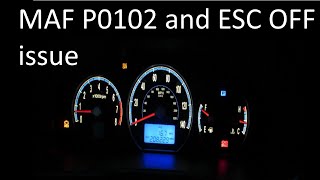
🎬 Watch: How the P0102 code triggers the ESC Off light.Symptoms You May Notice
- Check Engine Light is on
- Engine runs rough, especially at idle
- Stalling, particularly when shifting into gear or coming to a stop
- Hesitation or lack of power during acceleration
- Black smoke from the exhaust
- Poor fuel economy
- ESC (Electronic Stability Control) light may illuminate
- Hard starting
- Replacing oxygen (O2) sensors. While fuel trim issues can be related, P0102 points directly to the MAF circuit, which should be diagnosed first.
- Replacing the throttle body. Unless there are specific throttle-related codes, the throttle body is not a common cause for P0102.
Most Likely Causes
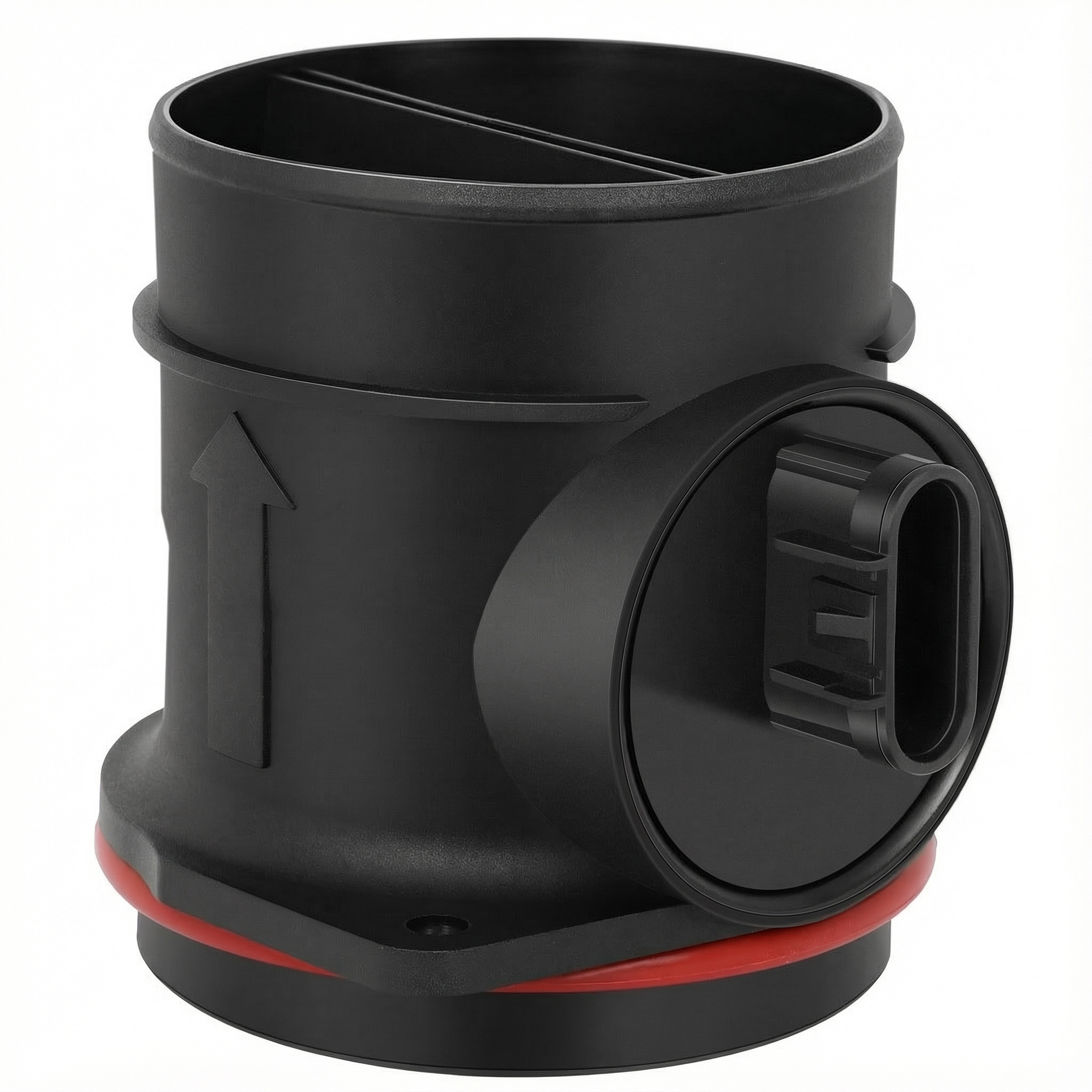
- Dirty or Contaminated MAF Sensor 🔴 High Probability → Shop Fuel Injection Air Flow Meter Over time, oil vapors from the PCV system and fine dust particles that get past the air filter can coat the sensor's delicate hot wire, insulating it and causing it to read airflow incorrectly. This is the most common reason for P0102.
How to confirm: Visually inspect the sensor's internal wires. If they appear coated in grime or oil, they need cleaning. This is the most common cause and the first thing to check.
Typical fix: Remove the sensor and clean it thoroughly with a dedicated Mass Air Flow sensor cleaner spray. Do not touch the sensor wires with anything. Let it air dry completely before reinstalling.
Est. part cost: $10-$20 for a can of MAF cleaner. - Failed MAF Sensor 🟡 Medium Probability → Shop Fuel Injection Air Flow Meter While cleaning often works, the sensor's internal electronics can fail with age and heat cycles, especially on higher-mileage vehicles. A common failure mode is the sensor getting 'stuck' at a low voltage reading regardless of actual airflow. MAF sensors on many vehicles have a high failure rate between 100,000 and 125,000 miles.
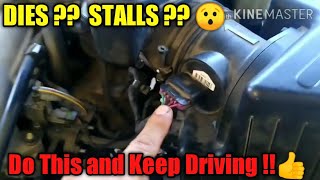
How to confirm: If cleaning the sensor and replacing the air filter does not resolve the code, and there are no visible wiring issues or vacuum leaks, the sensor itself has likely failed. A scan tool can monitor live MAF data (g/s). At idle, it should read a few g/s and increase smoothly as RPMs rise. If the reading is stuck near zero or doesn't change, the sensor is bad. A quick diagnostic trick is to disconnect the MAF sensor; if the engine runs better, the sensor is likely faulty 🎬 See this quick diagnostic trick for a stalling Santa Fe. and sending bad data.
Typical fix: Replace the MAF sensor assembly.
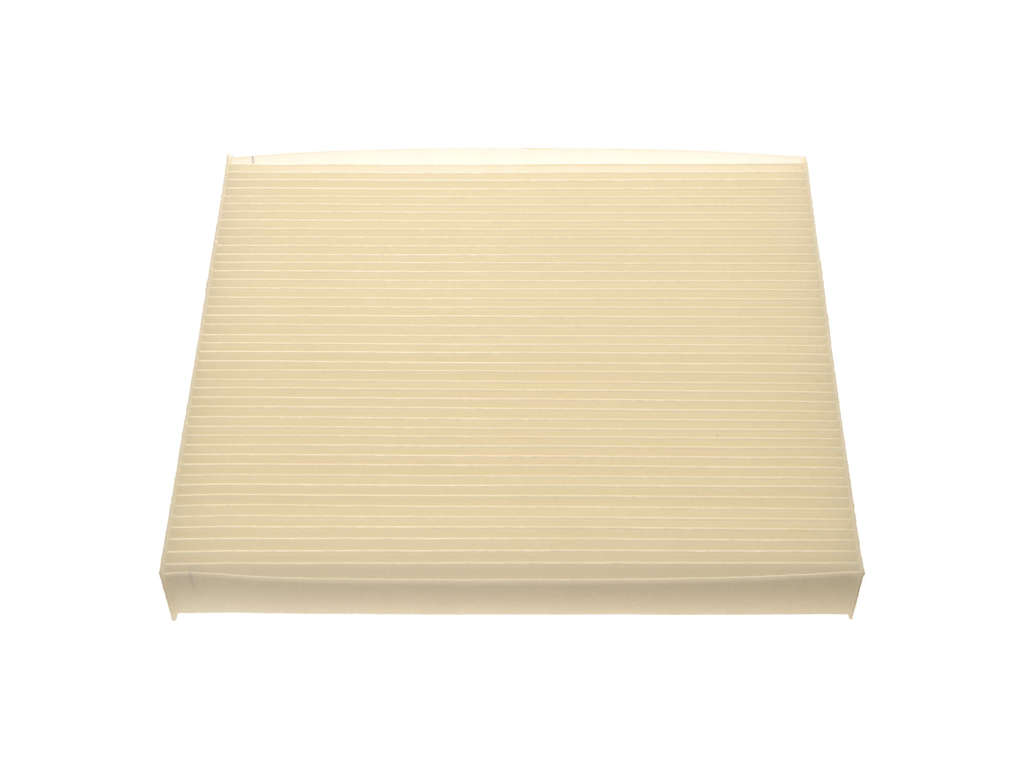
Est. part cost: $50-$120 for aftermarket, $125-$200 for OEM. - Clogged or Dirty Engine Air Filter 🟡 Medium Probability → Shop Air Cleaner Assembly A severely clogged air filter restricts the amount of air entering the intake, which can cause the MAF sensor to report a legitimately low airflow value, triggering the code.
How to confirm: Remove the engine air filter and inspect it. If it is visibly black, full of debris, or has not been changed in a long time, it is likely a contributing factor.
Typical fix: Replace the engine air filter.
Est. part cost: $20-$40 - Vacuum Leak or Cracked Intake Boot ⚪ Low Probability The plastic and rubber components of the air intake system can become brittle and crack over time, allowing unmetered air to enter the engine after the MAF sensor. This unmetered air doesn't get measured, causing the engine to run lean while the sensor reports low airflow.
How to confirm: Visually inspect the air intake tube between the MAF sensor and the throttle body for cracks or loose connections. Listen for a hissing sound at idle, which can indicate a vacuum leak. A smoke test is the most definitive way to find a leak.
Typical fix: Repair the source of the leak, which may involve replacing the intake boot or a cracked vacuum hose.
Est. part cost: $30-$100 for a new intake boot.
Rare But Worth Checking
- Wiring or Connector Issue: Check the MAF sensor's electrical connector for corrosion, pushed-out pins, or damaged wires. A bad ground connection or a short in the signal wire can also cause this code. Wiggling the harness while watching live data on a scan tool can sometimes reveal an intermittent connection issue.
Diagnosis Steps
- Read the code: Use an OBD-II scanner to confirm P0102 is the primary code and check for any other codes.
- Inspect the Air Filter: Open the airbox and check the engine air filter. If it's dirty, replace it before proceeding.
- Inspect the Intake System: Check the air intake tube between the airbox and the throttle body for any visible cracks, tears, or loose clamps. Ensure all connections are tight.
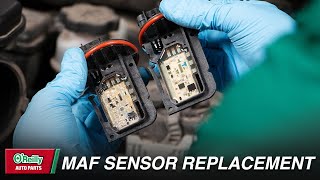
- Clean the MAF Sensor: Disconnect the battery. Unplug the MAF sensor's electrical connector. Remove the sensor from the intake tube (usually two 10mm bolts or screws). Spray the sensor's internal elements liberally with dedicated MAF sensor cleaner. Do not touch the wires. Allow it to air dry completely for at least 15-20 minutes. 🎬 Watch: A step-by-step guide to cleaning and replacing your sensor.
- Reinstall and Test: Reinstall the clean, dry sensor, reconnect the connector and battery, and clear the code. Start the engine and go for a test drive to see if the code returns.
- Check Wiring: If the code returns, inspect the MAF sensor connector for corrosion or loose pins. Check the wiring harness for any signs of damage or fraying. Use a multimeter to verify power, ground, and signal integrity at the connector.
- Monitor Live Data: Use a scan tool to observe the MAF sensor reading in grams per second (g/s). At idle, it should be stable (e.g., ~3-5 g/s for a V6). As you increase RPM, the g/s value should increase smoothly. If it's stuck at a very low number or doesn't respond, the sensor is bad.
- Consider Replacement: If all the above steps fail to resolve the issue, the MAF sensor itself has likely failed and needs to be replaced.
Parts You'll Likely Need
- Mass Air Flow (MAF) Sensor
(OEM #28164-3C100)— This is the most likely part to have failed if cleaning does not resolve the issue. The OEM part number 28164-3C100 is widely cited for the 2.7L and 3.3L V6 engines used in the 2007-2009 Santa Fe. The 2.4L I4 and 3.5L V6 (2010-2012) may use a different part number (e.g., 28164-2S000); always verify with VIN.
Trusted brands: Hyundai (OEM), Bosch, Delphi, Denso
OEM price range: $125-$200
Aftermarket price range: $50-$120 - MAF Sensor Cleaner — This is required for the first and most common troubleshooting step.
Trusted brands: CRC, WD-40 Specialist
Aftermarket price range: $15-$20 - Engine Air Filter
(OEM #28113-2B000 (2.4L), 28113-0W500 (V6))— A clogged air filter is a common contributing cause and should be replaced as part of routine maintenance.
Trusted brands: Hyundai (OEM), Wix, Fram, Purolator
OEM price range: $30-$50
Aftermarket price range: $20-$40
Related Codes That Often Appear With This One
- P0101 — P0101 (MAF Circuit Range/Performance) is a related code that indicates the sensor's readings are out of the expected range, which can occur for the same reasons as P0102.
- P0103 — P0103 (MAF Circuit High Input) can sometimes appear alongside P0102 if the sensor is failing intermittently or has significant wiring issues.
- P0113 — P0113 (Intake Air Temperature Sensor Circuit High) can sometimes appear with P0102 because the IAT sensor is often integrated into the same housing as the MAF sensor. A problem with the shared connector or ground can trigger both codes.
Platform-Specific Known Issues
- On some Santa Fe models, a failing MAF sensor can cause the 'ESC Off' light to illuminate on the dashboard. The engine's poor performance can be interpreted by the vehicle's computer as a condition where the stability control system cannot operate effectively, leading it to be disabled. Resolving the P0102 code by cleaning or replacing the MAF sensor typically resolves the ESC light issue as well.
Mechanic-Grade Diagnostic Values
- MAF Sensor Live Data (g/s) at Idle — expected: 2 to 7 g/s, depending on engine size and conditions.. Failure: A reading stuck near zero or one that does not increase smoothly with RPM.
- MAF Sensor Live Data (g/s) at 2500 RPM — expected: 15 to 25 g/s, depending on engine size.. Failure: A reading that is significantly lower than the expected range, or one that does not rise in a linear fashion with RPM.
- MAF Sensor Signal Wire Voltage — expected: A voltage that increases smoothly from idle as RPMs rise. A graph of MAF voltage should rise in parallel with a graph of the Throttle Position Sensor (TPS) voltage during acceleration.. Failure: Voltage is stuck low, does not respond to RPM changes, or rises too slowly compared to the TPS.
Scan Tool Commands That Help
- Hyundai GDS (Global Diagnostic System): Resetting Adaptive Values — After replacing the MAF sensor, it is good practice to use this function to clear the old learned fuel trim and airflow values from the Engine Control Module (ECM). This forces the ECM to relearn values with the new sensor, potentially improving performance faster.
- Hyundai GDS (Global Diagnostic System): Data Analysis / Live Data Graphing — Use this to graph the MAF sensor (g/s or voltage) and Throttle Position Sensor (%) simultaneously. During a gradual increase in RPM, the two graphs should rise in parallel. A MAF graph that lags, is erratic, or flat-lines indicates a problem with the sensor or its circuit.
Wiring & Ground Locations
- MAF Sensor Signal Wire — For the 2008 Santa Fe 2.7L, the MAF signal wire is BROWN. For the 3.3L, it is YELLOW. This wire runs from the MAF sensor connector to the Powertrain Control Module (PCM).. This is the specific wire to back-probe with a multimeter to test for correct voltage output from the sensor. A low or non-responsive signal on this wire points to a bad sensor or a wiring fault.
- PCM Connector C30-A, Pin 47 — This is the pin for the Mass Air Flow Sensor signal input at the Powertrain Control Module (PCM) for a 2008 Santa Fe 2.7L.. Allows for continuity testing of the signal wire between the sensor and the PCM. If voltage is good at the sensor but bad at this pin, there is a break or short in the wiring harness.
- Ground G03 / G04 — Located under the center console.. The PCM and various engine sensors rely on clean ground connections. While not directly for the MAF sensor itself, a poor main PCM ground can cause a variety of incorrect sensor readings and codes, including P0102.
Real Owner Repair Stories
- YouTube user 'Design Build Fix Review' (Hyundai Santa Fe, approx. 200,000 miles (year not specified but within 2007-2012 generation)) — Check Engine Light and 'ESC Off' light were both illuminated. OBD-II code was P0102.
❌ Tried (didn't work) Cleaning the MAF sensor with dedicated cleaner spray.
✅ What actually fixed it Replacing the entire MAF sensor assembly with a new genuine Hyundai part. After replacement, both the P0102 code and the ESC Off light were resolved.
OEM Part Supersession History
28164-3C100→N/A— This part number remains the standard OEM replacement for V6 models in the 2007-2009 range.
Heads up: This part is specified for the 2.7L and 3.3L V6 engines. It is not compatible with the 2.4L I4 or 3.5L V6 engines found in the 2010-2012 refresh models, which use a different sensor (e.g., 28164-2S000).
Model Year Variations Within This Range
- 2007-2009: These models primarily used the 2.7L and 3.3L V6 engines. The correct OEM MAF sensor is part number 28164-3C100.
- 2010-2012: These facelift models introduced the 2.4L I4 and 3.5L V6 engines. They use a different MAF sensor and housing design. For example, the 2.4L uses part number 28164-2S000 and the 3.5L may use 28164-3C100. It is critical to verify the part number by VIN for these years due to engine changes.
Diagnostic Flowchart
Other Known Issues on This Vehicle
Issues unrelated to this code that are worth knowing about as an owner of this generation:
- Faulty Fuel Level Sensor 🟠 Medium — Very common, often occurs around 80,000-100,000 miles. Causes erratic fuel gauge readings and can trigger a Check Engine Light. (Ref: No recall, but widespread owner complaints. Repair involves replacing two sending units in the fuel tank.)
- Leaking Valve Cover Gaskets (V6 models) 🔴 High → Shop Engine Valve Cover — Common on the 3.3L V6. The front gasket leaks oil directly onto the alternator, causing alternator failure and potential stalling. (Ref: Hyundai issued a service campaign (not a full recall) to address this, sometimes involving a new gasket and a deflector shield.)
- Failing Crankshaft Position Sensor 🔴 High — A known issue that can cause intermittent stalling while driving or a no-start condition.
- Transmission Hesitation / Hard Shifting 🟡 Low — Some owners report jerky shifting or hesitation, particularly in earlier model years of this generation. (Ref: Software updates for the Transmission Control Module (TCM) were released to address some shift quality issues.)
- Engine Oil Consumption (Theta II 2.4L) 🔴 High — The 2.4L engine in 2010-2012 models can be prone to excessive oil consumption, related to broader issues with the Theta II engine family that led to recalls and lawsuits in other Hyundai/Kia models. (Ref: Part of a larger series of engine-related recalls and warranty extensions for Theta II engines, though specific coverage can vary.)
Used vs. New Parts: Buying Guide for This Vehicle
When a used part is the smart pick: A used OEM MAF sensor from a low-mileage donor vehicle can be a cost-effective alternative to a new aftermarket part, as some aftermarket sensors have questionable quality control and may not match the factory calibration curve precisely. Given the electronic nature of the part, it's a moderate risk.
Donor-vehicle mileage cap: roughly under 80000 miles for the part to have meaningful remaining life.
What to inspect on the donor part:
- Check for a clean donor vehicle; avoid parts from cars with signs of engine sludge or a very dirty engine bay.
- Inspect the connector pins for any corrosion or damage.
- Ensure the delicate sensor wires inside the housing are physically intact and not broken or coated in oil.
- Ask for the donor vehicle's VIN to verify mileage and confirm part number compatibility.
OEM-only on this vehicle (don't cheap out):
- While not strictly 'OEM-only', many professional mechanics recommend using a genuine Hyundai/Kia (or the original supplier like Bosch/Denso) MAF sensor to avoid calibration issues that can persist even with a new aftermarket part.
Aftermarket brands forum-validated for this vehicle:
- Bosch
- Delphi
- Denso
- Walker Products
Brands owners have reported issues with on this vehicle:
- Unbranded, no-name sensors from online marketplaces are a significant risk and often fail quickly or are dead-on-arrival.
Real Owner Stories
Aggregated from forums and TSBs cited above. Mileages and costs reflect what owners reported in those sources.
2009 Hyundai Santa Fe 3.3L V6
Symptoms: Owner experienced issues leading to P0102 and P0103 codes being triggered.
What fixed it: Replacement of the Mass Air Flow (MAF) sensor assembly.
Source hint: YouTube video '2009 Hyundai Santa Fe 3 3 MAF Sensor Replacement Code P0102 and 0103 Problem Solved'
2007-2012 Hyundai Santa Fe
Symptoms: The 'ESC Off' light illuminated on the dashboard in conjunction with the MAF P0102 fault code.
What fixed it: Cleaning or replacing the MAF sensor resolved both the engine code and the stability control light.
Source hint: YouTube video 'MAF P0102 and ESC Off problem on a Santa Fe'
Related OBD-II Codes
Frequently Asked Questions
Why is my ESC Off light on at the same time as the P0102 code on my Santa Fe?
My 2009 Santa Fe 3.3L is stalling and has a P0102 code; what is the first thing I should check?
Is there a specific mileage when the MAF sensor usually fails on these vehicles?
Could a transmission issue be related to my P0102 code?
What part number should I look for if I need to replace the MAF sensor on a V6 Santa Fe or Veracruz?
Can I use any cleaner to fix the MAF sensor wires?
Helpful Videos
Used OEM Parts in Stock
New Aftermarket Parts Available

The information in this article is provided for general reference and educational purposes only. Vehicle specifications, procedures, and part compatibility can vary by production date, trim level, and region. Always consult your vehicle's factory service manual and verify part numbers before purchasing or performing repairs. Safety-critical components such as airbags, seat belts, and braking systems should be installed by a qualified professional.
- Hyundai Santa Fe:
- 🧭 Diagnostic Flowchart
- 🎬 Helpful Videos
- 🛍️ Shop This Part
- What's Unique About the 2007-2012 Hyundai Santa Fe
- Symptoms You May Notice
- Most Likely Causes
- Rare But Worth Checking
- Diagnosis Steps
- Parts You'll Likely Need
- Related Codes That Often Appear With This One
- Platform-Specific Known Issues
- Mechanic-Grade Diagnostic Values
- Scan Tool Commands That Help
- Wiring & Ground Locations
- Real Owner Repair Stories
- OEM Part Supersession History
- Model Year Variations Within This Range
- Other Known Issues on This Vehicle
- Used vs. New Parts: Buying Guide for This Vehicle
- Real Owner Stories
- 2009 Hyundai Santa Fe 3.3L V6
- 2007-2012 Hyundai Santa Fe
- Related OBD-II Codes
- Frequently Asked Questions
- 🎟️ Get 5% Off