

P0108 on 2000-2005 Chevrolet Impala 3.4L: MAP Sensor High Voltage Causes and Fixes
On a 2000-2005 Impala with the 3.4L V6, code P0108 almost always points to a failed Manifold Absolute Pressure (MAP) sensor. It's a very common, inexpensive, and easy DIY fix, typically costing $25-$60 for a new sensor. Before replacing, quickly check its vacuum hose for cracks.
- P0108 on your Impala means the engine computer is seeing an abnormally high voltage from the MAP sensor.
- The most likely cause is a failed MAP sensor, which is an easy and inexpensive part to replace yourself in about 15 minutes.
- Before buying a new sensor, always check its vacuum hose for cracks or loose connections, as this can cause the same code.
- If you also have a coolant leak, suspect a failed lower intake manifold gasket, a known issue on the 3.4L V6 engine.
- Ignoring this code can lead to poor performance, bad gas mileage, and eventual damage to your catalytic converter.
What's Unique About the 2000-2005 Chevrolet Impala
The 3.4L LA1 V6 engine, shared with vehicles like the Pontiac Grand Am and Oldsmobile Alero, is known for a specific issue that can mimic a bad MAP sensor: lower intake manifold (LIM) gasket failure. The original plastic/silicone gaskets can degrade over time from exposure to Dex-Cool coolant, causing both coolant and vacuum leaks. A significant vacuum leak from a failed gasket can reduce manifold vacuum, causing the MAP sensor to report a higher pressure and trigger a P0108 code. While the MAP sensor itself is still the most frequent cause, a coolant leak or overheating symptoms alongside a P0108 code strongly suggests a failing LIM gasket on this particular engine.
Symptoms You May Notice
- Check Engine Light is on
- Rough or unstable idle
- Poor fuel economy
- Hesitation or stumbling during acceleration
- Reduced engine power
- Black smoke from the exhaust
- Engine may stall when coming to a stop
- Hard starting
- In rare, severe cases, a crank-no-start condition
- Replacing the Mass Airflow (MAF) sensor. The Impala has both a MAP and a MAF sensor, and while they both measure air, they have different functions. P0108 is specific to the MAP sensor circuit.
Most Likely Causes
- Faulty Manifold Absolute Pressure (MAP) Sensor 🔴 High Probability → Shop Manifold Absolute Pressure Sensor This is a very common failure point on the GM 3.4L V6 due to age, heat cycles, and vibration. It is the most frequent cause of P0108.
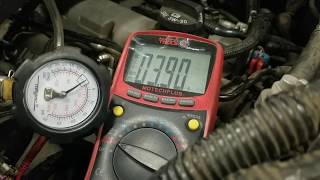
How to confirm: With the key on and engine off, use a scan tool to check the MAP sensor reading. It should match the BARO (barometric pressure) reading and show around 4.5-4.8 volts. With the engine idling, the voltage should drop significantly to around 1.0-1.5 volts. If the voltage is stuck high (near 5 volts) or doesn't change with engine vacuum, the sensor is bad.
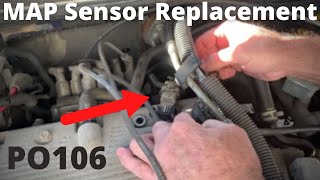
Typical fix: Replace the MAP sensor. On the 3.4L, it is mounted on a bracket near the throttle body, held by two 7mm bolts. 🎬 Watch: Step-by-step guide to replacing the MAP sensor.
Est. part cost: $25-$60 - Damaged or Disconnected Vacuum Line to MAP Sensor 🟡 Medium Probability → Shop Manifold Absolute Pressure Sensor Rubber and plastic vacuum lines become brittle and crack with age and exposure to engine heat. This is a common issue on older vehicles.
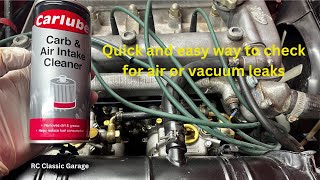
How to confirm: Visually inspect the small rubber vacuum hose that connects to the MAP sensor and the intake manifold. Look for cracks, splits, or loose connections. A smoke test is the most effective way to find a leak. Spraying carb cleaner near the hose with the engine running may cause a noticeable change in idle speed, indicating a leak.
Typical fix: Replace the cracked or broken vacuum hose.
Est. part cost: $5-$15 - Wiring or Connector Issue ⚪ Low Probability Wiring can become brittle or corroded over time, especially the connector at the sensor due to engine heat and vibration.
How to confirm: Inspect the MAP sensor's electrical connector and wiring for damage, corrosion, or loose pins. With the key on, use a multimeter to check for a 5-volt reference signal and a good ground at the connector. Wiggle the harness while monitoring the sensor voltage on a scan tool to see if the reading fluctuates, which would indicate a wiring short.
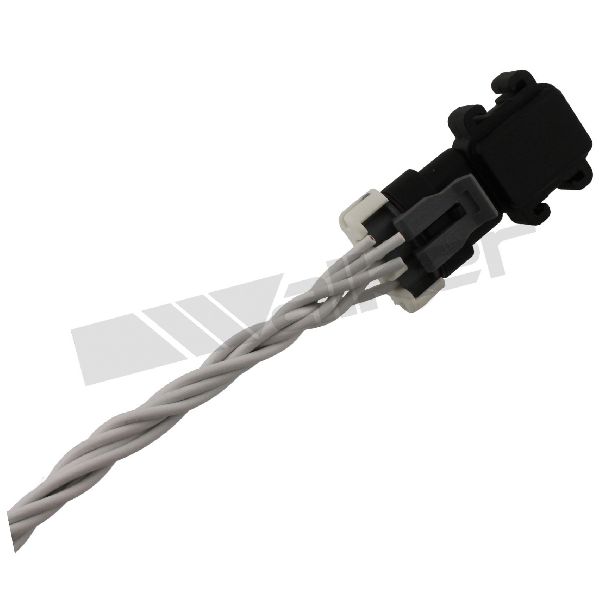
Typical fix: Repair the damaged section of wiring or replace the connector pigtail.
Est. part cost: $10-$30
Rare But Worth Checking
- Failed Lower Intake Manifold (LIM) Gaskets: This is a well-known, chronic issue on the GM 3.4L V6 (TSB #03-06-01-010B). A significant vacuum leak from a failed gasket can cause a P0108 code. This is usually accompanied by a coolant leak (often internal, so no drips on the ground), unexplained coolant loss, or milky residue on the oil cap. If you have these symptoms together, the LIM gasket is a strong suspect.
- Clogged Catalytic Converter: A severely restricted exhaust creates backpressure in the intake manifold, which can cause the MAP sensor to read higher than expected. This is usually accompanied by a severe loss of power, especially at higher RPMs, and potentially other codes like P0420.
- Faulty Powertrain Control Module (PCM): → Shop Engine Control Module (ECM) This is extremely rare. The PCM should only be considered after all other possibilities, including the sensor, wiring, and major vacuum leaks, have been definitively ruled out.
Diagnosis Steps
- Read the code with an OBD-II scanner to confirm P0108 is present.
- Perform a visual inspection. Check the MAP sensor's vacuum hose for any cracks, disconnections, or blockages. Inspect the electrical connector and wiring harness for obvious damage, corrosion, or loose pins.
- Use a scan tool to observe live data. With the Key On, Engine Off (KOEO), the MAP sensor reading should be around 4.5-4.8 volts and should be nearly identical to the Barometric Pressure (BARO) sensor reading.
- Start the engine. At idle, the MAP sensor voltage should drop significantly to 1.0-1.5 volts. If the voltage remains high (e.g., above 4.0 volts), it indicates a problem.
- Test the circuit. If the voltage is stuck high, disconnect the sensor. The voltage reading on the scan tool for the signal wire should drop low (near 0V). If it does, the sensor is faulty. If it stays high, there is a short to voltage in the signal wire that needs to be traced.
- If the sensor and wiring seem okay, check for a major vacuum leak. A smoke test is the most effective method. The most likely source on this engine is the lower intake manifold gasket, especially if there are signs of a coolant leak or overheating.
- As a final, less common check, inspect for a restricted exhaust system (e.g., a clogged catalytic converter), which can cause abnormally high pressure in the intake.
Parts You'll Likely Need
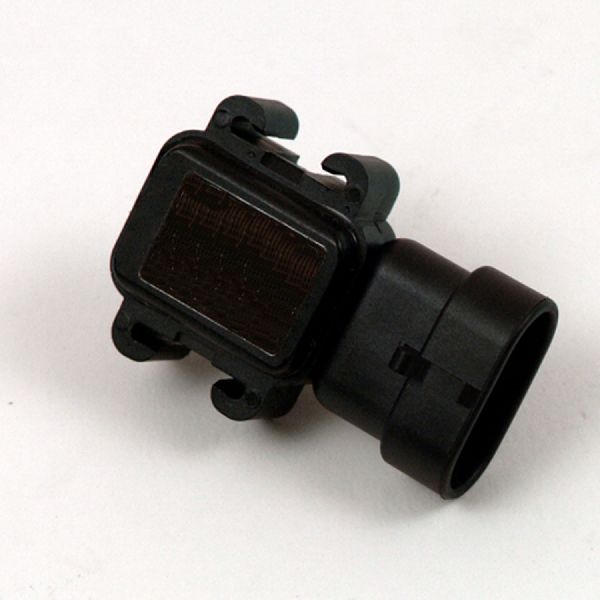
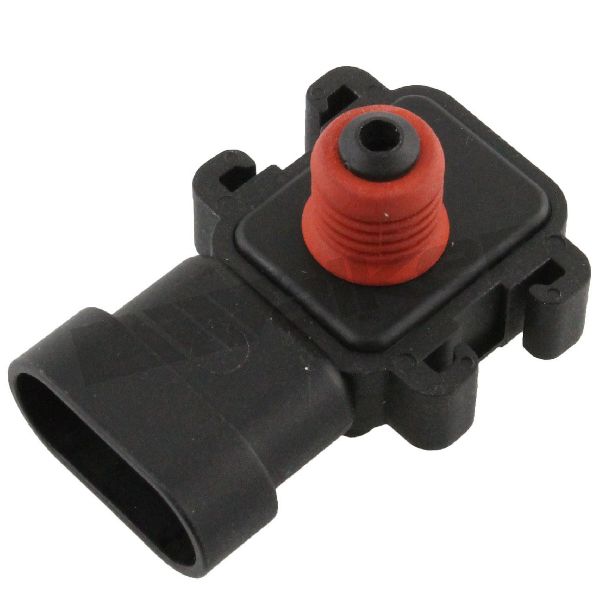
- Manifold Absolute Pressure (MAP) Sensor
(OEM #16249939)— This is the most common component to fail and directly cause a P0108 code.
Trusted brands: ACDelco, Delphi, Standard Motor Products (SMP), NTK
OEM price range: $50-$80
Aftermarket price range: $25-$60 - Lower Intake Manifold Gasket Set (Updated Design)
(OEM #Fel-Pro MS 98014 T)— If the root cause is a vacuum leak from the notorious LIM gasket failure, this updated metal-frame gasket set is the correct and permanent fix.
Trusted brands: Fel-Pro
OEM price range: N/A (OEM was the faulty design)
Aftermarket price range: $60-$90
Related Codes That Often Appear With This One
- P0106 — This code indicates a MAP sensor performance/range issue. It can appear with P0108 if the sensor's signal is erratic before it fails completely high.
- P0107 — This code for 'MAP Circuit Low Input' can sometimes appear intermittently if there is a wiring short that causes the voltage to fluctuate between high and low before settling on one fault.
- P0300 — A 'Random/Multiple Cylinder Misfire' code can be triggered because the incorrect MAP sensor reading leads to a severely imbalanced air/fuel mixture, causing misfires.
Technical Service Bulletins (TSBs) & Recalls
- No Technical Service Bulletins (TSBs) were found specifically for code P0108 on this vehicle. However, TSB #03-06-01-010B is highly relevant as it addresses the lower intake manifold gasket failure on the 3.4L LA1 engine, a common underlying cause of vacuum leaks that can trigger a P0108.
- Manufacturer service bulletins for other GM models, such as TSB Bulletin #N212330660 and TSB Bulletin #PIP5787A, confirm that a faulty MAP sensor is a primary cause for the Service Engine Soon lamp and DTC P0108, requiring sensor replacement.
Platform-Specific Known Issues
- The 3.4L LA1 V6 is widely known for failures of the lower intake manifold gaskets, which can cause both vacuum and coolant leaks. A large vacuum leak from this gasket failure can be a root cause of the P0108 code. GM issued TSB #03-06-01-010B for this issue, and the recommended fix is to use an updated metal-framed gasket set (like Fel-Pro MS 98014 T) instead of the original failure-prone plastic ones. 🎬 Watch: How to remove components for a lower intake gasket repair.
Mechanic-Grade Diagnostic Values
- MAP Sensor 5V Reference (KOEO) — expected: 4.8V to 5.2V. Failure: Voltage below 4.8V or above 5.2V indicates a PCM or wiring issue. If the voltage is low, it could be pulled down by a shorted sensor on the same circuit.
- MAP Sensor Ground Circuit (KOEO) — expected: Less than 100mV (0.10V). Failure: Voltage significantly higher than 0.1V indicates a poor ground connection, which can cause incorrect sensor readings.
- MAP Sensor Signal Wire (KOEO) — expected: ~4.5V (at sea level, should match BARO). Failure: Voltage stuck at 5V or near 0V. If voltage is stuck high, it points to a bad sensor or a short to power.
- MAP Sensor Signal Wire (Engine Idling) — expected: 1.0V to 1.7V (high vacuum). Failure: Voltage remains high (e.g., above 2.5V) at idle, indicating a bad sensor, a major vacuum leak, or a restricted exhaust.
- Engine Vacuum at Idle — expected: 17-21 in. Hg. Failure: A reading of less than 15 in. Hg suggests a significant vacuum leak (like a failed LIM gasket) or a worn engine.
Scan Tool Commands That Help
- Tech2 / GDS2: MAP vs BARO Comparison (KOEO) — This is the first and most crucial data check. With the Key On, Engine Off, the MAP sensor reading in kPa should be nearly identical to the Barometric Pressure (BARO) sensor reading. A significant difference points to an immediate sensor or circuit fault.
- Tech2 / GDS2: Graphing MAP Sensor Voltage — While driving or performing throttle 'snaps' in the bay, graphing the MAP voltage allows a technician to see if the signal is smooth and responsive. A glitchy, erratic, or flat-lined graph indicates a failing sensor or wiring issue that might not be apparent with static checks.
Wiring & Ground Locations
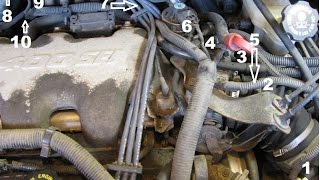
- MAP Sensor Connector — On the MAP sensor, mounted to a bracket near the throttle body.. This is the primary point of failure for wiring issues. The three pins are: Pin A (Gray wire) = 5-Volt Reference, Pin B (Light Green wire) = Signal to PCM, Pin C (Orange/Black wire) = Sensor Ground. These correspond to specific pins on the PCM connectors.
- PCM Connector C1, Pin 25 — At the Powertrain Control Module (PCM), typically located in the air filter housing.. This is the destination for the MAP sensor signal. The Light Green wire (Circuit 432) from the MAP sensor terminates here. Checking for a short to power on this wire is a key diagnostic step if the signal is stuck high even with the sensor disconnected.
- G113 — A ground point located on a transaxle stud, near the starter motor.. This is a major powertrain ground. While the MAP sensor has a dedicated sensor ground from the PCM, a poor main engine/transaxle ground can introduce electrical noise and cause erratic behavior in multiple sensors, including the MAP.
- G111 — A ground point located on the top right of the engine, below the ignition control module.. Another critical engine ground point. Corrosion or looseness here can lead to various difficult-to-diagnose electrical issues, including sensor data problems that could indirectly relate to a P0108.
Real Owner Repair Stories
- ImpalaForums.com user report (2002 Chevrolet Impala 3.4L) — Check Engine Light with code P0108.
❌ Tried (didn't work) Replaced the MAP sensor with a new, presumably aftermarket, part.
✅ What actually fixed it The P0108 code returned after the first replacement. The user then replaced the new sensor with a second, higher-quality brand sensor, which permanently resolved the code. This highlights the issue of poor quality control in some aftermarket electronic parts. - LS1Tech Forum user 'joecar' (GM vehicle with shared 5V reference circuit design) — Initial MAP sensor code (P0107, low input, but same circuit principle).
❌ Tried (didn't work) Replacing the MAP sensor did not fix the voltage issue.
✅ What actually fixed it The root cause was a shorted wire on the EGR valve, which was on the same 5V reference circuit shared by the MAP sensor. The short in the EGR circuit pulled down the reference voltage for the entire circuit, causing the MAP code. The fix was repairing the EGR wiring and replacing the PCM which had been damaged by the short.
OEM Part Supersession History
16187556→16249939— Standard part evolution and consolidation across GM platforms.
Heads up: These parts are generally interchangeable for this application. However, using a known quality brand like ACDelco (the GM OEM provider) or Delphi is highly recommended to avoid performance issues seen with some budget aftermarket sensors.
Model Year Variations Within This Range
- 2000-2005: The core LA1 3.4L engine and its MAP sensor system remained largely unchanged during this period for the Impala. The primary variation affecting this code is the known lower intake manifold gasket issue, which was more prevalent on pre-2003/2004 models before an improved gasket design was implemented from the factory. However, any original gasket can fail with age.
Diagnostic Flowchart
Other Known Issues on This Vehicle
Issues unrelated to this code that are worth knowing about as an owner of this generation:
- Lower Intake Manifold (LIM) Gasket Failure 🔴 High — Extremely common, often occurring between 80,000-150,000 miles. Caused by the original plastic-carrier gaskets degrading from Dex-Cool coolant. (Ref: TSB #03-06-01-010B)
- Passlock Security System Failure 🟠 Medium — Very common. Causes a no-start condition with a flashing security light. Often triggered by a worn ignition switch or key.
- Transmission Pressure Control (EPC) Solenoid Failure 🔴 High — Common failure in the 4T65-E transmission, typically after 90,000 miles. Causes hard, erratic shifting, slips, and jerks.
- Intermediate Steering Shaft Clunk 🟡 Low — A very common issue where the slip-joint in the intermediate shaft wears out, causing a clunking or popping noise in the steering wheel when turning or going over bumps. (Ref: Yes, multiple TSBs exist for this issue.)
- Instrument Panel Gauge Failure 🟠 Medium — Widespread problem where the speedometer, tachometer, or other gauges behave erratically or stop working. Often requires replacing the instrument cluster.
Used vs. New Parts: Buying Guide for This Vehicle
When a used part is the smart pick: A used MAP sensor is generally not recommended. It is an inexpensive electronic part where age and heat cycles are the primary failure mode. A used sensor from a junkyard has unknown history and is likely near the end of its service life. The cost savings are minimal compared to the risk of premature failure and re-diagnosis.
Donor-vehicle mileage cap: roughly under 50000 miles for the part to have meaningful remaining life.
What to inspect on the donor part:
- If considering a used sensor, pull it from the lowest-mileage vehicle possible.
- Inspect the plastic housing for heat-related brittleness or cracking.
- Ensure the connector pins are clean, straight, and free of corrosion.
- Verify the vacuum port is clear and unobstructed.
OEM-only on this vehicle (don't cheap out):
- While not strictly 'OEM-only', using a reputable OE-supplier brand for the MAP sensor is critical. Budget, no-name sensors for this vehicle are a common source of repeat failures.
Aftermarket brands forum-validated for this vehicle:
- ACDelco (Original Equipment)
- Delphi
- Standard Motor Products (SMP)
- NTK/NGK
Brands owners have reported issues with on this vehicle:
- Unbranded, 'white-box' parts from online marketplaces are frequently cited in forums as being dead-on-arrival or failing quickly.
Real Owner Stories
Aggregated from forums and TSBs cited above. Mileages and costs reflect what owners reported in those sources.
2002 Chevrolet Impala 3.4L
Symptoms: Code P0108 reported. After replacing the MAP sensor once, the code returned immediately.
What fixed it: Replacing the MAP sensor a second time with a third, quality-brand sensor resolved the issue, as the first replacement unit was also faulty.
Source hint: ImpalaForums.com: P0108 MAP Sensor High Input
2005 Chevrolet Impala 3.4L
Symptoms: From start-up the engine idles as if someone has foot fully applied to the gas.
What fixed it: Diagnosis of the MAP sensor circuit for high voltage/input issues.
Source hint: Car Talk Community
Related OBD-II Codes
Frequently Asked Questions
Does TSB #03-06-01-010B apply to my 3.4L Impala if I have a P0108 code?
What specific replacement gasket is recommended for the 3.4L LA1 engine to prevent vacuum leaks?
Where is the MAP sensor located on the 2000-2005 Impala 3.4L?
Can a coolant leak cause a P0108 code on this specific vehicle?
What should the MAP sensor voltage read at idle on my 3.4L Impala?
Is there a common wiring issue near the sensor I should check?
Helpful Videos
![How to Fix P0108 Engine Code in 2 Minutes [1 DIY Method / Only $11.6]](https://img.youtube.com/vi/1vsWxWRzbQk/mqdefault.jpg)
We Have This Part in Stock


The information in this article is provided for general reference and educational purposes only. Vehicle specifications, procedures, and part compatibility can vary by production date, trim level, and region. Always consult your vehicle's factory service manual and verify part numbers before purchasing or performing repairs. Safety-critical components such as airbags, seat belts, and braking systems should be installed by a qualified professional.
- Chevrolet Impala:
- 🧭 Diagnostic Flowchart
- 🎬 Helpful Videos
- 🛍️ Shop This Part
- What's Unique About the 2000-2005 Chevrolet Impala
- Symptoms You May Notice
- Most Likely Causes
- Rare But Worth Checking
- Diagnosis Steps
- Parts You'll Likely Need
- Related Codes That Often Appear With This One
- Technical Service Bulletins (TSBs) & Recalls
- Platform-Specific Known Issues
- Mechanic-Grade Diagnostic Values
- Scan Tool Commands That Help
- Wiring & Ground Locations
- Real Owner Repair Stories
- OEM Part Supersession History
- Model Year Variations Within This Range
- Other Known Issues on This Vehicle
- Used vs. New Parts: Buying Guide for This Vehicle
- Real Owner Stories
- 2002 Chevrolet Impala 3.4L
- 2005 Chevrolet Impala 3.4L
- Related OBD-II Codes
- Frequently Asked Questions
- 🎟️ Get 5% Off