

P0108 on 2007-2012 Hyundai Santa Fe 2.2L CRDi: MAP Sensor Circuit High Causes and Fixes
For the 2007-2012 Santa Fe 2.2L CRDi, code P0108 almost always points to a failed MAP/Boost Pressure sensor or a wiring issue. The sensor is typically located on the intercooler. Before replacement, check for soot clogging the sensor port and inspect the wiring. Expect to pay around $60-$150 for an aftermarket sensor, with DIY replacement being straightforward for many owners.
- P0108 on your Santa Fe diesel is most often a bad MAP/Boost sensor, part number 39300-84400.
- Before replacing the sensor, always check its wiring and connector for damage, as this is a common and cheaper fix.
- On this diesel engine, remove the sensor from the intercooler and check for soot buildup blocking the port; cleaning it may solve the problem.
- Symptoms often include black smoke and limp mode, in addition to a Check Engine Light and poor acceleration.
What's Unique About the 2007-2012 Hyundai Santa Fe
On this turbocharged diesel (CRDi) engine, the component that triggers P0108 is often called a 'Boost Pressure Sensor', but it performs the function of a MAP sensor by measuring the air pressure in the intake manifold after the turbocharger. For the D4EB engine, this sensor is most commonly found mounted directly on the intercooler. A common issue specific to these diesel engines is the potential for soot or carbon buildup from the EGR system in the intake, which can clog the small port for the sensor. This can lead to an incorrect high-pressure reading even if the sensor itself is functional. Therefore, cleaning the sensor and its port is a crucial and vehicle-specific diagnostic step.
Symptoms You May Notice
- Check Engine Light is on
- Poor acceleration and loss of power
- Engine may enter 'limp mode'
- Rough or unstable idle
- Engine stalling, especially when coming to a stop
- Decreased fuel economy
- Black smoke from the exhaust
- Replacing the throttle body when it only needs cleaning.
- Replacing the entire turbocharger when the issue is just the boost pressure sensor, its wiring, or a clogged port.
Most Likely Causes
- Faulty MAP / Boost Pressure Sensor 🔴 High Probability The sensor can fail internally from heat cycles and vibration, causing it to send a continuous high voltage signal regardless of actual manifold pressure. This is the most common cause of P0108 when no other codes are present.
How to confirm: With a scan tool, check the MAP sensor reading with the Key On, Engine Off (KOEO). It should read close to atmospheric pressure (BARO), which corresponds to a voltage near 4.5V. If it reads an abnormally high value or if the voltage is stuck near 5V, the sensor is likely bad. At idle, a healthy sensor should read around 30-40 kPa; a failed sensor will often read atmospheric pressure (around 101-102 kPa) at all times.
Typical fix: Replace the MAP sensor. Ensure the new sensor's O-ring is properly seated to prevent leaks.
Est. part cost: $60-$150 - Wiring Harness or Connector Issue 🟡 Medium Probability The wiring harness in the engine bay is exposed to heat and vibration, which can cause wires to fray, break, or short to a power source. The connector pins can also corrode, causing a high resistance or open circuit that the PCM interprets as a high voltage signal. An open ground circuit is a common cause for this code on Hyundai vehicles. NHTSA ODI #11292479 notes a case where a vehicle continued to get a P0108 error code and stalling until the owner removed paint and added electrical gel to all main ground wires to the body/frame.
How to confirm: Visually inspect the wiring harness leading to the MAP sensor for any signs of damage, melting, or corrosion. Use a multimeter to check for a 5V reference, a good ground, and the signal wire at the connector. Wiggle the harness while monitoring the voltage to see if the reading changes, indicating a loose connection or internal wire break.
Typical fix: Repair the damaged section of the wiring harness or clean/replace the connector pigtail.
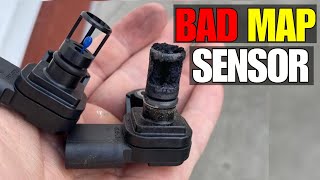
Est. part cost: $5-$50 - Clogged MAP Sensor Port 🟡 Medium Probability → Shop Manifold Absolute Pressure Sensor Diesel engines, especially those with a malfunctioning or dirty EGR system, can accumulate significant soot (carbon) buildup in the intake manifold. This can block the small opening where the sensor measures pressure, trapping pressure and causing a false high reading.
How to confirm: Remove the MAP sensor and inspect its port on the intercooler or intake manifold. If it is clogged with black soot, this is a very likely problem. One owner reported fixing P0108 on a Santa Fe simply by cleaning the port with a swab and alcohol.
Typical fix: Carefully clean the carbon buildup from the sensor port using a small pick and a cloth with intake cleaner. Do not let debris fall into the 🎬 Watch: Tips for cleaning a MAP sensor without full removal. intake manifold. Clean the sensor tip carefully as well.
Est. part cost: $0-$15
Rare But Worth Checking
- Faulty Powertrain Control Module (PCM): → Shop Engine Control Module (ECM) This is extremely rare. The PCM should only be considered after all other possibilities, including the sensor, wiring, and any blockages, have been thoroughly tested and ruled out.
- Clogged Catalytic Converter / DPF: A severely restricted exhaust can cause excessive backpressure in the intake manifold, leading to a legitimate high-pressure reading. This would typically be accompanied by other exhaust-related codes and a more severe, progressive loss of power.
Diagnosis Steps
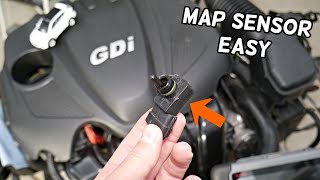
- Connect an OBD-II scanner and confirm P0108 is the primary code. Note any other codes, 🎬 Watch: A quick guide to diagnosing and fixing code P0108. like P0113, which points to a combined sensor failure.
- With the Key On, Engine Off (KOEO), view live data. Compare the MAP sensor pressure reading to the Barometric Pressure (BARO) reading. They should be nearly identical. If the MAP reading is significantly higher, the sensor is likely faulty.
- Start the engine. At idle, the MAP sensor voltage should drop significantly (typically to 1-1.5V) and pressure should be around 30-40 kPa. If it remains high (near 5V / 100+ kPa), this strongly points to a sensor, wiring, or blockage problem.
- Turn off the engine. Locate the MAP sensor on the intercooler. Visually inspect the connector and wiring for any obvious damage, corrosion, or loose connections.
- Disconnect the sensor. Check the harness connector for 5V reference on one pin and a good ground on another using a multimeter. If either is missing, the problem is in the wiring or PCM.
- If power and ground are good, remove the sensor from its mounting location. Inspect the sensor tip and the mounting port for heavy carbon/soot buildup. Clean if necessary, as this is a common fix.
- If no wiring or blockage issues are found, the MAP sensor itself is the most likely culprit and should be replaced with a quality part.
Parts You'll Likely Need
- MAP Sensor / Boost Pressure Sensor
(OEM #39300-84400)— This sensor is the most common failure point for code P0108. It directly measures the pressure that the code reports as being too high. The original part number listed in pass 1 was incorrect for this diesel engine.
Trusted brands: Bosch, Delphi, Mobiletron, NGK
OEM price range: $120-$180
Aftermarket price range: $50-$110
Related Codes That Often Appear With This One
- P0113 — Intake Air Temperature (IAT) Sensor Circuit High. On many Hyundai models, the IAT sensor is integrated into the same housing as the MAP sensor (a 4-wire sensor). A failure of the component or its shared wiring (especially the ground wire) can cause both codes to appear simultaneously.
Platform-Specific Known Issues
- A real-world repair account on an automotive blog highlighted a 2007 Santa Fe with P0108 where the fix was not replacing the sensor, but simply cleaning the carbon buildup from the sensor's port with a swab and alcohol, after which the code cleared.
Mechanic-Grade Diagnostic Values
- MAP Sensor Signal Voltage (KOEO) — expected: ~4.5 V (at sea level, should match BARO). Failure: Voltage is stuck near 5.0V or is significantly different from the BARO sensor reading.
- MAP Sensor Signal Voltage (Engine Idling) — expected: ~1.0 - 1.5 V. Failure: Voltage remains high, near the KOEO reading, indicating it is not responding to engine vacuum.
- Sensor Connector 5V Reference Pin — expected: ~5.0 V (with ignition on, sensor disconnected). Failure: Voltage is 0V or significantly below 5V, indicating a wiring issue or PCM fault.
- Sensor Connector Ground Pin — expected: ~12.6 V (battery voltage) when testing between battery positive and the ground pin.. Failure: Reading is 0V or very low, indicating an open or high resistance in the ground circuit, a common cause for P0108.
Scan Tool Commands That Help
- Hyundai GDS (Global Diagnostic System): Flight Record / Trigger Module — This function is extremely useful for diagnosing intermittent P0108 codes. It allows the technician to record sensor data during a drive cycle when the fault occurs. The recorded data can then be analyzed back at the shop to see the exact behavior of the MAP sensor signal, voltage, and other PIDs at the moment of the fault.
- Hyundai GDS Mobile (VCI-2): Wiggle Test — When a wiring harness issue is suspected, this function zooms in on the live data graph, making it easier to see small, rapid glitches in sensor voltage as you physically wiggle the harness and connectors. This helps pinpoint the exact location of a loose connection or internal wire break.
Wiring & Ground Locations
- MAP/IAT Sensor Connector (4-Pin Type) — On the sensor body, which is typically mounted to the intercooler on the D4EB engine.. This connector provides power, ground, and signal paths. For combined MAP/IAT sensors, a common failure point is the shared ground wire. A broken ground wire will cause both the MAP and IAT sensor signals to read high, triggering P0108 and P0113. Pinout on some models is: Pin 1 (5V Ref), Pin 2 (5V Ref), Pin 3 (Signal), Pin 4 (Ground).
Real Owner Repair Stories
- YouTube channel 'carhospital' (2020 Hyundai Accent (different model, but demonstrates identical P0108/P0113 logic on a 4-wire sensor)) — Check Engine Light with codes P0108 and P0113.
❌ Tried (didn't work) Initial diagnosis pointed towards a bad sensor.
✅ What actually fixed it The technician performed a pinout test at the 4-wire sensor connector and found that the ground wire (brown/orange) was broken further down the harness. Repairing the broken ground wire resolved both fault codes. - AliExpress Blog/Forum Discussion (2007 Hyundai Santa Fe) — Check Engine Light with code P0108.
❌ Tried (didn't work) Sensor replacement was considered but not performed first.
✅ What actually fixed it The owner/mechanic removed the MAP sensor and found the port on the intake manifold was heavily clogged with soot. Cleaning the port with a cotton swab and isopropyl alcohol was enough to fix the issue and clear the code after a short drive. - NHTSA ODI #10629611 — An owner reported finding trouble codes P0335 and P0108 using an OBDII scanner after multiple dealerships claimed nothing was wrong. The owner noted the car almost stalled while trying to cross a busy intersection.
"I Checked Everything" — The Actual Cause
- For code P0108, the equivalent of a 'smoke test clean' scenario is when the sensor and wiring test electronically perfect but the code persists. On the 2.2L CRDi engine, the root cause is often a physical blockage of the sensor's port by soot from the EGR and crankcase ventilation systems. The sensor itself is working, but it is reading a trapped, artificially high pressure, causing the PCM to set the code. Technicians who only perform electrical tests will miss this mechanical/physical cause.
OEM Part Supersession History
39300-2G000→39300-84400— Part has been updated or consolidated by the manufacturer.
Heads up: While 39300-84400 is the replacement, always verify fitment with VIN as there was an engine change during this vehicle's production run.
Model Year Variations Within This Range
- 2007-2009: These earlier models of the 'CM' Santa Fe are equipped with the 2.2L D4EB CRDi VGT engine, producing approximately 150-155 horsepower.
- 2010-2012: The facelifted 'CM' Santa Fe introduced the newer 2.2L D4HB 'R-Series' CRDi engine, which increased power to around 197 horsepower. While the P0108 code is functionally the same, the specific MAP sensor part number and engine components may differ from the earlier D4EB engine.
Diagnostic Flowchart
Other Known Issues on This Vehicle
Issues unrelated to this code that are worth knowing about as an owner of this generation:
- Faulty Fuel Level Sending Unit 🟠 Medium — Very common. The fuel gauge becomes erratic, showing full when empty or vice-versa, or getting stuck at a certain level. Often requires replacing both sending units in the tank.
- Premature Alternator Failure 🔴 High — A widely reported issue where the alternator fails, leading to a battery warning light, dimming/flickering lights, and eventual stalling once the battery is depleted.
- Sticking Turbocharger VGT Actuator 🟠 Medium → Shop Turbocharger — The variable geometry turbo (VGT) actuator can get stuck due to carbon buildup or electronic failure, causing a sudden loss of power and 'limp mode', sometimes with fault code P2563. This is often misdiagnosed as a complete turbo failure.
- AWD Coupler Failure 🟠 Medium — On all-wheel-drive models, the electronic coupler can fail, causing a binding or jerking sensation from the rear of the vehicle during sharp, low-speed turns, like in a parking lot.
Used vs. New Parts: Buying Guide for This Vehicle
When a used part is the smart pick: A used part is a reasonable choice for the wiring harness connector/pigtail if the original is damaged. For the sensor itself, a new part is strongly recommended as internal electronic failures are common and not visible. A used sensor should only be considered if it's from a verified low-mileage wreck.
Donor-vehicle mileage cap: roughly under 50000 miles for the part to have meaningful remaining life.
What to inspect on the donor part:
- For a pigtail, ensure wires are flexible with no cracks in the insulation and the connector lock tab is intact.
- For a sensor, check that the plastic housing is not cracked and the connector pins are clean and straight.
- Ensure the sensor's O-ring is present and not flattened or brittle.
Aftermarket brands forum-validated for this vehicle:
- Bosch
- Delphi
- NGK
Real Owner Stories
Aggregated from forums and TSBs cited above. Mileages and costs reflect what owners reported in those sources.
2007 Hyundai Santa Fe 2.2L CRDi
Symptoms: P0108 trouble code, failed emissions test. The voltage output from the old sensor was stuck at 4.95V.
What fixed it: Replaced the MAP sensor (part number 96440381). The new sensor read 3.1V at idle.
Cost: $25-$30
Source hint: AliExpress (quoting Reddit user in Poland)
2007 Hyundai Santa Fe
Symptoms: P0108 code present.
What fixed it: Cleaning the carbon buildup from the sensor's port with a swab and alcohol.
Source hint: Automotive blog/AliExpress Forum discussion
Hyundai Santa Fe 2.2 CRDI 197KM
Symptoms: Kopci na czarno (smoking black).
What fixed it: Replacement of the manifold pressure sensor (suggested part number 39200-2F000).
Source hint: elektroda.pl
Related OBD-II Codes
Frequently Asked Questions
Can I fix the P0108 code on my 2007 Santa Fe 2.2L CRDi without buying a new sensor?
What should the MAP sensor voltage read on my Santa Fe when the engine is idling?
Is there a specific part number I should look for when replacing the MAP sensor on the 2.2L CRDi?
Why is my Santa Fe 2.2L CRDi blowing black smoke along with the P0108 code?
Where is the MAP sensor located on the 2007-2012 Santa Fe 2.2L diesel?
Could a wiring problem cause P0108 even if the sensor is new?
Helpful Videos

The information in this article is provided for general reference and educational purposes only. Vehicle specifications, procedures, and part compatibility can vary by production date, trim level, and region. Always consult your vehicle's factory service manual and verify part numbers before purchasing or performing repairs. Safety-critical components such as airbags, seat belts, and braking systems should be installed by a qualified professional.
- Hyundai Santa Fe:
- 🧭 Diagnostic Flowchart
- 🎬 Helpful Videos
- What's Unique About the 2007-2012 Hyundai Santa Fe
- Symptoms You May Notice
- Most Likely Causes
- Rare But Worth Checking
- Diagnosis Steps
- Parts You'll Likely Need
- Related Codes That Often Appear With This One
- Platform-Specific Known Issues
- Mechanic-Grade Diagnostic Values
- Scan Tool Commands That Help
- Wiring & Ground Locations
- Real Owner Repair Stories
- "I Checked Everything" — The Actual Cause
- OEM Part Supersession History
- Model Year Variations Within This Range
- Other Known Issues on This Vehicle
- Used vs. New Parts: Buying Guide for This Vehicle
- Real Owner Stories
- 2007 Hyundai Santa Fe 2.2L CRDi
- 2007 Hyundai Santa Fe
- Hyundai Santa Fe 2.2 CRDI 197KM
- Related OBD-II Codes
- Frequently Asked Questions
- 🎟️ Get 5% Off