

P0108 on 2017-2026 Jeep Compass 2.4L: MAP Sensor Circuit High Causes and Fixes
On a 2017-2026 Jeep Compass with the 2.4L engine, code P0108 almost always points to a failed Manifold Absolute Pressure (MAP) sensor. This is a relatively simple and affordable DIY fix, with the part costing between $40 and $90. The issue is also extremely common across all other vehicles using the 2.4L MultiAir engine, like the Jeep Cherokee and Renegade.
- P0108 on your Jeep Compass almost always means you need a new MAP sensor.
- Before buying parts, check your engine oil level, as low oil can cause similar running problems on the 2.4L engine.
- The MAP sensor is located on the back of the intake manifold and is accessible for a DIY replacement, usually from underneath the vehicle.
- A faulty MAP sensor will cause poor fuel economy, rough running, and potential stalling, so it should be fixed promptly to avoid potential catalytic converter damage.
- Always use a quality replacement sensor from a reputable brand like Mopar or Delphi to ensure an accurate and lasting repair.
What's Unique About the 2017-2026 Jeep Compass
The 2.4L MultiAir "Tigershark" engine in the Jeep Compass is a speed-density system, meaning it does not use a Mass Airflow (MAF) sensor. Instead, it relies heavily on the MAP sensor and an intake air temperature sensor to calculate how much air is entering the engine. This makes the MAP sensor's accuracy especially critical for engine operation, and a failure will immediately impact drivability. Additionally, some of these engines are known for excessive oil consumption, which can sometimes cause symptoms that mimic a bad MAP sensor, so it's wise to check the oil level first.
Symptoms You May Notice
- Check Engine Light is on
- Rough or erratic idle
- Hesitation or sluggish acceleration
- Poor fuel economy
- Engine stalling, especially when stopping or at idle
- Black smoke from the exhaust
- Engine may start and then immediately sputter and die
- Replacing spark plugs or ignition coils without diagnosing the MAP sensor circuit first.
- Assuming a vacuum leak, which is more commonly associated with P0106 (performance) or P0107 (low input) codes, not P0108 (high input).
Most Likely Causes
- Faulty MAP Sensor 🔴 High Probability → Shop Manifold Absolute Pressure Sensor The MAP sensor is the most common point of failure for this code on the 2.4L MultiAir engine, as it is a critical sensor with no MAF sensor backup. This is a well-documented issue across all FCA platforms using this engine.
How to confirm: With the key on and engine off, use a scan tool to check the MAP sensor reading; it should match the barometric pressure. With the engine idling, the voltage should be between 1.0-2.0V. A reading stuck high (e.g., near 4.5-5.0V) regardless of engine state indicates a failed sensor.
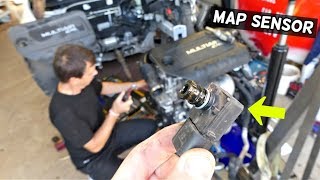
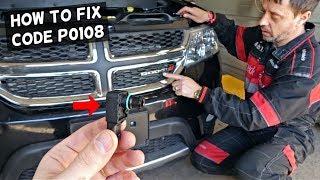
Typical fix: Replace the MAP sensor. It is located on the back of the intake manifold, accessible from underneath the vehicle on the passenger side. 🎬 Watch: How to locate and replace the MAP sensor from underneath.
Est. part cost: $40-$90 - Wiring Harness or Connector Issue 🟡 Medium Probability The MAP sensor is on the back of the engine in a tight space, and the wiring harness can sometimes be damaged, corroded, or not fully seated. In some cases, if harness clips are not re-secured after a repair, the wiring can fall and get damaged by the serpentine belt.
How to confirm: Visually inspect the wiring harness and connector for damage, corrosion, or loose connections. Ensure the connector is fully clipped on. Use a multimeter to check for a 5-volt reference and a good ground at the connector with the key on.
Typical fix: Repair the damaged wiring or clean/replace the connector pigtail.
Est. part cost: $5-$50
Rare But Worth Checking
- Clogged Catalytic Converter: A severely restricted exhaust can cause pressure to build in the intake, leading to a high MAP sensor reading. This is usually accompanied by other codes and a significant loss of power.
- Dirty/Clogged Throttle Body: A very dirty throttle body can disrupt airflow and pressure readings, potentially contributing to a P0108 code. Cleaning the throttle body is a possible, though less common, fix.
- Faulty Powertrain Control Module (PCM): → Shop Engine Control Module (ECM) In rare cases, the PCM itself can fail. A recall (U87 / 18V-524) was issued for some 2018 Compass models for a faulty voltage regulator inside the PCM, which could cause stalling and other issues. TSB 18-031-17 also calls for a PCM software update on some vehicles to address rough idle and stalling, which can present with similar symptoms. This should be considered only after all other possibilities are exhausted.
Diagnosis Steps
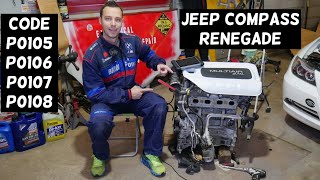
- Read the trouble codes with an OBD-II scanner and confirm P0108 is present. Note any other codes 🎬 Watch: Diagnosing engine light codes P0105 through P0108 on your Jeep. like P1185 or P2172.
- Check the engine oil level. Low oil on the 2.4L MultiAir can cause erratic engine behavior that may be confused with a sensor issue.
- Visually inspect the MAP sensor connector and wiring harness for any signs of damage, corrosion, or loose connections. The sensor is on the back of the intake manifold, often accessed from below.
- Using a scan tool with the Key On, Engine Off (KOEO), check the live data for the MAP sensor. The reading should be close to the Barometric Pressure (BARO) reading.
- Start the engine. At idle, the MAP sensor voltage should drop to around 1.0-2.0 volts.
- If the voltage is stuck high (near 4.5-5.0V) and does not change with engine RPM, the MAP sensor is almost certainly faulty and needs to be replaced.
- If the sensor readings seem plausible, test the wiring. Disconnect the sensor and check for a 5V reference signal and a good ground at the connector using a multimeter.
- If the sensor and wiring are good, the issue may be a severe exhaust restriction or, in very rare cases, the PCM itself.
Parts You'll Likely Need
- Manifold Absolute Pressure (MAP) Sensor
(OEM #68199324AB)— This is the most common failure point for code P0108 on this engine. This part number supersedes previous versions 68199324AA, 5149091AA, and 5033310AC.
Trusted brands: Mopar, Delphi, NGK/NTK, Walker Products
OEM price range: $60-$90
Aftermarket price range: $40-$75
Related Codes That Often Appear With This One
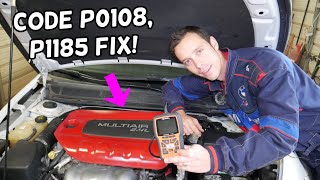
- P1185 — This manufacturer-specific code for 'General Pressure Sensor Correlation' can be triggered when the MAP sensor's reading is illogical compared to other sensors, often appearing alongside P0108. 🎬 See this guide for fixing codes P0108 and P1185 together.
- P2172 — This code for 'Throttle Actuator Control System - Sudden High Airflow Detected' is sometimes reported by owners as a precursor or companion to P0108, as the systems are closely related.
Technical Service Bulletins (TSBs) & Recalls
- 09-003-23 - 2.4L Excessive Oil Consumption XB1 Warranty Extension
- 18-031-17 - Flash: Powertrain Diagnostic and System Enhancements
- TSB Bulletin #18-014-13 - Flash: MIL Illumination P0108- Manifold Absolute Pressure Sensor Circuit High (Cross-manufacturer reference for Jeep platforms involving PCM reprogramming).
Platform-Specific Known Issues
- Recall U87 / NHTSA 18V-524 was issued for some 2018 Jeep Compass models due to a faulty voltage regulator in the Powertrain Control Module (PCM) that could cause stalling. While not directly for P0108, a faulty PCM can cause various sensor codes.
- TSB 09-003-23 addresses excessive oil consumption on 2017-2018 Compass models with the 2.4L engine. While not directly related to the code, low oil levels can cause drivability issues, so it's a good first check.
- TSB 18-031-17 involves a PCM software update for some FCA vehicles to correct issues like rough idle and stalling, which can mimic P0108 symptoms. It's worth checking if your vehicle's software is up to date.
Mechanic-Grade Diagnostic Values
- MAP Sensor 5V Reference — expected: ~5.0 Volts. Failure: Voltage is significantly lower or absent, indicating a PCM or wiring issue.
- MAP Sensor Ground Circuit Voltage Drop — expected: Less than 100 millivolts (0.1V). Failure: Voltage higher than 0.1V indicates a poor ground connection, which will skew sensor readings high.
- MAP Sensor Signal Voltage (Key On, Engine Off) — expected: ~4.5 Volts (at sea level). Failure: A voltage significantly different from the BARO sensor reading, or below 4.0V, suggests a faulty sensor.
- MAP Sensor Signal Voltage (Engine Idling) — expected: 1.0 to 2.0 Volts. Failure: Voltage remains high (near 4.5V) and does not drop when the engine is running, indicating a failed sensor or major vacuum leak.
- MAP Sensor Live Data (Scan Tool) — expected: ~8.3 inHg at idle. Failure: An extremely high reading, such as 75 inHg, is a definitive sign of a faulty sensor.
Hidden / Shadow Codes Worth Checking
- Mode $06, TID $53+: While not a specific shadow code for P0108, Mode $06 can provide raw data from PCM self-tests, including misfire counts for each cylinder. This can be useful to see if the rich condition caused by P0108 is leading to intermittent misfires before a P0300 code is set. (see via A professional OBD-II scanner capable of displaying Mode $06 test results.)
Scan Tool Commands That Help
- OBD-II Scanner / Battery Disconnect: Throttle Body Relearn / Reset — After replacing a MAP sensor or cleaning the throttle body, the PCM's learned throttle values may be incorrect. Performing a relearn procedure ensures the idle is stable. This can be done with some scan tools or by following a manual procedure, such as disconnecting the battery for several minutes and then letting the engine idle to relearn.
Wiring & Ground Locations
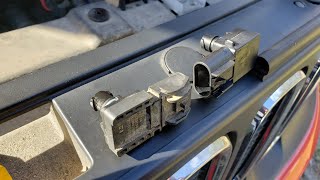
- MAP Sensor Connector (at PCM Connector C2) — The MAP sensor is on the back of the intake manifold. The wires run to the main Powertrain Control Module (PCM) connector C2.. These are the specific pins to test for voltage, ground, and signal when diagnosing a P0108. Knowing the wire colors and pin locations is essential for accurate electrical testing.
- MAP Signal (2017 Model) — Pin 45 on PCM connector C2. Wire is typically Violet/Brown (VT/BN).. This is the wire that carries the pressure reading back to the PCM. A short to power on this wire will cause a P0108.
- MAP Signal (2018+ Model) — Pin 11 on PCM connector C2. Wire is typically Violet/Brown (VT/BN).. Note the pin location change from 2017. Using the wrong pin for testing will lead to misdiagnosis.
- Sensor Ground — Pin 66 on PCM connector C2 (2017 model). Wire is typically Dark Blue/Dark Green (DB/DG).. A bad ground connection here will cause the sensor's voltage reading to be artificially high, directly causing a P0108.
- 5V Supply — Pin 67 on PCM connector C2 (2017 model). Wire is typically Pink/Yellow (PK/YE).. This wire provides the reference voltage. If this voltage is incorrect, the sensor's output will also be incorrect.
Real Owner Repair Stories
- YouTube channel 'Map sensor replacement 2.4 Jeep...' (Jeep Renegade with 2.4L MultiAir engine (platform mate)) — Check engine light with code P2172 (High Airflow Detected).
❌ Tried (didn't work) Visual inspection for vacuum leaks around hoses and throttle body.
✅ What actually fixed it Replacing the MAP sensor. Scan tool data showed the old sensor was reading an impossible 75 inHg at idle, while the new sensor correctly read 8.3 inHg. The part cost approximately $33. - YouTube channel 'Professor Mecânico Parceiro' (Jeep Compass with T270 (1.3L Turbo) engine, 55,000 km) — Check Engine Light with P0108, and harsh, strong jerks from the automatic transmission.
✅ What actually fixed it Replacing the MAP sensor on the intake manifold fixed both the engine code and the transmission shifting issue. The mechanic noted the transmission control module uses MAP data via the CAN bus, so a bad sensor directly affects shift quality. - NHTSA ODI #10631396 (Jeep Platform) — An owner reported a check engine light with DTC P0108. The dealer found that a powertrain flash to reprogram the PCM was required to resolve the issue.
OEM Part Supersession History
5033310AC, 5149091AA, 68199324AA→68199324AB— Standard part revision and consolidation by the manufacturer.
Heads up: No known incompatibilities. The newer part number is a direct replacement for the older versions.
Model Year Variations Within This Range
- 2017 vs 2018+: The pin location for the MAP sensor signal wire at the PCM's C2 connector changed. For 2017 models, it is reportedly at Pin 45. For 2018 and newer models, it is at Pin 11. This is critical for accurate electrical diagnosis.
Diagnostic Flowchart
Real Owner Stories
Aggregated from forums and TSBs cited above. Mileages and costs reflect what owners reported in those sources.
2019 Jeep Compass Trailhawk 2.4L
Symptoms: No crank, no engine movement, just 'ON' position on the dash. Multiple trouble codes including P0108. Main battery was at 8.7 volts, auxiliary at 3 volts.
What fixed it: Diagnosing an electrical or ground-related issue following an engine swap, with the extremely low battery voltages being the primary suspect.
Source hint: Reddit r/AskMechanics
Jeep Compass
Symptoms: After starter repair and battery replacement, the electronic throttle control (lightning bolt) light came on. The engine felt like it was choking or trying to stall, then ran normally. Scanned and found code P0108.
What fixed it: Diagnosing electrical issues after starter and battery replacement.
Source hint: Opinautos
2017 Jeep Renegade 2.4L
Symptoms: Initially had a P2172 code, changed the MAP sensor and oil, and then received the P0108 code. The car would start and then immediately die.
What fixed it: Suspected problem with the new sensor or wiring connection. Another owner fixed their issue by replacing a faulty sensor, which dropped scan tool readings from an incorrect 75 inHg to a normal 8.3 inHg at idle.
Source hint: Reddit r/MechanicAdvice - '2017 Jeep Renegade 2.4L P0108 code'
Related OBD-II Codes
Frequently Asked Questions
Does TSB 09-003-23 apply to my P0108 code on a 2017-2018 Compass?
Is there a recall for the PCM that could cause P0108 on my Compass?
Can a software update fix the rough idle and stalling associated with P0108?
Where is the MAP sensor located on the 2.4L MultiAir engine?
Does the 2.4L MultiAir Compass have a MAF sensor I should check too?
Why is the wiring harness a common cause for P0108 on this specific engine?
Helpful Videos

The information in this article is provided for general reference and educational purposes only. Vehicle specifications, procedures, and part compatibility can vary by production date, trim level, and region. Always consult your vehicle's factory service manual and verify part numbers before purchasing or performing repairs. Safety-critical components such as airbags, seat belts, and braking systems should be installed by a qualified professional.
- Jeep Compass:
- 🧭 Diagnostic Flowchart
- 🎬 Helpful Videos
- What's Unique About the 2017-2026 Jeep Compass
- Symptoms You May Notice
- Most Likely Causes
- Rare But Worth Checking
- Diagnosis Steps
- Parts You'll Likely Need
- Related Codes That Often Appear With This One
- Technical Service Bulletins (TSBs) & Recalls
- Platform-Specific Known Issues
- Mechanic-Grade Diagnostic Values
- Hidden / Shadow Codes Worth Checking
- Scan Tool Commands That Help
- Wiring & Ground Locations
- Real Owner Repair Stories
- OEM Part Supersession History
- Model Year Variations Within This Range
- Real Owner Stories
- 2019 Jeep Compass Trailhawk 2.4L
- Jeep Compass
- 2017 Jeep Renegade 2.4L
- Related OBD-II Codes
- Frequently Asked Questions
- 🎟️ Get 5% Off