

P0108 on 2017-2024 Mazda CX-5: MAP Sensor Circuit High Causes and Fixes
P0108 on a Mazda CX-5 most often indicates a failed Manifold Absolute Pressure (MAP) sensor. The code is triggered when the PCM sees a voltage signal from the sensor that is higher than the specified range (typically above 4.89V) for a sustained period. Replacing the sensor is a straightforward DIY job, with an aftermarket part costing around $40-$80 and an OEM part (PE02-18-211) costing $90-$160.
- P0108 on a 2017-2024 CX-5 almost always points to a problem with the Manifold Absolute Pressure (MAP) sensor or its circuit, triggered by a voltage reading over ~4.8V.
- The most likely fix is replacing the MAP sensor (OEM Part #: PE02-18-211), which is an inexpensive part and easy to access for a DIY repair.
- Before replacing the sensor, check its live data on a scan tool (should be ~4.5V KOEO, ~1.3V at idle) and inspect the connector for damage or corrosion.
- Do not confuse the MAP sensor with the Mass Airflow (MAF) sensor; P0108 is specific to the MAP circuit.
- If a new sensor doesn't fix the code, the next step is to thoroughly inspect the wiring harness for a short circuit to power on the signal wire.
What's Unique About the 2017-2024 Mazda CX-5
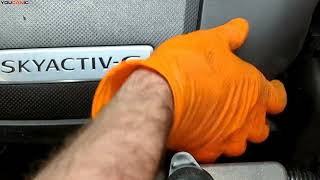
On the Mazda CX-5's Skyactiv-G engines, the MAP sensor is a standalone, easily accessible component mounted directly on the intake manifold. Unlike some vehicles that integrate it with other sensors, its individual placement simplifies diagnosis and replacement. While the code itself is generic, the most common failure point on this platform is the sensor itself rather than more complex issues like wiring harnesses or PCM faults. The PCM has a specific fail-safe strategy for this code, where it will estimate the MAP value using the MAF sensor and engine speed, but may restrict engine speed as a precaution.
Symptoms You May Notice
- Check Engine Light is on
- Rough or unstable idle
- Poor acceleration and engine hesitation
- Increased fuel consumption
- Black smoke from the exhaust
- Engine may stall, especially at idle
- Hard starting or no-start condition
- Replacing the Mass Airflow (MAF) sensor. While both sensors measure air, they have different functions. P0108 specifically points to the MAP sensor circuit. Owners sometimes confuse the two, but the diagnostic procedure is distinct.
Most Likely Causes
- Faulty Manifold Absolute Pressure (MAP) Sensor 🔴 High Probability → Shop Manifold Absolute Pressure Sensor Sensors can fail over time due to heat cycles and internal electronic degradation. This is the most frequently reported fix across Mazda forums and repair databases for a P0108 code.
How to confirm: With the Key On, Engine Off (KOEO), use a scan tool to check if the MAP sensor voltage reading is stuck high, near 5V. It should read around 4.0-4.5V and match the Barometric Pressure (BARO) reading. When the engine is started, the voltage at idle should drop to around 1.2-1.5V. If the voltage remains high, the sensor has failed.
Typical fix: Replace the MAP sensor. It is typically held in by a single bolt or screw and has one electrical connector, making it a 15-minute job.
Est. part cost: $40-$160 - MAP Sensor Circuit Wiring or Connector Issue 🟡 Medium Probability → Shop Manifold Absolute Pressure Sensor
How to confirm: Visually inspect the wiring harness and connector for damage, corrosion, or loose pins. Use a multimeter to check for a 5-volt reference signal and a good ground at the connector. Check for a short to power on the signal wire, which would cause a constant high voltage reading.
Typical fix: Repair the damaged section of wiring or clean/replace the connector pigtail.
Est. part cost: $5-$50 - Clogged Catalytic Converter ⚪ Low Probability
How to confirm: A severely restricted exhaust will cause a loss of power, especially at high RPMs, and can artificially raise pressure in the intake manifold. A technician can perform an exhaust backpressure test to confirm a blockage. This is usually accompanied by other codes like P0420.
Typical fix: Replace the clogged catalytic converter.
Est. part cost: $800-$2000+
Rare But Worth Checking
- Faulty Powertrain Control Module (PCM): → Shop Engine Control Module (ECM) This is very rare. All other possibilities, especially the sensor and its wiring, should be exhaustively ruled out before considering the PCM as the cause.
Diagnosis Steps
- Connect an OBD-II scanner and confirm P0108 is present. Note any other codes, but P0108 is often a standalone code for this issue.
- View live data with the scanner. With the Key On, Engine Off (KOEO), compare the MAP sensor voltage to the BARO reading. They should be nearly identical (around 4.0-4.5V at sea level). A MAP reading stuck at or near 5V points to a bad sensor or a short in the signal wire.
- Start the engine. At idle, the MAP sensor voltage should drop significantly to 1.2-1.5 volts due to engine vacuum. If the reading does not change or stays high, the sensor is likely faulty or its vacuum port is blocked.
- Turn off the engine. Visually inspect the MAP sensor's electrical connector and wiring for any signs of damage, corrosion, or loose connections.
- If wiring looks good, disconnect the sensor. With the key on, use a multimeter to verify you have a 5V reference wire and a good ground wire at the connector. Check the signal wire for any voltage; it should be near 0V with the sensor disconnected. If voltage is present, there is a short to power in the harness.
- If the sensor and wiring test good, consider a possible severe restriction in the exhaust system (e.g., a clogged catalytic converter) that could cause abnormally high manifold pressure.
Parts You'll Likely Need
- Manifold Absolute Pressure (MAP) Sensor
(OEM #PE02-18-211)— This is the most common failure component for a P0108 code. It directly measures the manifold pressure that the code references. This part number is specific to the non-turbo Skyactiv-G engines.
Trusted brands: Mazda (OEM), Denso, Bosch, Standard Motor Products, Goss
OEM price range: $90-$125
Aftermarket price range: $40-$80
Platform-Specific Known Issues
- While not directly causing P0108, owners should be aware that the Skyactiv-G Direct Injection engines can be prone to carbon buildup on the intake valves over time. While Mazda's design aims to minimize this, it can still occur, especially with extensive short-trip driving. Severe buildup could theoretically affect manifold pressure, but it's unlikely to be the primary cause of a P0108 code.
Mechanic-Grade Diagnostic Values
- PCM Fault Trigger Threshold — expected: Input voltage at PCM terminal 1BW should be below 4.89V.. Failure: If voltage is > 4.89 V for 5 seconds, the PCM logs P0108.
- MAP Sensor Voltage (MAP_V PID) — expected: Approx. 4.08 V (Key On, Engine Off at sea level). Failure: Voltage stuck near 5V or significantly different from expected.
- MAP Sensor Voltage at Idle (MAP_V PID) — expected: Approx. 1.25 V (after warm-up). Failure: Voltage does not drop from KOEO reading or stays high.
- Sensor Connector - Reference Voltage — expected: Approx. 5V at the reference wire terminal with key on.. Failure: Significantly less than 5V indicates a wiring or PCM issue.
Scan Tool Commands That Help
- Mazda M-MDS / FORScan: PID/DATA Monitor for 'MAP' and 'MAP_V' — This is the primary function to observe live voltage and pressure readings from the sensor at KOEO and idle to determine if it's responding correctly.
Wiring & Ground Locations
- PCM — Located under the battery tray in the engine compartment.. The PCM is the endpoint for the MAP sensor wiring. If the sensor and its connector are good, testing for a short or open circuit must be done at the PCM connector pins.
- MAP Sensor Signal Wire — Runs from MAP sensor/IAT sensor No.2 terminal D to PCM terminal 1BW.. A short to power on this specific wire is a likely cause for P0108 if the sensor itself is not faulty.
- MAP Sensor Ground Wire — Runs from MAP sensor/IAT sensor No.2 terminal C to PCM terminal 1BO.. An open circuit on this ground wire can cause the sensor's signal voltage to float high, triggering a P0108 code.
- MAP Sensor 5V Reference Wire — Runs from MAP sensor/IAT sensor No.2 terminal A to PCM terminal 1BX.. An open circuit on this wire would cause the sensor to stop functioning, likely triggering a different code (P0107), but a short to a higher voltage source could cause P0108.
- Engine Ground Points — Key grounds are located on the passenger side motor mount, on top of and on the front of the transmission case, and from the driver-side fender area to the negative battery terminal.. While a bad ground is more likely to cause a P0107 (low voltage), a poor PCM ground can cause a variety of unpredictable sensor reading issues, including a floating high signal.
Real Owner Repair Stories
- YouTube user 'The Car Care Nut' (Mazda 6 2.2 Skyactiv (similar MAP sensor diagnostics)) — Check engine light, MAP sensor code.
❌ Tried (didn't work) The owner purchased a new aftermarket MAP sensor.
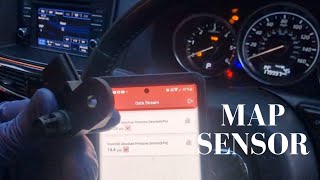
✅ What actually fixed it The new aftermarket MAP sensor was faulty out of the box, providing incorrect live data readings (36.98 PSI vs. a desired 16.35 PSI at KOEO). Swapping in a known-good OEM sensor from a friend's CX-5 showed correct readings (14.5 PSI). The final fix was to use a genuine, working sensor.
Diagnostic Flowchart
Other Known Issues on This Vehicle
Issues unrelated to this code that are worth knowing about as an owner of this generation:
- Cracked Cylinder Head (2.5L Turbo & some NA) 🔴 High — Primarily reported on 2.5T engines, but also some non-turbo models. Can occur outside of warranty. TSB 01-002/23 addresses the issue for some 2019-2020 models by noting coolant leaks near the exhaust manifold. (Ref: TSB 01-002/23)
- Infotainment 'Ghost Touch' 🟡 Low — Common issue on 2017-2020 models where the screen registers phantom touches, causing random inputs. Often resolved by disconnecting the touchscreen ribbon cable, as most users rely on the commander knob. (Ref: SSPB6 (Warranty extension for Mazda 3, but CX-5 has the same issue))
- Rocker Arm Failure (Cylinder Deactivation Engines) 🔴 High — Affects 2018-2019 models with cylinder deactivation. A software issue could cause a rocker arm to dislodge, potentially leading to engine stall and failure. (Ref: Recall 3719F / NHTSA #19V-497)
- Intake Valve Carbon Buildup 🟠 Medium — A known characteristic of all Skyactiv-G direct injection engines. Oil vapors from the PCV system can bake onto the intake valves over time, as they are not washed by fuel. Can cause performance loss at higher mileage. Mazda's design mitigates it, but it's not eliminated.
- Flickering LED Daytime Running Lights (DRL) 🟡 Low — Commonly reported on 2016-2017 models. The gasket around the headlight assembly can fail, allowing moisture in and causing the DRL to flicker or fail completely. Requires replacement of the headlight assembly.
Used vs. New Parts: Buying Guide for This Vehicle
When a used part is the smart pick: A used OEM sensor from a low-mileage donor vehicle can be a cost-effective and reliable alternative to a new aftermarket part. Since the failure mode is typically electronic and not wear-based, a working used part is likely to remain working.
Donor-vehicle mileage cap: roughly under 60000 miles for the part to have meaningful remaining life.
What to inspect on the donor part:
- Ensure the donor vehicle was not in a front-end collision.
- Inspect the connector pins for any signs of corrosion or damage.
- Check that the O-ring is present and not brittle or cracked.
Aftermarket brands forum-validated for this vehicle:
- Denso
- Bosch
Brands owners have reported issues with on this vehicle:
- Unbranded, 'white-box' parts from online marketplaces should be avoided. As seen in a documented repair, a brand-new aftermarket sensor can be faulty out of the box, leading to significant diagnostic confusion.
Real Owner Stories
Aggregated from forums and TSBs cited above. Mileages and costs reflect what owners reported in those sources.
2016 Mazda CX-5
Symptoms: After charging the battery and attempting to start, the vehicle threw 27 different codes including P0108, P0010, P0098, P0118, P0123, P0193, and P0222.
What fixed it: The context indicates this was part of a multi-code electrical/sensor circuit high issue, though the specific final repair for this user isn't detailed beyond the diagnostic report.
Source hint: Mazdas247
Mazda CX-5 (Skyactiv-G)
Symptoms: Owner experienced a P0108 code and sought confirmation on diagnostic steps and potential causes like vacuum leaks.
What fixed it: Replacing the MAP sensor.
Source hint: Mazdas247: "Code: P0108"
Mazda CX-5 (Skyactiv-G)
Symptoms: High voltage reading on the MAP sensor circuit.
What fixed it: Diagnostic testing of the 5V reference and ground; the fix involves replacing the sensor if voltage remains at 4.5V at KOEO and fails to drop to 1.3V at idle.
Source hint: Reddit r/MechanicAdvice: "P0108 - Manifold Absolute Pressure"
Related OBD-II Codes
Frequently Asked Questions
Is there a specific TSB for the P0108 code on my 2019-2020 Mazda CX-5?
Could the carbon buildup issue on my Skyactiv-G engine be causing this P0108 code?
I have a 2018 CX-5 with cylinder deactivation; could my engine stall be related to P0108?
How can I verify if the MAP sensor has failed on my CX-5 using a scan tool?
What is the typical cost to fix a P0108 on a Mazda CX-5?
Does the CX-5 share this MAP sensor issue with other Mazda models?
Helpful Videos

The information in this article is provided for general reference and educational purposes only. Vehicle specifications, procedures, and part compatibility can vary by production date, trim level, and region. Always consult your vehicle's factory service manual and verify part numbers before purchasing or performing repairs. Safety-critical components such as airbags, seat belts, and braking systems should be installed by a qualified professional.
- Mazda CX-5:
- 🧭 Diagnostic Flowchart
- 🎬 Helpful Videos
- What's Unique About the 2017-2024 Mazda CX-5
- Symptoms You May Notice
- Most Likely Causes
- Rare But Worth Checking
- Diagnosis Steps
- Parts You'll Likely Need
- Platform-Specific Known Issues
- Mechanic-Grade Diagnostic Values
- Scan Tool Commands That Help
- Wiring & Ground Locations
- Real Owner Repair Stories
- Other Known Issues on This Vehicle
- Used vs. New Parts: Buying Guide for This Vehicle
- Real Owner Stories
- 2016 Mazda CX-5
- Mazda CX-5 (Skyactiv-G)
- Mazda CX-5 (Skyactiv-G)
- Related OBD-II Codes
- Frequently Asked Questions
- 🎟️ Get 5% Off