

P0113 on 2012-2017 Toyota Camry Hybrid: IAT Circuit High Causes and Fixes
On a 2012-2017 Camry Hybrid, P0113 almost always means the entire Mass Air Flow (MAF) sensor assembly has failed, as it contains the Intake Air Temperature (IAT) sensor. The fix is replacing the MAF sensor, a simple 15-minute DIY job. Expect to pay around $120-$180 for a quality Denso (OEM) replacement part, part number 22204-37010.
- P0113 on this Camry Hybrid means the integrated MAF/IAT sensor has failed electrically.
- Do not look for a separate IAT sensor; you must replace the entire Mass Air Flow (MAF) sensor assembly, part number 22204-37010.
- The repair is very easy for a DIYer, taking only about 15 minutes with basic tools.
- Always use a high-quality replacement part, preferably from the OEM supplier Denso, to ensure accurate readings and avoid future issues.
- Ignoring the code will lead to poor fuel mileage and potential starting problems.
What's Unique About the 2012-2017 Toyota Camry Hybrid
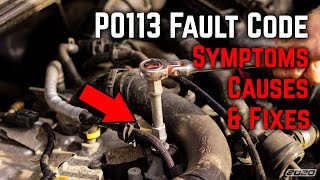
On the 2AR-FXE engine used in the Camry Hybrid, the Intake Air Temperature (IAT) sensor is not a separate, standalone part. Instead, it is integrated directly into the Mass Air Flow (MAF) sensor assembly located on the air intake tube after the air filter box. This design means that a P0113 code, which points to an electrical failure in the IAT circuit 🎬 Watch: P0113 code explained and how to fix it fast, almost always requires the replacement of the entire MAF sensor unit, not just a smaller, cheaper IAT sensor. This is a common design on many Toyota vehicles from this era.
Generation note: The 2012-2017 model years cover the entire 7th generation (XV50) of the Toyota Camry, which includes a significant facelift for the 2015 model year. However, the 2AR-FXE engine and the integrated MAF/IAT sensor design (part number 22204-37010) remained consistent, so the causes and fixes for P0113 are the same across this entire year range.
Symptoms You May Notice
- Check Engine Light is on
- Vehicle Stability Control (VSC) and/or TRAC OFF lights may also be illuminated
- Reduced fuel economy
- Rough or unstable idle
- Engine hesitation or lack of power during acceleration
- Difficulty starting the engine, particularly in very cold or hot weather
- Black, sooty spark plugs over time
- Vehicle stalling while driving, as noted in some Toyota engine fault reports
- Searching for a separate, standalone IAT sensor to replace. On this engine, it is part of the MAF sensor.
- Attempting to clean the MAF sensor. Cleaning can sometimes help with performance-related MAF codes (like P0101), but it will not fix the internal electrical 'Circuit High' fault of P0113.
Most Likely Causes
- Failed Mass Air Flow (MAF) / IAT Sensor Assembly 🔴 High Probability The IAT sensor's thermistor fails internally, creating an open circuit which the ECU reads as maximum voltage. Since it's integrated into the MAF sensor, the whole unit must be replaced. This is the most common failure mode for this code on this platform.
How to confirm: Use an OBD-II scanner to view live data. If the IAT reading is stuck at an extremely low value (e.g., -40°F or -40°C), the sensor has failed. You can also test the sensor with a multimeter; at room temperature (20°C / 68°F), it should read between 2.21 and 2.69 kΩ.
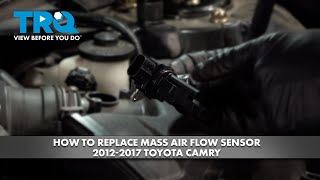
Typical fix: Replace the entire Mass Air Flow sensor assembly. This is a simple repair involving a couple of screws and an electrical connector. 🎬 See this walkthrough on how to replace the MAF sensor
Est. part cost: $80-$180 - Damaged Wiring or Connector ⚪ Low Probability Wiring can become brittle over time due to engine heat cycles, or be damaged by rodents. The connector pins can also corrode or become loose.
How to confirm: Visually inspect the wiring harness and 5-pin connector going to the MAF sensor for any signs of breaks, corrosion, or rodent damage. Use a multimeter to check for a ~5 volt reference signal on one wire and good continuity to ground on another with the key on, engine off.
Typical fix: Repair the broken wire(s) or replace the damaged connector pigtail.
Est. part cost: $10-$30
Rare But Worth Checking
- Faulty Engine Control Module (ECM): → Shop Engine Control Module (ECM) This is extremely rare. The ECM should only be considered after a new, known-good sensor and verified wiring do not resolve the code.
- Dirty Air Filter: A severely clogged air filter can sometimes cause erratic sensor readings, though it's more likely to cause performance codes like P0101 than a specific circuit high code like P0113. It's good practice to check it during diagnosis.
Diagnosis Steps
- Connect an OBD-II scanner and confirm P0113 is the active code. Note any other codes present, such as P0101 or P0102.
- Using the scanner's live data function, view the value for 'Intake Air Temperature'. If it shows a static, extremely low reading (like -40°F or -40°C), this confirms the 'Circuit High' fault and strongly suggests a failed sensor.
- Locate the MAF sensor on the engine's air intake tube, right after the air filter box.
- Visually inspect the MAF sensor's 5-pin electrical connector and wiring harness for any obvious damage, looseness, or corrosion.
- If wiring looks good, unplug the connector. With the key on, engine off, use a multimeter to verify you have a reference voltage (approx. 5V) and a ground signal at the connector pins. Refer to a wiring diagram for exact pinouts.
- If the wiring and connector check out and the live data confirms a -40° reading, the MAF/IAT sensor assembly has failed and needs to be replaced.
- After replacing the sensor, clear the codes with the scanner and take a test drive to ensure the Check Engine Light does not return.
Parts You'll Likely Need
- Mass Air Flow (MAF) Sensor
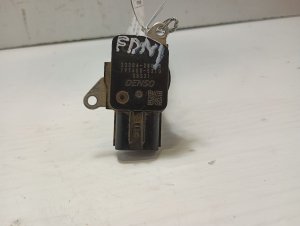
(OEM #22204-37010)— This assembly contains the integrated IAT sensor. An internal open circuit in the IAT portion of the sensor is the direct cause of the P0113 code on this vehicle. This part number is also cross-referenced as Denso 197-6160.
Trusted brands: Denso (OEM Supplier), Hitachi, Delphi
OEM price range: $120-$180
Aftermarket price range: $80-$130
Related Codes That Often Appear With This One
- P0101 — Mass Air Flow (MAF) Circuit Range/Performance. Since the IAT and MAF sensors are in the same housing, a single component failure can trigger both codes.
- P0102 — Mass Air Flow (MAF) Circuit Low Input. Seeing this with P0113 strongly points to a complete failure of the MAF/IAT sensor assembly or its connector.
- C1201 — Engine Control System Malfunction. This is a secondary code set by the Vehicle Stability Control (VSC) system, indicating it has been disabled because of the primary engine fault (P0113). Clearing the P0113 will resolve this code.
Mechanic-Grade Diagnostic Values
- IAT Sensor Resistance (Thermistor Check) — expected: 2.0 - 3.0 kΩ at 20°C (68°F); 0.9 - 1.3 kΩ at 40°C (104°F); 0.4 - 0.7 kΩ at 60°C (140°F). Resistance decreases as temperature increases.. Failure: Infinite resistance (open circuit) or a reading that does not change with temperature.
- IAT Sensor Resistance at Connector (Pins 4 & 5) — expected: With the sensor disconnected, resistance between pins 4 (THA) and 5 (E2) on the sensor side should be ~2.21kΩ to 2.69kΩ at 20°C (68°F).. Failure: Infinite resistance (no continuity) indicates an internal open circuit in the IAT portion of the sensor.
- IAT Signal Wire Voltage at Connector (KOEO) — expected: With the sensor disconnected and Key On, Engine Off, voltage at Pin 4 (THA, IAT signal) of the harness connector should be approximately 4.6 - 5.0 volts (reference voltage from ECM).. Failure: No voltage or significantly lower voltage indicates a wiring problem or an issue with the ECM's reference voltage supply.
Hidden / Shadow Codes Worth Checking
- Mode $06, Test ID $81, Component ID $11 (Example): While Toyota doesn't use proprietary 'shadow codes' for this fault, advanced scan tools can access Mode $06 data. This shows the raw results of the ECM's self-tests. For the IAT circuit, a technician can view the measured voltage and compare it against the minimum and maximum allowable thresholds set by the manufacturer. A P0113 is set when the measured value exceeds the maximum threshold (e.g., >4.9V). (see via Professional-grade OBD-II scan tool with Mode $06 data capability.)
Wiring & Ground Locations
- MAF/IAT Sensor Connector (A36) — On the air intake tube, immediately following the air filter housing.. This 5-pin connector is the primary point for testing. For P0113, the relevant pins are Pin 4 (THA - IAT Signal) and Pin 5 (E2 - Sensor Ground). An open circuit on either of these wires or a poor connection at these pins will cause the code.
OEM Part Supersession History
22204-37010→22204-28010— Standard part update by manufacturer.
Heads up: Part number 22204-37010 is the most commonly cited part for this generation, but dealer systems show it has been superseded by 22204-28010. Other numbers like 22204-0V010 may also be applicable. Always verify the correct part number with the vehicle's VIN at a dealership to avoid purchasing an incompatible part.
Model Year Variations Within This Range
- General Toyota Knowledge: While this vehicle range (XV50) uses a consistent MAF sensor, technicians should be aware that Toyota has used at least two different wiring configurations for their 5-wire MAF sensors over the years. This vehicle uses the 'later' style where the IAT circuit is on pins 4 and 5. An 'early' style on older vehicles used pins 1 and 2. This is not an issue for this specific Camry but is a critical detail when diagnosing a wider range of Toyota vehicles.
Diagnostic Flowchart
Other Known Issues on This Vehicle
Issues unrelated to this code that are worth knowing about as an owner of this generation:
- Brake Actuator Assembly Failure 🔴 High — Becomes common at higher mileage (over 100k miles). Can manifest as a buzzing noise from the engine bay, a spongy pedal, and multiple brake-related warning lights (ABS, VSC). (Ref: No recall, but a well-documented issue. Failure often logs codes like C1256 or C1391.)
- Melting / Sticky Dashboard 🟡 Low — Common in hot, humid climates. The dashboard surface can become shiny, sticky, or crack. Affects 2007-2011 models, but some later models may still exhibit issues. (Ref: Toyota issued a Warranty Enhancement Program (ZE6) to cover replacement, though the primary coverage period has expired.)
- Excessive Oil Consumption 🟠 Medium — Some 2AR-FXE engines can develop oil consumption issues, often due to piston rings sticking from extended oil change intervals. It is less prevalent than on the earlier 2AZ-FE engine but still a known concern, especially on higher mileage vehicles or those with poor maintenance history.
- Torque Converter Shudder 🟠 Medium — Some owners, particularly of 2012-2014 models, report a shudder or vibration during light acceleration. This can be related to the torque converter lock-up clutch. (Ref: Toyota issued TSB-0086-12 for some 4-cylinder 2012 models describing this issue.)
- Heat Shield Rattle 🟡 Low — A metallic rattle from under the car at speed can be caused by a loose exhaust heat shield. It's a common and simple fix but can be difficult to diagnose as it only occurs while driving.
Used vs. New Parts: Buying Guide for This Vehicle
When a used part is the smart pick: A used part is a reasonable budget option ONLY if it is a genuine OEM Denso part pulled from a low-mileage, documented donor vehicle. Given the high failure rate of aftermarket sensors for this component, a used OEM part is often more reliable than a new, non-OEM part.
Donor-vehicle mileage cap: roughly under 60000 miles for the part to have meaningful remaining life.
What to inspect on the donor part:
- Verify the part is a genuine Denso/Toyota part by looking for the logos on the housing.
- Inspect the connector pins for any signs of corrosion, bending, or moisture.
- Check the sensor element inside the housing; it should be clean and free of oil or debris.
- Ask for the VIN of the donor car to verify its year and low mileage.
OEM-only on this vehicle (don't cheap out):
- Mass Air Flow / IAT Sensor
Aftermarket brands forum-validated for this vehicle:
- Denso (This is the Original Equipment Manufacturer and is sold under its own brand name)
Brands owners have reported issues with on this vehicle:
- Generic, unbranded, or 'white-box' parts from online marketplaces and some auto parts stores are strongly discouraged. Forum and mechanic consensus indicates these parts often have incorrect calibration, leading to persistent performance issues, poor fuel economy, or immediate failure.
Real Owner Stories
Aggregated from forums and TSBs cited above. Mileages and costs reflect what owners reported in those sources.
2012 Toyota Camry Hybrid
Symptoms: Vehicle will not start (no crank). Multiple fault codes present: P0A0D, P0102, P0113, P3190, P3000. The engine attempted to start once but did not stay running.
What fixed it: Diagnosis suggested a failed MAF sensor; the recommended fix was to unplug the MAF sensor to verify if the car would start, then replace the sensor.
Source hint: 2012 Toyota Camry Hybrid - No crank - Electric Vehicle Forums
2009 Toyota Camry
Symptoms: Check engine light on, VSC light on, and TRAC OFF light on simultaneously. Codes P0113, P0101, and C1201 were present.
What fixed it: Straightforward replacement of the Mass Air Flow sensor.
Source hint: ToyotaNation Forum - 'Check engine light on, VSC light on, TRAC OFF light on'
2015 Toyota Camry 2.5L 4-cylinder
Symptoms: Fuel consumption is very high (~14.3 mpg). The engine won't rev beyond 4000 rpm and there is a 2–3 second hesitation before acceleration.
What fixed it: Replacing the MAF sensor (integrated IAT).
Source hint: r/MechanicAdvice
Documented NHTSA Reports
Toyota Electrical System Fault
Symptoms: An owner reported that error codes P0113 and P0102 appeared alongside warning messages for the Check Engine light and ICS malfunction when starting the vehicle in an apartment garage.
Source: NHTSA ODI #11296751
Toyota Engine Stall Incident
Symptoms: A report describes a vehicle stalling while driving, which triggered several diagnostic trouble codes including P0113, P0013, P1603, and P1605.
Source: NHTSA ODI #11139909
Related OBD-II Codes
Frequently Asked Questions
My 2012 Camry Hybrid has P0113 and won't start; could this be related to the interlock circuit?
Why are my VSC and TRAC OFF lights on when the issue is just an intake air temperature sensor?
Can I just replace the IAT sensor, or do I need the whole MAF assembly for my 2015 Camry Hybrid?
Is there a specific brand of sensor I should buy for my 2012-2017 Camry?
Could my high fuel consumption (14.3 mpg) be caused by P0113?
Does the 2AR-FXE engine in my Camry Hybrid have a known TSB for transmission-related vibrations?
Helpful Videos
We Have This Part in Stock

The information in this article is provided for general reference and educational purposes only. Vehicle specifications, procedures, and part compatibility can vary by production date, trim level, and region. Always consult your vehicle's factory service manual and verify part numbers before purchasing or performing repairs. Safety-critical components such as airbags, seat belts, and braking systems should be installed by a qualified professional.
- Toyota Camry Hybrid:
- 🧭 Diagnostic Flowchart
- 🎬 Helpful Videos
- 🛍️ Shop This Part
- What's Unique About the 2012-2017 Toyota Camry Hybrid
- Symptoms You May Notice
- Most Likely Causes
- Rare But Worth Checking
- Diagnosis Steps
- Parts You'll Likely Need
- Related Codes That Often Appear With This One
- Mechanic-Grade Diagnostic Values
- Hidden / Shadow Codes Worth Checking
- Wiring & Ground Locations
- OEM Part Supersession History
- Model Year Variations Within This Range
- Other Known Issues on This Vehicle
- Used vs. New Parts: Buying Guide for This Vehicle
- Real Owner Stories
- 2012 Toyota Camry Hybrid
- 2009 Toyota Camry
- 2015 Toyota Camry 2.5L 4-cylinder
- Documented NHTSA Reports
- Toyota Electrical System Fault
- Toyota Engine Stall Incident
- Related OBD-II Codes
- Frequently Asked Questions
- 🎟️ Get 5% Off