

P0133 on 2013-2016 Dodge Dart: O2 Sensor Slow Response Causes and Fixes
P0133 on a Dodge Dart indicates the upstream oxygen sensor is responding too slowly. While this often points to a failing sensor, a very common cause for these specific vehicles is outdated Powertrain Control Module (PCM) software, which requires a dealer update per Technical Service Bulletins (TSBs). Many owners replace the sensor first, only to have the code return, making the software check a critical first step.
- Before replacing any parts for a P0133 code on a 2013-2016 Dodge Dart, check if your vehicle needs a PCM software update, as this is a very common and specific issue for this car.
- If a software update is not needed, the most likely cause is a failing upstream (Bank 1, Sensor 1) oxygen sensor.
- Always inspect for exhaust leaks between the engine and the sensor before replacing the sensor itself, as a leak can mimic the symptoms of a bad sensor.
- Use a high-quality replacement O2 sensor from brands like Mopar, NTK, or Denso, as these vehicles can be sensitive to generic parts.
What's Unique About the 2013-2016 Dodge Dart
While a failing O2 sensor is a common cause for P0133 on any car, the 2013-2016 Dodge Dart with the 2.0L and 2.4L engines has a well-documented history of this code being triggered by overly sensitive software in the Powertrain Control Module (PCM). Chrysler issued multiple Technical Service Bulletins (TSBs) advising that a PCM software update is often the correct fix. Many owners replace the O2 sensor first, only to have the code return, indicating the software reflash was the necessary solution. One owner on dodge-dart.org with a 2.0L Dart reported replacing the sensor twice (once with aftermarket, once with OEM) before a dealer PCM update finally resolved the P0133 code.
Symptoms You May Notice
- Check Engine Light is on
- Decreased fuel economy
- Rough or unstable idle
- Sluggish acceleration or poor engine performance
- Failed emissions test 🎬 Watch: Understanding P0133 causes, symptoms, and how to fix it.
- Replacing the oxygen sensor without first checking for TSBs related to a PCM update. This is the most common mistake for this specific vehicle.
- Replacing the downstream (post-catalyst) O2 sensor instead of the upstream (pre-catalyst) sensor. P0133 is for Sensor 1.
- Using a cheap, universal, or incompatible aftermarket O2 sensor brand. Owners report Chrysler products are sensitive and work best with OEM (Mopar), NTK, or Denso sensors.
- Replacing the catalytic converter, which is not a direct cause of a P0133 code.
Most Likely Causes
- Outdated Powertrain Control Module (PCM) Software 🔴 High Probability → Shop Engine Control Module (ECM) Chrysler released TSBs #18-022-17 REV. A and #18-023-16 REV. C because the original software logic for monitoring the O2 sensor was too sensitive, falsely triggering the P0133 code. This is a widely acknowledged issue for the 2.0L and 2.4L engines.
How to confirm: A Dodge dealership or a qualified independent shop with a wiTECH scan tool can check your vehicle's current software calibration number against the latest version available. This should be the first step in diagnosis.
Typical fix: Reprogramming (flashing) the PCM with the updated software. This must be done by a dealer or a shop with the appropriate tools. 🎬 See how a professional technician flashes and reprograms a PCM. The cost is typically between $100 and $250.
Est. part cost: $0 - Failing or Contaminated Upstream Oxygen Sensor (Bank 1, Sensor 1) 🔴 High Probability → Shop Oxygen Sensor Oxygen sensors are wear items that degrade over time from heat, carbon, and other contaminants. On this platform, owners report that using non-OEM brands can cause the code to persist, making brand choice important.
How to confirm: Use a scan tool to graph the live data from the Bank 1 Sensor 1 O2 sensor. A healthy sensor's voltage should switch rapidly and cleanly between approximately 0.1V and 0.9V. A slow, lazy, or rounded waveform indicates a failing sensor.
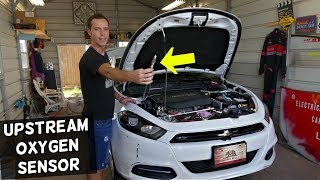
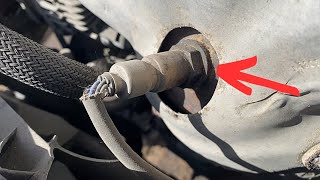
Typical fix: Replace the upstream oxygen sensor, which is located in the exhaust manifold before the catalytic converter. Use of an OEM (Mopar) or OEM-equivalent (NTK, Denso) sensor is strongly recommended.
Est. part cost: $50-$150 - Exhaust Leak Before the Oxygen Sensor 🟡 Medium Probability → Shop Oxygen Sensor Cracks in the exhaust manifold or failing gaskets can allow outside air to be pulled into the exhaust stream. This extra, unmetered oxygen fools the sensor, slowing its reaction time and triggering the code.
How to confirm: Visually inspect the exhaust manifold and the flange connections for black soot trails, which indicate a leak. A smoke test can also be performed to pinpoint the exact location of a small leak.
Typical fix: Replace the leaking gasket or repair/replace the cracked exhaust component.
Est. part cost: $20-$300 - Damaged Wiring or Connector ⚪ Low Probability
How to confirm: Visually inspect the O2 sensor's wiring harness and connector for any signs of melting on the exhaust, chafing, corrosion, or loose pins. Use a multimeter to check for continuity and proper voltage at the connector.
Typical fix: Repair the damaged section of wiring or replace the connector pigtail.
Est. part cost: $15-$50
Rare But Worth Checking
- Engine Vacuum Leak: A significant vacuum leak from a cracked hose or intake gasket can lean out the air-fuel mixture, which can sometimes affect O2 sensor readings and trigger a slow response code.
- Incorrect Fuel Pressure: Low or high fuel pressure from a failing pump or regulator can alter the air-fuel ratio beyond the PCM's normal adjustment range, potentially causing the O2 sensor to read incorrectly and trigger a fault.
Diagnosis Steps
- Check for any Technical Service Bulletins (TSBs) for your vehicle's VIN. For P0133 on a Dart, a PCM software update is a very common fix and should be investigated first by a dealer or qualified shop.
- If no TSBs apply or the software is up to date, perform a thorough visual inspection of the Bank 1 Sensor 1 (upstream) O2 sensor wiring and connector for damage, melting, or corrosion.
- Inspect the exhaust manifold and nearby exhaust components for cracks or black soot marks, which indicate an exhaust leak.
- Use a scan tool with live data graphing capabilities to monitor the voltage of the upstream O2 sensor while the engine is warm and running at a steady 2,000 RPM.
- Analyze the waveform. A healthy sensor will show rapid, clean switches between ~0.1V and ~0.9V. A slow, rounded, or flat-lined signal points to a faulty sensor.
- If the waveform is slow and no exhaust leaks or wiring issues are found, the oxygen sensor is the most likely culprit and should be replaced with a quality OEM or equivalent part.
Parts You'll Likely Need
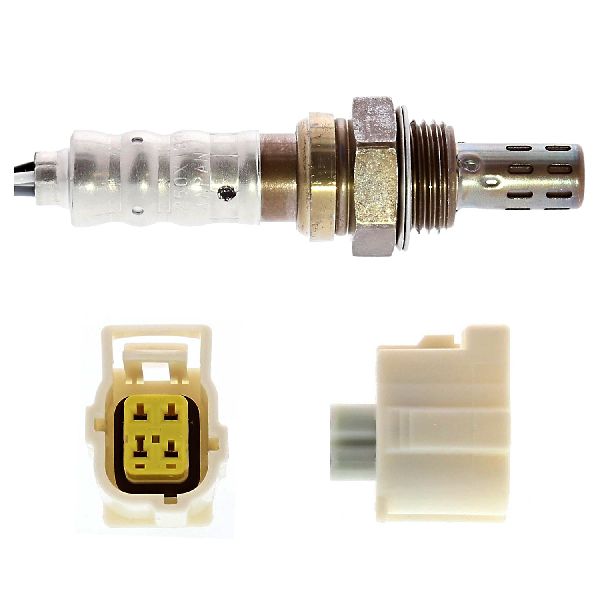
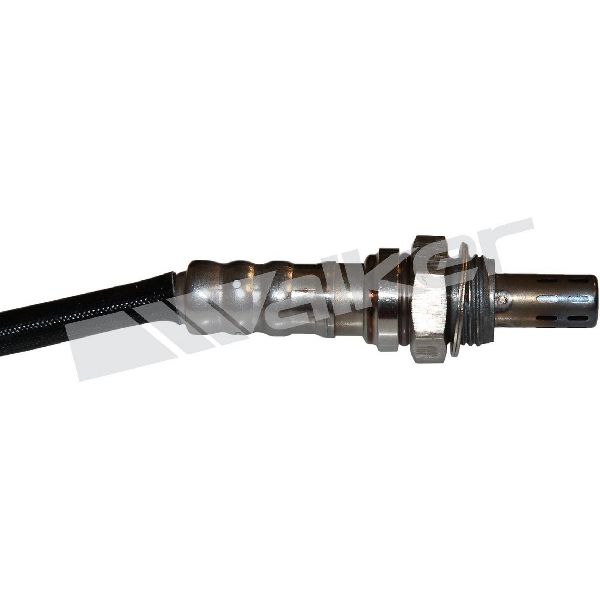
- Upstream Oxygen Sensor (Bank 1, Sensor 1)
(OEM #5149180AA)— This is the primary sensor that measures air-fuel ratio. It is a common wear-and-tear item and the most frequently replaced part for this code after a PCM update is ruled out.
Trusted brands: Mopar, NTK (OEM supplier, P/N: 23587) 🎬 Watch: How to locate and replace the upstream O2 sensor., Denso
OEM price range: $100-$130
Aftermarket price range: $50-$90
Related Codes That Often Appear With This One
- P0456 — This EVAP system small leak code is listed in the same TSBs (#18-023-16 REV. C) as P0133, indicating the PCM software update addresses both potential faults.
- P2172 — This code for a high airflow/vacuum leak is also mentioned in the PCM update TSBs, suggesting a potential link through software logic.
- U0140 — This communication code with the Body Control Module is another fault addressed by the same PCM software updates that fix P0133.
- P0335 — The Crankshaft Position Sensor Circuit code is also listed in TSB #18-023-16 as being resolved by the PCM reflash.
Technical Service Bulletins (TSBs) & Recalls
- 18-023-16 REV. C: Involves reprogramming the PCM on 2013-2015 Darts (and 2015 Chrysler 200) with the 2.4L engine to correct false triggers for P0133, P0456, P2172, U0140, and others.
- 18-022-17 REV. A: Addresses P0133 via a PCM software update for 2013-2015 models with the 2.4L engine, also improving logic for other DTCs.
- TSB Bulletin #18-023-16: Notes that for vehicles with Sales Codes ED6 or ED8, a software update addresses P0133 (O2 Sensor 1/1 Slow Response) along with Cold Start Rough Idle (P050D) and Cooling Fan Control issues (P0480).
- TSB Bulletin #18-023-16 REV. D: Confirms that the PCM reprogramming for the 2.4L engine also resolves P1607 (PCM Internal Shutdown Timer Rationality) and U0402 (Implausible Data Received From TCM).
Platform-Specific Known Issues
- TSB #18-023-16 REV. C and #18-022-17 REV. A were released by Chrysler to address false P0133 codes on 2013-2015 Darts with 2.0L or 2.4L engines by reprogramming the PCM with less sensitive monitoring logic.
- A real-world owner experience posted on dodge-dart.org confirmed that replacing the upstream O2 sensor with both aftermarket and OEM parts failed to fix the P0133 code. The issue was only resolved after a dealership performed the PCM software update specified in the TSB.
Mechanic-Grade Diagnostic Values
- Upstream O2 Sensor (B1S1) Heater Circuit Resistance — expected: 2 to 16 Ohms (when cold). Failure: An infinite reading (open circuit) or zero reading (short circuit) on a multimeter.
- Upstream O2 Sensor (B1S1) Voltage via Scan Tool — expected: Rapidly fluctuating between ~0.1V and ~0.9V in closed loop.. Failure: A slow, lazy, or rounded waveform that takes more than 100-200ms to switch, or a signal that is biased high or low.
- O2 Sensor Wiring Harness Resistance — expected: Less than 0.5 Ohms. Failure: Resistance greater than 0.5 Ohms can dampen the voltage signal enough to make the sensor appear slow to the PCM.
- O2 Sensor Heater Fuse (F87) — expected: Continuity. Failure: A blown fuse, indicating an open circuit. The fuse is located in the under-hood fuse box.
Wiring & Ground Locations
- G104 — Lower left (driver's) front side of the engine block.. This is a primary engine block ground. A poor connection due to corrosion or looseness can cause a host of PCM and sensor issues, including erratic O2 sensor readings or communication faults that could mimic a slow sensor.
- G105 — Left front corner of the engine compartment.. This is a key chassis and engine harness ground point. A fault here can cause floating ground issues, affecting sensor reference voltages and leading to incorrect readings by the PCM.
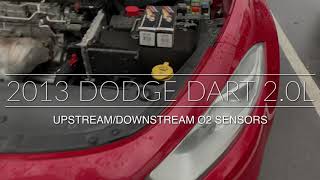
- O2 Sensor 1/1 Connector — The wiring follows from the sensor in the exhaust manifold to a connector point on the engine harness. On the 2.0L, the sensor is at the left rear of the engine.. This connector and its wiring are common failure points due to heat and vibration. Technicians should inspect for melted plastic, corroded pins, or chafed wires before condemning the sensor itself.
- PCM Connector C1 (Orange Insert) — The Powertrain Control Module (PCM) is at the left front of the engine compartment.. The O2 sensor heater and signal wires terminate at specific pins in this connector. Verifying signal and voltage directly at the PCM can definitively rule out wiring issues between the sensor and the computer.
Real Owner Repair Stories
- dodge-dart.org forum member (2013 Dodge Dart SXT 2.0L) — Persistent P0133 Check Engine Light.
❌ Tried (didn't work) Replaced the upstream O2 sensor with an aftermarket part., Replaced the upstream O2 sensor again with an OEM Mopar part.
✅ What actually fixed it The code was only resolved after a Dodge dealership performed a PCM reflash as specified in the relevant Technical Service Bulletin (TSB).
When the Usual Fixes Don't Work
- While the PCM software update is a very common fix, it is not a universal solution. If the code appears after the PCM has been confirmed to be up-to-date, the root cause is almost certainly mechanical. In these cases, technicians should revert to standard diagnostics, focusing on the O2 sensor itself, its wiring, and potential exhaust or vacuum leaks. The forum story where the PCM flash was the *final* fix after two sensor replacements underscores that both paths are possible, but the software should always be checked first to avoid unnecessary parts replacement.
OEM Part Supersession History
5149180AA→5149180AB— Standard part revision by the manufacturer for improvements or supplier changes.
Heads up: The new part number (5149180AB) is the correct and current replacement for the original. Using old stock of 5149180AA is not advised.
Model Year Variations Within This Range
- 2013-2015: The primary TSBs for the P0133 software reflash specifically list model years up to 2015. While not a guarantee, this suggests 2016 models may have left the factory with the updated PCM software, making a faulty sensor or other mechanical issue a more likely cause than software on the final model year.
- 2014-2016: In 2014, the 2.4L MultiAir engine, which is heavily implicated in the P0133 TSBs, became standard on the popular SXT and Limited trims. In 2013, it was primarily found on the GT trim. This increases the likelihood of encountering the software issue on a wider range of non-GT 2014+ Darts.
Diagnostic Flowchart
Other Known Issues on This Vehicle
Issues unrelated to this code that are worth knowing about as an owner of this generation:
- Excessive Oil Consumption (2.4L MultiAir) 🔴 High — Widespread issue, subject of a class-action lawsuit. Can manifest as losing a quart of oil in as little as 1,000-2,000 miles. (Ref: A PCM software update was developed to alter engine vacuum characteristics to reduce consumption, but the underlying issue may be with piston ring design.)
- Transmission Control Module (TCM) Failure 🔴 High — Common enough to trigger a recall (NHTSA 15V-508), causing the transmission to unexpectedly shift into neutral. (Ref: Recall NHTSA 15V-508)
- Shifter Cable Bushing Failure 🟠 Medium — A common failure point leading to a recall where the shifter cable detaches from the transmission, preventing the vehicle from being secured in Park. (Ref: Recall NHTSA 19V-293)
- Engine Stalling 🔴 High — Particularly prevalent in 2013-2014 models, with numerous complaints of the engine stalling while driving. This was a major safety concern noted by owners.
- Faulty Thermostat (Code P0128) 🟡 Low — A frequently reported cause for the Check Engine Light, where the thermostat fails and triggers code P0128.
Used vs. New Parts: Buying Guide for This Vehicle
When a used part is the smart pick: A used part is NOT recommended for the oxygen sensor itself, as it is a wear item with a finite lifespan. However, if the fault is a damaged wiring harness connector, sourcing a used connector pigtail from a junkyard is a smart and cost-effective repair.
Donor-vehicle mileage cap: roughly under 100000 miles for the part to have meaningful remaining life.
What to inspect on the donor part:
- For a used connector: Ensure the plastic is not brittle or cracked.
- Check that all locking tabs are intact.
- Inspect the pins to ensure they are straight and free of green or white corrosion.
- Ensure you get at least 6 inches of wire to make splicing easier.
OEM-only on this vehicle (don't cheap out):
- Upstream Oxygen Sensor
Aftermarket brands forum-validated for this vehicle:
- NTK (often the OEM supplier)
- Denso
Brands owners have reported issues with on this vehicle:
- Generic 'no-name' sensors from online marketplaces.
- While Bosch is a reputable brand, some owners on forums have reported persistent issues when using their sensors on this specific platform, making OEM/NTK/Denso a safer bet.
Real Owner Stories
Aggregated from forums and TSBs cited above. Mileages and costs reflect what owners reported in those sources.
2013 Dodge Dart SXT 2.0L
Symptoms: The P0133 code (Bank 1 Sensor 1 slow response) persisted even after the owner replaced the upstream O2 sensor with both an aftermarket part and a genuine OEM Mopar part.
What fixed it: The issue was resolved only after taking the vehicle to a dealer for a PCM reflash/software update as specified in the TSB.
Source hint: dodge-dart.org forum member report
2013 Dodge Dart 2.0L
Symptoms: Check Engine Light with P0133 code; the owner was unable to pass an emissions inspection.
What fixed it: The owner replaced the upstream O2 sensor, but the code did not go away, suggesting the need for the TSB software update.
Source hint: r/dodgedart
Related OBD-II Codes
Frequently Asked Questions
Does TSB #18-023-16 REV. C apply to my 2015 Dodge Dart with the 2.4L engine?
I replaced my O2 sensor but the P0133 code came back. Is there a software update for the 2.0L engine?
Which brand of oxygen sensor should I use for my Dodge Dart 2.4L?
Can an exhaust leak cause a P0133 code on the Dart?
How much does it cost to fix the software issue related to P0133 at a Dodge dealer?
Is the P0133 code related to the 2.4L MultiAir oil consumption issue?
Helpful Videos

We Have This Part in Stock

The information in this article is provided for general reference and educational purposes only. Vehicle specifications, procedures, and part compatibility can vary by production date, trim level, and region. Always consult your vehicle's factory service manual and verify part numbers before purchasing or performing repairs. Safety-critical components such as airbags, seat belts, and braking systems should be installed by a qualified professional.
- Dodge Dart:
- 🧭 Diagnostic Flowchart
- 🎬 Helpful Videos
- 🛍️ Shop This Part
- What's Unique About the 2013-2016 Dodge Dart
- Symptoms You May Notice
- Most Likely Causes
- Rare But Worth Checking
- Diagnosis Steps
- Parts You'll Likely Need
- Related Codes That Often Appear With This One
- Technical Service Bulletins (TSBs) & Recalls
- Platform-Specific Known Issues
- Mechanic-Grade Diagnostic Values
- Wiring & Ground Locations
- Real Owner Repair Stories
- When the Usual Fixes Don't Work
- OEM Part Supersession History
- Model Year Variations Within This Range
- Other Known Issues on This Vehicle
- Used vs. New Parts: Buying Guide for This Vehicle
- Real Owner Stories
- 2013 Dodge Dart SXT 2.0L
- 2013 Dodge Dart 2.0L
- Related OBD-II Codes
- Frequently Asked Questions
- 🎟️ Get 5% Off