

P0174 on 2011-2016 BMW M5: S63 Engine Lean Code Causes and Fixes
P0174 on the F10 M5 most commonly points to a faulty Mass Airflow (MAF) sensor, failing fuel injectors, or a vacuum leak from brittle crankcase vent (CCV) hoses. Swapping the MAF sensors between banks is a quick diagnostic test. Expect to pay $150-$400 for a new MAF sensor or over $1,000 for a set of injectors.
- P0174 on your M5 means Bank 2 (driver's side) is running lean (too much air, not enough fuel).
- The most likely culprits are a bad MAF sensor, failing fuel injectors, or a cracked CCV hose.
- A simple first step is to swap the two MAF sensors to see if the code follows the sensor.
- Do not ignore this code. Driving for an extended period with a lean condition can cause expensive engine damage.
- Due to the complexity of the S63 engine, professional diagnosis with a smoke machine and advanced scan tool is often necessary to pinpoint the exact cause.
What's Unique About the 2011-2016 BMW M5
The S63 engine in the F10 M5 is a high-performance, direct-injected, twin-turbocharged V8. This 'hot-vee' design, with turbochargers and exhaust manifolds situated between the cylinder banks, creates significant radiant heat that can cause plastic and rubber components to become brittle over time. This makes vacuum leaks from crankcase ventilation (CCV) hoses, valve covers, and turbocharger lines particularly common. Furthermore, the high-pressure direct fuel injectors are a well-documented failure point on this platform, often becoming leaky or clogged, leading to lean conditions and misfires.
Symptoms You May Notice
- Check Engine Light is on
- Rough or unstable idle
- Hesitation or bucking during acceleration
- Reduced engine power and sluggish performance
- Poor fuel economy
- Whistling or sucking noise from the engine bay, indicating a vacuum leak
- Long crank time to start the engine
- Engine stalling, especially at low speeds
- Replacing the oxygen sensor first. The O2 sensor is usually just reporting the lean condition, not causing it. The problem is almost always an issue with unmetered air (vacuum leak) or insufficient fuel delivery.
Most Likely Causes
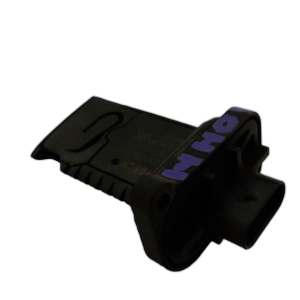
- Faulty Mass Airflow (MAF) Sensor 🔴 High Probability → Shop Fuel Injection Air Flow Meter The S63 engine uses two MAF sensors, one for each bank. A dirty or failing sensor on Bank 2 can under-report the amount of air entering the engine, causing the DME to inject too little fuel. This is a very frequent first point of failure for single-bank lean codes.
How to confirm: Swap the MAF sensors between Bank 1 (passenger side) and Bank 2 (driver side). Clear the codes and drive the vehicle. If the code changes to P0171 (System Too Lean Bank 1), the MAF sensor is faulty. This is a widely accepted diagnostic step on forums.
Typical fix: Replace the faulty MAF sensor. It is recommended to use a high-quality OEM brand like Bosch or a Genuine BMW part to avoid compatibility issues.
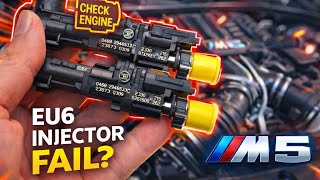
Est. part cost: $150-$400 - Leaking or Clogged Fuel Injectors 🔴 High Probability → Shop Fuel Injector The direct fuel injectors on the S63 are a well-documented failure point. They can become clogged, restricting fuel flow, or more dangerously, leak fuel into the cylinder, which can wash oil from the cylinder walls and lead to catastrophic engine damage. BMW has released multiple revisions, with 'Index 12' being the latest and most reliable version.
How to confirm: This is difficult to confirm without professional tools. A technician can check injector values with a diagnostic tool or perform a leak-down test. Misfire codes for specific cylinders on Bank 2 (e.g., P0305, P0306, P0307, P0308) often accompany a failing injector. A borescope can be used to look for fuel pooling on top of the piston after the engine has sat.
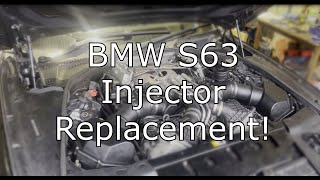
Typical fix: Replace the faulty fuel injector(s). It is highly recommended to replace all injectors on a bank, or all eight, at the same time. Only injectors with an index of 11 or higher can be mixed. If you have older injectors (index 10 or lower), all must be replaced. New injectors must be coded to the DME.
Est. part cost: $150-$350 per injector - Cracked Crankcase Ventilation (CCV) Hoses 🟡 Medium Probability The intense heat in the 'hot-vee' engine valley causes the plastic CCV hoses to become extremely brittle and crack over time, creating a significant vacuum leak. This introduces unmetered air after the MAF sensors, leading to a lean mixture.
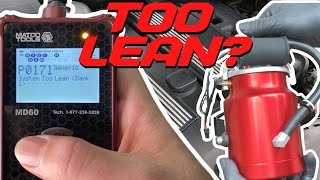
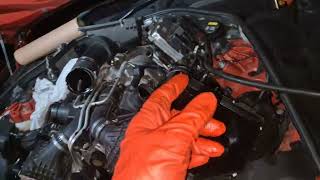
How to confirm: A smoke test is the most effective way to find a vacuum leak. 🎬 Watch: How to use a smoke machine to find leaks. A technician will fill the intake system with smoke and look for where it escapes. A hissing or whistling sound at idle can also point to a leak. Visual inspection may reveal obvious cracks if the engine covers are removed.
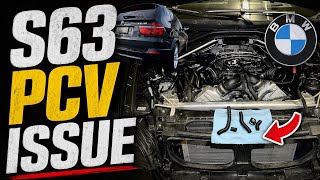
Typical fix: Replace the cracked CCV hose(s). Due to the difficulty in accessing these hoses, it is often recommended to replace both Bank 1 and Bank 2 hoses 🎬 Watch: A guide to replacing these brittle CCV hoses. as a preventative measure.
Est. part cost: $100-$250 for a kit
Rare But Worth Checking
- Leaking Valve Cover or Gasket: → Shop Engine Valve Cover A crack in the plastic valve cover or a failed gasket can create a vacuum leak, as the PCV system is integrated into the cover. This is a labor-intensive repair on the S63, often costing thousands at a shop due to the components that must be removed for access.
- Faulty Upstream Oxygen (O2) Sensor: → Shop Oxygen Sensor While an O2 sensor can fail and send incorrect lean readings, it is more often correctly reporting a problem caused by something else. It should not be the first part replaced without proper diagnosis, such as swapping sensors between banks to see if the fault follows.
- Failing High-Pressure Fuel Pump (HPFP): → Shop Fuel Pump The S63 has two HFFPs, one for each bank. A failing pump on Bank 2 may not supply adequate pressure to the fuel rail, causing a lean condition across all four cylinders on that bank. Symptoms include long cranks and 'drivetrain malfunction' errors.
Diagnosis Steps
- Read the codes with a BMW-capable OBD-II scanner and check for any other stored codes, especially P0171, misfire codes, or fuel pressure codes.
- Check long-term fuel trim (LTFT) values for Bank 2. A value significantly higher than +10% (often in the +20-25% range) confirms the lean condition.
- Perform a visual inspection of the engine bay. Look for any obvious cracks in air intake boots or disconnected vacuum lines.
- Listen for a hissing or whistling sound at idle, which would indicate a vacuum leak.
- Swap the MAF sensors between Bank 1 and Bank 2. Clear codes and see if the fault moves to Bank 1 (P0171). If it does, the MAF sensor is bad.
- If the MAF sensors are good, perform a smoke test to definitively check for vacuum leaks from CCV hoses, intake gaskets, or the valve cover.
- If no vacuum leaks are found, use a diagnostic tool to monitor fuel rail pressure for Bank 2. Compare it to Bank 1 and the target pressure. A significant deviation could indicate a failing HPFP.
- If fuel pressure is good, the next most likely cause is failing fuel injectors on Bank 2. This step typically requires professional diagnosis to test individual injectors.
Parts You'll Likely Need
- Mass Airflow (MAF) Sensor
(OEM #13627602038)— This is a common failure item and a primary cause of a single-bank lean code. A faulty MAF under-reports airflow, leading to an incorrect (lean) fuel mixture.
Trusted brands: Bosch, Genuine BMW
OEM price range: $350-$450
Aftermarket price range: $150-$250 - Fuel Injector (Index 12)
(OEM #13538616079)— Direct injectors on the S63 are a known weak point and frequently cause lean and misfire codes. 'Index 12' is the latest revision and should always be used for replacement.
Trusted brands: Bosch, Genuine BMW
OEM price range: $250-$350
Aftermarket price range: $150-$220 - Crankcase Vent Hose Kit
(OEM #11157595188)— The plastic hoses in the hot-vee become brittle and crack, causing major vacuum leaks. It's common to replace them as a set.
Trusted brands: Genuine BMW, Vaico
OEM price range: $150-$250
Aftermarket price range: $80-$150
Related Codes That Often Appear With This One
- P0171 — System Too Lean (Bank 1). When both P0171 and P0174 appear together, it points to a large vacuum leak or a fuel delivery issue affecting the entire engine, such as a major CCV system failure, leaks in the intake plenum, or a weak low-pressure fuel pump.
- P0305, P0306, P0307, P0308 — Cylinder Misfire (Cylinders 5-8). A severe lean condition on Bank 2 can cause misfires in the corresponding cylinders. This often points towards failing fuel injectors on that bank.
- 11A401, 11B401 — These are BMW-specific shadow codes for 'Fuel high pressure... pressure too low'. They often appear when a High-Pressure Fuel Pump (HPFP) is failing and can accompany lean codes, especially with symptoms like a long crank.
Technical Service Bulletins (TSBs) & Recalls
- SI B13 08 15: This Service Information bulletin from BMW discusses an updated fuel injector part number for S63 engines, pointing to a newer, more reliable version (Index 12) to address known issues.
Platform-Specific Known Issues
- The 'hot-vee' design of the S63 engine subjects components in the valley, like the CCV hoses and turbo lines, to extreme heat, accelerating their degradation and leading to vacuum and oil leaks.
- High-pressure fuel injectors are a common failure item on this engine, often requiring replacement well before 100,000 miles. Leaking injectors are a significant risk factor for catastrophic engine failure due to oil dilution.
Mechanic-Grade Diagnostic Values
- Long-Term Fuel Trim (LTFT) for Bank 2 — expected: Close to 0%, ideally under +/- 5%. Failure: Sustained positive values above +10% confirm a lean condition. The P0174 code typically sets when trims exceed +20-25%.
- High-Pressure Fuel Rail Pressure (Bank 2) — expected: Approximately 200 bar (2900 PSI) under load, stable at idle (typically 50-100 bar). Should match Bank 1 pressure.. Failure: Pressure that is significantly below the target value set by the DME, or pressure that crashes under acceleration, indicates a failing HPFP.
- Mass Air Flow Sensor (Bank 2) Reading at Idle — expected: Approximately 4-7 grams/second at warm idle (will vary with engine temp and load). Should be very similar to the Bank 1 MAF reading.. Failure: A reading that is significantly lower than Bank 1, or a reading that does not increase smoothly with RPM, suggests a faulty sensor.
Hidden / Shadow Codes Worth Checking
- 11A401: Fuel high pressure during fuel injection release: Pressure too low. (see via BMW-specific scan tools like ISTA or advanced OBD-II scanners that can read shadow/inactive codes.)
- 11B401: Fuel high pressure or after enabling injection (2nd ambient condition set after delay): Pressure too low. (see via BMW-specific scan tools like ISTA or advanced OBD-II scanners that can read shadow/inactive codes.)
Scan Tool Commands That Help
- ISTA: Delete engine adaptation values — After fixing a vacuum leak or replacing fuel system components (injectors, MAF, fuel pumps), this function should be run to clear the old learned fuel trim corrections. The path is typically: Vehicle Management > Service Functions > Powertrain > Engine Electronics > Adjustment functions > Delete adaptations.
- ISTA: Learn Valvetronic limit positions — This should be performed after deleting engine adaptations, as the DME may 'forget' the end stops for the Valvetronic system, which can cause rough running.
- ISTA: Fuel pressure test / HPFP test plan — To diagnose a suspected High-Pressure Fuel Pump failure. The test plan will guide the technician through checking the fuel pressure from both the low-pressure and high-pressure pumps against specified values under various engine conditions.
Real Owner Repair Stories
- Bimmerpost user WesamJaber (2011 BMW 535i (F10 with N55 engine, but symptoms and codes are identical for S63)) — Long crank time (3+ seconds) only on cold starts. Starts perfectly when warm. No driveability issues otherwise.
❌ Tried (didn't work) Replaced fuel pressure sensor, Replaced DMTL pump
✅ What actually fixed it The user reported shadow codes 11A401 and 11B401. The community identified these symptoms (long cold crank + low-pressure shadow codes) as classic indicators of a failing High-Pressure Fuel Pump (HPFP) that is losing its prime overnight. - Reddit user on r/BmwTech (2012 BMW 528i (N20 engine, but principle applies)) — Rough start, shaking, fluctuating RPM, jerking on acceleration after replacing the valve cover.
❌ Tried (didn't work) Initial visual inspection
✅ What actually fixed it The user disconnected the MAF sensor and the rough start disappeared. This pointed to a massive unmetered air leak. The community advised a smoke test, which would likely reveal a vacuum leak introduced during the valve cover installation, such as a disconnected hose or improperly seated cover.
"I Checked Everything" — The Actual Cause
- An exhaust leak located between the cylinder head and the upstream O2 sensor can cause a P0174 code. The leak allows unmetered oxygen into the exhaust stream, causing the O2 sensor to read a false lean condition and command the DME to add fuel. This will not be found with a standard intake smoke test and can be difficult to diagnose, often leading to unnecessary replacement of fuel system parts.
OEM Part Supersession History
Various PNs with Index 10 or lower→13538616079 (Index 12)— Early index injectors were prone to failure (clogging, leaking). Index 11 and later (currently Index 12) feature improved internal construction and calibration.
Heads up: Injectors with an index of 10 or lower CANNOT be mixed in the same engine with injectors of index 11 or higher. If any injector is index 10 or lower, all 8 must be replaced with the newer index parts.13538616079→13538648937 (functionally identical)— A new part number was released under a Technical Service Bulletin (SI B13 08 15), reportedly with minor internal material updates. It is functionally identical to 13538616079.
Heads up: No incompatibility. Both part numbers are Index 12 and can be used. The #937 part is often sold at a lower price. The injector itself will be stamped with '13537585261-12'.
Model Year Variations Within This Range
- 2011-2016: The engine in the F10 M5 is the S63B44T0, a 'Technical Update' (TÜ) of the original S63 from the 2010-2013 X5M/X6M. Key improvements include the addition of VALVETRONIC, a higher compression ratio (10.0:1 vs 9.3:1), and increased max boost pressure (1.5 bar). These changes do not fundamentally alter the causes of P0174 but contribute to the engine's overall complexity.
- 2014-2016 (LCI): The Life Cycle Impulse (LCI) update in 2014 was primarily cosmetic and electronic (new steering wheel, LED headlights, updated iDrive). The Competition Package also became available, increasing horsepower. There were no major changes to the core engine components (injectors, MAFs, CCV system) that are the primary causes of P0174.
Diagnostic Flowchart
Other Known Issues on This Vehicle
Issues unrelated to this code that are worth knowing about as an owner of this generation:
- Premature Rod Bearing Wear 🔴 High — A widely discussed issue, though frequency is debated. Risk increases with long oil change intervals or aggressive use. Preventative replacement is recommended by some specialists around 60,000-80,000 miles.
- Excessive Oil Consumption 🟠 Medium — Commonly reported by owners. Can be caused by failing valve stem seals, turbocharger seals, or PCV system issues. Consumption of 1 quart every 1,000-1,500 miles is not uncommon.
- High-Pressure Fuel Injector Failure 🔴 High → Shop Fuel Injector — Very common failure item, often occurring between 60,000 and 100,000 miles. Leaking injectors can wash out cylinder walls and dilute engine oil, potentially leading to catastrophic engine damage. (Ref: Injectors on some related N63 engines were covered under extended warranties/recalls, but this is less consistent for the S63. TSB SI B13 08 15 discusses updated parts.)
- Turbocharger Coolant/Oil Line Leaks 🟠 Medium — The rubber sections of the turbocharger lines, located in the hot-vee, degrade and leak oil or coolant onto the top of the engine, creating a burning smell and fire risk.
- VANOS Solenoid Failure 🟡 Low — Solenoids can get clogged with oil deposits over time, typically after 100,000 miles, causing rough running, poor performance, and VANOS-related fault codes.
Used vs. New Parts: Buying Guide for This Vehicle
When a used part is the smart pick: For this specific repair, buying used parts is generally not recommended due to the high failure rates of the common culprits. The only potential exception would be major structural components like an intake manifold or engine covers if they are confirmed to be free of cracks, but the savings are often not worth the risk.
Donor-vehicle mileage cap: roughly under 60000 miles for the part to have meaningful remaining life.
What to inspect on the donor part:
- For a valve cover, inspect meticulously for any hairline cracks, especially around the integrated PCV ports and mounting holes.
- Verify the donor vehicle did not suffer from a catastrophic engine failure that could have sent debris through related systems.
- Check for signs of oil leaks or residue which could indicate failing gaskets or cracks.
OEM-only on this vehicle (don't cheap out):
- Fuel Injectors: Never buy used. They are a high-wear item with known failure patterns. Always buy new, Index 12 injectors and code them to the vehicle.
- Mass Airflow (MAF) Sensors: It is strongly recommended to buy new OEM (Bosch) or Genuine BMW sensors. Used sensors may be contaminated or near the end of their service life, causing persistent diagnostic headaches.
- Crankcase Ventilation (CCV) Hoses: These plastic parts fail from heat and age. A used part will have the same brittleness and is likely to fail soon, if not already cracked. Always buy new.
Aftermarket brands forum-validated for this vehicle:
- Bosch: Bosch is the Original Equipment Manufacturer (OEM) for both the MAF sensors and fuel injectors. Buying the Bosch-branded part is identical to the Genuine BMW part but typically costs significantly less.
Brands owners have reported issues with on this vehicle:
- Unbranded/no-name MAF sensors and fuel injectors from online marketplaces. These parts often have incorrect calibrations, leading to poor performance and immediate or recurring fault codes.
Real Owner Stories
Aggregated from forums and TSBs cited above. Mileages and costs reflect what owners reported in those sources.
2012-2016 BMW M5 S63B44T0
Symptoms: P0174 code appeared. Community members suggested it could be MAF sensors, O2 sensors, or injectors.
What fixed it: Swapping MAF sensors is the first diagnostic step; injectors are also a primary suspect and may be covered under a 120k mile warranty.
Source hint: M5POST - 'Lean in Bank 2' (https://f10.m5post.com/forums/showthread.php?t=1740037)
2012-2016 BMW M5 S63B44T0
Symptoms: P0171 and P0174 codes. Owner initially replaced a fuel pump with no success.
What fixed it: Investigating the fuel injectors, which are a well-documented failure point on the S63 engine.
Source hint: Bimmerpost thread discussed in common_causes
2010-2013 BMW X5 M (E70) S63B44O0
Symptoms: Long cranks and 'Engine Malfunction' warnings.
What fixed it: Replacing the Bank 2 High-Pressure Fuel Pump (HPFP) after it failed to meet pressure specs.
Source hint: XBimmers - 'N63/S63 HPFP Issues' (https://www.xbimmers.com/forums/showthread.php?t=990914)
2012-2016 BMW M5 S63B44T0
Symptoms: Persistent lean code.
What fixed it: Replacing the PCV (CCV) hoses after performing a smoke test to confirm a vacuum leak.
Source hint: Forum discussion cited in common_causes real_world_example
2012-2016 BMW M5 S63B44T0
Symptoms: P0171/P0174 codes appeared after installing an aftermarket intake.
What fixed it: Identifying a faulty or incorrectly seated MAF sensor by swapping them between banks.
Source hint: M5POST reports cited in common_causes
Related OBD-II Codes
Frequently Asked Questions
Is there a specific TSB for the fuel injector issues on my S63 engine?
I'm seeing a P0174 code on my M5; is there an extended warranty for the injectors?
How can I tell if my Bank 2 lean code is caused by a bad MAF sensor without buying a new one?
Why are the CCV hoses on the M5 so prone to cracking and causing vacuum leaks?
Can a failing fuel pump cause a P0174 code on this platform?
What is the recommended replacement interval for rod bearings to prevent catastrophic failure?
Helpful Videos
Used OEM Parts in Stock
New Aftermarket Parts Available

The information in this article is provided for general reference and educational purposes only. Vehicle specifications, procedures, and part compatibility can vary by production date, trim level, and region. Always consult your vehicle's factory service manual and verify part numbers before purchasing or performing repairs. Safety-critical components such as airbags, seat belts, and braking systems should be installed by a qualified professional.
- BMW M5:
- 🧭 Diagnostic Flowchart
- 🎬 Helpful Videos
- 🛍️ Shop This Part
- What's Unique About the 2011-2016 BMW M5
- Symptoms You May Notice
- Most Likely Causes
- Rare But Worth Checking
- Diagnosis Steps
- Parts You'll Likely Need
- Related Codes That Often Appear With This One
- Technical Service Bulletins (TSBs) & Recalls
- Platform-Specific Known Issues
- Mechanic-Grade Diagnostic Values
- Hidden / Shadow Codes Worth Checking
- Scan Tool Commands That Help
- Real Owner Repair Stories
- "I Checked Everything" — The Actual Cause
- OEM Part Supersession History
- Model Year Variations Within This Range
- Other Known Issues on This Vehicle
- Used vs. New Parts: Buying Guide for This Vehicle
- Real Owner Stories
- 2012-2016 BMW M5 S63B44T0
- 2012-2016 BMW M5 S63B44T0
- 2010-2013 BMW X5 M (E70) S63B44O0
- 2012-2016 BMW M5 S63B44T0
- 2012-2016 BMW M5 S63B44T0
- Related OBD-II Codes
- Frequently Asked Questions
- 🎟️ Get 5% Off