

P0175 on 2010-2012 Audi A8 4.2L FSI: System Too Rich Bank 2 Causes and Fixes
P0175 on the Audi A8 4.2L FSI most often points to a failing High-Pressure Fuel Pump (HPFP) or a leaking fuel injector on Bank 2 (driver's side). Check your oil for a gasoline smell; if present, the HPFP is the likely cause. Expect a repair cost of $400-$800 for one HPFP or $200-$400 for a single injector.
- P0175 on your A8 4.2L FSI is a serious code that should be addressed immediately.
- The most critical diagnostic step is to check your engine oil. If it is overfull and smells like gasoline, a High-Pressure Fuel Pump has likely failed. Do not drive the car in this condition.
- If the oil is fine, the next most likely cause is one or more leaking fuel injectors on the driver's side bank.
- Do not immediately replace the oxygen sensor; it is usually just reporting the problem accurately.
- Due to the high-pressure fuel system and complexity, professional diagnosis and repair are strongly recommended.
What's Unique About the 2010-2017 Audi A8
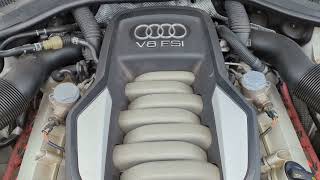
On the D4 Audi A8 with the 4.2L FSI engine (engine code: CALA), a P0175 code, especially if paired with P0172 for Bank 1, is frequently caused by a failing High-Pressure Fuel Pump (HPFP). These camshaft-driven pumps can fail internally, leaking raw fuel directly into the engine crankcase. This dilutes the engine oil, raises the oil level, and can lead to catastrophic engine damage if not addressed. Leaking fuel injectors are also a very common failure point on this direct-injection engine, often causing hot-start problems and misfires on the affected bank.
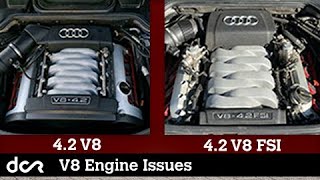
Generation note: The 2010-2017 Audi A8 is the 'D4' generation. However, the 4.2L FSI V8 engine (engine code CALA) was only offered in this chassis from model years 2010 to 2012 in North America before being replaced by the 4.0L twin-turbo V8. This guide is specific to the 2010-2012 models with the 4.2L FSI engine.
Symptoms You May Notice
- Check Engine Light is on
- Strong smell of fuel from the exhaust or under the hood
- Black smoke from the exhaust pipe
- Rough or unstable idle, sometimes with engine shaking
- Engine hesitation or stumbling on acceleration
- Reduced fuel economy
- Hard starting, especially when the engine is warm (hot-soak)
- Oil level is too high and/or smells strongly of gasoline
- Blinking Check Engine Light if misfires are occurring
- Replacing the oxygen sensor first. While an O2 sensor can fail, it is more often correctly reporting a rich condition caused by a fuel delivery problem. Always diagnose fuel pressure, injectors, and check for fuel in the oil before replacing the O2 sensor.
- Ignoring the possibility of a bad MAF sensor when only one bank has a code. While a bad MAF often affects both banks, it can sometimes cause a code on only one bank initially as fuel trims reach their limit at different times.
Most Likely Causes
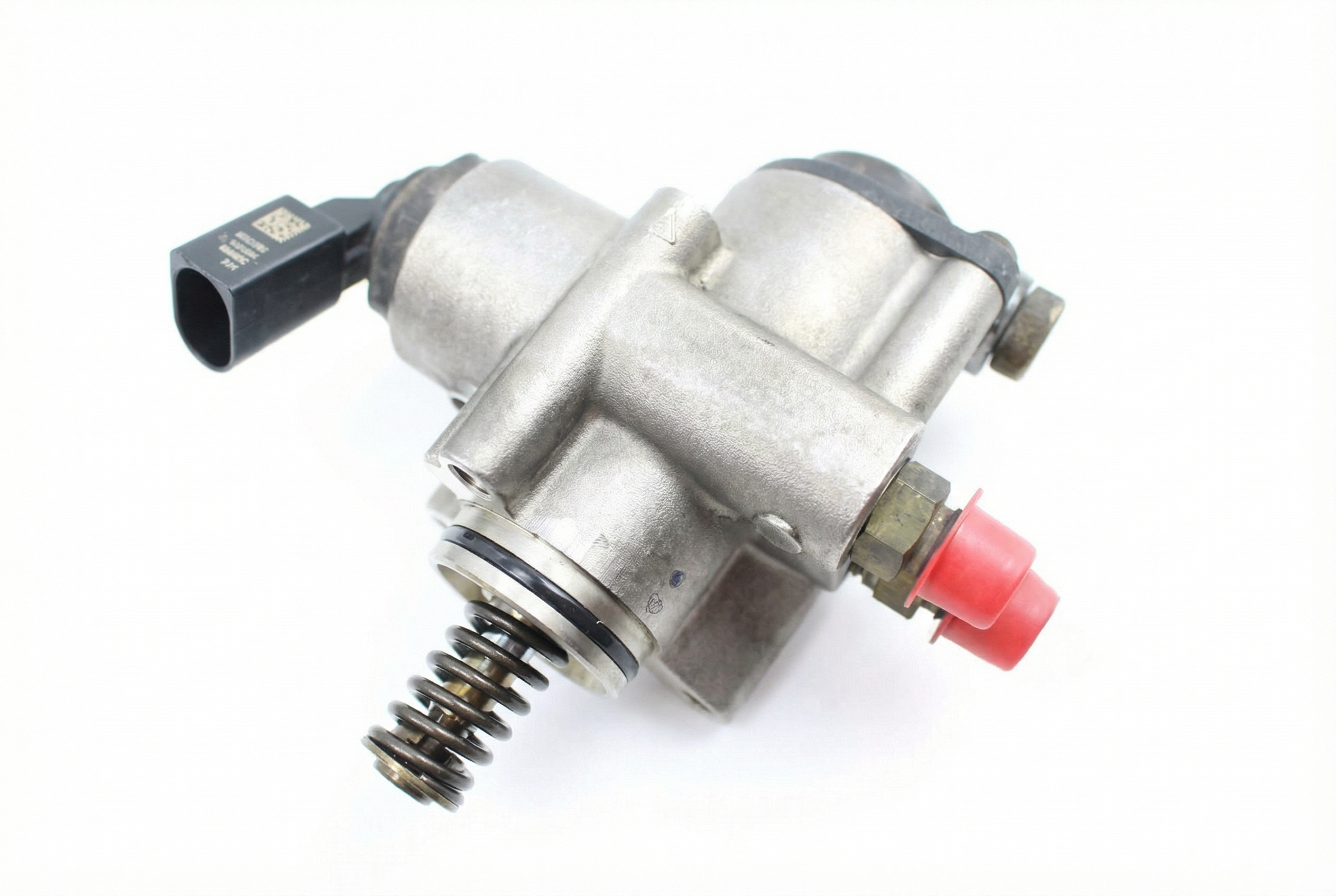
- Failing High-Pressure Fuel Pump (HPFP) 🔴 High Probability → Shop Fuel Pump The HPFPs on the 4.2L FSI are a known failure point. They are mechanical pumps driven by the camshaft and can develop internal seal leaks, allowing gasoline to enter the engine's crankcase and mix with the oil.
How to confirm: Check the engine oil dipstick (or use a spare dipstick if the vehicle only has an electronic sensor). If the oil level is above the maximum mark and smells strongly of gasoline, the HPFP has very likely failed. This issue often sets rich codes for both banks (P0172 and P0175) and may trigger 🎬 Watch this video to see how to fix these codes. an 'oil overfilled' warning on the dash.
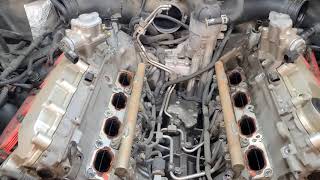
Typical fix: Replace the failing High-Pressure Fuel Pump on the corresponding bank. It is highly recommended to replace both pumps at the same time, as the other is likely near the end of its service life. An engine oil and filter change is mandatory to remove the contaminated oil. Some shops recommend an engine flush treatment before the oil change.
Est. part cost: $350-$600 per pump - Leaking Fuel Injector(s) 🔴 High Probability → Shop Fuel Injector Direct injection (FSI) injectors operate under very high pressure and are prone to failure from carbon buildup or internal wear. They can leak fuel into the cylinder after the engine is shut off, causing a rich condition on startup.
How to confirm: A key symptom is difficulty starting the engine when it's warm. You can also remove the spark plugs on Bank 2 (cylinders 5, 6, 7, 8) and inspect them. A plug that is wet with fuel or excessively black and sooty indicates a leaking injector in that cylinder. A professional can perform a fuel pressure leak-down test; if pressure drops after shutdown, a leaking injector is a likely cause.
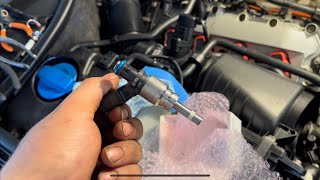
Typical fix: Replace the faulty fuel injector and its one-time-use Teflon seals. Special tools, including a slide hammer for removal and seal installation cones, are required to properly service the injectors. 🎬 See this walkthrough for replacing injectors on the 4.2L engine. It is often recommended to replace all four injectors on that bank at the same time.
Est. part cost: $150-$250 per injector - Faulty Mass Airflow (MAF) Sensor 🟡 Medium Probability → Shop Fuel Injection Air Flow Meter The MAF sensor can become contaminated with oil vapors or debris, or fail electronically, causing it to send inaccurate airflow readings to the ECM. It may under-report airflow, leading the ECM to inject too much fuel for the actual amount of air entering the engine.
How to confirm: Use a diagnostic scan tool (like VCDS) to monitor the MAF reading in grams per second (g/s). A healthy 4.2L FSI engine should read approximately 4-7 g/s at a stable, warm idle. A reading significantly outside this range, or one that doesn't increase smoothly with RPM, suggests a problem. A more definitive test is to log data at wide-open throttle near redline; the peak g/s reading should be at least 80% of the engine's horsepower rating (e.g., ~297 g/s for a 372hp engine).
Typical fix: First, try cleaning the sensor with a dedicated MAF sensor cleaner spray. Do not touch the sensor elements. If this does not resolve the issue, the MAF sensor must be replaced.
Est. part cost: $150-$300 - Faulty Upstream Oxygen Sensor (Bank 2, Sensor 1) ⚪ Low Probability → Shop Oxygen Sensor While possible, a faulty O2 sensor is less likely to be the root cause than a fuel delivery issue. The sensor is often correctly reporting the rich condition caused by another component. The ECM typically performs checks on the O2 sensor's rationality before setting a fuel trim code.
How to confirm: Use a scan tool to graph the voltage of the Bank 2, Sensor 1 O2 sensor. A sensor that is stuck high (e.g., above 0.8V) and does not fluctuate could be faulty. However, this reading can also be a correct reflection of a true rich condition caused by a bad injector or HPFP.
Typical fix: Replace the Bank 2, Sensor 1 (upstream) oxygen sensor. This sensor is located on the driver's side exhaust manifold, before the catalytic converter.
Est. part cost: $100-$200
Rare But Worth Checking
- Faulty Fuel Pressure Regulator / Sensor: → Shop Fuel Injection Pressure Regulator On the D4 A8, the low-pressure fuel system is regulated by the in-tank fuel pump assembly's controller. A failure causing excessive low-side pressure could overwhelm the HPFPs. More commonly, a faulty high-pressure rail sensor could incorrectly report low pressure, causing the pumps to work harder and create a rich condition. This usually sets other fuel pressure-specific codes like P0088 (Fuel Rail/System Pressure - Too High).
- Stuck Open Thermostat or Faulty Coolant Temp Sensor: If the engine computer thinks the engine is always cold (due to a stuck-open thermostat or bad sensor), it will continuously command a richer fuel mixture intended for warm-up. This usually triggers other codes related to engine temperature or thermostat performance.
Diagnosis Steps
- Read all fault codes using an Audi-specific OBD-II scanner (like VCDS). Note if P0172 (Bank 1 Rich) is also present, as this points to a systemic issue.
- CRITICAL STEP: Carefully check the engine oil level and smell the oil on the dipstick for a strong gasoline odor. If the level is high and it smells of fuel, stop the diagnosis. This is a hallmark symptom of a failed High-Pressure Fuel Pump (HPFP).
- With a scan tool, view live data for Short-Term Fuel Trim (STFT) and Long-Term Fuel Trim (LTFT) for both banks. For P0175, you will see highly negative numbers for Bank 2 (typically -10% to -30%). If both banks are negative, suspect a common cause like HPFPs or MAF.
- If the oil is not contaminated, investigate for a leaking fuel injector. Check for hard-starting when the engine is warm (hot-soak). Pull the spark plugs from Bank 2 cylinders (5, 6, 7, 8) and inspect for black, sooty fouling or wetness from fuel.
- Test the Mass Airflow (MAF) sensor. Monitor its g/s reading at a warm idle (should be ~4-7 g/s) and check that it rises smoothly with RPM. Compare actual vs. specified values under load if possible.
- Test the fuel pressure of both the low-pressure and high-pressure systems. This requires specialized gauges and knowledge of the FSI system. A high-pressure rail leak-down test after shutdown can identify leaking injectors. This is best performed by a professional.
- As a final check, inspect the Bank 2, Sensor 1 oxygen sensor's live data to ensure it is fluctuating correctly and not stuck in a high-voltage state, which would indicate it is either faulty or correctly reading a very rich mixture.
Parts You'll Likely Need
- High-Pressure Fuel Pump (HPFP)
(OEM #079127026J / 079127026AB (verify by VIN))
Related Codes That Often Appear With This One
- P0172 — System Too Rich, Bank 1. If both P0175 and P0172 are present, it strongly suggests a common problem affecting both cylinder banks, such as failing HPFPs, a bad MAF sensor, or a fuel pressure regulator issue.
- P0300, P0305, P0306, P0307, P0308 — Misfire codes for Bank 2 cylinders (5, 6, 7, 8). An excessively rich mixture from a leaking injector can foul the spark plug and cause misfires on the affected cylinder(s).
Mechanic-Grade Diagnostic Values
- High-Pressure Fuel Rail Pressure (at idle) — expected: ~40 bar (580 PSI). Failure: Significantly lower pressure may indicate a weak pump; significantly higher pressure may indicate a regulator/sensor issue.
- Low-Pressure Fuel System Pressure — expected: 5 to 8 bar (72 to 116 PSI). Failure: Pressure exceeding 8 bar could indicate a faulty in-tank pump controller or restriction.
- Mass Airflow (MAF) Sensor Reading (warm idle) — expected: 4.0 - 7.0 g/s. Failure: Readings significantly outside this range, or readings that do not increase smoothly with RPM, suggest a faulty sensor or a large vacuum/boost leak.
- Mass Airflow (MAF) Sensor Reading (Wide-Open Throttle) — expected: Peak reading should be >80% of engine horsepower (e.g., >297 g/s for a 372hp CALA engine). Failure: A significantly lower reading indicates the sensor is not measuring airflow correctly or there is a major intake restriction.
- FSI Fuel Injector Resistance — expected: ~1.5 - 1.7 ohms. Failure: A reading far outside this range (e.g., an open circuit or a much higher resistance) indicates a failed injector coil.
Hidden / Shadow Codes Worth Checking
- P1923: Please Check DTC Memory of ECU Number 2 (Slave) (see via This code is set in the master Engine Control Module (ECU 1) when the slave ECU (ECU 2) has stored its own fault codes. It requires a scanner capable of communicating with both engine modules, like VCDS, to read the codes from the second module.)
Scan Tool Commands That Help
- VCDS (VAG-COM): Engine -> Basic Settings -> Group 103 — This function is sometimes cited online for fuel pump adaptation. However, Ross-Tech employees have noted that the factory repair manual does NOT require any adaptation after replacing the HPFP. Using this may not be necessary or applicable.
- VCDS (VAG-COM): Engine -> Output Tests -> Fuel Pump Electronics — This is used to run the in-tank low-pressure fuel pump to prime the fuel system after replacing a fuel filter or pump. This prevents long cranking and potential damage to high-pressure components from running dry.
- VCDS (VAG-COM): Engine -> Adaptation -> Channel 'IDE00433 - Reset learned values' — After a major repair that affects airflow or fuel delivery, such as carbon cleaning or injector replacement, resetting the long-term fuel trim adaptations can help the ECU re-learn the new baseline faster.
Wiring & Ground Locations
- Ground Point 12 — In engine compartment, left side.. A poor engine ground can cause erratic sensor readings and control module behavior, potentially leading to incorrect fuel calculations. This is a main ground point for components on the left side of the engine bay.
- Ground Point 13 — In engine compartment, right side.. Similar to the left-side ground, a fault here can affect components on the right side of the engine. Ensuring all main engine grounds are clean and tight is a crucial step in diagnosing any complex electronic issue.
- Ground Point G394 — Located within the main engine wiring harness.. An internal harness ground point failure is rare but can be difficult to diagnose. It could cause issues for multiple sensors that share this ground path, potentially leading to confusing codes like P0175.
Real Owner Repair Stories
- Reddit user r/MechanicAdvice (2012 Audi A8) — Check engine light with P0172 and P0175 (rich on both banks). Car would start, run, stop, then not start at all without throttle input.
❌ Tried (didn't work) Suspected bad gas, refilled with premium ethanol-free fuel.
✅ What actually fixed it The dealership diagnosed gasoline in the engine oil and replaced both High-Pressure Fuel Pumps (HPFPs).
When the Usual Fixes Don't Work
- While failing HPFPs are the most common cause of dual-bank rich codes, it is not a guaranteed diagnosis. In one documented case on a similar 4.2 FSI engine (RS4), an owner replaced both HPFPs, performed a carbon cleaning, replaced the PCV valve, replaced multiple fuel sensors, and cleaned the MAF, yet the P0172/P0175 codes persisted. This highlights that in rare instances, the cause can be more elusive, potentially related to wiring, ECU issues, or another unidentified component, even after all common culprits are eliminated.
OEM Part Supersession History
079127026J→079127026AB, then 079127026AC— Revisions by the manufacturer to improve reliability and address failure modes.
Heads up: While older numbers may still be found, it is always recommended to use the latest revision (e.g., 079127026AC) for the most updated design.
Diagnostic Flowchart
Real Owner Stories
Aggregated from forums and TSBs cited above. Mileages and costs reflect what owners reported in those sources.
2016 Audi A8 4.0T — 118000 miles
Symptoms: Triggered codes P0172 and P0175 for running rich.
What fixed it: Replaced both High-Pressure Fuel Pumps (Hitachi HPP0023) and the cam followers.
Source hint: AudiWorld forums thread 3067807
2012 Audi A8L 4.2 FSI
Symptoms: VCDS scan showed P0175 along with misfires on all of Bank 2 (cylinders 5, 6, 7, and 8).
What fixed it: Diagnosed as a High-Pressure Fuel Pump (HPFP) failure after confirming the engine oil smelled like gasoline.
Source hint: Ross-Tech Forums thread 35335
2012 Audi A8
Symptoms: Engine running rich on both banks, triggering P0172 and P0175 codes.
What fixed it: The dealership diagnosed bad HPFPs as the root cause by finding gasoline mixed into the engine oil.
Source hint: Reddit r/MechanicAdvice thread '0172 0175 2012 Audi A8 running rich both banks'
2013 Audi S8 4.0T
Symptoms: P0172 and P0175 codes accompanied by a chattering noise on startup.
What fixed it: Community advice pointed toward fuel system cleaning and a tune-up to address the fueling issues.
Source hint: AudiWorld forums thread 2999914
Related OBD-II Codes
Frequently Asked Questions
Why does my 2010-2017 Audi A8 4.2L FSI smell strongly of gas and show code P0175?
I have code P0175 and my A8 is hard to start when the engine is warm. What causes this?
Should I replace both High-Pressure Fuel Pumps if only one bank is showing a rich code?
How can I test the MAF sensor on my 4.2L V8 using VCDS?
If I replace the HPFPs on my A8 to fix the P0175 code, do I need to do anything else?
Helpful Videos

Used OEM Parts in Stock
New Aftermarket Parts Available



The information in this article is provided for general reference and educational purposes only. Vehicle specifications, procedures, and part compatibility can vary by production date, trim level, and region. Always consult your vehicle's factory service manual and verify part numbers before purchasing or performing repairs. Safety-critical components such as airbags, seat belts, and braking systems should be installed by a qualified professional.
- Audi A8:
- 🧭 Diagnostic Flowchart
- 🎬 Helpful Videos
- 🛍️ Shop This Part
- What's Unique About the 2010-2017 Audi A8
- Symptoms You May Notice
- Most Likely Causes
- Rare But Worth Checking
- Diagnosis Steps
- Parts You'll Likely Need
- Related Codes That Often Appear With This One
- Mechanic-Grade Diagnostic Values
- Hidden / Shadow Codes Worth Checking
- Scan Tool Commands That Help
- Wiring & Ground Locations
- Real Owner Repair Stories
- When the Usual Fixes Don't Work
- OEM Part Supersession History
- Real Owner Stories
- 2016 Audi A8 4.0T — 118000 miles
- 2012 Audi A8L 4.2 FSI
- 2012 Audi A8
- 2013 Audi S8 4.0T
- Related OBD-II Codes
- Frequently Asked Questions
- 🎟️ Get 5% Off