

P0175 on 2010-2011 Cadillac SRX 3.0L: System Too Rich Bank 2 Causes and Fixes
Code P0175 on a 2010-2011 SRX 3.0L means the engine is running too rich on Bank 2. The most common causes are a leaking fuel injector or a failing high-pressure fuel pump (HPFP). A strong smell of gas in the engine oil is a key indicator of a bad HPFP. Expect to pay $100-$300 for an injector replacement or over $1,000 for a high-pressure fuel pump replacement at a shop.
- P0175 means Bank 2 (front of engine) is running too rich.
- The most likely causes are a leaking fuel injector on Bank 2 or a failing high-pressure fuel pump.
- Check the oil dipstick for a gasoline smell; if present, the high-pressure fuel pump is the probable cause.
- If the oil is fine, inspect the Bank 2 spark plugs for signs of fuel fouling to pinpoint a leaking injector.
- Do not drive extensively with this code, as it can lead to catalytic converter damage and engine wear.
What's Unique About the 2010-2011 Cadillac SRX
The 3.0L LF1 V6 engine in the 2010-2011 SRX uses a direct injection (GDI) fuel system with two fuel pumps: a low-pressure pump in the tank and a high-pressure fuel pump (HPFP) on the engine. This high-pressure system, while efficient, introduces specific failure points. The HPFP is camshaft-driven and supplies fuel at up to 1,740 PSI (120 bar), though it idles around 300-500 PSI. A failing HPFP can leak fuel internally into the engine crankcase, and the high-pressure injectors can leak directly into the cylinders, both of which are common causes for a rich condition on this platform. GM issued a technical service bulletin (PIT-4730A) for the related 3.0L CTS acknowledging that P0172 and P0175 codes are often caused by a failed high-pressure fuel pump.
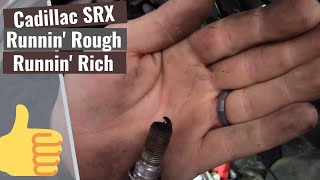
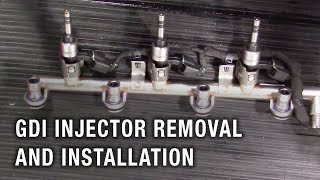
🎬 Watch: Diagnosing a rich condition and hard starting issues.Symptoms You May Notice
- Check Engine Light is on
- Poor fuel economy
- Rough or unstable idle, sometimes stalling
- Engine hesitation or stumbling during acceleration
- Strong smell of gasoline from the exhaust or in the engine oil
- Black smoke from the tailpipe in severe cases
- Hard starting or extended cranking
- "Popcorn" sounds from the engine on a cold start.
- Replacing the oxygen (O2) sensor first. The O2 sensor is usually just the messenger reporting the rich condition, not the cause of it. Always diagnose the fuel system (injectors, pump, pressure) first, especially on this GDI engine.
Most Likely Causes
- Leaking Fuel Injector(s) 🔴 High Probability → Shop Fuel Injector The direct injection fuel injectors operate under extremely high pressure and can fail by leaking fuel into a cylinder even when closed. This is a common failure on GM direct injection engines of this era, often due to carbon buildup. GM has issued bulletins (e.g., PIP4964F) for related engines advising technicians to check injectors early in the diagnosis for rich codes.
How to confirm: A mechanic can perform a fuel injector balance test using a professional scan tool to measure pressure drops for each injector. Another method is to remove the spark plugs on Bank 2 (cylinders 2, 4, 6) and inspect them; a plug from a cylinder with a leaking injector will be black, sooty, and may smell of raw fuel. A key-off fuel pressure test can also be indicative: with a scan tool monitoring fuel rail pressure, turn the engine off. If the pressure drops steadily instead of holding, it points to a leak, likely an injector.
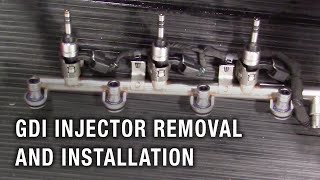
Typical fix: Replace the faulty fuel injector. It is often recommended to replace all three injectors on the same bank at the same time. You must also replace the injector's single-use Teflon seal and often the retaining clip.
Est. part cost: $60-$130 per injector - Failing High-Pressure Fuel Pump (HPFP) 🟡 Medium Probability → Shop Fuel Pump The camshaft-driven HPFP is a known failure point on the 3.0L/3.6L GM V6 engine family. The pump's internal seals can fail, causing it to leak fuel directly into the engine crankcase. This contaminates the oil and causes a rich condition across both banks, often setting both P0172 and P0175. TSB PIT-4730A directly addresses this failure mode for the 3.0L engine.
How to confirm: Check the engine oil dipstick for a strong gasoline smell and a higher-than-normal oil level. This is a tell-tale sign of HPFP failure. A professional scan tool can also monitor fuel rail pressure; if the desired and actual pressures don't match or are erratic, the pump may be at fault.
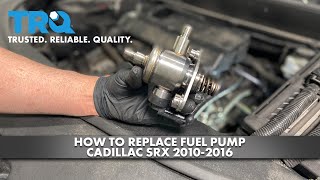
Typical fix: Replace the high-pressure fuel pump and the single-use high-pressure fuel line connected to it. An oil and filter change is mandatory to remove the fuel-contaminated oil. The pump is located in the valley of the engine, under the intake manifold.
Est. part cost: $400-$600 - Dirty or Faulty Mass Airflow (MAF) Sensor ⚪ Low Probability → Shop Fuel Injection Air Flow Meter
How to confirm: A faulty MAF sensor will typically affect both engine banks, setting P0172 and P0175 simultaneously. You can try cleaning the sensor with a dedicated MAF sensor cleaner. If the problem persists, monitor the MAF reading on a scan tool to see if it's providing plausible data for the given engine speed and load. A contaminated sensor can under-report airflow, causing the PCM to inject less fuel than needed, which would cause a lean code, not a rich one. It's less likely to be the cause of a rich code unless it is severely malfunctioning. A manufacturer service bulletin for related Cadillac models, TSB Bulletin #PIP5446A, notes that technicians should also inspect for cast flashing near the MAF sensor which can cause a rough idle and rich codes.
Typical fix: Clean the MAF sensor with a specialized cleaner. If cleaning doesn't work, replace the sensor.
Est. part cost: $70-$150
Rare But Worth Checking
- Faulty Upstream Oxygen (O2) Sensor: → Shop Oxygen Sensor While the O2 sensor is what reports the rich condition, it can sometimes fail and send incorrect rich signals. However, this is less common than a fuel delivery issue, as the PCM usually validates O2 sensor readings before setting a fuel trim code.
- EVAP Purge Valve Stuck Open: → Shop Vapor Canister If the evaporative emissions purge valve sticks open, it can allow unmetered fuel vapors from the gas tank to enter the intake manifold, creating a rich condition. This usually also sets an EVAP system code (like P0441 or P0496) and tends to affect both banks, triggering P0172 and P0175.
- Incorrect Fuel Alcohol Calculation: In some GM vehicles, the PCM may incorrectly calculate the ethanol content in the fuel. TSB Bulletin #PIP4792D describes how an incorrect Fuel Alcohol Content parameter can lead to a cold start rich condition and black exhaust smoke.
- Faulty Fuel Rail Pressure Sensor: A faulty fuel rail pressure sensor can send incorrect (lower than actual) pressure readings to the PCM. The PCM would then command the high-pressure pump to increase pressure to compensate, leading to an actual fuel pressure that is too high and causing a rich condition. This can sometimes set a P0191 code as well.
Diagnosis Steps
- Use an OBD-II scanner to confirm P0175 and check for any other codes, such as P0172 or misfire codes. Note the freeze frame data to see the conditions when the code was set.
- Crucial Step: Inspect the engine oil dipstick. If it smells strongly of gasoline or the level is above 'Full', the high-pressure fuel pump is the most likely culprit. Do not continue to run the engine if the oil is severely diluted.
- If the oil seems fine, focus on Bank 2 (front of the engine). Remove the spark plugs from cylinders 2, 4, and 6. Inspect their condition. A plug that is wet with fuel or covered in black soot indicates a leaking injector in that cylinder.
- With a scan tool, monitor long-term and short-term fuel trims for Bank 2 at idle and while driving. For P0175, you will see highly negative numbers (e.g., -15% to -30%) as the PCM tries to remove fuel.
- Monitor the fuel rail pressure with a scan tool. For the 3.0L engine, idle pressure should be around 300-500 PSI. Shut the engine off and watch the pressure. If it drops quickly (more than 5-10 PSI in a minute), it suggests a leak, likely from an injector.
- Inspect the air filter and intake tube for any blockages or restrictions that could limit airflow.
- If no obvious cause is found, consider testing the Bank 2, Sensor 1 (upstream) oxygen sensor to ensure it is functioning correctly and not stuck in a 'rich' reading.
- Check the EVAP purge solenoid to ensure it is not stuck open, allowing un-commanded fuel vapor into the intake.
Parts You'll Likely Need
- Fuel Injector
(OEM #12629927)— Leaking fuel injectors are a primary cause of a rich condition on a single bank for this GDI engine.
Trusted brands: ACDelco (GM OE), Bosch, Hitachi
OEM price range: $80-$150
Aftermarket price range: $50-$100 - High-Pressure Fuel Pump
(OEM #12642287 (superseded by HPM1006))— A common failure on this engine family that can cause rich codes on both banks by leaking fuel into the crankcase.
Trusted brands: ACDelco (GM OE), Bosch
OEM price range: $500-$700
Aftermarket price range: $350-$500 - Fuel Injector Seal Kit
(OEM #12644827)— The Teflon seals for the fuel injectors are single-use and must be replaced anytime an injector is removed.
Related Codes That Often Appear With This One
- P0172 — This is the same 'System Too Rich' code but for Bank 1. If both P0172 and P0175 are present, it points to a problem affecting the entire engine, such as the high-pressure fuel pump, MAF sensor, or a stuck EVAP purge valve.
- P0300-P0306 — Misfire codes (e.g., P0302, P0304, P0306 for Bank 2) can occur because an overly rich mixture can foul the spark plugs and fail to ignite properly.
- P0089 — This code indicates a problem with the fuel pressure regulator performance, often pointing towards an issue with the high-pressure fuel pump which has an integrated regulator. It is frequently seen alongside rich codes when the HPFP is failing.
- P2099 — This code is 'Post Catalyst Fuel Trim Too Rich Bank 2'. If the upstream sensor (P0175) and downstream sensor (P2099) both report a rich condition, it strongly confirms a real fuel delivery problem, like a leaking injector, rather than a sensor fault.
Technical Service Bulletins (TSBs) & Recalls
- 20-NA-098: Information on Fuel Injector Replacement Guidelines. Notes that injectors are flow-matched from the factory and care must be taken to order the correct replacement part number.
- PIT-4730A: A bulletin for the 2010 3.0L CTS that directly links P0172 and P0175 codes to a failed high-pressure fuel pump.
- 12-06-04-002B: While for diesel engines, this bulletin's existence shows GM's awareness of complex emission system diagnostics during this era, which can be relevant to understanding diagnostic logic.
- PIP4964F: A GM bulletin that specifically advises checking for leaking fuel injectors as a primary cause for post-catalyst rich codes (like P2099) on the 3.0L/3.6L engine family, which is directly relevant to the upstream P0175 code.
- TSB Bulletin #PIP5446A: Advises that a sputter when applying throttle between 0 and 30% and a rough idle may be accompanied by P0175; technicians should inspect for cast flashing near the Mass Air Flow sensor.
- TSB Bulletin #PIP4792D: Notes that a rich condition, cold start issues, and black exhaust color may be caused by incorrect fuel alcohol content parameters in the scan tool data list.
Platform-Specific Known Issues
- A Reddit user with a 2011 SRX reported having both P0172 and P0175 codes that would appear after idling for 15 minutes and disappear after driving. This idle-specific rich condition often points to a leaking component (injector or HPFP) that over-saturates the mixture at low airflow, while the effect is diluted at higher RPMs.
- On cadillacforums.com, a 2011 SRX 3.0L owner with P0172/P0175 confirmed the fix was replacing the high-pressure fuel pump after noticing a strong fuel smell in the oil. The repair also required replacing the intake manifold gaskets.
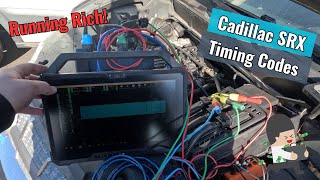
- A YouTube video diagnosing a 2011 SRX with P0172 and P0175 (along with timing codes) demonstrated the complexity of issues that can arise, showing how fuel trim problems can be linked to other engine faults.
Mechanic-Grade Diagnostic Values
- Fuel Injector Coil Resistance — expected: 11 - 14 Ohms. Failure: A reading of OL (open), near 0 (shorted), or a significant deviation from the expected range indicates a failed injector coil.
- High-Pressure Fuel Rail (Scan Tool, at idle) — expected: 290 - 370 PSI. Failure: Pressure that does not match the desired/commanded pressure on the scan tool, or is erratic, can indicate a problem with the high-pressure fuel pump or sensor.
- Low-Pressure Fuel System (Scan Tool, at idle) — expected: Approximately 60 PSI. Failure: Low pressure from the in-tank pump can starve the HPFP, but this typically causes lean codes, not rich codes.
- Mass Air Flow (MAF) Sensor Reading (at idle, warm engine) — expected: 4 - 7 g/s. Failure: A reading significantly outside this range could indicate a faulty sensor, though it's an uncommon cause for a rich code unless severely malfunctioning.
- Upstream Oxygen Sensor (Bank 2, Sensor 1) Voltage — expected: Fluctuating rapidly between 0.1V and 0.9V (100-900mV). Failure: A sensor that is stuck high (e.g., consistently above 800mV) may be faulty, but this is usually a correct reading indicating a true rich condition.
Scan Tool Commands That Help
- GDS2 / Tech2: Fuel Injector Balance Test — This automated test commands each injector to fire and measures the corresponding drop in fuel rail pressure. If the pressure drop for one injector on Bank 2 is significantly different (GM specifies more than 20% variance) from the others, it points to a faulty injector.
- GDS2 / Tech2: Cylinder Power Balance — This function disables one cylinder at a time and measures the drop in engine RPM. If disabling a cylinder on Bank 2 (2, 4, or 6) causes little to no change in RPM, it confirms that cylinder is not contributing correctly, possibly due to a fouled plug from a leaking injector.
- GDS2 / Tech2: Clear Fuel Trim / Reset Adaptations — After replacing a component like a fuel injector or HPFP, fuel trims should be reset. The most reliable method is to use the scan tool's function to clear all DTCs, which also resets learned values, and then perform a comprehensive drive cycle to allow the PCM to relearn.
Wiring & Ground Locations
- Bank 2 Injector Control Wires — At the Engine Control Module (ECM), located in the left front of the engine compartment.. The control signals for injectors 2, 4, and 6 originate at the ECM. A wiring diagram confirms the specific pins ('Fuel inj 2 ctrl', 'Fuel inj 4 ctrl', 'Fuel inj 6 ctrl'), allowing for continuity tests from the ECM connector to the injector connectors to rule out a wiring fault.
- G112 — Right front cylinder head.. This is a primary engine ground. Since Bank 2 is the front bank, a poor connection at G112 could potentially cause erratic behavior for sensors or injectors on that bank, leading to a rich condition. Verifying this ground is clean and tight is a crucial step.
- G110 — Left engine block.. This is another main engine ground. While less likely to affect only Bank 2, a poor connection here can cause widespread electrical issues that could manifest unexpectedly.
- Injector Harness Chafe Points (TSB #PIP4924D) — Where the wiring harness routes over the intake plenum, near valve cover bolts, and against fuel lines.. This is a well-documented failure pattern. A wire for a Bank 2 injector could be chafed and shorting to ground, causing the injector to stay open longer than commanded and creating a rich condition on that specific cylinder. This fault would not be found with a vacuum leak smoke test.
Real Owner Repair Stories
- South Main Auto LLC YouTube Channel (2011 Cadillac SRX 3.0L) — Hard to start, Check Engine Light on, running rich.
❌ Tried (didn't work) Initial scan showed P0172 (Rich Bank 1) and a misfire.
✅ What actually fixed it The diagnosis pointed to a leak in the high-pressure fuel system. Using a scan tool, the mechanic observed that the fuel rail pressure dropped immediately after shutting the engine off, indicating a leak. A cylinder power balance test then helped isolate the issue to a specific cylinder, suggesting a leaking fuel injector was the root cause. While this case was for Bank 1 (P0172), the diagnostic process is identical for a P0175 on Bank 2.
"I Checked Everything" — The Actual Cause
- A common scenario for this vehicle family involves chasing rich or injector circuit codes where a smoke test for vacuum leaks comes back clean. The actual cause is often a chafed fuel injector wiring harness, as documented in GM TSB #PIP4924D. The harness can rub against the intake plenum or valve cover bolts, causing an intermittent short or open in an injector's control circuit. This electrical fault will not be detected by a smoke test but can be found with a careful visual inspection of the harness and continuity tests from the ECM to the injector.
OEM Part Supersession History
12642287→12673410, 12679090, 12688607, 12694529, and finally 12711668— Updates for reliability and performance of the High-Pressure Fuel Pump (HPFP).
Heads up: Always use the latest available part number for replacement. While older numbers may be referenced, they represent previous, less reliable versions of the pump.
Model Year Variations Within This Range
- 2010-2011: The 2010-2011 SRX uses the 3.0L LF1 V6. From 2012-on, it was replaced by the 3.6L LFX V6. The fuel injectors for these two engines have different electrical resistance (~12 Ohms for the 3.0L vs. ~1.5 Ohms for the 3.6L) and are not interchangeable. Using the wrong injector will cause immediate running problems and fault codes.
Diagnostic Flowchart
Real Owner Stories
Aggregated from forums and TSBs cited above. Mileages and costs reflect what owners reported in those sources.
2011 Cadillac SRX 3.0L
Symptoms: Experienced P0172 and P0175 codes and noticed a strong fuel smell in the engine oil.
What fixed it: Replaced the high-pressure fuel pump and the intake manifold gaskets.
Source hint: cadillacforums.com/threads/2011-srx-3-0-fuel-in-oil-p0172-p0175.1098765/
Related OBD-II Codes
Frequently Asked Questions
Does TSB PIT-4730A apply to my 2010-2011 Cadillac SRX 3.0L?
Why does my 2011 SRX only throw the P0175 code after idling for a while?
I have code P0175 and my engine oil smells strongly of gas. What needs to be replaced?
Are there any special guidelines for replacing fuel injectors on the 3.0L LF1 engine?
Can a dirty MAF sensor cause P0175 on my SRX?
Helpful Videos
We Have This Part in Stock



The information in this article is provided for general reference and educational purposes only. Vehicle specifications, procedures, and part compatibility can vary by production date, trim level, and region. Always consult your vehicle's factory service manual and verify part numbers before purchasing or performing repairs. Safety-critical components such as airbags, seat belts, and braking systems should be installed by a qualified professional.
- Cadillac SRX:
- 🧭 Diagnostic Flowchart
- 🎬 Helpful Videos
- 🛍️ Shop This Part
- What's Unique About the 2010-2011 Cadillac SRX
- Symptoms You May Notice
- Most Likely Causes
- Rare But Worth Checking
- Diagnosis Steps
- Parts You'll Likely Need
- Related Codes That Often Appear With This One
- Technical Service Bulletins (TSBs) & Recalls
- Platform-Specific Known Issues
- Mechanic-Grade Diagnostic Values
- Scan Tool Commands That Help
- Wiring & Ground Locations
- Real Owner Repair Stories
- "I Checked Everything" — The Actual Cause
- OEM Part Supersession History
- Model Year Variations Within This Range
- Real Owner Stories
- 2011 Cadillac SRX 3.0L
- Related OBD-II Codes
- Frequently Asked Questions
- 🎟️ Get 5% Off