

P0191 on 2005-2011 Audi A6 3.2L V6 FSI: Fuel Pressure Sensor Causes and Fixes
For the Audi A6 3.2L FSI, code P0191 is most often caused by a failing fuel rail pressure sensor (G247) or a weak high-pressure fuel pump (HPFP). Replacing the sensor costs around $70-$150 for the part, while a new HPFP can be over $500. Unlike the 2.0T engine, the cam follower is a less frequent, but still possible, cause.
- On the Audi A6 3.2L FSI, P0191 is most likely a bad fuel rail pressure sensor (G247) or a failing high-pressure fuel pump (HPFP).
- Before replacing expensive parts, use a scan tool to compare requested vs. actual fuel pressure and test the low-pressure fuel pump's output.
- The HPFP cam follower is a critical wear item. It should be inspected before condemning the HPFP, as its failure can cause the same symptoms.
- Do not ignore this code. It can lead to stalling, which is a serious safety risk, and continued driving could potentially damage the HPFP or camshaft.
- Due to the extremely high pressures involved, diagnosis and repair of the high-pressure fuel system are best left to a qualified professional.
What's Unique About the 2005-2011 Audi A6
The 2005-2011 Audi A6 (C6 generation) uses a 3.2L V6 FSI engine with both a low-pressure and a high-pressure fuel system. While other Audi/VW engines from this era, like the 2.0T FSI (EA113), are infamous for P0191 being caused by a rapidly wearing cam follower, the 3.2L V6 uses a different, more durable roller-style follower design. While the follower can still wear and should be inspected, the primary suspects for P0191 on this specific engine are more often the fuel rail pressure sensor (G247) itself or the high-pressure fuel pump (HPFP).
Symptoms You May Notice
- Check Engine Light illuminated
- Sudden loss of power, especially during acceleration or going uphill
- Engine hesitation, stuttering, or surging
- Rough or unstable idle
- Hard starting, requiring long crank times
- Engine stalling, sometimes when coming to a stop
- Reduced fuel economy
- Loud ticking or whining sounds from the engine bay, potentially indicating HPFP or follower issues
- Replacing the High-Pressure Fuel Pump (HPFP) when the actual problem is a weak in-tank Low-Pressure Fuel Pump (LPFP) or a faulty fuel pump control module.
- Replacing the fuel rail pressure sensor when it is accurately reporting a pressure loss caused by a worn cam follower or failing HPFP.
- Replacing fuel system components when the issue is a corroded ground wire or damaged connector for the G247 sensor or J538 module.
Most Likely Causes
- Faulty Fuel Rail Pressure Sensor (G247) 🔴 High Probability → Shop Fuel Pressure Sensor This sensor is a common electronic failure point on many VAG engines of this era, subject to intense heat and pressure cycles. It can fail internally, sending erratic or out-of-range signals.
How to confirm: With a capable scan tool (like VCDS), monitor Measuring Value Blocks for fuel pressure. Compare 'requested' fuel rail pressure to the 'actual' fuel rail pressure. If the actual reading is erratic, stuck at a fixed value, or clearly incorrect while the low-pressure supply is stable, the sensor is likely faulty. A typical good sensor shows ~0.5V at idle and up to ~4.5V under high pressure.
Typical fix: Replace the fuel rail pressure sensor. It is located on the high-pressure fuel rail, which may be under the intake manifold. It is recommended to apply a drop of engine oil to the new sensor's threads before installation.
Est. part cost: $70-$150 - Failing High-Pressure Fuel Pump (HPFP) 🟡 Medium Probability → Shop Fuel Pump The HPFP is a known weak point on FSI engines and is responsible for generating the high pressure required for direct injection. Internal wear can cause it to fail to meet pressure demands, especially under load.
How to confirm: If the fuel pressure sensor and cam follower are known to be good, but the 'actual' fuel pressure consistently fails to meet the 'requested' pressure under load (a condition logged with code P0087), the HPFP is the prime suspect. Physical signs can include fuel leaking from the pump body.
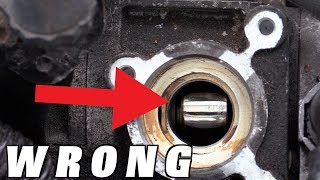
Typical fix: Replace the high-pressure fuel pump. 🎬 Watch this step-by-step guide on replacing the 3.2L HPFP. It is highly recommended to replace the cam follower at the same time.
Est. part cost: $400-$800 - Worn HPFP Cam Follower 🟡 Medium Probability → Shop Fuel Pump The cam follower is a small metal cap that rides on the camshaft to drive the HPFP. It is a sacrificial part designed to wear out. While more robust than the 2.0T's design, it still wears. A 2006 A6 3.2L owner reported significant wear (coating gone, concave surface) which can cause a loss of pump actuation.
How to confirm: Physical inspection is required. The HPFP must be removed to access and inspect the cam follower for wear on its contact surface. A worn-through follower is a definitive failure. Even if not worn through, loss of the black coating and a concave surface indicates it needs replacement.
Typical fix: Replace the cam follower. If it has failed completely, inspect the HPFP plunger and camshaft lobe for damage, which may require their replacement as well.
Est. part cost: $40-$60 - Failing Low-Pressure Fuel Pump (LPFP) or Control Module (J538) ⚪ Low Probability → Shop Fuel Pump The in-tank LPFP supplies fuel to the HPFP. If it weakens or its control module (J538, located under the rear seat) fails, it can starve the HPFP, leading to high-side pressure codes like P0191.
How to confirm: Test the low-side fuel pressure with a mechanical gauge to ensure it meets specification (typically 4-5 Bar or ~60-75 PSI) before it reaches the HPFP. Audi has a specific TSB for this diagnostic step (TPI 2015106/7). If low-side pressure is out of spec, diagnose the LPFP and its control module.
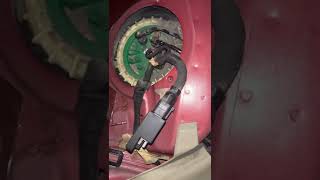
Typical fix: Replace the in-tank low-pressure fuel pump or the fuel pump control module, which is often located under the rear seat bench 🎬 Watch: How to access and replace the fuel control module. on the passenger side.
Est. part cost: $200-$400
Rare But Worth Checking
- Wiring or Connector Damage: The wiring harness to the G247 sensor can become frayed or corroded, causing an intermittent or incorrect signal. Check for 5V reference, good ground, and signal integrity at the connector before replacing the sensor.
- Leaking Fuel Injector(s): → Shop Fuel Injector A fuel injector that is stuck open or leaking can cause a drop in rail pressure, potentially triggering a P0191 code. This is less common than pump or sensor failure but can be a cause if other components check out.
- Clogged Fuel Filter: → Shop Fuel Filter A severely clogged fuel filter can restrict flow to the HPFP, starving it of fuel and causing low pressure codes. This is a maintenance item that is often overlooked.
Diagnosis Steps
- Connect an OBD-II scanner capable of reading live data (VCDS is recommended). Monitor 'Requested Fuel Rail Pressure' and 'Actual Fuel Rail Pressure' in the engine measuring blocks.
- Check for companion codes like P0087 (pressure too low) or P310B (low-pressure system fault) to help guide the diagnosis.
- Visually inspect the wiring harness and electrical connector for the G247 fuel pressure sensor. Look for any signs of corrosion, damage, or loose pins. Test for 5V reference, ground, and signal voltage.
- Test the low-pressure fuel system. Following Audi TPI 2015106/7, use a fuel pressure gauge to verify the in-tank pump is delivering adequate pressure (spec is typically 4-5 Bar) to the HPFP. If low, investigate the LPFP, its filter, and the J538 control module.
- If the low-pressure system is healthy, the next step is to inspect the HPFP cam follower. This requires removing the HPFP. A detailed guide 🎬 See how to properly inspect the cam follower and pump. for the 3.2L FSI exists on AudiWorld forums.
- If the cam follower is significantly worn (coating gone, concave surface) or damaged, replace it. Also inspect the tip of the HPFP plunger and the camshaft lobe for any corresponding damage.
- If the cam follower is in good condition, the G247 fuel pressure sensor is the most likely electrical cause. Replace the sensor.
- If the code returns after replacing the sensor and confirming the follower is good, the High-Pressure Fuel Pump (HPFP) itself has likely failed internally and requires replacement. One owner on AudiWorld forums confirmed this fixed their P0087 after replacing the sensor did not.
Parts You'll Likely Need
- Fuel Rail Pressure Sensor (G247)
(OEM #06E906051K)— This is the most common electronic failure point for this code on the 3.2L FSI engine. It provides the reading that the ECM flags as implausible. An updated part number may be 06J906051D.
Trusted brands: Bosch, Genuine Audi/VW
OEM price range: $120-$160
Aftermarket price range: $70-$110 - High-Pressure Fuel Pump (HPFP)
Related Codes That Often Appear With This One
- P0087 — This code means 'Fuel Rail/System Pressure - Too Low' and often appears with P0191 because the underlying mechanical issues (bad pump, worn follower) cause a real drop in pressure that the sensor correctly reports as being out of spec.
- P2293 — This code for 'Fuel Pressure Regulator 2 Performance' is also related to the HPFP's ability to regulate pressure and is commonly seen when the cam follower or pump fails.
- P310B — This code indicates a problem with the low-pressure fuel system. Seeing it with P0191 strongly suggests the issue may originate from the in-tank fuel pump or its control module, not the high-pressure components.
- P0190 — This code for 'Fuel Rail Pressure Sensor 'A' Circuit' indicates a direct electrical fault (e.g., short or open circuit) with the sensor, whereas P0191 is a performance/range issue. They can appear together if the sensor is failing electrically.
Technical Service Bulletins (TSBs) & Recalls
- {"id": "TPI 2015106/7", "title": "Engine running problems, fault code P0087, P1093, P310B stored in ECM", "description": "This Audi Technical Service Information bulletin provides a diagnostic procedure for low fuel pressure codes. It emphasizes checking the low-pressure system's delivery rate *before* replacing high-pressure components like the HPFP. It outlines specific pressure and flow tests for the in-tank pump."}
Mechanic-Grade Diagnostic Values
- High-Pressure Fuel Rail (Live Data at Idle) — expected: ~40 Bar (~580 PSI). Failure: Pressure matches low-pressure system (~5 Bar) or is wildly erratic. Under load, pressure should rise to 140-150 Bar.
- G247 Sensor Connector Voltage (Key On, Engine Off) — expected: ~5.0 V between terminals 1 and 3. Failure: No voltage or significantly lower voltage indicates a wiring or ECU problem.
- G247 Sensor Harness Wire Resistance — expected: ~0.5 Ω (± 0.3 Ω). Failure: High resistance (O.L.) indicates an open circuit in the harness between the sensor and the ECU.
- LPFP Control Module (J538) Voltage to Pump (at idle) — expected: 4.0 V to 5.7 V. Failure: Voltage is outside this range or does not respond correctly to a throttle blip (should rise, fall, then return to idle value).
- Low-Pressure Fuel System (Mechanical Gauge) — expected: 5 Bar (~72.5 PSI). Failure: Pressure significantly below 5 Bar indicates a fault with the in-tank pump (LPFP), filter, or control module (J538).
Scan Tool Commands That Help
- VCDS (VAG-COM): Engine -> Output Tests -> Fuel Pump Electronics — To manually run the low-pressure fuel pump for testing its operation or for priming the fuel system after replacing the fuel filter or pump. Note that the test may only run for about 10 seconds per activation.
Wiring & Ground Locations
- Engine Harness Ground — On a bolt for the oil filter housing. It is a small gauge, brown wire.. A forum member reported that after an engine replacement, this ground was left unattached, causing various electrical issues. A poor ground for engine sensors can cause erratic readings, potentially triggering a P0191 code.
- G247 Sensor Connector — On the high-pressure fuel rail. The harness has three pins.. This is the direct connection to the sensor. Pin 1 is 5V reference, Pin 2 is the signal wire to the ECU, and Pin 3 is ground. Testing voltage and resistance at these pins is a primary diagnostic step.
- J538 LPFP Control Module — Under the rear seat bench, typically on the passenger side.. This module controls the in-tank fuel pump. A failure or wiring issue here will starve the high-pressure system. The connector can be tested for incoming power, ground, and the output voltage to the pump.
- 327 (Earth Connection) — An earth connection point designated '327' (sender earth) located in the engine compartment wiring harness.. This is the official designation for the ground circuit shared by sensors like the G247. A fault at this ground point can affect multiple sensors.
Real Owner Repair Stories
- AudiWorld Forums user 'Jaako40' (Audi A3 (TDI, but symptom is relevant)) — P0191 code returned after sensor replacement.
❌ Tried (didn't work) Replacing the fuel pressure sensor with an OE part.
✅ What actually fixed it The code came back on immediately after a car wash, strongly indicating the root cause was a wiring harness or connector issue that was sensitive to moisture, not the sensor itself. - AudiWorld Forums user (2006 Audi A6 3.2 Quattro) — Unspecified electrical issues after engine replacement.
❌ Tried (didn't work) Initial troubleshooting by the mechanic was unsuccessful.
✅ What actually fixed it The owner discovered a small, single ground wire from the main engine harness was not re-attached to its post on the oil filter housing. Securing this ground resolved the issues.
"I Checked Everything" — The Actual Cause
- A user replaced the fuel pressure sensor for P0191, and the code was gone for a day. After a car wash, the light immediately came back on. This points to a scenario where all components might test fine statically, but the actual cause is a compromised wiring harness or connector allowing moisture ingress, creating a short or high resistance that triggers the 'range/performance' fault.
When the Usual Fixes Don't Work
- In one case on a similar FSI engine, a technician performed a thorough electrical diagnosis for P0191. They confirmed the 5V reference and ground at the G247 sensor were good, and the low-side fuel pressure was a solid 5 bar. However, live data showed the high pressure was stuck at 5 bar and would not increase. After replacing the sensor did not fix the issue, the evidence pointed conclusively to a mechanical failure of the high-pressure system (either the HPFP itself or the cam follower), demonstrating that the sensor was correctly reporting the problem.
OEM Part Supersession History
06E906051E, 06E906051J→06E906051K— Standard part revision and improvement by the manufacturer.06E906051K→06J906051D (Potential update)— Part consolidation or design update across different engine platforms.
Heads up: While listed as an update in some sources, always verify fitment with VIN. 06J906051D is confirmed as a rail pressure sensor for other VAG engines.
Model Year Variations Within This Range
- 2005-2008: The 3.2L FSI V6 engine was a primary gasoline engine option during the pre-facelift era of the C6 A6.
- 2009-2011: For the 2009 model year facelift, Audi introduced a new 3.0L TFSI (supercharged) V6 and revised 2.8L FSI engines. While the 3.2L may have been available briefly, it was largely phased out, making this P0191 issue most relevant to the 2005-2008 models.
Diagnostic Flowchart
Other Known Issues on This Vehicle
Issues unrelated to this code that are worth knowing about as an owner of this generation:
- Intake Valve Carbon Buildup 🔴 High — Very common, especially after 40,000-60,000 miles. Causes rough idle, misfires, and power loss. Cleaning can cost $700-$1200.
- Timing Chain Tensioner Wear/Failure 🔴 High — A significant issue, especially on pre-2008 models. Symptoms start with a brief rattle on cold starts and can progress to constant noise, misfires, and catastrophic engine failure if the chain jumps. It is an engine-out service to replace the upper tensioners.
- Intake Manifold Runner Flap Failure 🟠 Medium — The plastic linkage arms or internal flaps can break or get stuck, causing CELs (P2006, P2007, P2008) and a loss of low-end torque. Repair often requires replacing the entire intake manifold or using aftermarket repair kits.
- Oil Leaks 🟠 Medium — Common from multiple areas as the engine ages, including valve cover gaskets, timing chain covers, and cam girdles.
- Thermostat Failure 🟠 Medium — The thermostat can fail, leading to overheating or the engine not reaching operating temperature. Replacement is labor-intensive as it is located behind the intake manifold.
Used vs. New Parts: Buying Guide for This Vehicle
When a used part is the smart pick: For the Low-Pressure Fuel Pump Control Module (J538), a used part from a reputable salvage yard can be a cost-effective option. It is an electronic module that typically either works or doesn't, and is less subject to mechanical wear.
Donor-vehicle mileage cap: roughly under 120000 miles for the part to have meaningful remaining life.
What to inspect on the donor part:
- For a J538 module, ensure the connector pins are clean, straight, and free of any corrosion.
- Check the part number on the used module to ensure it matches the original exactly.
- Ask for the donor vehicle's VIN to check for any history of flood or fire damage.
OEM-only on this vehicle (don't cheap out):
- High-Pressure Fuel Pump (HPFP)
- HPFP Cam Follower
Aftermarket brands forum-validated for this vehicle:
- Bosch (Often the Original Equipment Manufacturer for sensors and pumps)
Brands owners have reported issues with on this vehicle:
- URO (Some forum users report lower long-term reliability for electronic parts like fuel pressure regulators compared to OEM/Bosch)
Real Owner Stories
Aggregated from forums and TSBs cited above. Mileages and costs reflect what owners reported in those sources.
2006 Audi A6 3.2L FSI — ~55000 miles
Symptoms: Significant wear on the cam follower where the black coating was gone and the surface had become concave.
What fixed it: Replacement of the HPFP cam follower as a preventative service item.
Source hint: AudiWorld: 3.2L FSI, How to inspect and replace HPFP Cam follower
2008 Audi A6 3.2L
Symptoms: Hard starting issues followed by a return of fuel pressure codes after an initial sensor replacement failed to fix the problem.
What fixed it: Replacement of the high-pressure fuel pump (HPFP) and the cam follower.
Source hint: AudiWorld: 2008 Audi A6 3.2 Fuel Pressure issues.
2008 Audi A6 3.2L
Symptoms: Pressure deviation under load and persistent P0087 code despite replacing the LPFP, HPFP, both sensors, and the filter.
What fixed it: The source indicates the issue remained complex and unresolved even after nearly the entire fuel system was replaced, highlighting diagnostic difficulty.
Source hint: Ross-Tech Forums: 2008 Audi A6 3.2 L (P0087) Fuel rail pressure too low...
Related OBD-II Codes
Frequently Asked Questions
Is there an Audi Technical Service Bulletin for fuel pressure issues on my A6 3.2L?
Where is the fuel pump control module located on the 2005-2011 Audi A6?
How often should I inspect the HPFP cam follower on my 3.2L FSI engine?
What are the voltage specifications for a healthy G247 Fuel Rail Pressure Sensor?
Can I just replace the G247 sensor to fix P0191, or is it usually the pump?
Are there any specific installation tips for the new fuel rail pressure sensor?
Helpful Videos
Used OEM Parts in Stock
New Aftermarket Parts Available


The information in this article is provided for general reference and educational purposes only. Vehicle specifications, procedures, and part compatibility can vary by production date, trim level, and region. Always consult your vehicle's factory service manual and verify part numbers before purchasing or performing repairs. Safety-critical components such as airbags, seat belts, and braking systems should be installed by a qualified professional.
- Audi A6:
- 🧭 Diagnostic Flowchart
- 🎬 Helpful Videos
- 🛍️ Shop This Part
- What's Unique About the 2005-2011 Audi A6
- Symptoms You May Notice
- Most Likely Causes
- Rare But Worth Checking
- Diagnosis Steps
- Parts You'll Likely Need
- Related Codes That Often Appear With This One
- Technical Service Bulletins (TSBs) & Recalls
- Mechanic-Grade Diagnostic Values
- Scan Tool Commands That Help
- Wiring & Ground Locations
- Real Owner Repair Stories
- "I Checked Everything" — The Actual Cause
- When the Usual Fixes Don't Work
- OEM Part Supersession History
- Model Year Variations Within This Range
- Other Known Issues on This Vehicle
- Used vs. New Parts: Buying Guide for This Vehicle
- Real Owner Stories
- 2006 Audi A6 3.2L FSI — ~55000 miles
- 2008 Audi A6 3.2L
- 2008 Audi A6 3.2L
- Related OBD-II Codes
- Frequently Asked Questions
- 🎟️ Get 5% Off