

P0191 on 2012-2019 Ford Explorer 3.5L EcoBoost: Causes and Fixes for Fuel Pressure Faults
On a 2012-2019 Explorer with the 3.5L EcoBoost, code P0191 is most often caused by a failing Fuel Rail Pressure (FRP) sensor. Due to its location under the intake manifold, replacement is labor-intensive. Expect a shop repair to cost between $400 and $800, while the part itself is around $100-$180 for an OEM sensor. Before replacing the sensor, it's wise to rule out wiring issues or a failing Fuel Pump Driver Module (FPDM).
- P0191 on your Explorer most likely means the Fuel Rail Pressure (FRP) sensor has failed.
- Symptoms are serious and include stalling and loss of power, making the vehicle unsafe to drive.
- Diagnosis requires a scan tool to compare desired vs. actual fuel pressure to determine if the fault is the sensor or the fuel pump.
- Repair is difficult for a DIYer because the sensor is located under the intake manifold.
- If you own a 2018 model, check for the specific fuel pressure sensor recall (18S35).
What's Unique About the 2012-2019 Ford Explorer
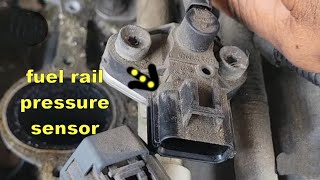
On the 3.5L EcoBoost engine, the fuel system is complex, utilizing both a low-pressure in-tank pump and a high-pressure mechanical pump (HPFP) driven by the engine. The most common point of failure for a P0191 code is the Fuel Rail Pressure (FRP) sensor itself. However, what makes this job particularly challenging on the Explorer is that the sensor is buried under the upper intake manifold, making replacement a difficult and labor-intensive task 🎬 Watch: See exactly where the fuel rail pressure sensor is hidden. compared to many other vehicles where it is easily accessible. Additionally, a small number of 2018 models were subject to a recall for a fuel pressure sensor that could leak, posing a fire risk.
Symptoms You May Notice
- Check Engine Light is on
- Engine stalling, especially when coming to a stop or at low RPM
- Hesitation or significant loss of power during acceleration
- Rough or shaking idle
- Hard starting or extended cranking time
- Increased fuel consumption
- Symptoms mimicking transmission problems, like harsh or erratic shifting
- Replacing the fuel pump without first verifying if the issue is electrical (the sensor) or mechanical (actual pressure). A scan tool that can read desired vs. actual fuel pressure is critical to avoid this.
- Mistaking a Fuel Pump Driver Module (FPDM) failure for a sensor issue. While this is a very common problem on F-150s, it is less frequently cited for the Explorer. It's worth checking but is not the primary suspect.
- Assuming drivability issues like harsh shifting are a transmission problem when they are actually caused by erratic fuel pressure from a failing FRP sensor.
Most Likely Causes
- Faulty Fuel Rail Pressure (FRP) Sensor 🔴 High Probability → Shop Fuel Pressure Sensor The sensor is a sensitive electronic component that operates in a high-heat, high-pressure environment under the intake manifold and can fail over time, sending erratic or incorrect voltage signals. Many owners report this as the definitive fix after experiencing stalling and hesitation.
How to confirm: Use a diagnostic scan tool to monitor live data. Compare the 'Desired Fuel Rail Pressure' PID to the 'Actual Fuel Rail Pressure' PID. If the 'Actual' reading is erratic, stuck, or doesn't follow the 'Desired' reading under various engine loads, the sensor is likely faulty. The actual pressure should closely mirror the desired pressure.
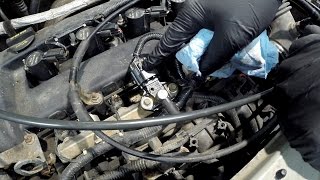
Typical fix: Replace the Fuel Rail Pressure sensor. This requires removing the upper intake manifold to gain access. It is highly recommended to use an OEM Motorcraft part (BU5Z-9F972-B) to ensure reliability and avoid premature failure of aftermarket parts.
Est. part cost: $90-$180 - Failing High-Pressure Fuel Pump (HPFP) 🟡 Medium Probability → Shop Fuel Pump The HPFP is a mechanical pump driven by the camshaft that can wear out, becoming unable to generate the high pressures (up to 2000+ PSI) demanded by the PCM, especially under load.
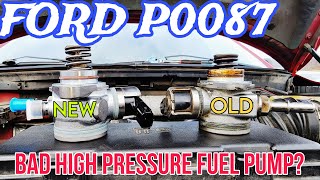
How to confirm: Using a scan tool, observe that the 'Actual Fuel Rail Pressure' is consistently below the 'Desired Fuel Rail Pressure', particularly when accelerating. 🎬 Watch: How to diagnose a failing high-pressure fuel pump. This often triggers code P0087 ('Fuel Rail/System Pressure - Too Low') alongside P0191.
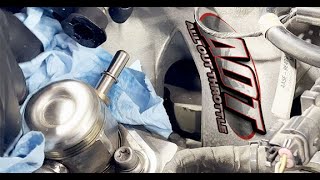
Typical fix: Replace the high-pressure fuel pump. This pump is located on the engine and is driven by the camshaft. 🎬 See this walkthrough on replacing the high-pressure fuel pump.
Est. part cost: $300-$600 - Damaged Wiring or Connector ⚪ Low Probability The wiring harness to the FRP sensor can become damaged from engine heat and vibration over time, leading to corrosion, loose pins, or frayed wires. Ford issued TSB 19-2231 for other models regarding an engine harness chafing on a PCM bracket, which could potentially cause similar issues.
How to confirm: Visually inspect the FRP sensor connector and its wiring for any signs of damage, corrosion, or loose connections. Perform a continuity and resistance test on the circuit if a visual inspection is inconclusive.
Typical fix: Repair the damaged section of the wiring harness or replace the connector pigtail.
Est. part cost: $20-$50 - Failing Low-Pressure In-Tank Fuel Pump or Driver Module (FPDM) ⚪ Low Probability → Shop Fuel Pump The in-tank pump supplies fuel to the HPFP. If it becomes weak or the FPDM fails, it cannot provide enough volume, starving the high-pressure pump and causing a drop in rail pressure. While FPDM failure from corrosion is a very common issue on the F-150 platform, it is less frequently cited but still a possibility on the Explorer.
How to confirm: A fuel pressure gauge can be used to test the low-pressure side of the system. If the pressure is below specification (typically 40-60 PSI) before it reaches the HPFP, the in-tank pump or FPDM is suspect.
Typical fix: Replace the in-tank fuel pump assembly or the Fuel Pump Driver Module.
Est. part cost: $250-$450
Rare But Worth Checking
- Clogged Fuel Filter: → Shop Fuel Filter While less common as a direct cause for a 'Range/Performance' code, a severely clogged filter can restrict fuel flow enough to cause a pressure drop that the sensor reports. The main fuel filter is often part of the in-tank fuel pump assembly and not a separate serviceable item.
- Faulty Powertrain Control Module (PCM): → Shop Engine Control Module (ECM) In very rare cases, the PCM itself can fail, misinterpreting a perfectly good signal from the FRP sensor. This should only be considered after all other possibilities have been exhaustively ruled out.
Diagnosis Steps
- Connect a high-quality OBD-II scanner capable of reading live Ford data.
- Monitor the 'FRP_DES' (Desired Fuel Rail Pressure) and 'FRP' (Actual Fuel Rail Pressure) PIDs.
- Observe the readings at idle, during steady cruising, and under hard acceleration.
- If 'FRP' is erratic, stuck at one value, or does not respond logically while 'FRP_DES' changes, suspect a faulty FRP sensor or wiring issue.
- If 'FRP' consistently reads much lower than 'FRP_DES', especially under load, suspect a mechanical issue like a failing high-pressure fuel pump (HPFP) or a weak in-tank pump. This will often be accompanied by code P0087.
- Visually inspect the FRP sensor connector and wiring harness for any signs of damage, corrosion, or oil contamination. Check for potential harness chafing points.
- If a mechanical pressure issue is suspected, test the low-pressure fuel system with a mechanical gauge to rule out the in-tank pump and FPDM.
- Check the Fuel Pump Driver Module (FPDM), if accessible, for corrosion or damage, as this is a known failure point on related Ford platforms.
- Before replacing any parts, check if your vehicle's VIN falls under recall 18S35 (for certain 2018 models).
Parts You'll Likely Need
- Fuel Rail Pressure Sensor
(OEM #BU5Z-9F972-B)— This is the most common failure point for a P0191 code on this platform. It sends incorrect readings to the PCM, causing drivability issues. The Motorcraft part is strongly recommended for longevity.
Trusted brands: Motorcraft, Bosch
OEM price range: $90-$180
Aftermarket price range: $60-$120 - High-Pressure Fuel Pump (HPFP)
(OEM #BL3Z-9350-C (Motorcraft M73105))— This is the second most likely cause, especially if P0191 is accompanied by P0087. The pump wears out and can no longer supply the pressure commanded by the PCM.
Trusted brands: Motorcraft, Bosch
OEM price range: $400-$600
Aftermarket price range: $250-$450
Related Codes That Often Appear With This One
- P0087 — This code for 'Fuel Rail/System Pressure - Too Low' often appears with P0191 when there is a genuine mechanical problem, like a failing high-pressure or low-pressure fuel pump, causing the low pressure that the sensor is correctly reporting.
- P0190 — This code for 'Fuel Rail Pressure Sensor Circuit Malfunction' points more directly to a hard electrical fault (like a short or open circuit) in the sensor's wiring, whereas P0191 is a 'performance' or rationality fault.
- P0192 — Indicates 'Fuel Rail Pressure Sensor Circuit Low Input', suggesting the sensor's signal voltage is lower than expected, which can be caused by a short to ground or a faulty sensor.
Technical Service Bulletins (TSBs) & Recalls
- Recall 18S35 / NHTSA 18V779000: Improperly assembled fuel pressure sensor may leak fuel.
- TSB 19-2231: Notes that on some Ford vehicles, DTCs including P0191 can be caused by an engine harness chafe on the powertrain control module (PCM) bracket.
- TSB 18-2326: A manufacturer service bulletin notes that certain vehicles may exhibit an illuminated MIL with DTC P0191 stored in the PCM; technicians should follow the specific service procedure to correct the condition.
Platform-Specific Known Issues
- Recall 18S35: A small number of 2018 Explorers with the 2.3L or 3.5L GTDI engine were recalled for a fuel pressure sensor that was improperly assembled into the fuel line, which could cause a fuel leak and increase the risk of a fire.
Mechanic-Grade Diagnostic Values
- Low-Pressure Fuel System — expected: 40-60 PSI at idle.. Failure: Pressure consistently below 40 PSI indicates a weak in-tank pump, clogged filter, or FPDM issue.
- High-Pressure Fuel System (Scan Tool PID 'FRP') — expected: Up to 2150+ PSI under load; should closely track 'FRP_DES' (Desired) PID.. Failure: Actual pressure (FRP) that is erratic, stuck, or consistently lags desired pressure by more than 200 PSI points to a failing FRP sensor or HPFP.
- FRP Sensor Signal Voltage (Backprobed) — expected: Approximately 0.5V at KOEO (Key On, Engine Off) and rises with pressure, up to ~4.5V at maximum pressure.. Failure: Voltage that is stuck, does not change with engine RPM, or is outside the 0.5V-4.5V range suggests a sensor or wiring fault.
- FRP Sensor Reference Voltage — expected: Approximately 5.0V from the PCM.. Failure: Voltage significantly lower or higher than 5.0V indicates a wiring or PCM issue.
- FRP Sensor Ground Circuit — expected: Near 0V, with resistance to chassis ground less than 5 ohms.. Failure: Voltage present on the ground wire or high resistance indicates a bad ground connection.
Scan Tool Commands That Help
- Ford IDS (Integrated Diagnostic System): Power Balance Test — If misfires are also present, this test can help determine if a specific cylinder's fuel delivery is compromised, which might be related to the pressure issue.
- Ford IDS (Integrated Diagnostic System): Fuel System Tests (Injector/Pump Actuation) — Allows a technician to command the fuel pumps and solenoids on/off with the engine off to verify their electrical operation independently of the engine running, helping to isolate a failed component from a wiring issue.
- High-End Scanners (e.g., FORScan, Autel): Datalogging FRP vs. FRP_DES — This is the primary diagnostic step. Recording these two PIDs during a drive cycle (idle, cruise, wide-open throttle) is the best way to see if the actual pressure is irrationally deviating from what the PCM is commanding, which is the definition of a P0191 fault.
Wiring & Ground Locations
- G104 — On the right-hand fender apron, behind the battery area.. This is a primary engine bay ground point. A loose or corroded connection here can cause unstable voltage and erratic signals for various powertrain sensors, including the FRP sensor.
- G108 — On the left-hand fender apron, often near the air intake tube assembly.. Another critical ground for the engine compartment. Poor contact at this location can lead to intermittent sensor faults and false codes as the sensor's ground reference fluctuates.
- FRP Sensor Connector — On the fuel rail, underneath the upper intake manifold.. This is the direct connection point for the sensor. It is susceptible to heat damage and oil contamination. The three pins are typically 5V Reference, Signal, and Ground. Testing voltage and continuity at these specific pins is essential for diagnosis.
Real Owner Repair Stories
- Ford Expedition Forum User (Ford Expedition (similar powertrain architecture)) — Intermittent no-start and frequent stalling, with P0191 code.
❌ Tried (didn't work) Replaced Fuel Pump Driver Module (FPDM), Replaced fuel pump multiple times (both aftermarket and Motorcraft), Replaced fuel filter, Replaced Throttle Body and TPS
✅ What actually fixed it The internal, non-serviceable fuel pump relay (R303) inside the main fuse panel/box had burn marks and was failing intermittently. Replacing the entire fuse panel assembly resolved all issues. - Reddit user r/FordExplorer (2018 Ford Explorer Sport 3.5L EcoBoost) — Lean codes P0171 & P0174, with very high long-term fuel trims (29% on both banks).
❌ Tried (didn't work) Smoke testing for vacuum leaks (none found), Cleaning injectors, Replacing intake manifold seals
✅ What actually fixed it Replacing both the fuel injectors and the Fuel Rail Pressure (FRP) sensor solved the lean condition and brought fuel trims back to normal.
Documented NHTSA Reports
- NHTSA ODI #11478786: An owner reported multiple failures of fuel system equipment resulting in P0191 codes occurring two and three times per day on a vehicle with only 22,000 miles.
- NHTSA ODI #10780588: A driver reported the vehicle stalled at 45mph without warning; while P0191 was found, the ultimate cause was broken bolts holding the internal fuel pump.
- NHTSA ODI #10446792: An owner noted that replacing the fuel rail pressure sensor for a P0191 code did not resolve their issue, suggesting a deeper electrical or mechanical fault.
OEM Part Supersession History
BU5Z-9F972-A→BU5Z-9F972-B— Standard part revision and improvement by the manufacturer.
Heads up: BU5Z-9F972-B is the current recommended replacement and is fully compatible with vehicles that used the -A revision. The part is also sold under the engineering number CM-5226.
Model Year Variations Within This Range
- 2011-2015 (Pre-facelift): While the core engine is the same, earlier models in the generation may share some electrical architecture with platforms like the F-150 that had more prevalent issues with Fuel Pump Driver Module (FPDM) corrosion and fuel pump fuse (Fuse 27) failures. While less common on the Explorer, these should be considered on earlier models if stalling is a primary symptom.
- 2016-2019 (Post-facelift): The FPDM was generally improved and relocated in later models, making it a less likely cause of failure compared to the 2011-2014 period on related platforms. Diagnosis on these later models is more likely to point directly to the FRP sensor or the HPFP itself.
Diagnostic Flowchart
Other Known Issues on This Vehicle
Issues unrelated to this code that are worth knowing about as an owner of this generation:
- Internal Water Pump Failure 🔴 High — Common after 80,000-120,000 miles. Failure can be catastrophic if coolant mixes with engine oil.
- Timing Chain Stretch & Phaser Rattle 🟠 Medium — More common on first-generation (pre-2016) 3.5L EcoBoost engines, often noticeable after 100,000 miles. (Ref: TSB 16-0027, TSB 18-2305)
- Power Transfer Unit (PTU) Failure 🟠 Medium — Common on AWD models. The fluid is considered 'lifetime' but can overheat and break down, leading to failure.
- Cracked Exhaust Manifolds 🟡 Low — Can occur over time due to heat cycles.
Used vs. New Parts: Buying Guide for This Vehicle
When a used part is the smart pick: For this repair, using used parts is generally not recommended. The primary failure items are an electronic sensor (FRP) and a high-wear mechanical pump (HPFP). The labor to access these parts, especially the FRP sensor under the intake manifold, is significant. The risk of a used part failing shortly after installation outweighs the potential cost savings.
Donor-vehicle mileage cap: roughly under 40000 miles for the part to have meaningful remaining life.
What to inspect on the donor part:
- For a High-Pressure Fuel Pump (HPFP), only consider a part from a very low-mileage, documented wreck.
- Avoid parts from vehicles with signs of poor maintenance, sludge in the engine, or a history of fuel contamination.
- Never buy a used Fuel Rail Pressure (FRP) sensor. It is a sensitive electronic part and its remaining lifespan is impossible to determine.
OEM-only on this vehicle (don't cheap out):
- Fuel Rail Pressure (FRP) Sensor
- High-Pressure Fuel Pump (HPFP)
Aftermarket brands forum-validated for this vehicle:
- Bosch (Often the OEM supplier for fuel components)
Brands owners have reported issues with on this vehicle:
- Unbranded, 'white-box' sensors and pumps from online marketplaces are frequently cited in forums as failing quickly, sometimes within weeks, leading to a repeat of the expensive labor.
Real Owner Stories
Aggregated from forums and TSBs cited above. Mileages and costs reflect what owners reported in those sources.
2013 Ford Explorer 3.5L EcoBoost
Symptoms: The owner experienced harsh shifting and drivability issues so severe they were misdiagnosed as a total transmission failure.
What fixed it: Replacing the fuel rail pressure sensor resolved the P0191 code and all shifting issues.
Cost: $2,800-$2,800
Source hint: AliExpress User Story - P0191 Misdiagnosed as Transmission Failure
2018 Ford Explorer 3.5L GTDI
Symptoms: Potential for fuel leaks due to an improperly assembled fuel pressure sensor in the fuel line.
What fixed it: Vehicle was subject to Recall 18S35 / NHTSA 18V779000 for sensor replacement/inspection.
Source hint: Recall 18S35 / NHTSA 18V779000
Related OBD-II Codes
Frequently Asked Questions
Is there a recall for the fuel pressure sensor on my 2018 Ford Explorer 3.5L?
Why is my Explorer shifting harshly when the Check Engine Light for P0191 is on?
Where is the Fuel Rail Pressure sensor located on the 3.5L EcoBoost V6?
Which specific replacement part should I use for the FRP sensor to avoid repeat failures?
Does TSB 19-2231 apply to the P0191 code on Ford vehicles?
Can a failing water pump cause a P0191 code on my Explorer?
Helpful Videos
Used OEM Parts in Stock
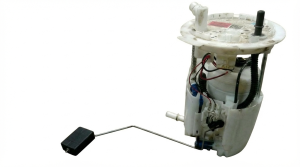
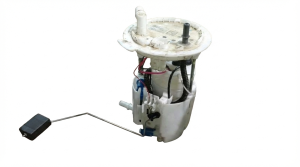
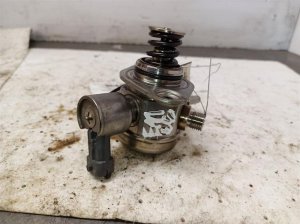
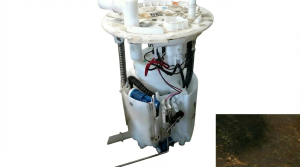
New Aftermarket Parts Available


The information in this article is provided for general reference and educational purposes only. Vehicle specifications, procedures, and part compatibility can vary by production date, trim level, and region. Always consult your vehicle's factory service manual and verify part numbers before purchasing or performing repairs. Safety-critical components such as airbags, seat belts, and braking systems should be installed by a qualified professional.
- Ford Explorer:
- 🧭 Diagnostic Flowchart
- 🎬 Helpful Videos
- 🛍️ Shop This Part
- What's Unique About the 2012-2019 Ford Explorer
- Symptoms You May Notice
- Most Likely Causes
- Rare But Worth Checking
- Diagnosis Steps
- Parts You'll Likely Need
- Related Codes That Often Appear With This One
- Technical Service Bulletins (TSBs) & Recalls
- Platform-Specific Known Issues
- Mechanic-Grade Diagnostic Values
- Scan Tool Commands That Help
- Wiring & Ground Locations
- Real Owner Repair Stories
- Documented NHTSA Reports
- OEM Part Supersession History
- Model Year Variations Within This Range
- Other Known Issues on This Vehicle
- Used vs. New Parts: Buying Guide for This Vehicle
- Real Owner Stories
- 2013 Ford Explorer 3.5L EcoBoost
- 2018 Ford Explorer 3.5L GTDI
- Related OBD-II Codes
- Frequently Asked Questions
- 🎟️ Get 5% Off