

P0202 on 2012-2018 Ford Focus 2.0L: Injector Circuit Malfunction Causes and Fixes
P0202 on a 2012-2018 Ford Focus indicates an electrical fault with the cylinder 2 fuel injector. The most common fix is replacing the fuel injector, which is a moderate to difficult DIY job requiring removal of the intake manifold. Before replacing the injector, it is critical to rule out a faulty canister purge valve (CPV), which can cause identical symptoms and was subject to a major recall (18S32).
- P0202 points to an electrical fault in the cylinder 2 injector circuit, not just a clogged injector.
- Before buying any parts, investigate Ford Recall 18S32 for the Canister Purge Valve (CPV), as it causes identical symptoms and is a common point of misdiagnosis.
- The most likely cause is a failed fuel injector, but always test the circuit with a noid light first to rule out wiring or PCM issues.
- Replacing the injector on this GDI engine is a difficult job (DIY 4/5) because the intake manifold must be removed.
- If you replace one injector, it is best practice to replace all four at once to ensure balanced engine performance.
What's Unique About the 2012-2018 Ford Focus
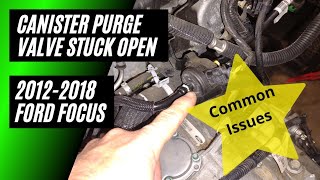
The 2012-2018 Focus uses a Gasoline Direct Injection (GDI) engine, where fuel is sprayed directly into the combustion chamber under very high pressure. This makes the injectors more complex and also more difficult to replace, as they are located under the intake manifold. Critically, these cars were recalled for a faulty Canister Purge Valve (CPV) that can stick open, causing excessive vacuum in the fuel system which leads to stalling, rough idle, and difficulty starting—symptoms nearly identical to a bad injector. 🎬 Watch: How a stuck purge valve mimics injector failure It is a very common misdiagnosis to replace the injector when the CPV is the actual problem.
Symptoms You May Notice
- Check Engine Light is on (can be steady or flashing)
- Rough or shaking idle
- Engine misfiring, which can feel like a stutter, vibration, or popping sound
- Hesitation or lack of power during acceleration
- Poor fuel economy
- Engine stalling, especially at low speeds or when stopping
- Replacing the fuel injector when the actual cause is a faulty Canister Purge Valve (CPV). The symptoms are nearly identical. Always check if the vehicle has had recall 18S32 performed before replacing fuel system components. The recall involves a PCM software update to better detect the fault, and replacement of the valve if necessary.
Most Likely Causes
- Faulty Cylinder 2 Fuel Injector 🔴 High Probability → Shop Fuel Injector The 2.0L GDI engine's injectors operate under high pressure and can become clogged with carbon deposits or fail internally from heat and wear. The internal coil winding can burn out, creating an open circuit.
How to confirm: After confirming the circuit has a pulse with a noid light, swap the cylinder 2 injector with another cylinder (e.g., cylinder 3). If the code changes to P0203, the injector is confirmed bad. You can also test the injector's resistance with a multimeter; an open circuit (infinite resistance) or a resistance value outside of the manufacturer's specification indicates failure. 🎬 See how to test fuel injectors with basic hand tools
Typical fix: Replace the faulty fuel injector. It is highly recommended to replace all four injectors at the same time to ensure balanced fuel flow, as they have all experienced the same wear. The Teflon seals and O-rings must also be replaced.
Est. part cost: $90 - $125 for one OEM/Bosch injector, or $120 - $250 for a set of 4 remanufactured or aftermarket injectors. - Wiring Harness or Connector Issue 🟡 Medium Probability Engine vibration and heat can cause wires to break or insulation to fray over time. The connector pins can also become corroded, loose, or damaged, especially the small plastic locking tabs which can become brittle. A manufacturer service bulletin for other Ford models, TSB Bulletin #SSM 49759, notes that an illuminated MIL with P0202 may require following specific pinpoint tests in the Powertrain Control/Emissions Diagnosis manual.
How to confirm: Visually inspect the wiring harness leading to the cylinder 2 injector for any signs of damage, melting, or corrosion. Check that the connector is securely plugged in. Use a noid light to test for a pulse signal at the connector; if the light does not flash, the problem is in the wiring or PCM. Wiggle the harness while the engine is running to see if it induces a misfire or stumble.
Typical fix: Repair the broken wire(s) or replace the damaged connector pigtail. A common part number for the connector pigtail is WPT-1051 or similar aftermarket equivalents.
Est. part cost: $10 - $30 for a new connector pigtail. - Faulty Powertrain Control Module (PCM) ⚪ Low Probability → Shop Engine Control Module (ECM) Some Ford vehicles of this era may lack robust circuit protection between the injectors and the PCM, meaning a shorted injector can potentially damage the internal injector driver circuit in the computer. This is a known, though uncommon, failure mode.
How to confirm: This is a diagnosis of exclusion. If the fuel injector and wiring have both been tested and are known to be good (e.g., noid light doesn't flash, and wiring shows continuity to the PCM), the PCM itself is the likely culprit. A professional may need to use an oscilloscope to verify the driver signal is absent from the PCM pin.
Typical fix: Replace and reprogram the Powertrain Control Module. This requires specialized tools and should be done by a professional or a specialized service like Flagship One.
Est. part cost: $300 - $800 for a remanufactured PCM.
Diagnosis Steps
- Scan the vehicle for all OBD-II codes. Note if P0202 is accompanied by other codes like P0302 (misfire) or P1450 (EVAP system).
- Check for recalls. Verify if Ford recall 18S32 (NHTSA ID: 18V-735) for the Canister Purge Valve (CPV) has been performed, as a faulty CPV can mimic these symptoms and even cause fuel tank deformation. Ford advised owners to keep the fuel tank at least half full until the repair was made.
- Visually inspect the wiring harness and connector for the cylinder 2 fuel injector. Cylinder 2 is the second cylinder from the passenger side (serpentine belt side) of the engine. Look for any obvious damage, corrosion, or loose connections.
- Perform a noid light test. Disconnect the injector and plug a noid light into the connector. Crank the engine. If the light flashes, the PCM and wiring are sending a signal, and the injector is likely the problem. If it does not flash, the issue is in the wiring or the PCM.
- If the noid light flashes, confirm the injector has failed. The most definitive test is to swap the cylinder 2 injector with an adjacent one (e.g., cylinder 3). Clear the codes and run the engine. If the code returns as P0203 ('Injector Circuit / Open - Cylinder 3'), the injector is faulty. If P0202 returns, the problem is intermittent and likely in the wiring to cylinder 2.
- If the noid light does not flash, check for continuity on the two wires between the injector connector and the PCM connector using a multimeter. If a wire is open (infinite resistance), repair it.
- If all wiring and the injector are confirmed to be good, the PCM's internal injector driver is the most likely point of failure. This requires professional diagnosis and replacement.
Parts You'll Likely Need
- Fuel Injector
(OEM #BB5Z9F593B)— This is the most common component to fail, either electrically or by becoming clogged, causing the P0202 circuit code. This part number supersedes BB5Z-9F593-A.
Trusted brands: Motorcraft, Bosch
OEM price range: $100 - $125
Aftermarket price range: $70 - $100 - Intake Manifold Gasket Set
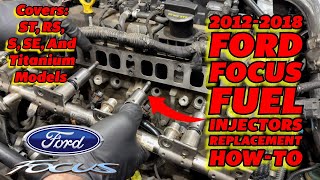
(OEM #CJ5Z-9439-A)— The intake manifold must be removed to access the fuel injectors. The gaskets are single-use and must be replaced to prevent vacuum leaks. 🎬 Watch: Step-by-step guide to replacing your fuel injectors
Trusted brands: Fel-Pro, Mahle, Motorcraft
OEM price range: $25 - $40
Aftermarket price range: $15 - $30 - Fuel Injector Connector Pigtail
(OEM #WPT-1051)— If the wiring inspection reveals a damaged or corroded connector, the pigtail will need to be spliced in. The locking tabs are fragile and often break during removal.
Trusted brands: Motorcraft, Dorman, Standard Motor Products (S-824)
OEM price range: $20 - $35
Aftermarket price range: $10 - $25
Related Codes That Often Appear With This One
- P0302 — P0302 is a 'Cylinder 2 Misfire' code. Since the P0202 code indicates a fuel delivery problem for cylinder 2, that cylinder cannot fire correctly, directly causing a misfire.
- P1450 — This code for 'Unable to Bleed Up Fuel Tank Vacuum' is often associated with the faulty Canister Purge Valve (CPV) that was subject to recall 18S32. If you see P0202 with P1450, the CPV is a very strong suspect.
Technical Service Bulletins (TSBs) & Recalls
- TSB 15-0034: Addresses inaccurate fuel gauge readings and various DTCs including P1450, which can be related to the same CPV issue that mimics injector failure.
- TSB Bulletin #SSM 49759: While issued for other Ford models, this bulletin notes that P0202 can be present with an illuminated MIL and directs technicians to follow specific pinpoint tests in the Powertrain Control/Emissions Diagnosis Manual.
Platform-Specific Known Issues
- Ford Recall 18S32 (NHTSA ID: 18V-735): Affects 1.3 million 2012-2018 Focus models with the 2.0L GDI engine. A faulty Canister Purge Valve (CPV) can stick open, causing excessive vacuum in the fuel system. This leads to symptoms like rough idle, stalling, and difficulty starting, which are often misdiagnosed as a fuel injector problem. In severe cases, the vacuum can deform the plastic fuel tank.
- A follow-up recall (19V-515) was issued for vehicles that received the 18S32 remedy because the initial PCM software update was not always performed correctly.
Mechanic-Grade Diagnostic Values
- Fuel Injector Coil Resistance — expected: Approximately 11-18 Ohms. All injectors should be within 0.5 Ohms of each other.. Failure: A reading of infinite resistance (open circuit) or a value significantly different (more than 1-2 Ohms) from the other injectors.
- Injector Circuit Voltage (at connector) — expected: Approximately 12V (battery voltage) with Key On, Engine Off.. Failure: Voltage significantly below battery voltage suggests a wiring issue or PCM fault.
- Low-Pressure Fuel System Pressure — expected: 55-75 PSI.. Failure: Pressure below this range indicates a weak in-tank fuel pump or clogged filter, which can starve the high-pressure pump.
- High-Pressure Fuel System Pressure (at idle) — expected: Typically 400-800 PSI, but can vary. The system can reach over 2,000 PSI under load.. Failure: Pressure that is erratic or does not respond to engine RPM changes can indicate a failing High-Pressure Fuel Pump (HPFP) or Fuel Rail Pressure (FRP) sensor.
- Wiring Harness Continuity (Injector to PCM) — expected: Near 0 Ohms of resistance.. Failure: Resistance above 0.5 Ohms indicates corrosion or a break in the wire.
Scan Tool Commands That Help
- FORScan: Key On Engine Off (KOEO) Injector Electrical Self Test (Buzz Test) — This command sequentially activates each injector, creating an audible 'buzz'. It's used to quickly verify that the PCM driver and wiring are capable of activating the injector solenoid. If all other injectors buzz except for cylinder 2, it strongly points to a wiring or PCM driver issue for that specific circuit.
- FORScan / Ford IDS: Power Balance Test — This live data test graphically displays the power contribution of each cylinder while the engine is running. If cylinder 2 shows a significant drop in contribution compared to the others, it confirms a performance issue on that cylinder, which, when combined with P0202, points directly to a fuel delivery problem.
Wiring & Ground Locations
- G1 / G105 — Main engine compartment ground, located on the chassis underneath the air filter box, in front of the battery.. This is a primary ground point for the engine control system. A corroded or loose connection here can cause a wide range of intermittent electrical problems, including erratic sensor readings and injector circuit faults. Cleaning this ground is a common fix for unexplained electrical issues on this platform.
- Injector #2 Connector — On the fuel rail, under the intake manifold. Cylinder #2 is the second cylinder from the right (passenger side) of the engine.. This is the direct connection point for the injector. The pins can corrode, and the plastic locking tab is notoriously brittle and can break, leading to a poor connection that triggers P0202.
- PCM Connector C1232B — This is one of the main connectors on the Powertrain Control Module (PCM).. The control wires for the fuel injectors run from this connector. A continuity test must be performed from the pins at this connector to the corresponding pins at the injector connector to rule out a broken wire.
Real Owner Repair Stories
- YouTube user comment on 'Ford Focus Electrical Grounds' (2012 Ford Focus) — Jerking transmission, driveability issues, and low system voltage readings (13.4-13.8V).
❌ Tried (didn't work) Suspected a bad alternator due to low voltage.
✅ What actually fixed it Cleaning the main engine ground points. After cleaning, the system voltage returned to a normal 14.2-14.4V and the driveability issues were resolved.
Documented NHTSA Reports
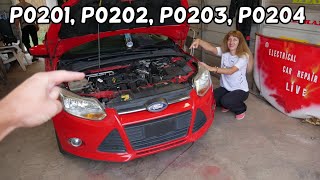
- NHTSA ODI #10944544: An owner reported that while driving, their vehicle would turn over but not start. The check engine light was on with codes P0201 and P0202, described as an open circuit for every injector.
- NHTSA ODI #10405277: A report describes a situation where an owner had to pull over immediately on a highway. The codes pulled included P0201, P0202, P0203, and P0204. The dealer checked electrical connections and reassembled the components, but the issue recurred.
OEM Part Supersession History
CM5E-BB→BB5Z-9F593-B (Motorcraft CM-5213)— Likely an internal revision for improved reliability or manufacturing process.
Heads up: The part number CM5E-BB is widely referenced by aftermarket suppliers, while BB5Z-9F593-B is the current Ford/Motorcraft service part number. They are interchangeable.BB5Z-9F593-A→BB5Z-9F593-B— Standard part number revision.
Model Year Variations Within This Range
- 2015-2018: The Ford Focus received a facelift for the 2015 model year, which included revised exterior styling and a more intuitive interior layout. However, the primary 2.0L GDI engine and its fuel system components remained fundamentally the same, so the diagnosis for P0202 is identical across the 2012-2018 range.
Diagnostic Flowchart
Other Known Issues on This Vehicle
Issues unrelated to this code that are worth knowing about as an owner of this generation:
- DPS6 'PowerShift' Dual-Clutch Automatic Transmission Failure 🔴 High — Extremely common. Affects a large percentage of non-ST/RS automatic models. Problems include shuddering, hesitation, jerking, and complete loss of drive. (Ref: Multiple lawsuits and extended warranty programs (e.g., 14M01, 14M02) were issued, but the fundamental design is flawed.)
- Passenger-Side Hydraulic Engine Mount Collapse 🟠 Medium — Very common failure item. The fluid-filled mount collapses, causing severe vibration at idle and clunking noises.
- Canister Purge Valve (CPV) Malfunction 🔴 High — Widespread, affecting over a million vehicles. The valve sticks open, causing stalling, rough idle, and potential fuel tank deformation. (Ref: Ford Recall 18S32 (NHTSA 18V-735) and 19V-515.)
- Loss of Power Steering Assist 🔴 High — Common enough to be a well-documented complaint. The electric power steering rack (EPAS) can fail suddenly, making the vehicle very difficult to steer. (Ref: Multiple TSBs exist for steering noises and issues, such as SSM 46210.)
- Door Latch Failure 🟠 Medium — Common across many Ford models of the era, including the Focus. A component in the latch breaks, preventing the door from closing securely or indicating it is closed when it is not. (Ref: Ford Recall 15V-246 and subsequent recalls for improper repair.)
Used vs. New Parts: Buying Guide for This Vehicle
When a used part is the smart pick: A used wiring harness pigtail or a section of the engine harness from a junkyard is a smart choice if your original wiring is physically damaged (e.g., rodent damage, melted insulation). A used Powertrain Control Module (PCM) can also be a cost-effective option, but it absolutely requires professional reprogramming to match your vehicle's VIN and security information.
Donor-vehicle mileage cap: roughly under 80000 miles for the part to have meaningful remaining life.
What to inspect on the donor part:
- For wiring: Inspect for any signs of brittleness, cracking, or previous repairs (e.g., mismatched tape, butt connectors). Ensure connector locking tabs are intact.
- For a PCM: Check for any signs of water intrusion or physical damage to the case or connectors. Try to get the VIN of the donor car to aid in reprogramming.
- Avoid parts from vehicles that show signs of a major frontal collision or engine fire, as the heat can damage electronics and wiring insulation.
OEM-only on this vehicle (don't cheap out):
- Fuel Injectors: Due to the high pressures and precise nature of GDI systems, it is strongly recommended to use OEM (Motorcraft/Bosch) or reputable OEM-quality remanufactured injectors. Cheap, unbranded aftermarket injectors are known to have inconsistent flow rates and high failure rates, leading to persistent performance issues.
Aftermarket brands forum-validated for this vehicle:
- Bosch (Often the Original Equipment Manufacturer)
- Standard Motor Products (SMP)
- Dorman (for connector pigtails)
Brands owners have reported issues with on this vehicle:
- Unbranded, no-name injector sets sold on marketplaces like eBay or Amazon. While the price is tempting, they are a very common source of repeat failures and are often poorly matched.
Real Owner Stories
Aggregated from forums and TSBs cited above. Mileages and costs reflect what owners reported in those sources.
2012-2018 Ford Focus 2.0L GDI
Symptoms: P0202 and P0302 codes appearing together; the engine experienced a misfire.
What fixed it: Diagnosis of a failed injector driver in the ECM/PCM, caused by a lack of robust circuit protection against injector shorts.
Source hint: r/MechanicAdvice on Reddit
2012-2018 Ford Focus 2.0L GDI
Symptoms: Rough idle, stalling, and difficulty starting; symptoms were initially thought to be injector-related but were actually caused by excessive vacuum in the fuel system.
What fixed it: Replacement of the Canister Purge Valve (CPV) under Ford Recall 18S32.
Source hint: Ford Recall 18S32 (NHTSA ID: 18V-735)
Related OBD-II Codes
Frequently Asked Questions
Could the stalling and rough idle on my 2014 Focus be related to a recall instead of a bad injector?
Where is the Cylinder 2 injector located on the 2.0L GDI engine?
Is there a specific connector part number if my injector wiring is damaged?
Why would a bad injector cause my PCM to fail on this specific Ford model?
I already had the CPV recall performed, but I still have P0202 symptoms. Could the repair have failed?
Should I replace just the Cylinder 2 injector or all of them?
Helpful Videos
Used OEM Parts in Stock
New Aftermarket Parts Available


The information in this article is provided for general reference and educational purposes only. Vehicle specifications, procedures, and part compatibility can vary by production date, trim level, and region. Always consult your vehicle's factory service manual and verify part numbers before purchasing or performing repairs. Safety-critical components such as airbags, seat belts, and braking systems should be installed by a qualified professional.
- Ford Focus:
- 🧭 Diagnostic Flowchart
- 🎬 Helpful Videos
- 🛍️ Shop This Part
- What's Unique About the 2012-2018 Ford Focus
- Symptoms You May Notice
- Most Likely Causes
- Diagnosis Steps
- Parts You'll Likely Need
- Related Codes That Often Appear With This One
- Technical Service Bulletins (TSBs) & Recalls
- Platform-Specific Known Issues
- Mechanic-Grade Diagnostic Values
- Scan Tool Commands That Help
- Wiring & Ground Locations
- Real Owner Repair Stories
- Documented NHTSA Reports
- OEM Part Supersession History
- Model Year Variations Within This Range
- Other Known Issues on This Vehicle
- Used vs. New Parts: Buying Guide for This Vehicle
- Real Owner Stories
- 2012-2018 Ford Focus 2.0L GDI
- 2012-2018 Ford Focus 2.0L GDI
- Related OBD-II Codes
- Frequently Asked Questions
- 🎟️ Get 5% Off