

P0202 on 2005-2012 Porsche Boxster: Injector Circuit Malfunction - Cylinder 2
P0202 on a Porsche Boxster indicates an electrical fault with the fuel injector on cylinder 2. The most common cause is a failed fuel injector. Due to the mid-engine layout, replacement is extremely difficult and costly, requiring removal of the intake manifold. Injectors range from ~$60 for port injection models (987.1) to over $200 for direct injection (987.2 S).
- P0202 on a 2005-2012 Boxster points to an electrical issue with the cylinder 2 fuel injector, most likely a failed injector itself.
- Crucially, you must identify your Boxster's sub-generation: 987.1 (2005-08) and 987.2 Base (2009-12) use less expensive port injectors, while the 987.2 S (2009-12) uses expensive Direct Injection (DFI) injectors.
- The definitive diagnostic step is to swap the suspect injector with one from another cylinder to see if the fault code follows the injector.
- This is not an easy DIY job. Accessing the injectors on the mid-engine Boxster is very time-consuming and difficult, making professional labor a significant portion of the repair cost.
What's Unique About the 2005-2012 Porsche Boxster
The 2005-2012 Boxster spans two generations, the 987.1 and 987.2, which have fundamentally different engines and fuel systems. The 987.1 (2005-2008) uses the M97 engine family with traditional port fuel injection. The 987.2 (2009-2012) introduced the entirely new 9A1 engine family; the base 2.9L model continued with port injection, but the 3.4L 'S' model switched to a more complex and high-pressure Direct Fuel Injection (DFI) system. This generational divide means that the fuel injectors, their costs, and the diagnostic nuances are different. Furthermore, the mid-engine layout of the Boxster makes accessing any of the injectors a significantly more labor-intensive job compared to front-engine cars, requiring removal of the engine cover from inside the cabin and disassembly of the intake manifold to reach the fuel rails.
Generation note: This range covers two Porsche Boxster generations, both designated 987, but with a major refresh in 2009. * 987.1 (2005-2008): These models use M96/M97 series engines (2.7L, 3.2L, 3.4L) with traditional port fuel injection. The injectors are relatively inexpensive and well-understood. * 987.2 (2009-2012): These models use the newer 9A1 series engines. The base 2.9L model uses port injection (similar to 987.1 but a different engine). The 'S' 3.4L model uses a high-pressure Direct Fuel Injection (DFI) system. DFI injectors are more expensive and operate under much higher pressure, making their replacement more complex and requiring special one-time-use seals.
Symptoms You May Notice
- Check Engine Light (CEL) is on
- Engine misfiring or running rough, especially at idle
- Hesitation or lack of power during acceleration
- Noticeable decrease in fuel economy
- Engine may shake or vibrate more than usual
- Abnormal ticking sound from the passenger side of the engine bay
- Engine may stall in severe cases
- Replacing spark plugs or ignition coils. While these can cause a misfire (P0302), they will not cause an injector circuit code (P0202). The code P0202 specifically points to an electrical fault in the injector circuit, not a combustion problem.
Most Likely Causes
- Failed Fuel Injector (Cylinder 2) 🔴 High Probability → Shop Fuel Injector Injectors are wear items that can fail electrically (coil failure) or mechanically over time. A Rennlist forum user with a 996 (similar engine architecture) reported P0202 along with misfire codes, with a bad injector being the confirmed cause.
How to confirm: The most definitive test is to swap the cylinder 2 injector with an injector from another cylinder (e.g., cylinder 1). Clear the codes and drive the car. If the code changes to P0201 (for cylinder 1), the injector is confirmed bad. If the code remains P0202, the issue is with the wiring or DME. Before disassembly, a mechanic's stethoscope can be used to listen to the injectors; a silent injector on cylinder 2 would point towards a failure.
Typical fix: Replace the failed fuel injector. It is often recommended to replace injectors in sets (e.g., all three on the same bank or all six) to ensure balanced fuel delivery and because of the high labor cost to access them.
Est. part cost: $60-$250 per injector, depending on generation. - Wiring Harness or Connector Issue 🟡 Medium Probability Engine vibration and heat can cause wiring to become brittle or connectors to loosen over time. The tight packaging of the mid-engine bay can also lead to chafing if wires are not properly secured. A user on Rennlist documented a case where a previous repair left a wiring harness clip missing, showing how easily things can be disturbed in the tight space.
How to confirm: Visually inspect the wiring harness and connector for cylinder 2. Check for any signs of damage, corrosion, or loose pins. Use a multimeter to check for continuity between the injector connector and the DME. Use a 'noid light' at the injector connector to see if the DME is sending a pulse signal.
Typical fix: Repair the damaged section of wiring or replace the injector pigtail connector. Ensure the harness is properly routed and secured away from heat sources or sharp edges.
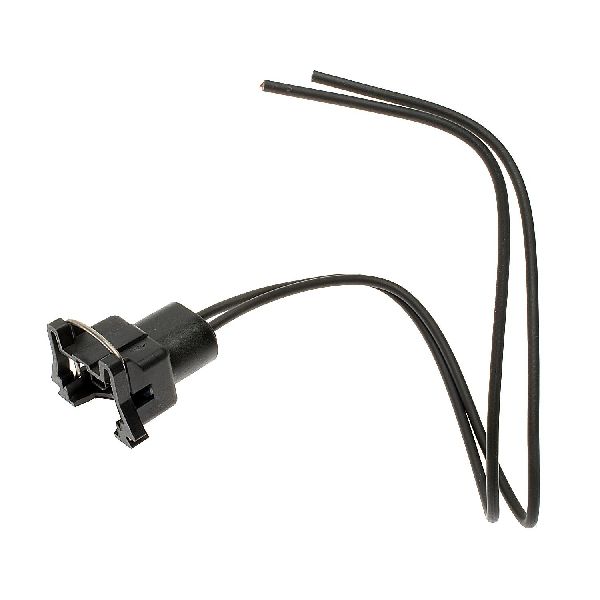
Est. part cost: $10-$30 for a connector pigtail. - Faulty DME Injector Driver ⚪ Low Probability While rare, the transistor inside the DME that controls the injector can fail. This is typically a last-resort diagnosis. In some cases, software issues can mimic hardware failures; NHTSA ODI #11721529 notes a instance where a vehicle running rough with P0202 and P0204 electrical faults was addressed by updating the DME software and clearing faults.
How to confirm: This is confirmed only after a faulty injector and wiring have been definitively ruled out. If an injector swap does not move the code and the wiring shows perfect continuity and signal, the DME is the likely culprit.
Typical fix: The DME must be sent to a specialist for repair or be replaced entirely. Replacement often requires programming to the vehicle's VIN and security system.
Est. part cost: $500-$2000+ for repair or replacement.
Rare But Worth Checking
- DME Power Supply Issue After Battery Problems:
Diagnosis Steps
- Read the trouble codes with an OBD-II scanner to confirm P0202 and any other related codes.
- Locate cylinder 2. On the Boxster's flat-six engine, cylinders 1-2-3 are on the passenger side (US) and 4-5-6 are on the driver's side (US), with cylinder #1 being closest to the front of the car (pulleys). Cylinder #2 is the middle cylinder on the passenger side.
- As a non-invasive first check, use a mechanic's stethoscope on the fuel rail near injector #2 while the engine is running. Compare the rhythmic clicking sound to a known good injector (like #1 or #3). A lack of clicking from #2 suggests an electrical or mechanical injector failure.
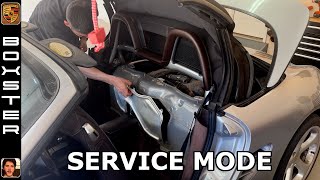
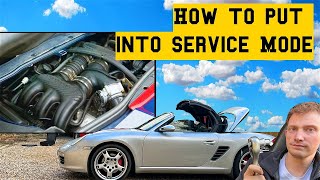
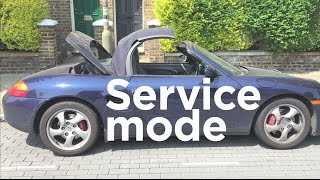
- Gain access to the engine. This is the hardest part on a Boxster and involves removing interior panels and covers from behind the seats to access the engine cover. 🎬 Watch: How to put your Boxster into service mode
- Visually inspect the wiring and connector for the cylinder 2 fuel injector. Look for any obvious damage, corrosion, or loose connections.
- If the wiring looks good, disconnect the injector and test its resistance (impedance) with a multimeter. Compare the reading to the other injectors or to the manufacturer's specification (typically around 12-16 Ohms for port injectors, 1-2 Ohms for DFI). An open circuit (infinite resistance) or a reading far from the others indicates a bad injector.
- Use a 'noid light' plugged into the injector's electrical connector. Crank the engine. The light should flash, indicating the DME is sending a signal. If it doesn't flash, the problem is in the wiring or the DME.
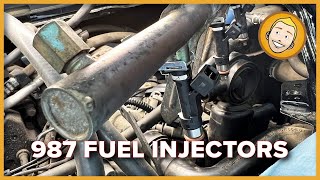
- If a noid light confirms a signal, but the injector is not working, perform an injector swap. Swap the cylinder 2 injector with the cylinder 1 injector. This requires significant disassembly. 🎬 See this fuel injector replacement walkthrough Clear the codes and run the engine. If the code returns as P0201, the injector is faulty. If P0202 returns, the problem is in the wiring or DME.
- If the wiring is suspected, perform a continuity test on both wires from the injector connector back to the DME connector to check for breaks or shorts.
Parts You'll Likely Need
- Fuel Injector (Port Injection)
(OEM #99760512300)— This is the most common failure point for a P0202 code. This part is for the 987.1 (2005-2008) models and the 987.2 Base (2009-2012) model. The Bosch equivalent is a common replacement.
Trusted brands: Bosch (P/N: 0280158023)
OEM price range: $120-$180
Aftermarket price range: $60-$90 - Fuel Injector (Direct Injection)
(OEM #9A160512402)— This is the correct injector for the 987.2 Boxster S (2009-2012) with the 3.4L DFI engine. These are more complex and expensive than port injectors.
Trusted brands: Bosch
OEM price range: $200-$300
Aftermarket price range: $150-$220 - DFI Injector Seal Kit
(OEM #9A111091000)— For DFI models (987.2 S), the injector seals are one-time use and must be replaced. They resist combustion pressure and are critical for preventing leaks. The installation process can be daunting.
Related Codes That Often Appear With This One
- P0302 — P0302 is 'Cylinder 2 Misfire Detected'. A malfunctioning injector circuit will prevent fuel from being delivered to cylinder 2, causing it to misfire. This is the most common companion code.
- P0300 — P0300 is 'Random/Multiple Cylinder Misfire Detected'. Sometimes, a severe misfire in one cylinder can be misinterpreted by the DME or affect engine balance enough to trigger a general misfire code.
Platform-Specific Known Issues
- Accessing the fuel injectors is extremely difficult due to the mid-engine design. It requires significant disassembly from the top side of the engine bay, which is located inside the cabin behind the seats. Multiple forum users confirm that removing the intake manifold is necessary to gain enough clearance to remove the fuel rails, turning it into a very frustrating, multi-day job for a DIYer. One user on Rennlist described it as 'the most frustrating car repair I've ever had the misfortune to undertake'.
Mechanic-Grade Diagnostic Values
- 987.1 Port Fuel Injector (High-Impedance) Resistance — expected: 12-16 Ohms. All injectors should measure within 0.5 Ohms of each other.. Failure: A reading of 0 Ohms (short circuit) or infinite/OL (open circuit).
- 987.2 Direct Fuel Injector (Low-Impedance) Resistance — expected: Approximately 1.7 - 1.8 Ohms.. Failure: A reading of 0 Ohms (short circuit) or infinite/OL (open circuit).
- Injector Control Signal (Noid Light Test) — expected: A steady, flashing light from the noid light when plugged into the injector harness connector and the engine is cranked.. Failure: No light or a very weak/erratic flash indicates a problem with the wiring or the DME driver.
- Injector Circuit Inductive Kick Voltage — expected: A sharp voltage spike of approximately 50-75 volts, visible on an oscilloscope, immediately after the DME closes the injector ground.. Failure: Absence of this voltage spike is what triggers the P0202 code in the DME.
Scan Tool Commands That Help
- PIWIS (Porsche Integrated Workshop Information System): DME Control Unit > Drive Links > Input Signals/Actuations — This function allows a technician to individually activate specific fuel injectors with the engine off. By commanding injector #2 to fire, you can listen for the audible click with a stethoscope to confirm the injector's mechanical function and the integrity of the circuit from the DME to the injector. This can isolate a bad injector without an engine swap if the tool is available.
- PIWIS (Porsche Integrated Workshop Information System): DME Control Unit > Fault Memory > Read All — Beyond just reading the P-code, the PIWIS system can provide more detailed fault descriptions and timestamps, which can help determine if the fault is intermittent or constant.
- Durametric: Actual Values > Fuel Trim (RKAT and FRA) — While P0202 is an electrical code, observing fuel trims can give context. If the injector was intermittently failing before setting the hard electrical fault, you might see extreme fuel trim values on Bank 1 (Cylinders 1-3) as the DME tried to compensate for the faulty injector.
Wiring & Ground Locations
- DME Connector III, Pin 14 — The DME (ECU) is located behind the rear seats under a cover. Connector III is a 52-pole connector.. According to a Bosch Motronic 7.8 pinout diagram, Pin 14 on Connector III is the ground-side trigger for the cylinder 2 fuel injector. A continuity test should be performed from this pin to the corresponding wire at the injector connector.
- Engine-to-Chassis Ground Strap — There is a primary ground strap connecting the engine/transmission to the chassis, often near the front of the transmission or from the passenger side cylinder head area to the chassis.. A corroded or loose main ground strap can cause a host of bizarre electrical issues, including intermittent faults in sensor and actuator circuits. While it wouldn't typically isolate to a single injector, it's a critical check for any electrical problem, as the DME and its drivers rely on a stable ground reference.
- Injector Power Supply — The power side (12V) of the fuel injectors is typically supplied via the DME relay.. While a failure here would usually affect multiple injectors, a fault in the wiring loom branching off from the main power supply could potentially affect only one injector circuit. The DME monitors this circuit for expected voltage.
Real Owner Repair Stories
- Rennlist user (2006 Cayman S (987.1)) — Leaky fuel injector, decided to replace all six as preventative maintenance.
❌ Tried (didn't work) Attempting to remove the fuel rails without removing the intake manifolds. The user found this to be impossible on their car due to the fuel rail bracket design.
✅ What actually fixed it The user had to remove the intake manifolds to gain access. The job was described as 'the most frustrating car repair I've ever had the misfortune to undertake' due to extremely tight access, particularly for the forward-most manifold bolts. The successful fix required multiple days, patience, and specialized tools like 1/4" drive E-Torx sockets with taped extensions to prevent dropping them.
OEM Part Supersession History
99760513200, 99760513201→99760513202— Likely minor internal revisions or manufacturer changes by Bosch over the production run.
Heads up: A Bosch injector with part number 0 280 158 123 is listed as a cross-reference for the Porsche OEM numbers, suggesting it is a compatible replacement for port-injected models.
Diagnostic Flowchart
Other Known Issues on This Vehicle
Issues unrelated to this code that are worth knowing about as an owner of this generation:
- IMS Bearing Failure (987.1) 🔴 High — A notorious issue primarily affecting 2005-2008 models with M97 engines. Failure is catastrophic to the engine. Early 2005 models have a serviceable bearing with a higher failure rate (~8%), while late-2005 to 2008 models have a more robust, non-serviceable bearing with a much lower failure rate (~1%).
- Cylinder Bore Scoring (987.1) 🔴 High — Most prevalent in the 3.4L 'S' models (M97.21 engine) from 2006-2008, but can affect other M97 engines. It leads to excessive oil consumption, a characteristic ticking noise, and eventual engine failure. Diagnosis requires a borescope inspection from the oil sump.
- Air-Oil Separator (AOS) Failure 🟠 Medium — Common across all 987 models. A failed AOS can cause large plumes of white smoke from the exhaust, especially on startup, a squealing noise, and a rough idle. If left unchecked, it can lead to oil being ingested into the intake, potentially causing engine damage.
- High-Pressure Fuel Pump (HPFP) Failure (987.2 S) 🟠 Medium — Specific to the 2009-2012 'S' models with Direct Fuel Injection (DFI). The HPFP can fail, leading to long crank times, stalling, and fuel pressure-related fault codes. An independent specialist noted this as a trend for the 9A1 DFI engines. (Ref: A revised part was reportedly fitted as part of a service campaign, so checking the service history is recommended.)
- Cracked Ignition Coils 🟡 Low — A common maintenance item on all 987 models due to heat cycles. Cracks in the coil housing can lead to misfires (P030x codes) and rough running, especially in damp conditions.
Used vs. New Parts: Buying Guide for This Vehicle
When a used part is the smart pick: For this repair, used parts are generally not recommended. The labor to access the injectors is so high (5-8 hours) that the risk of installing a used injector with unknown life remaining is not worth the potential cost savings. If a used part must be sourced (e.g., for a wiring harness connector pigtail), it is a viable option.
Donor-vehicle mileage cap: roughly under 50000 miles for the part to have meaningful remaining life.
What to inspect on the donor part:
- For a wiring pigtail, ensure the plastic is not brittle and the locking tab is intact.
- For an injector (if absolutely necessary), ask for it to be professionally cleaned and flow-tested before installation. Check for any physical damage to the nozzle or connector.
OEM-only on this vehicle (don't cheap out):
- DFI Injector Seal Kit: These are one-time-use, critical seals operating under extreme pressure. Aftermarket versions may not meet the required material specifications for heat and pressure, leading to catastrophic leaks. Always use genuine Porsche or OEM supplier seals.
Aftermarket brands forum-validated for this vehicle:
- Bosch: As the original equipment manufacturer for the injectors, Bosch-branded replacements are considered equivalent to genuine Porsche parts and are a reliable choice.
Brands owners have reported issues with on this vehicle:
- Unbranded/No-Name Injectors: Avoid generic, unbranded fuel injectors from online marketplaces. They often have inconsistent flow rates and poor reliability, which can lead to poor performance, other engine codes, and even engine damage. The high labor cost of this job makes it critical to use a quality part.
Real Owner Stories
Aggregated from forums and TSBs cited above. Mileages and costs reflect what owners reported in those sources.
2006 Cayman S (M97.21)
Symptoms: Owner described the injector replacement as 'the most frustrating car repair I've ever had the misfortune to undertake' due to the extreme difficulty of accessing the fuel rails.
What fixed it: Replacement of fuel injectors, which required removing the intake manifolds to gain clearance.
Source hint: Rennlist: 'Replacing Fuel Injectors' - account of a 2006 Cayman S injector replacement
2011 Porsche Boxster (987.2)
Symptoms: Vehicle would not start; multiple injector circuit malfunction codes appeared.
What fixed it: The issues appeared following battery problems, suggesting electrical system sensitivity.
Source hint: Rennlist: '2011 Porsche Boxster won't start injector circuit malfunction'
Porsche 996 (Similar Architecture)
Symptoms: P0202 code appearing along with misfire codes.
What fixed it: A bad fuel injector was confirmed as the cause of the circuit fault and misfire.
Source hint: Rennlist: 'P0202 - pending fault' thread
Porsche 911 (Cross-Model Reference)
Symptoms: An owner reported that the check engine light came on and the vehicle ran rough, with codes P0202 and P0204 indicating fuel injector electrical faults on cylinders 2 and 4 (NHTSA ODI #11721529).
What fixed it: According to the service invoice, the technician updated the DME software and cleared the faults.
Source hint: NHTSA ODI #11721529
Related OBD-II Codes
Frequently Asked Questions
Where is cylinder 2 located on my 2005-2012 Boxster engine?
Is it true that I have to remove the intake manifold to fix a P0202 code?
Can I just swap the injector to another cylinder to test it?
What should the resistance be for a healthy injector on this model?
Could my P0202 code be related to the battery?
Is the P0202 issue common on the Cayman as well?
Helpful Videos

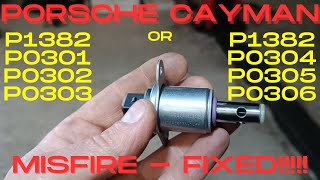
We Have This Part in Stock


The information in this article is provided for general reference and educational purposes only. Vehicle specifications, procedures, and part compatibility can vary by production date, trim level, and region. Always consult your vehicle's factory service manual and verify part numbers before purchasing or performing repairs. Safety-critical components such as airbags, seat belts, and braking systems should be installed by a qualified professional.
- Porsche Boxster:
- 🧭 Diagnostic Flowchart
- 🎬 Helpful Videos
- 🛍️ Shop This Part
- What's Unique About the 2005-2012 Porsche Boxster
- Symptoms You May Notice
- Most Likely Causes
- Rare But Worth Checking
- Diagnosis Steps
- Parts You'll Likely Need
- Related Codes That Often Appear With This One
- Platform-Specific Known Issues
- Mechanic-Grade Diagnostic Values
- Scan Tool Commands That Help
- Wiring & Ground Locations
- Real Owner Repair Stories
- OEM Part Supersession History
- Other Known Issues on This Vehicle
- Used vs. New Parts: Buying Guide for This Vehicle
- Real Owner Stories
- 2006 Cayman S (M97.21)
- 2011 Porsche Boxster (987.2)
- Porsche 996 (Similar Architecture)
- Porsche 911 (Cross-Model Reference)
- Related OBD-II Codes
- Frequently Asked Questions
- 🎟️ Get 5% Off