

P0203 on 2004-2007 Chevrolet Malibu 3.5L: Cylinder 3 Injector Circuit Fixes
Code P0203 on a 2004-2007 Malibu 3.5L almost always means the cylinder 3 fuel injector has failed electrically. A new injector costs about $40-$80. Before replacing it, test its resistance (around 12.5 ohms) at the main harness connector to confirm.
- P0203 on this Malibu is an electrical fault for the cylinder 3 fuel injector.
- The most likely cause is a failed fuel injector, which can be confirmed with a multimeter by testing resistance (~12.5 Ohms) at the main harness connector without major disassembly.
- Do not mistake this for an ignition problem; replacing the spark plug or coil for cylinder 3 will not fix a P0203 code.
- Cylinder 3 is on the front bank of the engine, making the injector easier to access than the rear bank injectors if replacement is needed.
- Address this code promptly to avoid damaging the catalytic converter from the resulting misfire.
What's Unique About the 2004-2007 Chevrolet Malibu
For the 3.5L LX9 V6 in this Malibu, the key is in the diagnosis. While the fuel injectors are buried under the intake manifold, a well-documented procedure allows you to test the electrical resistance of all six injectors from a single, easily accessible main harness connector. Cylinder #3 is located on the front bank of the V6 (cylinders 1-3-5), which makes it significantly easier to access than the rear-bank injectors if replacement is necessary.
Symptoms You May Notice
- Check Engine Light is on
- Rough idle or engine shaking
- Noticeable loss of power and poor acceleration
- Engine misfire, which may feel like a shudder or stumble
- Reduced fuel economy
- Smell of raw fuel from the exhaust
- Flashing Check Engine Light if the misfire is severe
- Replacing the cylinder 3 spark plug. A spark plug causes an ignition misfire (P0303), not an injector circuit fault (P0203).
- Replacing the cylinder 3 ignition coil. Like the spark plug, a bad coil is an ignition system component and will not cause a P0203 code.
Most Likely Causes
- Failed Cylinder 3 Fuel Injector 🔴 High Probability → Shop Fuel Injector The internal coil windings of the fuel injector can degrade over time from heat cycles and age, leading to an open or short circuit. This is a common failure mode for this part across many GM vehicles using the LX9 engine.
How to confirm: Test the injector's resistance. For the 3.5L LX9, it should be around 12.5 Ohms. This can be done without removing the intake by testing the appropriate pins at the main fuel injector harness connector located above spark plug #2. A reading that is infinite (open) or near zero (short) confirms a bad injector. An injector swap with an adjacent cylinder (e.g., swapping injectors for cylinder 1 and 3) can also confirm; if the code changes to P0201, the injector is faulty.
Typical fix: Replace the cylinder 3 fuel injector. It is often recommended to replace all injectors on the same bank, or all six, if they are original and have high mileage.
Est. part cost: $40-$100 - Wiring Harness or Connector Issue 🟡 Medium Probability Engine bay heat and vibration can cause wires to become brittle, chafe against other components, or lead to corrosion at the connector pins. In some cases, wires within the main harness loom can melt and short together.
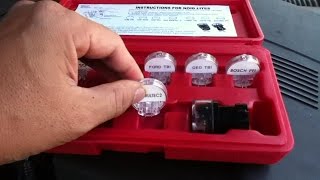
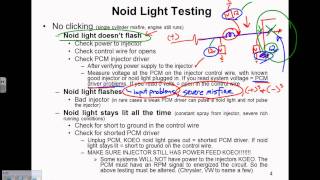
How to confirm: Visually inspect the wiring going to the cylinder 3 injector for any signs of melting, chafing, or breaks. Check the connector for corrosion or loose pins. Use a 'noid light' at the connector to see if the ECM is sending a pulse signal. 🎬 Watch: A quick demonstration of how noid lights work. If multiple injector codes for the front bank (P0201, P0203, P0205) appear at once, a wiring issue is more likely.
Typical fix: Repair the damaged section of wire or replace the injector connector pigtail. In a documented case on a similar GM vehicle, separating melted wires within the harness and re-taping them solved the issue.
Est. part cost: $10-$30 - Faulty Powertrain Control Module (PCM/ECM) ⚪ Low Probability → Shop Engine Control Module (ECM)
How to confirm: This is a diagnosis of exclusion. If the fuel injector and the wiring circuit have both been tested and are confirmed to be good, the fault likely lies with the injector driver circuit inside the PCM. This is rare, and all other possibilities must be exhausted first. GM Preliminary Information bulletins for newer models explicitly state not to replace the ECM for injector circuit codes until all other diagnostics are complete.
Typical fix: Replace the Powertrain Control Module. This often requires programming to the vehicle's VIN.
Est. part cost: $200-$400
Diagnosis Steps
- Scan the vehicle for all stored trouble codes. Confirm P0203 is present and note any other codes like P0303.
- Locate the main fuel injector harness connector, which is on the front (radiator side) of the engine, above spark plug #2.
- Using a multimeter set to Ohms, test the resistance of the cylinder 3 injector through the harness connector pins. The expected value is approximately 12.5 Ohms.
- If resistance is very high (open circuit) or very low (short circuit), the fuel injector has failed and needs to be replaced.
- If the resistance is good, use a 'noid light' plugged into the injector connector for cylinder 3. Start the engine; the light should flash, indicating the PCM is sending the trigger pulse. 🎬 Watch: Professional guide to testing injector circuits with noid lights. If it does not flash, a wiring or PCM issue is likely.
- If the noid light test fails, inspect the wiring harness for cylinder 3 back to the PCM. Check for continuity on both wires between the injector connector and the PCM connector to rule out a broken wire.
- Check for a short to ground by testing for continuity between each wire and the engine block.
- If the injector and wiring are confirmed to be good, the issue is likely a faulty injector driver in the PCM.
Technical Service Bulletins (TSBs) & Recalls
Manufacturer service bulletin #PIP4924C addresses vehicles that have the Service Engine Soon Malfunction Indicator Lamp on and a misfire, noting that technicians may find Diagnostic Trouble Codes P0201 through P0206, as well as various injector circuit low or high voltage codes.
Parts You'll Likely Need
- Fuel Injector
(OEM #12582219)— This is the most common cause of a P0203 code, due to internal electrical failure of the injector's coil.
Trusted brands: ACDelco, Delphi, Bosch, Standard Motor Products
OEM price range: $80-$120
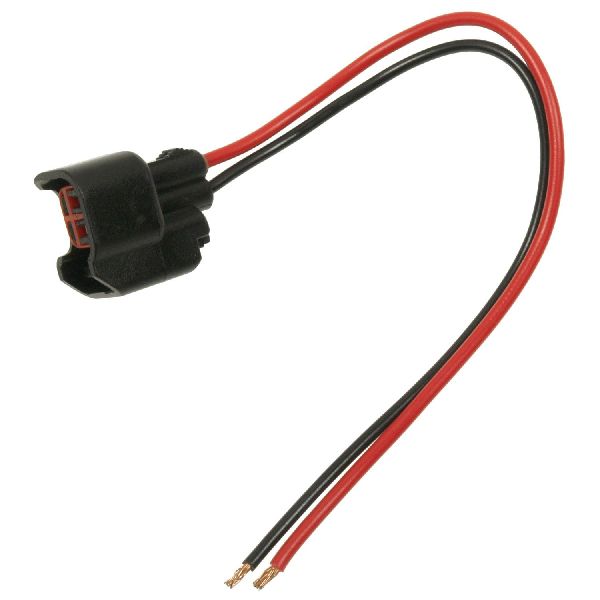
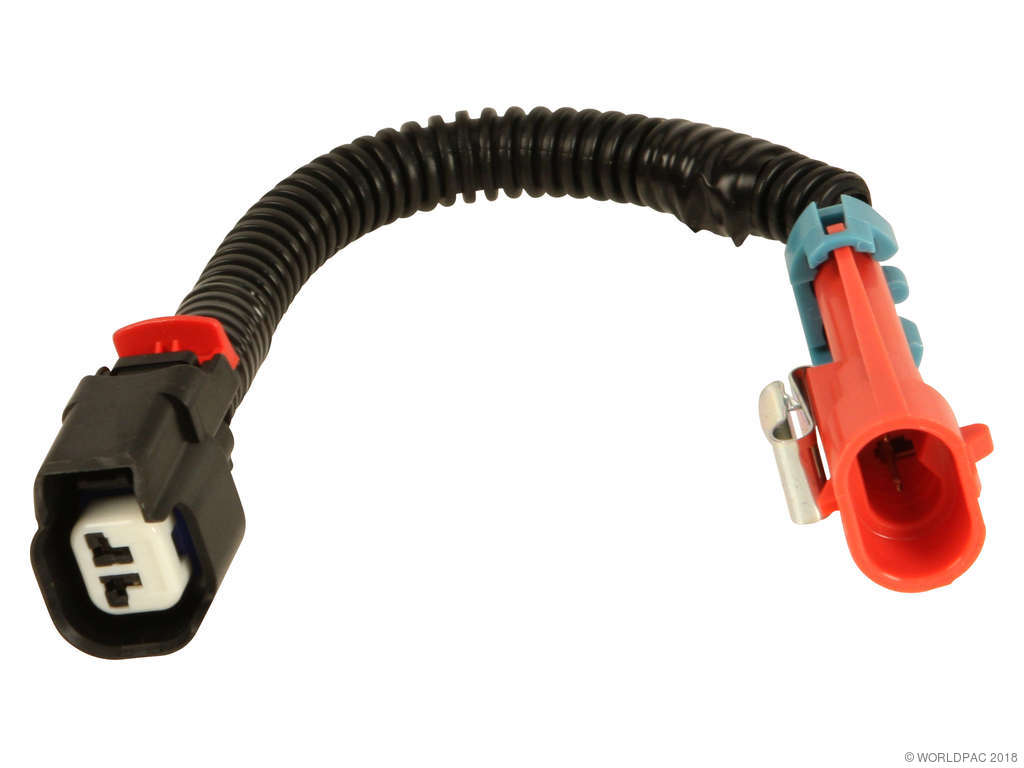
Aftermarket price range: $40-$80 - Fuel Injector Connector Pigtail — If the wiring inspection reveals a damaged, melted, or corroded connector at the injector, replacing the pigtail is the proper repair.
Trusted brands: ACDelco, Dorman
OEM price range: $20-$35
Aftermarket price range: $10-$20
Related Codes That Often Appear With This One
- P0303 — P0303 means 'Cylinder 3 Misfire Detected'. Since the P0203 code indicates the injector circuit is failing, cylinder 3 isn't getting fuel, which directly causes a misfire.
- P0300 — If the misfire on cylinder 3 is severe enough to affect overall engine balance and crankshaft speed, it can sometimes trigger a P0300 'Random/Multiple Cylinder Misfire' code as well.
Mechanic-Grade Diagnostic Values
- Fuel Injector Coil Resistance — expected: ~12.5 Ohms. Failure: A reading near zero (short circuit) or infinite/OL (open circuit).
- Fuel Pressure (Key On, Engine Off) — expected: 380-410 kPa (55-60 psi). Failure: Pressure below this range suggests a fuel pump or filter issue, not an injector electrical fault. Pressure dropping more than 5 psi in one minute indicates a leak.
- Injector Pulse Width (at idle) — expected: 1-5 milliseconds (ms). Failure: A scan tool showing zero or erratic pulse width for cylinder 3 confirms a circuit issue.
- Injector Circuit Power (Key On, Engine Off) — expected: 12 Volts (Battery Voltage). Failure: Low or no voltage on the power supply wire at the injector connector indicates an upstream wiring problem, not a faulty injector or PCM driver.
Scan Tool Commands That Help
- GM Tech 2: Cylinder Power Balance Test — To confirm which cylinder is not contributing power. The Tech 2 deactivates one injector at a time; if disabling cylinder 3 causes no change in engine RPM or smoothness, it confirms that cylinder was already dead.
- GM Tech 2: Fuel Injector Balance Test — To test for a clogged or mechanically failed injector, which is different from the P0203 electrical fault. The tool pulses each injector and measures the fuel pressure drop. An inconsistent drop for cylinder 3 would point to a flow issue, not an electrical one.
- GM Tech 2: Injector Kill / Disable — This is a manual version of the power balance test, allowing a technician to selectively disable individual injectors to isolate a misfire.
Wiring & Ground Locations
- G101 — Located at the front of the engine, on the lower block.. This ground serves the Engine Control Module (ECM). A poor connection here can cause a wide range of erratic engine control issues, including false sensor readings and injector driver problems.
- G102 — Located at the left rear of the engine.. This ground is primarily for the ignition coils, but ensuring all major engine grounds are clean and tight is a critical step when diagnosing any electrical fault.
- Injector Power Wire — Pink wire in the injector harness (common for this GM era).. All injectors on a bank share a common power wire, which should have battery voltage with the key on. A fault in this wire would typically cause codes for multiple injectors (e.g., P0201, P0203, P0205), not just P0203.
- Injector Control Wire (Cylinder 3) — Specific pin at the ECM connector that provides the ground pulse for the #3 injector.. A break or short in this specific wire between the ECM and the injector connector is a primary cause of P0203. A continuity test of this wire is essential if the injector itself tests good.
OEM Part Supersession History
12582219→This part number is still listed as the primary OEM number, but is often sold under ACDelco alternate number 217-1606 or interchange number FJ10574.— Standard part lifecycle and branding.
Heads up: While this injector was used in many GM vehicles (like the Cobalt 2.2L), ensure the specific application list includes the 2004-2007 Malibu 3.5L. Physical fit does not guarantee correct flow rate or electrical properties for the LX9 engine.
Model Year Variations Within This Range
- 2004-2005: Early models of this generation used a slightly different communication protocol for diagnostics. While the P0203 code is the same, a GM Tech 2 scanner may require a specific software card or the CANdi module for full bidirectional communication on later models (2005+).
Diagnostic Flowchart
Other Known Issues on This Vehicle
Issues unrelated to this code that are worth knowing about as an owner of this generation:
- Electric Power Steering (EPS) Failure 🔴 High — Very common. Can result in a sudden loss of power steering assist, making the vehicle difficult to steer at low speeds. (Ref: Recall 14772 (NHTSA 15V064000) was issued for some 2006-2007 models to replace the steering shaft torque sensor.)
- Lower Intake Manifold (LIM) Gasket Leak 🟠 Medium → Shop Engine Intake Manifold — Common issue on GM 60-degree V6 engines of this era, including the LX9. The original plastic-framed gaskets degrade, causing external coolant leaks or, less commonly, internal leaks mixing coolant and oil. (Ref: No specific recall, but it is a widely documented failure. Upgraded metal-frame gaskets (e.g., Fel-Pro) are the recommended replacement.)
- Passlock Anti-Theft System Fault 🟡 Low — A frequent complaint where the Passlock sensor in the ignition lock cylinder fails, causing an intermittent no-start condition, often with a security light illuminated on the dash.
- Shift Cable Failure 🟠 Medium — A recall was issued for earlier models where the plastic end of the shift cable could break, causing the shifter to feel like it's in Park when the transmission is not, creating a rollaway risk. (Ref: Recall for earlier models, may affect this generation.)
- Water Leaks into Cabin / Kick Panel Connectors 🟡 Low — Can cause various difficult-to-diagnose electrical issues. TSB 07-06-04-019 addresses water intrusion into the IP-to-body harness connector in the driver's kick panel, which can cause unrelated codes like P2138 (APP sensor). (Ref: TSB #07-06-04-019.)
Used vs. New Parts: Buying Guide for This Vehicle
When a used part is the smart pick: A used engine wiring harness from a low-mileage donor vehicle can be a cost-effective solution if a complex, hard-to-find short is diagnosed. A used ECM is also an option but will require professional programming (VIN flashing) to function in a new vehicle.
Donor-vehicle mileage cap: roughly under 80000 miles for the part to have meaningful remaining life.
What to inspect on the donor part:
- For a wiring harness, inspect for any signs of prior repair (tape, non-OEM connectors), brittleness, or oil saturation.
- Ensure the donor vehicle was not in a front-end collision that could have stressed the harness.
- Check for intact connector locking tabs and clean, corrosion-free pins.
OEM-only on this vehicle (don't cheap out):
- Powertrain Control Module (ECM) - While a used one can be sourced, it must be reprogrammed by a dealer or specialist with access to GM's TIS2Web service. Aftermarket ECMs are not recommended for this platform.
Aftermarket brands forum-validated for this vehicle:
- ACDelco (OEM)
- Delphi (Often the original manufacturer for GM)
- Bosch
- Standard Motor Products (SMP)
Brands owners have reported issues with on this vehicle:
- Unbranded, no-name injectors from online marketplaces. These often have inconsistent flow rates and poor longevity, leading to repeat failures or new performance problems.
Real Owner Stories
Aggregated from forums and TSBs cited above. Mileages and costs reflect what owners reported in those sources.
2008 Chevrolet Malibu
Symptoms: Multiple injector codes (P0201, P0203, and P0205) appeared simultaneously.
What fixed it: Found that the power wires for the injectors had melted together inside the harness loom, causing a short that blew the injector fuse. Separating the wires and re-taping them resolved the issue.
Source hint: 2carpros.com: A user with a 2008 Malibu with multiple injector codes (P0201, P0203, P0205)
2007 Pontiac G6 3.5L
Symptoms: Intermittent P0201 through P0206 codes and a no-start condition when the engine was hot.
What fixed it: The issue was identified as systemic, related to a main power or ground issue/faulty fuse box rather than individual injector failures.
Source hint: batauto.com: A forum thread discussing a 2007 Pontiac G6 3.5L with intermittent P0201-P0206 codes
NHTSA Report #10705647
Symptoms: An owner reported spitting and sputtering of the engine and losing power. Diagnostic testing revealed codes P0300, P0204, P0203, P0202, and P0201.
What fixed it: Following a recommendation from GM, the technician replaced the ECM to resolve the multiple injector and misfire codes.
Source hint: NHTSA ODI #10705647
Related OBD-II Codes
Frequently Asked Questions
Is there a recall for the fuel injector issues on my 2006 Chevrolet Malibu 3.5L?
Can I test the cylinder 3 injector without removing the intake manifold on my 3.5L LX9 engine?
My Malibu has codes P0201, P0203, and P0205 all at once. Is it likely that three injectors failed simultaneously?
What is the recommended replacement part if my cylinder 3 injector is confirmed bad?
Could a coolant leak from my intake manifold cause electrical codes like P0203?
Helpful Videos

We Have This Part in Stock


The information in this article is provided for general reference and educational purposes only. Vehicle specifications, procedures, and part compatibility can vary by production date, trim level, and region. Always consult your vehicle's factory service manual and verify part numbers before purchasing or performing repairs. Safety-critical components such as airbags, seat belts, and braking systems should be installed by a qualified professional.
- Chevrolet Malibu:
- 🧭 Diagnostic Flowchart
- 🎬 Helpful Videos
- 🛍️ Shop This Part
- What's Unique About the 2004-2007 Chevrolet Malibu
- Symptoms You May Notice
- Most Likely Causes
- Diagnosis Steps
- Technical Service Bulletins (TSBs) & Recalls
- Parts You'll Likely Need
- Related Codes That Often Appear With This One
- Mechanic-Grade Diagnostic Values
- Scan Tool Commands That Help
- Wiring & Ground Locations
- OEM Part Supersession History
- Model Year Variations Within This Range
- Other Known Issues on This Vehicle
- Used vs. New Parts: Buying Guide for This Vehicle
- Real Owner Stories
- 2008 Chevrolet Malibu
- 2007 Pontiac G6 3.5L
- NHTSA Report #10705647
- Related OBD-II Codes
- Frequently Asked Questions
- 🎟️ Get 5% Off