

P0204 on 2009-2012 Ford Escape 3.0L V6: Injector Circuit Malfunction Causes and Fixes
P0204 on a 3.0L V6 Ford Escape almost always means the fuel injector for cylinder #4 has failed. This is a common failure for this engine. Cylinder #4 is on the front bank of the engine, making it easier to access than the rear injectors. Expect to pay around $40-$80 for a new injector and another $100-$200 in labor if you don't do it yourself. The repair requires removing the upper intake manifold, so new gaskets are a must.
- P0204 on this vehicle means there is an electrical fault in the cylinder 4 fuel injector circuit.
- The most probable cause is a failed fuel injector, which is a common issue.
- Cylinder 4 is located on the f
What's Unique About the 2009-2012 Ford Escape
On the 3.0L Duratec V6 in the Ford Escape, the engine is mounted transversely (sideways). This puts one bank of cylinders (1-2-3) against the firewall and the other bank (4-5-6) at the front of the engine bay. Fortunately, P0204 points to cylinder #4, which is on the more accessible front bank, making diagnosis and replacement much simpler than for cylinders 1, 2, or 3. While wiring issues can occur, injector failure is the most common cause reported by owners for this specific engine. The repair does require removing the upper intake manifold (plenum) to access the fuel rail.
Symptoms You May Notice
- Check Engine Light is on (may be flashing if misfire is severe)
- Rough or shaking idle
- Engine hesitation or stumbling during acceleration
- Noticeable loss of engine power
- Poor fuel economy
- Engine may stall, especially when coming to a stop
- Engine misfire that may be intermittent, sometimes only occurring after a warm restart
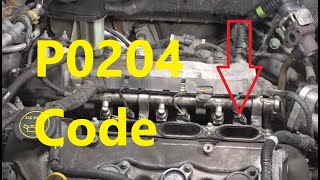
- Replacing the spark plug or ignition coil for cylinder 4. While these can cause a misfire (P0304), the P0204 code specifically points to an electrical fault in the injector circuit, not the ignition system. 🎬 Watch: Understanding the common causes and fixes for P0204 codes. The P0204 is the cause, and the P0304 is the effect.
Most Likely Causes
- Failed Fuel Injector #4 🔴 High Probability → Shop Fuel Injector The internal electronic coil within the injector can fail over time due to heat cycles and mileage, causing an open circuit. This is a well-documented failure pattern on the 3.0L Duratec engine. The failure can be intermittent when hot before becoming a permanent fault.
How to confirm: Swap the cylinder 4 fuel injector with an adjacent one (e.g., cylinder 5). Clear the codes and drive. If the code changes to P0205, the injector is confirmed faulty. Alternatively, test the injector's resistance with a multimeter; a good injector should read around 11-18 ohms. An open circuit (OL) reading indicates a bad injector.
Typical fix: Replace the failed fuel injector. While you only need to replace the faulty one, some mechanics recommend replacing all three on the front bank at the same time if the vehicle has high mileage, as the others may fail soon.
Est. part cost: $40 - $120 - Wiring Harness or Connector Issue 🟡 Medium Probability Engine bay heat and vibration can cause wiring insulation to become brittle and crack, or the connector pins can become loose or corroded over time. In some cases, a wire can chafe and short against another component.
How to confirm: Visually inspect the wiring harness and connector for cylinder 4 for any signs of damage, melting, or corrosion. Use a 'noid light' plugged into the injector connector; if it flashes when the engine is cranked, the wiring and PCM are sending a signal correctly, pointing back to the injector. 🎬 Watch: A professional diagnostic walkthrough for this specific Escape issue. If the noid light is dim or doesn't flash, wiggle the harness to see if it triggers a change, indicating a break or short in the wire.
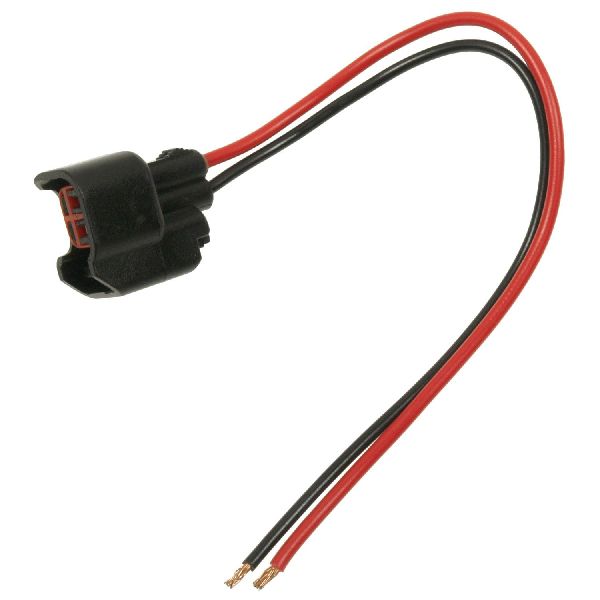
Typical fix: Repair the damaged section of wire or replace the connector pigtail. A common Motorcraft pigtail part is WPT-1051 (Ford part 5U2Z-14S411-ZB).
Est. part cost: $15 - $35
Rare But Worth Checking
- Faulty Powertrain Control Module (PCM): → Shop Engine Control Module (ECM) This is the least likely cause. The internal driver circuit for the injector can fail, but all other possibilities should be exhausted before condemning the PCM. This is a last-resort diagnosis after confirming the injector and wiring are both good.
Diagnosis Steps
- Verify the code P0204 is present using an OBD-II scanner. Check for other codes like P0304.
- Locate cylinder #4. On the 3.0L V6 Escape, it is the first cylinder on the front bank (closest to the radiator) on the passenger side.
- Visually inspect the wiring and connector going to the cylinder 4 injector. Look for any obvious signs of damage, melting, corrosion, or rodent damage.
- Perform a 'noid light' test. Disconnect the injector and plug the noid light into the harness connector. Crank the engine. If the light flashes brightly and consistently, the PCM and wiring are providing a signal. If it does not flash, or is very dim, there is a problem with the wiring or the PCM.
- If the noid light flashes, the problem is almost certainly the injector itself. Test the injector's internal resistance using a multimeter. Disconnect the injector and measure the resistance across its two pins. It should be between 11-18 ohms. If it reads as an open loop (OL) or has zero resistance, it is bad.
- To be absolutely certain, swap the cylinder 4 injector with the cylinder 5 injector (the middle one on the front bank). This requires removing the upper intake manifold. After swapping, reinstall the manifold with its old gaskets temporarily for the test. Clear the codes, drive the vehicle, and re-scan. If the code has moved and you now have a P0205, you have definitively proven the injector is the faulty component.
- If the noid light did not flash, check the wiring for continuity from the PCM connector to the injector connector to rule out a broken wire. If the wiring is good, the issue may be a faulty PCM driver, which is rare.
Parts You'll Likely Need
- Fuel Injector
(OEM #8S4Z-9F593-A (also known as Motorcraft CM5138))— This is the most common failure point for a P0204 code on this engine, where the internal coil of the injector fails and creates an open circuit.
Trusted brands: Motorcraft, Bosch, Standard Motor Products (SMP), GB Remanufacturing
OEM price range: $90-$120
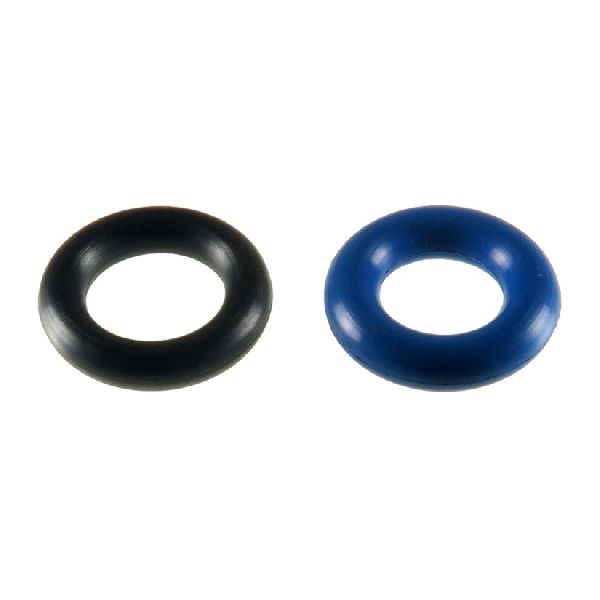
Aftermarket price range: $40-$80 - Upper Intake Manifold Gasket Set
(OEM #8L8Z-9439-A)— To access the fuel injectors on the 3.0L Duratec, the upper intake manifold (plenum) must be removed. 🎬 See this step-by-step guide on removing the upper intake manifold. The gaskets are single-use and must be replaced to prevent vacuum leaks. A popular aftermarket kit is Fel-Pro MS 96650.
Trusted brands: Fel-Pro, Motorcraft, Mahle
OEM price range: $30-$50
Aftermarket price range: $15-$30
Related Codes That Often Appear With This One
- P0304 — This code means 'Cylinder 4 Misfire Detected.' It is almost always present with P0204 because the injector circuit failure prevents fuel from being delivered, which guarantees the cylinder will misfire.
- P0174 — This code means 'System Too Lean (Bank 2).' Bank 2 is the front bank of cylinders (4-5-6). A non-functioning injector on this bank causes the oxygen sensor to detect excess unburnt oxygen in the exhaust, which the PCM interprets as a lean condition, triggering this code.
- P0316 — This code means 'Misfire Detected on Startup (First 1000 Revolutions).' It often appears with P0204 because the injector circuit fault causes an immediate misfire as soon as the engine starts.
Technical Service Bulletins (TSBs) & Recalls
- While not directly for the Escape, Ford TSB 15-0137 was issued for 2009-2014 F-150s for a related issue where the fuel pump fuse (Fuse 27) could overheat, causing a variety of fuel system DTCs, including P0201-P0208. This highlights a potential, though less likely, area to investigate if a direct injector or wiring fault isn't found.
- Manufacturer Bulletin #SSM 49759 notes that for related Ford models, an illuminated MIL with DTCs P0201 through P0206 may occur, requiring pinpoint testing for the specific injector circuit received.
- Ford Bulletin #TSB 16-0163 describes instances of an illuminated MIL with various drivability issues and one or more DTCs including P0201-P0204 and P0316, indicating broader electrical or engine management concerns.
Platform-Specific Known Issues
- The injector failure causing P0204 can sometimes be intermittent, occurring only when the engine is hot. A user on 2CarPros reported a misfire only on warm starts, which was resolved by replacing the injector.
Mechanic-Grade Diagnostic Values
- Fuel Injector Coil Resistance — expected: 11 - 18 Ohms. A more precise range is often cited as 11-15 Ohms.. Failure: A reading of infinity (OL) indicates an open coil, while a reading near zero indicates a shorted coil. Both mean the injector is bad.
- Injector Connector Power Wire Voltage (Key On, Engine Off) — expected: Approximately 12.0 - 12.6 Volts (Battery Voltage) on one of the two pins.. Failure: 0 Volts or significantly low voltage suggests a break in the power supply wire, a bad fuse, or a faulty relay.
- Injector Control Wire Voltage (Key On, Engine Off) — expected: Should show battery voltage. The PCM supplies power through the injector coil to the control wire, waiting to pull it to ground to fire the injector.. Failure: 0 Volts on the control wire with the key on indicates an open circuit in the injector coil or a break in the power supply wire.
- Injector Control Wire Waveform (Engine Running) — expected: Using an oscilloscope, a good injector shows a pattern: voltage drops to zero when the PCM grounds the circuit (injector opens), followed by a sharp inductive spike of up to 50V when the ground is released (injector closes).. Failure: With an open injector, the waveform will be flat, showing no drop to zero and no inductive spike.
Scan Tool Commands That Help
- Ford IDS / FORScan: Power Balance Test — This is an engine-running test that allows the user to disable individual cylinders and observe the RPM drop. If disabling cylinder 4 causes little or no change in RPM, it confirms that cylinder was not contributing power, which is the expected result of a P0204 fault.
- Ford IDS / FORScan: KOEO Injector Electrical Self Test (Buzz Test) — This key-on, engine-off test commands the PCM to cycle each injector solenoid audibly. A weak or absent 'buzz' from cylinder 4 when others sound strong points directly to an electrical fault in that injector or its wiring before any parts are removed.
Wiring & Ground Locations
- Cylinder 4 Injector Control Wire — This wire runs from the #4 fuel injector connector (front bank, passenger side) to Pin 10 of PCM connector C175B.. This is the specific ground-side control wire from the PCM for the cylinder 4 injector. A break or short on this wire will cause a P0204. The wire color is typically Violet/Orange (VT-OG).
- Injector Power Supply Wire — This wire provides 12V+ power to all fuel injectors. It is typically Red (RD) at the injector connector.. While a fault here would likely cause multiple injector codes (P0201, P0202, etc.), a break in the wire near the splice for cylinder 4 could isolate the fault to just P0204.
- PCM Connector C175B — The Powertrain Control Module (PCM) is located at the center rear of the firewall in the engine compartment. C175B is one of the main connectors.. This is the connector where the control signal originates. Testing for continuity between Pin 10 here and the injector connector is the definitive test for a broken wire.
- G101 / G104 — G101 is located near the battery. G104 is at the left front corner of the engine compartment, near the Battery Junction Box (BJB).. These are primary engine compartment ground points. While a bad ground here would likely cause multiple, more severe issues than just a P0204, ensuring they are clean and tight is a fundamental step in any electrical diagnosis.
Real Owner Repair Stories
- Reddit r/MechanicAdvice (2010 Ford Escape 3.0L V6) — Intermittent blinking CEL with P0204 and P0304. Misfire would sometimes disappear after restarting the engine but eventually became persistent.
❌ Tried (didn't work) Replacing the fuel injector for cylinder 4, Swapping ignition coils between cylinders 4 and 5
✅ What actually fixed it A technician found and repaired an exposed section of wire in the harness that was causing an electrical short. - 2CarPros Forum (2011 Ford Escape 3.0L V6, 200,000 miles) — Car starts and runs fine when cold. If turned off when hot (e.g., at a gas station) and restarted, it develops a persistent misfire with codes P0204 and P0304 that does not clear until the engine cools down completely.
❌ Tried (didn't work) No failed fixes reported; user was seeking advice.
✅ What actually fixed it The expert diagnosis was a classic case of a fuel injector failing due to heat soak. The recommended fix, which is the standard procedure for these symptoms, was to replace the fuel injector.
Documented NHTSA Reports
- An owner reported in NHTSA ODI #10405277 that their vehicle stalled on the highway with codes P0010, P0201, P0202, P0203, and P0204; the dealer initially checked electrical connections and reassembled, but the issue recurred.
Diagnostic Flowchart
Other Known Issues on This Vehicle
Issues unrelated to this code that are worth knowing about as an owner of this generation:
- 6F35 Transmission Failure 🔴 High — Widespread issue, can occur under 100,000 miles. Complaints include harsh shifting, shuddering, slipping, and complete failure. (Ref: Multiple class-action lawsuits have been filed regarding this transmission.)
- Electronic Throttle Body (ETB) Failure 🔴 High — Very common issue, often causing the vehicle to enter a low-power 'limp mode' suddenly. More common on the 3.0L V6. (Ref: Ford had a Customer Satisfaction Program (13N03) for some models, but it has expired.)
- Rear Shock Mount/Wheel Arch Rust 🟠 Medium — Very common in regions that use road salt. The rear wheel arches and shock towers are prone to severe corrosion, which can become a structural safety issue.
- Leaking Driver's Side Axle Seal 🟠 Medium — A frequently reported issue leading to transmission fluid leaks. If not addressed, low fluid can cause transmission damage.
- Cracked Front ABS Tone Ring 🟡 Low — Common failure where the ABS tone ring on the front axle cracks, causing the ABS and Traction Control lights to illuminate and the systems to function erratically.
Used vs. New Parts: Buying Guide for This Vehicle
When a used part is the smart pick: A used part is a reasonable choice for the injector wiring connector pigtail if the original is damaged. Since the upper intake manifold must be removed, sourcing a used manifold from a low-mileage donor is also acceptable if the original is cracked or damaged during removal.
Donor-vehicle mileage cap: roughly under 80000 miles for the part to have meaningful remaining life.
What to inspect on the donor part:
- For a wiring pigtail, ensure the plastic is not brittle, the locking tab is intact, and there are several inches of clean wire to splice into.
- For an intake manifold, check for cracks, especially around bolt holes, and ensure all mounting surfaces are flat and undamaged.
OEM-only on this vehicle (don't cheap out):
- Fuel Injector
Aftermarket brands forum-validated for this vehicle:
- Fel-Pro for the upper intake manifold gaskets (Part No. MS 96650).
Brands owners have reported issues with on this vehicle:
- Unnamed, no-brand 'remanufactured' or new fuel injectors from online marketplaces are a significant risk. Stick with OEM (Motorcraft) or major brands like Bosch or Standard Motor Products (SMP) to avoid premature failure.
Real Owner Stories
Aggregated from forums and TSBs cited above. Mileages and costs reflect what owners reported in those sources.
2011 Ford Escape 3.0L V6
Symptoms: Misfire occurring specifically on warm starts; codes P0204 and P0304 were present.
What fixed it: Replacement of the cylinder 4 fuel injector, which required removing the upper intake manifold.
Source hint: 2CarPros forum thread titled 'Ford Escape: 2011 Ford Escape Codes P0204 and P0304 Misfire on Warm Start Only'
2011 Ford Escape 3.0L V6
Symptoms: P0204 code indicating an open injector circuit.
What fixed it: The owner confirmed the injector was faulty by swapping it from cylinder 4 to cylinder 5, which caused the code to move to P0205.
Source hint: YouTube: 3.0 durtec p0204 open injector fix
2010 Ford Escape 3.0L V6
Symptoms: Intermittent P0204 and P0304 codes that persisted even after the fuel injector was replaced.
What fixed it: Repairing a damaged wire in the harness that was causing a short.
Source hint: Reddit r/MechanicAdvice thread titled 'P0304 P0204 intermittent misfire even after...'
Related OBD-II Codes
Frequently Asked Questions
Where is the cylinder #4 fuel injector located on my 3.0L V6 Escape?
Does Ford TSB 15-0137 regarding fuel pump fuses apply to my P0204 code?
Can I just replace the one bad injector, or do I need to do all of them?
Is there a specific replacement wiring part for the injector connector?
Why does my Escape only misfire and throw the P0204 code after a warm restart?
What should the resistance be if I test the injector with a multimeter?
Helpful Videos
We Have This Part in Stock


The information in this article is provided for general reference and educational purposes only. Vehicle specifications, procedures, and part compatibility can vary by production date, trim level, and region. Always consult your vehicle's factory service manual and verify part numbers before purchasing or performing repairs. Safety-critical components such as airbags, seat belts, and braking systems should be installed by a qualified professional.
- Ford Escape:
- 🧭 Diagnostic Flowchart
- 🎬 Helpful Videos
- 🛍️ Shop This Part
- What's Unique About the 2009-2012 Ford Escape
- Symptoms You May Notice
- Most Likely Causes
- Rare But Worth Checking
- Diagnosis Steps
- Parts You'll Likely Need
- Related Codes That Often Appear With This One
- Technical Service Bulletins (TSBs) & Recalls
- Platform-Specific Known Issues
- Mechanic-Grade Diagnostic Values
- Scan Tool Commands That Help
- Wiring & Ground Locations
- Real Owner Repair Stories
- Documented NHTSA Reports
- Other Known Issues on This Vehicle
- Used vs. New Parts: Buying Guide for This Vehicle
- Real Owner Stories
- 2011 Ford Escape 3.0L V6
- 2011 Ford Escape 3.0L V6
- 2010 Ford Escape 3.0L V6
- Related OBD-II Codes
- Frequently Asked Questions
- 🎟️ Get 5% Off