

P0205 on 1994-2001 Dodge Ram 1500 5.9L: Injector Circuit Causes and Fixes
For the 1994-2001 Dodge Ram 1500 5.9L, code P0205 is most often caused by a damaged fuel injector wiring harness that runs under the intake manifold. Heat and oil cause the wires to melt and short out. Before replacing the injector, inspect this harness. A bad injector is the second most likely cause.
- P0205 on this truck is an electrical circuit problem for the #5 injector.
- Always inspect the wiring harness under the intake manifold for heat damage before buying any parts. This is the most likely cause.
- A simple 'injector swap' with a neighboring cylinder is a free and effective way to confirm if the injector itself is bad.
- Do not drive for an extended period with this code, as you risk damaging your expensive catalytic converter.
- Cylinder #5 is the third cylinder from the front on the driver's side.
What's Unique About the 1994-2001 Dodge Ram 1500
On the 5.9L Magnum V8, the injector wiring harness is routed in a high-heat area under the intake manifold. Over time, the protective loom degrades, and the wire insulation becomes brittle, cracks, or melts from exposure to engine heat and oil. This frequently leads to short circuits between injector wires or to ground, making wiring failure the number one suspect for a P0205 code, often more common than a failed injector. Owners frequently report finding multiple melted wires in this specific harness section.
Symptoms You May Notice
- Check Engine Light is on
- Rough, shaking idle
- Engine misfire, which may feel like a stumble or shudder
- Hesitation and lack of power during acceleration
- Noticeably worse fuel economy
- Engine may stall at idle
- Replacing the fuel injector without first thoroughly inspecting the wiring harness. Many owners replace a perfectly good injector only to find the P0205 code returns because the true fault was in the wiring.
Most Likely Causes
- Damaged Injector Wiring Harness 🔴 High Probability → Shop Engine Wiring Harness The harness is routed under the intake manifold, where it is exposed to intense heat and oil saturation over many years. This environment causes the wire insulation to become brittle, crack, and melt, leading to shorts or open circuits.
How to confirm: Visually inspect the wiring harness that runs along the fuel rail and under the intake manifold. Look for melted plastic loom, brittle or cracked insulation, exposed copper wire, or wires shorted together. A 'wiggle test' (wiggling the harness with the engine running) may cause the misfire to change, confirming a wiring issue.
Typical fix: Repair the damaged section of wire. This often involves cutting out the bad section, splicing in a new piece of wire, and protecting it with solder, heat shrink tubing, and new high-temperature wire loom. In severe cases, the entire injector sub-harness may need to be replaced.
Est. part cost: $5-$25 - Failed Fuel Injector 🟡 Medium Probability → Shop Fuel Injector After many years and miles, the internal electromagnetic coil inside the fuel injector can fail, creating an open or shorted circuit.
How to confirm: Measure the resistance across the two terminals of the #5 injector using a multimeter. A good injector should read between 10.8-15.7 ohms, depending on the specific year. A reading of infinity (open) or near zero (short) indicates a bad injector. The most definitive test is to swap the #5 injector with an adjacent one (like #3). Clear the codes and drive. If the code changes to P0203, the injector is faulty. If P0205 returns, the problem is in the wiring.
Typical fix: Replace the failed fuel injector. It is often recommended to replace all injectors if they are original and have high mileage.
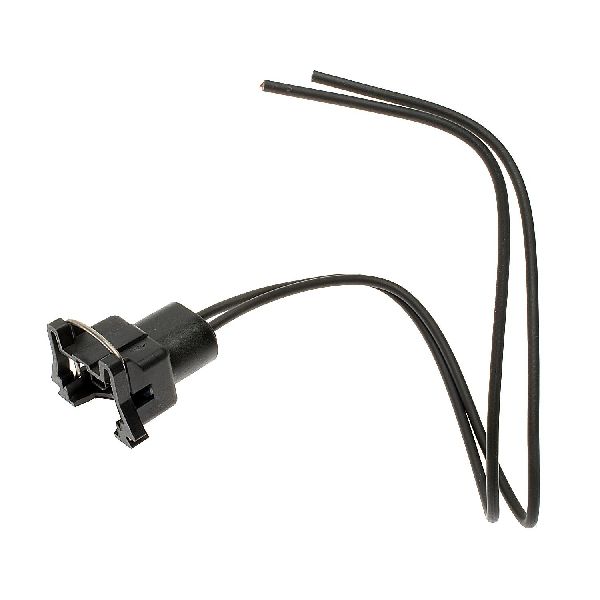
Est. part cost: $40-$100 - Damaged Injector Connector (Pigtail) ⚪ Low Probability The plastic connector that plugs onto the injector becomes brittle from years of heat cycles and can crack or fail to make a secure connection.
How to confirm: Inspect the plastic connector for cylinder #5 for cracks, broken locking tabs, or corroded terminals inside. Wiggle the connector with the engine running to see if it affects the idle.
Typical fix: Replace the connector pigtail by cutting off the old one and splicing the new one onto the harness. A common part number is Mopar #5013856AA or its successor.
Est. part cost: $10-$25
Rare But Worth Checking
- Failed Powertrain Control Module (PCM): → Shop Engine Control Module (ECM) This is the least likely cause. The internal driver circuit for the #5 injector can fail, but you should exhaust all other diagnostic steps before condemning the PCM. This fault usually occurs after a wiring short has damaged the PCM, so ensure the wiring is repaired before installing a new PCM.
Diagnosis Steps
- Read the trouble codes with an OBD-II scanner. Confirm P0205 is present, and note any other codes like P0305.
- Identify Cylinder #5: On the 5.9L V8, this is the third cylinder from the front on the driver's side.
- Perform a visual inspection: Carefully inspect the injector wiring harness for cylinder #5, paying close attention to the area under the intake manifold. Look for any signs of melting, chafing, cracking, or corrosion.
- Conduct a 'Noid Light' Test: Disconnect the wiring from the #5 injector and plug in a noid light. Start the engine. The light should flash steadily. If it doesn't flash, the problem is in the wiring or PCM. If it does flash, the wiring is likely okay, and the injector itself is suspect.
- Test the Injector Resistance: Disconnect the injector and use a multimeter to measure the resistance between its two electrical pins. The reading should be between 10.8 and 15.7 ohms, with sources indicating a range of 13.3-15.7 for 1993-1998 models and 10.8-13.2 for 1998-2000 models. If it's outside this range, the injector has failed.
- Perform an Injector Swap: If the noid light flashes and the injector resistance is good, swap the #5 injector with a neighboring one (e.g., #3). Clear the codes and run the engine. If the code moves to P0203, the injector is confirmed to be the problem. If P0205 returns, the fault is intermittent or hidden in the wiring.
- Test the Wiring Harness: If all signs point to wiring, disconnect the battery and the PCM connector. Use a multimeter to check for continuity on the injector control wire from the PCM connector pin to the injector connector pin (should be less than 1.0 ohm). Then, check that same wire for a short to ground and a short to voltage.
- If all wiring and the injector test good, the PCM may be at fault, which is rare.
Parts You'll Likely Need
- Fuel Injector
(OEM #53030778)— This is the second most common cause of failure after the wiring. The internal coil shorts out or breaks, causing an electrical fault. This part number is applicable to 1996-2001 5.9L engines.
Trusted brands: Mopar, Bosch, Standard Motor Products (SMP), Siemens
OEM price range: $100-$150
Aftermarket price range: $40-$90 - Fuel Injector Connector Pigtail
(OEM #5013856AA)— The connector itself can become brittle and fail. Splicing in a new pigtail is often easier than repairing the harness if the damage is only at the connector. This part number may be superseded.
Trusted brands: Dorman, Duralast, Mopar
OEM price range: $20-$30
Aftermarket price range: $10-$20
Related Codes That Often Appear With This One
- P0305 — P0305 means 'Cylinder 5 Misfire Detected'. Since P0205 indicates an electrical fault in the injector circuit, cylinder 5 is not receiving the proper amount of fuel, which directly causes a misfire.
- P0207, P0203, etc. — If multiple injector circuit codes appear for other cylinders on the same bank (1, 3, 5, 7 are on the driver's side), it strongly points to a widespread wiring harness issue, like a melted section affecting several wires, rather than multiple injectors failing at once.
Technical Service Bulletins (TSBs) & Recalls
- While no TSB is specific to P0205 on the Ram 1500, TSB 9002688 for similar Dodge Ram Vans with Magnum engines advises checking the injector wiring harness before replacing the injector, confirming the known wiring issue on this engine family.
- Manufacturer TSB Bulletin #9002688 specifically warns that before replacing injectors for Diagnostic Trouble Codes P0201 through P0206, technicians should make sure that the wiring loom and/or connector is not the root cause of the concern.
Platform-Specific Known Issues
- The injector wiring harness that runs under the intake manifold is a well-documented failure point on 5.2L and 5.9L Magnum engines due to prolonged exposure to high heat and oil saturation.
- A user on DodgeForum.com with a 2001 Ram 5.9L experiencing P0205 and P0207 performed extensive testing, confirming 12.5-12.8 ohms across all injectors and good voltage from the PCM, highlighting how frustrating intermittent wiring faults can be.
Mechanic-Grade Diagnostic Values
- Fuel Injector Coil Resistance (1998-2000 5.9L) — expected: 10.8 - 13.2 Ohms. Failure: A reading of infinity (OL) indicates an open circuit; a reading near 0 Ohms indicates a shorted circuit.
- Fuel Injector Coil Resistance (Warm) — expected: 12.6 - 12.8 Ohms. Failure: Significant deviation from this range or from other injectors on the engine.
- Injector Pulse Width (at warm idle) — expected: 2.0 - 3.5 milliseconds (ms). Failure: A value of 0 ms or an erratic reading for cylinder 5 while other cylinders are normal suggests a PCM driver or wiring fault.
- Injector Connector Voltage (Key On, Engine Off) — expected: ~12 Volts (Battery Voltage). Failure: Low or no voltage points to an issue with the ASD (Auto Shutdown) relay or the power feed wire (often Dark Green/Orange).
- Injector Control Wire Continuity (PCM to Injector) — expected: Less than 5.0 Ohms, with professional sources recommending less than 1.0 Ohm.. Failure: Resistance higher than 5.0 Ohms or an OL (Open Line) reading indicates a break in the wire.
- Injector Inductive Kick (via oscilloscope) — expected: A sharp voltage spike of 60-80 Volts when the PCM commands the injector off.. Failure: A missing or weak voltage spike is the specific fault the PCM detects to set the P0205 code.
Scan Tool Commands That Help
- DRB III or equivalent professional scan tool: Injector Actuator Test / ASD Relay Control State — This bidirectional command allows a technician to manually command the PCM to fire the #5 injector or cycle the ASD relay. This can help determine if the PCM driver is capable of functioning and if the relay circuit is intact, isolating the problem to the wiring or the injector itself without the engine running.
Wiring & Ground Locations
- Cylinder #5 Injector Driver Wire — This wire runs from the PCM C1 harness connector, pin A15, to the cylinder #5 fuel injector connector. The wire color is typically Tan with a White stripe (TN/WT).. This is the specific control wire that the PCM uses to ground-pulse the injector. A break (open) or a short to ground/voltage on this wire is a direct cause of P0205. Testing continuity and for shorts on this exact wire is a critical diagnostic step.
- Injector Power Supply Wire — This wire provides ~12V to all injectors from the Auto Shutdown (ASD) relay. On many Chrysler products of this era, it is a Dark Green wire with an Orange stripe (DG/OR).. While a fault on the main part of this wire would cause multiple injector codes, a localized short or open in the harness branch leading specifically to the cylinder 5 injector could cause an isolated P0205.
- Engine/Chassis Grounds — Key grounds are located from the battery negative to the chassis, from the chassis to the engine block (often a braided strap near the back of the head), and smaller grounds on the firewall.. A poor engine ground can cause the PCM to seek a ground path through sensor circuits, leading to erratic behavior and potentially incorrect codes. While not a direct cause of a single injector circuit fault, ensuring all main grounds are clean and tight is a foundational step in any electrical diagnosis.
Real Owner Repair Stories
- DodgeForum.com user 'Scuba Sam' (as cited in a Go-Parts article) (1999 Dodge Ram 1500, 5.9L gas engine) — Engine misfire, Check Engine Light with code P0206 (same fault, different cylinder).
❌ Tried (didn't work) Confirmed wiring from the injector plug to the PCM connector had good continuity., Used a noid light and back-probed the connector, confirming no pulse signal was being sent from the PCM.
✅ What actually fixed it After verifying the wiring was good but the PCM was not sending an output signal, the user concluded the fault was internal to the Powertrain Control Module (PCM). Replacing the PCM resolved the issue. - DodgeForum.com user 'notahemi2001' (2001 Dodge Ram 1500 5.9L gas, 238k miles) — Rough running, won't idle, codes P0205 and P0207.
❌ Tried (didn't work) Checked fuel pressure (41 psi - good)., Noid light test showed all injectors pulsing., Checked for 12V+ from ASD relay (good)., Checked resistance on all injectors (12.5-12.8 ohms - good)., Replaced #7 fuel injector., Replaced the PCM with a remanufactured unit (no change).
✅ What actually fixed it The user posted a very detailed account of their diagnostic process but did not post a final resolution. This story is included as a cautionary tale showing that even when all common components (wiring, injector, PCM) appear to test good, the problem can persist, often pointing to a very intermittent or hidden wiring fault that standard tests miss.
OEM Part Supersession History
53030778→53030778AB— Standard part revision by the manufacturer.
Heads up: Part 53030778 is specified for 1996-1999 5.2L and 5.9L engines. It is critical to verify the part number for your specific model year, as 2000+ Magnum engines may use different injectors.
Model Year Variations Within This Range
- 1996-1999: The specified fuel injector is typically part number 53030778.
- 1998-2000: The specified fuel injector resistance is typically 10.8-13.2 ohms.
- 1998-2001: These models are noted as being most susceptible to the wiring harness failures due to heat and oil saturation under the intake manifold.
Diagnostic Flowchart
Other Known Issues on This Vehicle
Issues unrelated to this code that are worth knowing about as an owner of this generation:
- Intake Manifold Plenum Gasket Failure 🔴 High → Shop Engine Intake Manifold — Extremely common. The original steel bottom plate on the aluminum intake manifold leads to gasket failure due to different thermal expansion rates. (Ref: TSB 09-05-00 describes the issue and repair procedure.)
- Cracked Dashboard 🟠 Medium — Extremely common across this generation. The plastic becomes brittle and cracks, often in large pieces, especially around the defroster vents. (Ref: No recall was ever issued, as the manufacturer deemed it a cosmetic problem.)
- 46RE Automatic Transmission Problems 🔴 High — Common at higher mileage (100k+ miles). Issues include shifting problems between 1-2 and 3-4, often caused by failed governor pressure solenoids and sensors inside the transmission.
- Front End / Steering Component Wear 🟠 Medium — Common, can lead to the infamous 'Death Wobble.' Worn track bars, ball joints, and steering boxes are frequent culprits.
- Body and Frame Rust 🔴 High — Very common, especially in the rust belt. Rocker panels, cab corners, and the frame area above the rear axle are notorious for severe corrosion.
Used vs. New Parts: Buying Guide for This Vehicle
When a used part is the smart pick: A complete engine wiring harness from a low-mileage donor vehicle can be a smart choice if your original harness is extensively damaged (melted, brittle, multiple repairs). It's often better than trying to patch dozens of bad wires. A single used fuel injector can be a cheap diagnostic tool to confirm a failure, but it's not recommended as a permanent repair.
Donor-vehicle mileage cap: roughly under 100000 miles for the part to have meaningful remaining life.
What to inspect on the donor part:
- For a wiring harness, inspect for flexibility; avoid any that are stiff, brittle, or cracked.
- Check all connector tabs to ensure they are present and not broken.
- Look for signs of oil saturation or melting, especially on the loom that runs under the intake.
- Ensure there are no previous, poorly-done splice repairs.
OEM-only on this vehicle (don't cheap out):
- Powertrain Control Module (PCM) - While remanufactured units are common, avoid no-name used units from junkyards as they may have hidden faults and require programming that is difficult for DIYers.
Aftermarket brands forum-validated for this vehicle:
- Bosch (often the OEM supplier)
- Standard Motor Products (SMP)
- Siemens/VDO
Brands owners have reported issues with on this vehicle:
- Unbranded, no-name injector sets from online marketplaces are frequently cited on forums as having poor flow matching, leading to rough running and other codes even if they fix the initial circuit fault.
Real Owner Stories
Aggregated from forums and TSBs cited above. Mileages and costs reflect what owners reported in those sources.
2001 Dodge Ram 1500 5.9L V8
Symptoms: Check Engine Light with codes P0205 and P0207, accompanied by a rough engine.
What fixed it: The owner performed extensive testing, including confirming correct resistance (12.5-12.8 ohms) on all injectors and good voltage from the PCM. The diagnosis pointed towards a complex, intermittent fault within the injector wiring harness.
Source hint: DodgeForum.com - Thread '2001 Ram 5.9 P0205 P0207 Rough'
Related OBD-II Codes
Frequently Asked Questions
Where is cylinder #5 located on my 1994-2001 Ram's 5.9L V8 engine?
Is the injector wiring harness failing a common problem on these 5.9L Magnum engines?
What is the correct resistance for a fuel injector on my 5.9L V8?
How can I definitively tell if my fuel injector is bad versus the wiring?
Is there a Technical Service Bulletin (TSB) for code P0205 on the Ram 1500?
I have a Dodge Durango with the 5.9L V8 and this code. Does this article apply?
We Have This Part in Stock


The information in this article is provided for general reference and educational purposes only. Vehicle specifications, procedures, and part compatibility can vary by production date, trim level, and region. Always consult your vehicle's factory service manual and verify part numbers before purchasing or performing repairs. Safety-critical components such as airbags, seat belts, and braking systems should be installed by a qualified professional.
- Dodge Ram 1500:
- 🧭 Diagnostic Flowchart
- 🛍️ Shop This Part
- What's Unique About the 1994-2001 Dodge Ram 1500
- Symptoms You May Notice
- Most Likely Causes
- Rare But Worth Checking
- Diagnosis Steps
- Parts You'll Likely Need
- Related Codes That Often Appear With This One
- Technical Service Bulletins (TSBs) & Recalls
- Platform-Specific Known Issues
- Mechanic-Grade Diagnostic Values
- Scan Tool Commands That Help
- Wiring & Ground Locations
- Real Owner Repair Stories
- OEM Part Supersession History
- Model Year Variations Within This Range
- Other Known Issues on This Vehicle
- Used vs. New Parts: Buying Guide for This Vehicle
- Real Owner Stories
- 2001 Dodge Ram 1500 5.9L V8
- Related OBD-II Codes
- Frequently Asked Questions
- 🎟️ Get 5% Off