

P0222 on 2015-2023 Ford Mustang: Throttle Position Sensor 'B' Circuit Low Causes and Fixes
On a 2015-2023 Mustang, code P0222 is most often caused by a failed electronic throttle body assembly. This triggers a 'wrench' light and limp mode. Replacing the entire throttle body is the most common fix, with the part costing between $90 and $250.
- P0222 on a 2015-2023 Mustang will put the car in a dangerous, low-power 'limp mode' and requires immediate attention.
- The most likely cause is a failed electronic throttle body assembly; do not waste time just cleaning it.
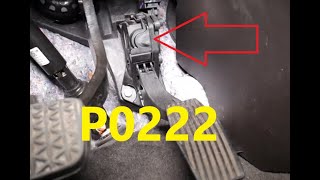
- The second most likely cause is a failed accelerator pedal assembly.
- Diagnosis is straightforward with a scan tool that can read live sensor data for the throttle and pedal position sensors.
- The repair is DIY-friendly for those with basic tools, typically involving the replacement of the entire throttle body or pedal assembly.
What's Unique About the 2015-2023 Ford Mustang
The S550 Mustang, like many other Ford vehicles of this era, has a known weakness in its electronic throttle body (ETB). While P0222 can also point to the accelerator pedal sensor, the ETB is a very frequent point of failure. Ford has issued Customer Satisfaction Program 16B32 for various models, including certain 2016 Mustangs, due to internal ETB contamination causing electrical resistance. Unlike some cars where cleaning a dirty throttle body can resolve sensor issues, on the Mustang, a P0222 code almost always indicates an internal electronic failure requiring replacement of the entire assembly.
Generation note: This guide covers the entire S550 generation of the Ford Mustang (2015-2023). This generation had a major facelift for the 2018 model year, but the electronic throttle control system and the common causes for code P0222 remain consistent across the entire year range. The throttle bodies themselves differ between engines (2.3L, 5.0L, 5.2L) but the failure mode is similar. A key difference is that 2018+ models use a digital TPS, while 2015-2017 models use an analog one; they are not interchangeable despite having similar connectors.
Symptoms You May Notice
- Check Engine Light is on
- Wrench light is on.
- Vehicle enters 'limp mode' with drastically reduced engine power.
- Poor or no throttle response.
- Hesitation or stumbling during acceleration.
- Unstable or rough idle
- Difficulty starting the engine.
- Vehicle may stall.
- Cleaning the throttle body. While a dirty throttle body can cause other issues like stalling, it will not fix the internal electronic sensor failure that triggers code P0222 on this vehicle.
Most Likely Causes
- Faulty Electronic Throttle Body (ETB) 🔴 High Probability → Shop Fuel Injection Throttle Body The internal throttle position sensors (TPS) are a known weak point on many Ford ETBs of this era, leading to premature electronic failure. Ford acknowledged this with Customer Satisfaction Program 16B32, which cited contamination of internal motor contacts leading to increased electrical resistance. This is the most common cause for P0222 on this platform.
How to confirm: Use an OBD-II scanner with live data to monitor the voltage of both TPS circuits (TP1/TPPA and TP2/TPPB). If TPS 'B' voltage is stuck low (e.g., <0.5V) and doesn't change when the accelerator is pressed, while TPS 'A' reads normally, the throttle body has failed internally. The expected range for each sensor is typically a sweep from under 1V at idle to over 4V at wide-open throttle.
Typical fix: Replace the entire electronic throttle body assembly. After replacement, a throttle body relearn procedure should be performed. This can often be done by disconnecting the battery for 15 minutes, but a more reliable method is to use a capable scan tool to perform the reset.
Est. part cost: $90-$350 - Faulty Accelerator Pedal Position (APP) Sensor 🟡 Medium Probability → Shop Accelerator Pedal Assembly
How to confirm: Using a live data scanner, monitor the APP sensor circuits (APP1, APP2). If one of the APP circuits is flatlined or provides an erratic signal while the other responds correctly to pedal movement, the APP sensor assembly is faulty. The two sensors should mirror each other, with one often reading double the voltage of the other as a cross-check.
Typical fix: Replace the entire accelerator pedal assembly, as the sensors are integrated into it.
Est. part cost: $50-$120 - Wiring or Connector Issue ⚪ Low Probability
How to confirm: Visually inspect the wiring harnesses and connectors going to both the throttle body and the accelerator pedal. Look for any signs of damage, chafing, corrosion, or pushed-out pins. Use a multimeter to check for a stable 5-volt reference and good ground at the sensor connector with the key on, engine off.
Typical fix: Repair the damaged section of the wiring harness or clean/replace the faulty connector. Ensure connectors are fully seated.
Est. part cost: $10-$50
Rare But Worth Checking
- Powertrain Control Module (PCM) Failure: → Shop Engine Control Module (ECM) This is very rare, but if both the throttle body and pedal sensor have been replaced and wiring is confirmed to be good, a faulty PCM could be the cause. This requires advanced diagnostics by a professional and typically involves checking for communication errors with the module.
Diagnosis Steps
- Connect an OBD-II scanner and confirm P0222 is present. Check for other related codes like P2135, P2111, P2112, or P0122.
- Access the live data stream on the scanner. Display the PIDs for TPS Circuit A (TP1), TPS Circuit B (TP2), APP Sensor Circuit A (APP1), and APP Sensor Circuit B (APP2).
- With the key on and engine off, slowly press and release the accelerator pedal. Observe the voltage readings.
- If TPS 'B' voltage is flatlined at a low voltage (typically <0.5V) while TPS 'A' sweeps smoothly from its base voltage to over 4V, the throttle body has an internal fault and is the most likely culprit.
- If one of the APP circuits is flatlined or erratic while the other responds correctly to the pedal, the accelerator pedal assembly is the likely culprit.
- If the live data is inconclusive, perform a visual inspection of the wiring and connectors to the throttle body and accelerator pedal for any obvious damage, corrosion, or loose connections.
- If wiring appears intact, use a multimeter to test for the correct 5-volt reference signal and a solid ground at the throttle body connector. A missing reference voltage or bad ground points to a wiring or PCM issue.
- Based on the findings, replace the faulty component (most often the throttle body).
- After replacement, perform the throttle body relearn procedure as specified for your vehicle, either with a scan tool or by using a manual procedure.
Parts You'll Likely Need
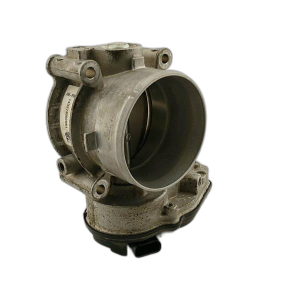
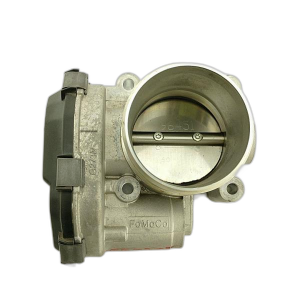
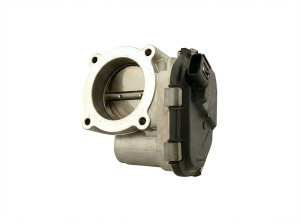
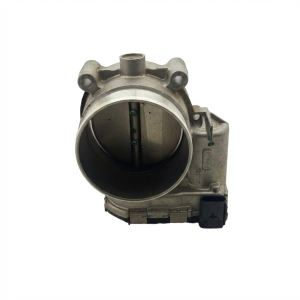
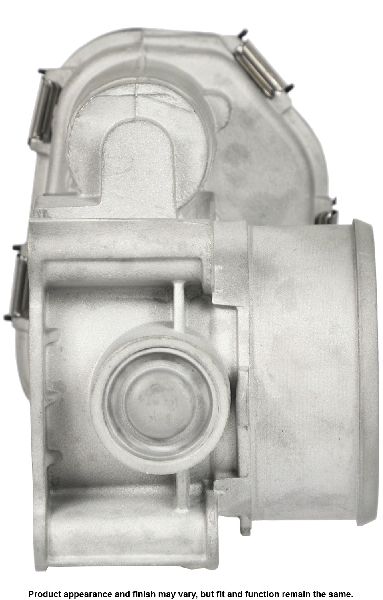
- Electronic Throttle Body Assembly
(OEM #GR3Z-9E926-A (5.2L GT350), M-9926-M50B (5.0L Bullitt 87mm), FR3Z-9E926-D (2.3L EcoBoost))— This is the most common failure point for code P0222 on this platform due to internal sensor failure. Part numbers vary by engine.
Trusted brands: Motorcraft, Bosch, Hitachi, Standard Motor Products
OEM price range: $150-$350
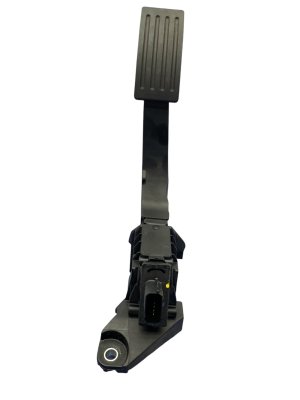
Aftermarket price range: $90-$220 - Accelerator Pedal Assembly — This is the second most likely cause if the throttle body is not at fault. The position sensors are integrated into the pedal assembly.
Trusted brands: Motorcraft, Standard Motor Products (SMP), Wells
OEM price range: $80-$120
Aftermarket price range: $50-$90
Related Codes That Often Appear With This One
- P2135 — This code means 'Throttle/Pedal Position Sensor/Switch A/B Voltage Correlation.' It is often triggered alongside P0222 because the PCM sees a direct conflict between the two sensor readings when one fails.
- P2111 — This code means 'Throttle Actuator Control System - Stuck Open.' A fault in the position sensor can confuse the PCM about the throttle plate's actual position, leading to related actuator codes. This code was specifically mentioned in Ford's TSB 16-0139.
- P2112 — This code means 'Throttle Actuator Control System - Stuck Closed.' Similar to P2111, a sensor fault can lead the PCM to believe the throttle plate is stuck when it is not. This was a primary code addressed by Ford's Customer Satisfaction Program 16B32.
- P0122 — This code is for 'Throttle/Pedal Position Sensor/Switch 'A' Circuit Low Input'. If there is a wiring or power supply issue affecting the entire throttle body, both the 'A' and 'B' sensor circuits can fail simultaneously, triggering both codes.
Technical Service Bulletins (TSBs) & Recalls
- TSB 16-0139: While not explicitly for P0222, this TSB addresses ETB failure causing related codes (P2111, P2112, P2119) on many Fords including the 2016 Mustang, corroborating the ETB as a common failure point.
- Customer Satisfaction Program 16B32: A program to replace the ETB on certain 2016 Mustangs and other Ford models due to potential internal contamination and failure causing limp mode. This program had a deadline of September 30, 2017.
- TSB 16-0163: A manufacturer service bulletin notes that various drivability issues and MIL illumination with DTC P0222 can occur across multiple Ford engine platforms.
- TSB 18-2062: This bulletin addresses concerns of rough running, loss of power, or loss of engine RPM accompanied by DTC P0222 and related throttle position codes.
Platform-Specific Known Issues
- Ford issued Customer Satisfaction Program 16B32 for some 2016 Mustangs to replace the electronic throttle body, acknowledging a known issue with the component. The program cited contamination of internal motor contacts. It expired on September 30, 2017.
- Ford TSB 16-0139 addresses ETB failures on many Ford vehicles, including 2016 Mustangs, for related codes like P2111 and P2112, pointing to a pattern of failure for vehicles built on or before May 31, 2016.
Mechanic-Grade Diagnostic Values
- Throttle Position Sensor 'B' (TP2) Signal Voltage — expected: Smoothly sweeps from approximately 0.5V to 4.5V as the accelerator pedal is pressed (Key On, Engine Off).. Failure: Voltage is stuck below 0.5V (often seen at 0.2V or 0.3V) and does not change with pedal movement.
- Throttle Position Sensor 'A' (TP1) Signal Voltage — expected: Smoothly sweeps from approximately 1.0V to 4.5V as the accelerator pedal is pressed (Key On, Engine Off).. Failure: Voltage is stuck, erratic, or does not sweep smoothly through the range.
- TPS Reference Voltage at Connector — expected: 5.0 volts nominal between the reference wire (often orange) and the ground wire (often black) with the key on, sensor disconnected.. Failure: Voltage is significantly lower than 4.9V or is unstable, indicating a wiring or PCM issue.
- TPS Ground Circuit Resistance — expected: Less than 1.0 ohm between the TPS connector ground pin and a known good chassis ground.. Failure: Resistance is higher than 1.0 ohm, indicating a poor ground connection which can cause low voltage readings.
Scan Tool Commands That Help
- Ford IDS (Integrated Diagnostic System) or equivalent professional scanner: Throttle Body Relearn / Reset Adaptive Tables — This function should be used after replacing the electronic throttle body to clear the old learned values and establish a new baseline for the new part. It is more reliable than the manual battery-disconnect method.
- Ford IDS (Integrated Diagnostic System): Live Data Graphing for TP1, TP2, APP1, APP2 — Essential for diagnosis. Graphing the sensor voltages while operating the pedal allows a technician to visually confirm if one sensor signal is dropping out or lagging, which is the key indicator of an internal ETB or APP sensor failure.
Wiring & Ground Locations
- Throttle Body Connector (C134) — Directly on the electronic throttle body assembly at the front of the intake manifold.. This is the primary connection point for the TPS 'A' and 'B' circuits. Corrosion, pushed-out pins, or harness damage right at the connector are common points of failure that can cause a P0222.
- Ground Splice S132 (V8) / S139 (EcoBoost) — Located within the main engine wiring harness, typically near the back of the engine bay before the harness passes through the firewall.. The throttle body, along with other critical sensors, shares a ground circuit that terminates at this splice. An internal failure in this splice can cause a floating ground, leading to low voltage readings on multiple sensors, including the TPS.
- Ground Point G104 — On the right-hand (passenger side) front of the engine compartment, near the shock tower.. This is a major chassis ground point for the engine harness. A loose or corroded connection at G104 can cause intermittent and difficult-to-diagnose electronic issues, including sensor circuit low voltage codes.
Real Owner Repair Stories
- club.liberty.asn.au forum user (MY06 Liberty GT (Subaru, but demonstrates identical P0222 failure pattern)) — P0222 code on cold mornings, limp mode, rough idle, and low power.
❌ Tried (didn't work) Replacing the accelerator pedal position (APP) sensor., Cleaning the throttle body., Resetting the ECU., Replacing a suspected split vacuum hose.
✅ What actually fixed it The user's problem was intermittent. While the final post showed the issue returned, the initial steps taken (replacing APP, cleaning TB) are classic misdiagnoses when the ETB itself is the true, common culprit for this code, which is what other users pointed towards. The story highlights the futility of cleaning and replacing the pedal sensor when the ETB is the root cause. - NHTSA ODI #10817084 — An owner reported that while driving in stop-and-go traffic, the check engine light came on with no power, forcing them to idle home. Diagnostic codes included P0122, P0222, P2111, and P2135, with the TPS reading stuck at 82%, confirming a defective throttle body.
- NHTSA ODI #11629480 — A Ford owner reported the car stalled out and dash lights illuminated with code P0222; technicians eventually found a "chaffed wire" as the root cause.
- NHTSA ODI #10561056 — An owner experienced a failure where the car would not accelerate above 1,000 RPM, with P0222 appearing alongside a large cluster of other throttle and pedal position codes.
Model Year Variations Within This Range
- 2015-2017 vs 2018-2023: The throttle position sensors integrated into the throttle bodies are different. 2015-2017 models use an analog TPS, while the 2018+ facelift models use a digital TPS. Despite looking very similar and having the same connector, they are not interchangeable. Installing a 2018+ throttle body on a 2015-2017 car (or vice-versa) will result in TPS codes and failure to operate correctly.
Diagnostic Flowchart
Other Known Issues on This Vehicle
Issues unrelated to this code that are worth knowing about as an owner of this generation:
- A/C Evaporator Core Leak 🔴 High — Very common, especially on 2015-2017 models, but occurs across all years. Can fail at low mileage (under 20k miles). Repair is labor-intensive, requiring full dashboard removal. (Ref: TSB 18-2166, TSB 18-2256 (Allows for evaporator-only replacement instead of the whole housing on 2015-2017 models).)
- Aluminum Hood Corrosion/Bubbling Paint 🟠 Medium — Widespread issue affecting the leading edge and seams of the aluminum hood due to contamination during manufacturing. Often appears after 3-5 years. (Ref: TSB 19-2026 (Supersedes earlier versions and recommends panel replacement, not repair).)
- Coyote Engine "BBQ Tick" or "Typewriter Tick" 🟡 Low — A common, intermittent ticking noise from the 5.0L V8 engine, often noticed at idle or low RPMs, especially after an oil change. Ford and the general consensus consider it a harmless characteristic of the engine design related to oil pressure and tight tolerances, not a sign of impending failure.
- MT82 Manual Transmission High-RPM Lockout/Shift Feel 🟠 Medium — Common complaint on GT models with the 6-speed manual transmission, where shifting can be difficult or impossible near redline. Many owners resort to aftermarket shifters, clutch lines, and transmission fluid to improve feel.
- Premature Wheel Bearing Failure 🟠 Medium — Rear wheel bearings are known to fail more commonly than on other vehicles, often indicated by a clicking sound when starting from a stop in forward or reverse.
Used vs. New Parts: Buying Guide for This Vehicle
When a used part is the smart pick: Given the high failure rate of the electronic components within the throttle body for this specific vehicle generation, buying a used part is generally NOT recommended. The risk of purchasing a part that has already failed or is near the end of its service life is very high. A new OEM (Motorcraft) or reputable aftermarket part is a much safer investment.
Donor-vehicle mileage cap: roughly under 20000 miles for the part to have meaningful remaining life.
What to inspect on the donor part:
- Verify the exact part number matches your vehicle's engine and model year (especially pre- vs. post-2018).
- Inspect the electrical connector for any signs of corrosion, bent pins, or heat damage.
- Ask for the donor vehicle's mileage; lower is always better, but the failure is not strictly mileage-dependent.
- Avoid parts from vehicles with front-end collision damage.
OEM-only on this vehicle (don't cheap out):
- Electronic Throttle Body. While some aftermarket options exist, the OEM Motorcraft part is the most reliable choice to avoid compatibility and longevity issues. Forum users report mixed results with cheaper brands.
Aftermarket brands forum-validated for this vehicle:
- Bosch (Often the OEM supplier)
- Standard Motor Products (SMP)
- Hitachi
Brands owners have reported issues with on this vehicle:
- BBK (Some users report drivability issues like surging or bucking, even after a tune).
- SR Performance (Often cited on forums with the mnemonic 'Soon Replace' due to perceived lower quality).
- Unbranded/white-box parts from online marketplaces.
Real Owner Stories
Aggregated from forums and TSBs cited above. Mileages and costs reflect what owners reported in those sources.
2021 Ford Mustang GT
Symptoms: Persistent limp mode and the Wrench light will not go away.
What fixed it: Checking all harness connections for bent or pushed-out pins that were touched during previous repairs.
Source hint: mustang6g.com - "Limp Mode and Wrench light will NOT GO AWAY."
2018 Ford Mustang GT
Symptoms: Wrench light and vehicle entering limp mode.
What fixed it: Discussion points to electronic throttle body failure, a common issue on the S550 platform.
Source hint: mustang6g.com - "Limp mode on my mustang GT 2018"
2015 Ford F-150 (3.5L NA V6)
Symptoms: Rough idle and limp mode symptoms.
What fixed it: Replacement of the electronic throttle body under Customer Satisfaction Program 16B32.
Source hint: f150forum.com - "F150 Throttle body issue- 16B32"
Related OBD-II Codes
Frequently Asked Questions
Does Customer Satisfaction Program 16B32 apply to my 2016 Ford Mustang?
My 2016 Mustang has a wrench light and P2111/P2112 codes; is this related to P0222?
Can I just replace the sensor on the throttle body of my Mustang?
Is there a specific procedure I need to follow after replacing the throttle body?
How can I tell if the issue is my accelerator pedal or the throttle body?
What is the estimated cost to fix P0222 on a Ford Mustang?
Helpful Videos
Used OEM Parts in Stock
New Aftermarket Parts Available


The information in this article is provided for general reference and educational purposes only. Vehicle specifications, procedures, and part compatibility can vary by production date, trim level, and region. Always consult your vehicle's factory service manual and verify part numbers before purchasing or performing repairs. Safety-critical components such as airbags, seat belts, and braking systems should be installed by a qualified professional.
- Ford Mustang:
- 🧭 Diagnostic Flowchart
- 🎬 Helpful Videos
- 🛍️ Shop This Part
- What's Unique About the 2015-2023 Ford Mustang
- Symptoms You May Notice
- Most Likely Causes
- Rare But Worth Checking
- Diagnosis Steps
- Parts You'll Likely Need
- Related Codes That Often Appear With This One
- Technical Service Bulletins (TSBs) & Recalls
- Platform-Specific Known Issues
- Mechanic-Grade Diagnostic Values
- Scan Tool Commands That Help
- Wiring & Ground Locations
- Real Owner Repair Stories
- Model Year Variations Within This Range
- Other Known Issues on This Vehicle
- Used vs. New Parts: Buying Guide for This Vehicle
- Real Owner Stories
- 2021 Ford Mustang GT
- 2018 Ford Mustang GT
- 2015 Ford F-150 (3.5L NA V6)
- Related OBD-II Codes
- Frequently Asked Questions
- 🎟️ Get 5% Off