

P0222 on 2018-2023 Kia Stinger 3.3T: Causes and Fixes for Throttle Position Sensor 'B' Circuit Low
On a 2018-2023 Kia Stinger 3.3T, code P0222 almost always indicates a failure of the internal electronics in the throttle body assembly. The most common fix is to replace the entire electronic throttle body. Expect to pay $450-$680 for a new OEM part. Before replacement, a thorough cleaning is recommended.
- P0222 on your Stinger 3.3T points directly to a problem with the electronic throttle body.
- Before replacing the expensive assembly, first try cleaning the throttle plate and bore of any carbon buildup, as this is a cheaper potential fix.
- The correct replacement part is the entire throttle body assembly, OEM part number 35100-3L000.
- A throttle relearn procedure is mandatory after cleaning or replacement to avoid idle or shifting issues.
What's Unique About the 2018-2023 Kia Stinger
The Kia Stinger's Lambda II 3.3T-GDi V6 uses a sophisticated electronic 'drive-by-wire' throttle system shared with the Genesis G70, G80, G90, and Kia K900 models. Unlike older cars, the throttle position sensor (TPS) is not a separate, replaceable part; it is integrated directly into the electronic throttle body assembly. Therefore, a P0222 code, which points to an internal sensor circuit failure, typically requires the replacement of the entire throttle body unit rather than just a small sensor.
Symptoms You May Notice
- Sudden and severe loss of engine power (Limp Mode).
- Check Engine Light is on.
- Electronic Stability Control (ESC) or Traction Control light may also illuminate.
- Hesitation or jerky acceleration.
- Unresponsive accelerator pedal.
- Rough or unstable idle.
- Difficulty starting the engine.
- Replacing the accelerator pedal assembly. While it also has position sensors, the P0222 code specifically points to the 'B' circuit on the throttle body, not the pedal.
Most Likely Causes
- Faulty Electronic Throttle Body Assembly 🔴 High Probability → Shop Fuel Injection Throttle Body The integrated electronic sensors or the internal actuator motor within the throttle body can wear out over time, which is a known failure point on this platform and its Genesis counterparts.
How to confirm: Using a scan tool, monitor the live data for Throttle Position Sensor 'B' voltage. If the voltage is stuck low (typically <0.5V) and does not increase smoothly as the throttle is manually opened (with engine off, key on), and the wiring is confirmed good, the throttle body has failed internally.
Typical fix: Replace the entire electronic throttle body assembly. A throttle relearn procedure is required after installation.
Est. part cost: $450-$680 - Excessive Carbon Buildup 🟡 Medium Probability Direct injection engines like the 3.3T-GDi are prone to carbon and oil vapor deposits in the intake tract, including the throttle body, due to the PCV system. This buildup can cause the throttle plate to stick or move sluggishly, leading to sensor correlation errors.
How to confirm: Remove the air intake hose from the throttle body and visually inspect the throttle plate and bore for a thick layer of black carbon. This buildup can cause the plate to stick, leading to sensor correlation errors.
Typical fix: Thoroughly clean the throttle plate and bore using a dedicated throttle body cleaner and a soft cloth or brush. 🎬 Watch: How to clean a Kia drive-by-wire throttle body Never force the throttle plate open with your fingers. Perform a throttle relearn procedure afterward.
Est. part cost: $10-$20 - Wiring Harness or Connector Issue ⚪ Low Probability
How to confirm: Visually inspect the wiring harness and connector going to the throttle body for any signs of damage, corrosion, or loose pins. Use a multimeter to check for continuity and proper voltage/ground signals at the connector according to the factory service manual. A common check is for a 5V reference signal.
Typical fix: Repair the damaged section of the wiring harness or clean/replace the connector.
Est. part cost: $5-$50
Rare But Worth Checking
- Faulty Powertrain Control Module (PCM): → Shop Engine Control Module (ECM) This is very rare. The PCM should only be considered after all other possibilities, including the throttle body and wiring, have been definitively ruled out.
Diagnosis Steps
- Connect an OBD-II scanner and confirm P0222 is present. Check for any other related codes like P2135 or P0638.
- Visually inspect the throttle body's electrical connector and wiring harness for any obvious damage, corrosion, or loose connections.
- Remove the air intake hose from the throttle body. Inspect the throttle plate and the inside of the housing for heavy carbon buildup. If significant buildup is present, clean it thoroughly with throttle body cleaner and a soft cloth. Do not force the plate open by hand.
- With the key in the 'ON' position (engine off), have a helper slowly press the accelerator pedal while you observe the throttle plate. It should open and close smoothly. Any sticking or hesitation is a sign of a problem.
- Using a scan tool with live data capability, monitor the voltage readings for 'Throttle Position Sensor B'. The voltage should be low at idle (around 0.5V) and increase smoothly and linearly as the throttle opens, with no dropouts or erratic jumps. A reading that is stuck low confirms the fault indicated by P0222. 🎬 See: Understanding the P0222 sensor circuit low code
- If the sensor data is faulty and the wiring is confirmed to be intact, the electronic throttle body assembly is defective and must be replaced.
- After cleaning or replacement, perform a throttle body relearn procedure. A common manual method is to turn the ignition ON (engine off) for 15 seconds, then OFF for 5 seconds, repeating 5 times. Alternatively, disconnecting the battery for 30 minutes or using a bidirectional scan tool can also work. 🎬 Watch: Four ways to perform a throttle body relearn
Parts You'll Likely Need
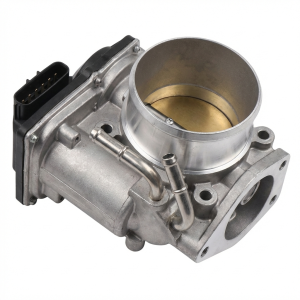
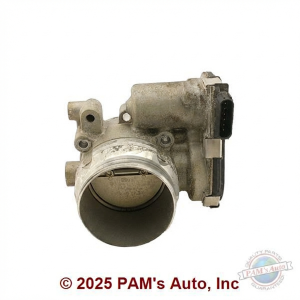
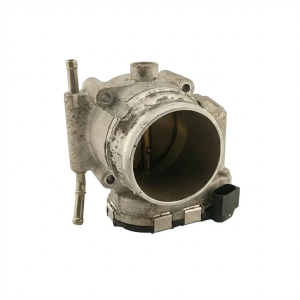
- Electronic Throttle Body Assembly
(OEM #35100-3L000)— This is the primary fix for P0222, as the internal throttle position sensor that triggers the code is integrated into this assembly and cannot be replaced separately.
Trusted brands: Kia (OEM), Bosch, Hyundai (OEM)
OEM price range: $450-$680
Aftermarket price range: $250-$400
Related Codes That Often Appear With This One
- P2135 — This code indicates a 'Voltage Correlation' error between the 'A' and 'B' throttle position sensors. It is very common to see this with P0222, as a failure in one sensor circuit causes its readings to disagree with the other.
- P0638 — This code means 'Throttle Actuator Control Range/Performance'. It can be triggered alongside P0222 if the PCM detects that the throttle plate is not responding to its commands as expected, which can happen when sensor feedback is faulty.
- P0122 — This is the corresponding 'Circuit Low' code for the 'A' sensor. It's possible to see both codes if there is a widespread electrical issue affecting the throttle body.
Platform-Specific Known Issues
- source — A user on r/kia posted a video of their car with a P0222 code that would not turn over. The community suggested first cleaning the throttle body before replacing the entire unit, highlighting this as a common first diagnostic step.
Mechanic-Grade Diagnostic Values
- Throttle Position Sensor 'B' Voltage (KOEO, throttle closed) — expected: ~0.5V. Failure: Voltage is stuck low (<0.5V) and does not change, or is erratic.
- Throttle Position Sensor 'B' Voltage (KOEO, throttle wide open) — expected: ~4.5V. Failure: Voltage does not reach the expected maximum or does not sweep smoothly from closed to open.
- Reference Voltage at Throttle Body Connector — expected: 5.0V. Failure: Voltage is significantly lower than 5.0V or absent, indicating a wiring or PCM issue.
Scan Tool Commands That Help
- Kia GDS (Global Diagnostic System) or equivalent advanced scanner: Active Test: ETC (Electronic Throttle Control) Motor — This command allows a technician to directly activate the throttle plate motor, cycling it open and closed. It's used to confirm if the motor and gear mechanism are functioning mechanically, independent of sensor inputs. If the plate moves smoothly during the test but fails during normal operation, it further isolates the problem to the sensor or wiring.
Wiring & Ground Locations
- 91860-J5010 — Engine bay, connecting the engine block to the chassis.. This is the specific part number for the engine ground wiring assembly for the 3.3L Lambda II engine. A poor or corroded engine ground can cause a variety of electrical issues, including incorrect low voltage readings from sensors like the TPS. While not a primary cause, checking the integrity of this ground strap is a valid step in advanced diagnosis if direct wiring checks to the sensor are inconclusive.
OEM Part Supersession History
35100-3L000→No clear supersession found, part number appears consistent.— N/A
Heads up: This part is shared with several Hyundai/Genesis 3.3T models, including the G70, G80, and G90, confirming its wide application on this engine platform.
Model Year Variations Within This Range
- 2018-2023: While the Stinger received a facelift for the 2022 model year which included a new 2.5L base engine option and cosmetic updates, sources confirm the 3.3T V6 engine and its core components, including the electronic throttle body, remained mechanically unchanged throughout the entire production run. Therefore, the diagnosis for P0222 is identical for all 3.3T model years.
Diagnostic Flowchart
Other Known Issues on This Vehicle
Issues unrelated to this code that are worth knowing about as an owner of this generation:
- High-Pressure Fuel Pump (HPFP) Failure 🔴 High — Affects 2018-2021 models. A faulty fuel control valve plunger can stick, leading to over-pressurization and a sudden loss of drive power. (Ref: NHTSA Recall 21V760000 / Kia Recall SC218. Note: Other fuel pump recalls exist for different issues.)
- Brake Judder / Premature Rotor 'Warping' 🟠 Medium — Very common complaint on 2018-2020 models. Owners report steering wheel vibration under braking. Forum consensus suggests it's not true warping, but uneven brake pad deposits from the OEM pads. (Ref: No recall, but widely discussed. The common fix is upgrading to aftermarket pads and resurfacing or replacing rotors.)
- Left Turbocharger Oil Feed Pipe Leak 🟠 Medium — Affects 2018-2023 models. The oil feed pipe and hose assembly can deteriorate and leak oil onto engine components. (Ref: Kia Recall SC300 / NHTSA 24V143000.)
- Sunset Yellow Paint Chipping 🟡 Low — Specific to 2018 models with 'Sunset Yellow' (S7Y) paint. An error in the factory paint process led to poor adhesion, causing chipping. (Ref: Voluntary Service Campaign SC166.)
- Interior Rattles (Sunroof/Trunk) 🟡 Low — Frequently reported by owners across multiple model years. Common sources include the sunroof shade/assembly and items in the trunk/hatch area.
Used vs. New Parts: Buying Guide for This Vehicle
When a used part is the smart pick: A used throttle body can be a cost-effective option if sourced from a low-mileage, reputable salvage yard, potentially saving 50% or more compared to a new OEM part. It makes sense for a DIY repair where the budget is a primary concern and the risk of a shorter lifespan is acceptable.
Donor-vehicle mileage cap: roughly under 50000 miles for the part to have meaningful remaining life.
What to inspect on the donor part:
- Verify the part number on the used unit (35100-3L000) matches the original exactly.
- Inspect the electrical connector for any bent, corroded, or damaged pins.
- Look inside the throttle bore. Minimal carbon is acceptable, but avoid units that are caked in heavy black deposits, as this may indicate a hard life.
- Check for any physical damage to the housing or plastic components.
- Ask for the donor vehicle's VIN and mileage to verify its history if possible.
OEM-only on this vehicle (don't cheap out):
- Electronic Throttle Body Assembly
Aftermarket brands forum-validated for this vehicle:
- Bosch (often the OEM manufacturer)
Brands owners have reported issues with on this vehicle:
- Unnamed, no-brand parts from online marketplaces are a significant gamble. The internal electronics may not be calibrated correctly, leading to persistent codes, poor idle, or premature failure.
Real Owner Stories
Aggregated from forums and TSBs cited above. Mileages and costs reflect what owners reported in those sources.
2018-2022 Kia Stinger 3.3T-GDi
Symptoms: The car would not turn over and was throwing a P0222 code.
What fixed it: The community suggested cleaning the throttle body as a first diagnostic step before replacing the entire unit.
Source hint: Reddit r/kia thread titled 'I'm getting a p0222 code and car b won't turn over/'
Related OBD-II Codes
Frequently Asked Questions
What is the specific OEM part number for the throttle body on my 3.3T-GDi Stinger?
Is there a manual way to perform a throttle relearn on my Stinger after cleaning the carbon buildup?
Could my P0222 code be related to the High-Pressure Fuel Pump (HPFP) recall?
Why does my Stinger go into Limp Mode when this code triggers?
Are there any other recalls for the 2018-2023 Stinger that I should check while fixing the throttle body?
Helpful Videos
We Have This Part in Stock

The information in this article is provided for general reference and educational purposes only. Vehicle specifications, procedures, and part compatibility can vary by production date, trim level, and region. Always consult your vehicle's factory service manual and verify part numbers before purchasing or performing repairs. Safety-critical components such as airbags, seat belts, and braking systems should be installed by a qualified professional.
- Kia Stinger:
- 🧭 Diagnostic Flowchart
- 🎬 Helpful Videos
- 🛍️ Shop This Part
- What's Unique About the 2018-2023 Kia Stinger
- Symptoms You May Notice
- Most Likely Causes
- Rare But Worth Checking
- Diagnosis Steps
- Parts You'll Likely Need
- Related Codes That Often Appear With This One
- Platform-Specific Known Issues
- Mechanic-Grade Diagnostic Values
- Scan Tool Commands That Help
- Wiring & Ground Locations
- OEM Part Supersession History
- Model Year Variations Within This Range
- Other Known Issues on This Vehicle
- Used vs. New Parts: Buying Guide for This Vehicle
- Real Owner Stories
- 2018-2022 Kia Stinger 3.3T-GDi
- Related OBD-II Codes
- Frequently Asked Questions
- 🎟️ Get 5% Off