

P0234 on 2012-2015 Ford Explorer 2.0L EcoBoost: Turbo Overboost Causes and Fixes
On a 2012-2015 Explorer with the 2.0L EcoBoost, P0234 is most often caused by a faulty turbocharger wastegate solenoid. It's an easy and affordable DIY fix, with the part costing between $30 and $70. Replacing it usually takes less than 30 minutes.
- P0234 on your Explorer 2.0L EcoBoost is a serious code, but the fix is usually simple and cheap.
- The most likely cause is a bad turbocharger wastegate solenoid, located conveniently on top of the engine.
- Before considering an expensive turbo replacement, always check the solenoid and its vacuum hoses first.
- This is a very DIY-friendly repair that can be done in under 30 minutes with basic tools.
- If you also have a P0299 (underboost) code, it further points to a failing wastegate solenoid.
What's Unique About the 2012-2015 Ford Explorer
The 2.0L EcoBoost engine in this generation of Explorer is known for issues with its boost control components. Unlike some vehicles where the solenoid is buried near the turbo, on this platform the primary culprit—the turbocharger wastegate solenoid—is conveniently located on top of the engine, making it exceptionally easy to access and replace for a DIYer. This common failure point means a scary 'overboost' code often has a simple and inexpensive solution, 🎬 Watch: A quick overview of why turbo boost goes out of control. a fact corroborated across numerous platforms using this engine, including the Ford Escape and Focus ST.
Symptoms You May Notice
- Check Engine Light is on
- Drastic loss of engine power (limp mode), sometimes intermittent or resets after restarting the car
- Vehicle struggles to accelerate
- Audible 'whoosh' or whistling sound from the engine bay during acceleration
- Engine running rough or misfiring
- Harsh or erratic transmission shifting
- Sudden hesitation or surging during acceleration
- Excessive turbo noise during operation (as noted in manufacturer bulletin #SSM 53328)
- Replacing the entire turbocharger when only the inexpensive wastegate solenoid was faulty.
- Replacing the MAP sensor before checking the wastegate solenoid and its vacuum lines.
Most Likely Causes
- Faulty Turbocharger Wastegate Solenoid (Boost Control Solenoid) 🔴 High Probability → Shop Turbocharger This electronic valve is a very common failure point on Ford EcoBoost engines. It gets brittle from heat cycles and can stick internally, failing to properly regulate the vacuum sent to the wastegate actuator. This is the most cited cause in owner forums for the P0234 code.
How to confirm: The solenoid is located on top of the engine and is easy to access. Check for cracked vacuum lines connected to it. A definitive test involves using a vacuum pump to see if the solenoid holds and releases vacuum when 12v is applied and removed. However, given the low cost and extremely high failure rate, replacement is often the easiest and most effective diagnostic step.
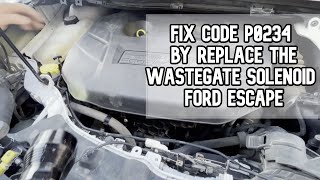
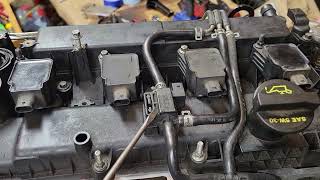
Typical fix: Replace the solenoid. It is held by a simple slide-on clip and has three hoses and one electrical connector. The job typically takes less than 15-20 minutes. 🎬 See this step-by-step walkthrough for replacing the wastegate solenoid.
Est. part cost: $30-$70 - Cracked, Leaking, or Blocked Vacuum Hoses 🟡 Medium Probability → Shop Vacuum Hose The rubber hoses that connect the wastegate solenoid to the vacuum source and the turbo actuator become brittle and crack over time due to engine heat.
How to confirm: Visually inspect all three small vacuum lines connected to the wastegate solenoid for cracks, brittleness, or loose connections. A smoke test can also be performed to find leaks in the system. Pay close attention to the fittings on the solenoid itself, as aftermarket parts sometimes have slightly undersized ports causing a poor seal.
Typical fix: Replace the damaged vacuum lines. This can be done with generic vacuum hose of the correct diameter.
Est. part cost: $5-$20 - Sticking Turbocharger Wastegate Actuator or Arm ⚪ Low Probability → Shop Turbocharger The mechanical actuator on the turbocharger itself can fail, or the arm it controls can bind due to corrosion or carbon buildup, preventing it from opening to release excess boost.
How to confirm: With the engine off, apply vacuum directly to the wastegate actuator with a hand pump. The actuator rod should begin to move at 3-9 PSI and be fully extended by 12-19 PSI. Visually inspect the arm's movement at the turbo to ensure it is smooth and not binding.
Typical fix: If the actuator is faulty or the wastegate is stuck, the entire turbocharger assembly usually needs to be replaced. The actuator is typically not sold as a separate component by Ford for this model year.
Est. part cost: $350-$1300
Rare But Worth Checking
- Faulty Boost Pressure Sensor (MAP Sensor): An inaccurate sensor can send incorrect pressure readings to the PCM, causing it to command the wrong amount of boost. If other causes are ruled out, this is worth investigating. A professional technician on iATN reported a case where a shop had replaced almost every other component before finding a faulty MAP sensor was the cause.
- PCM Software Issue: A Technical Service Bulletin (TSB 16-0119) was issued for the 2017 Fusion/MKZ with the 2.0L engine for a P0234 code that was fixed with a PCM reprogram. While not for this exact vehicle, it indicates a software fix is a possibility, especially on newer models in the EcoBoost family.
Diagnosis Steps
- Read the code and check for any other accompanying codes. Codes like P0299 or P0243 strongly point towards the boost control system. Manufacturer bulletin #SSM 53328 notes that P0234 often appears alongside codes like P003A, P0046, or P0299 in Ford vehicles experiencing a lack of power.
- Visually inspect the engine bay. The wastegate solenoid is on top of the engine. Check the three vacuum hoses connected to it for any obvious cracks, breaks, or loose fittings.
- Given its high failure rate and low cost, the most common and cost-effective next step is to replace the wastegate solenoid. This fixes the issue in the vast majority of cases.
- If replacing the solenoid does not fix the issue, test the vacuum lines. Use a hand-held vacuum pump to check if the lines can hold vacuum.
- Test the wastegate actuator. Apply vacuum directly to the actuator on the turbocharger and watch to see if the actuator arm moves smoothly through its full range of motion. 🎬 Watch: How to easily test and fix an overboost code. It should begin moving around 3-9 PSI.
- If the actuator and solenoid are confirmed good, test the boost pressure sensor (MAP sensor) by monitoring its live data on a scan tool to ensure its readings are logical.
- If all components test good, the issue may be a mechanical failure within the turbocharger itself, requiring replacement.
Parts You'll Likely Need
- Turbocharger Wastegate Solenoid
(OEM #AG9Z-9K378-A (or superseding part number))— This is the most common failure point for a P0234 code on this engine. It's an electronic valve that controls the turbo's wastegate and frequently fails due to heat and age.
Trusted brands: Motorcraft, Pierburg, Dorman
OEM price range: $60-$80
Aftermarket price range: $25-$50
Related Codes That Often Appear With This One
- P0299 — This code for 'Turbocharger Underboost' can appear if the wastegate solenoid is failing erratically, sometimes sticking closed (P0234) and other times sticking open or leaking (P0299).
- P0243 — This code indicates a malfunction specifically in the wastegate solenoid circuit, making it a strong confirmation that the solenoid is the root cause.
- P0420 — An owner report (NHTSA ODI #11688277) noted that P0234 can sometimes be triggered alongside catalyst efficiency codes, which may be consistent with observed mechanical failures.
Technical Service Bulletins (TSBs) & Recalls
- TSB 16-0119: For 2017 Fusion/MKZ with 2.0L GTDI, addresses a P0234 code with a PCM reprogram. While not for the Explorer, it shows a precedent for software fixes on this engine family.
- Bulletin #SSM 53328: Notes that P0234 may be stored in the powertrain control module along with symptoms like a malfunction indicator lamp (MIL), lack of power, and excessive turbo noise.
- TSB 14-0100: Unrelated to P0234. This TSB addresses a transmission squawk noise on 5-3 downshifts in various Ford vehicles and is not relevant to this diagnostic article.
Mechanic-Grade Diagnostic Values
- Turbocharger Wastegate Solenoid Coil Resistance — expected: 10 - 30 Ohms is a general specification for this type of component.. Failure: A reading of infinite resistance (open circuit) or near-zero resistance (short circuit) indicates a failed solenoid.
- Wastegate Solenoid Power Pin Voltage (KOEO) — expected: 12 V (Battery Voltage) ± 0.5 V.. Failure: A reading below 11V points to a problem in the power supply circuit, such as a bad fuse or corroded wire.
- MAP Sensor Voltage (KOEO) — expected: Approximately 4.5V - 5.0V, which should correlate with the Barometric Pressure (BARO) sensor reading.. Failure: A significant difference of more than 0.5V between the MAP and BARO sensor live data readings indicates a fault.
- MAP Sensor Voltage (Engine Idling) — expected: 0.8V to 2.0V on a warm, stable engine.. Failure: Voltage is stuck high (near 5V) or does not respond to changes in engine load/throttle.
Scan Tool Commands That Help
- Ford IDS, FORScan, or other high-end scanner: Wastegate Solenoid Test / Output State Control (OSC) — This bidirectional command allows a technician to manually cycle the solenoid to confirm if it is functioning electrically and to listen for an audible click. It helps differentiate between a failed solenoid and a wiring issue.
- Any OBD-II scanner with live data: Live Data Monitoring: TCBP vs. Desired TCBP — Monitor the actual Turbo Charger Boost Pressure (TCBP) versus the desired value commanded by the PCM. During an overboost event, the actual pressure will significantly exceed the desired pressure, confirming the condition in real-time.
- Any OBD-II scanner with live data: Live Data Monitoring: Wastegate Duty Cycle (WGDC) — For intermittent faults, monitoring the WGDC can reveal if the solenoid is electrically sticking. If the duty cycle value freezes or fails to respond to engine load changes when the fault occurs, it strongly points to a failing solenoid rather than a vacuum leak.
Wiring & Ground Locations
- G103 — Located in the engine compartment, at the left front corner.. This is a primary engine compartment ground. A poor connection at G103 can cause erratic behavior from various engine sensors and actuators, including those in the turbo control system.
- MAP Sensor Connector — On the intake manifold.. The connector for the MAP/Boost pressure sensor is a 4-terminal rectangular male connector. Knowing the pin count and shape helps in identifying the correct sensor and testing its wiring for the 5V reference, ground, and signal circuits.
Real Owner Repair Stories
- Reddit r/FocusST (2013-2018 Ford Focus ST 2.0L EcoBoost) — Intermittent limp mode with P0234 that would resolve after restarting the car.
❌ Tried (didn't work) Initial diagnosis was uncertain between a vacuum leak and a bad solenoid.
✅ What actually fixed it Replacing the turbocharger wastegate solenoid. The owner confirmed the diagnosis by monitoring the 'WGDC Actual' (Wastegate Duty Cycle) PID on a scan tool and saw the value get stuck when the fault occurred, proving it was an electrical/solenoid issue, not a vacuum leak. - Ford Edge Forum (2020 Ford Edge 2.0L EcoBoost) — Wrench light during acceleration, followed by Check Engine Light and significantly reduced power. Codes P0243 and P0299 were present.
✅ What actually fixed it The dealer replaced the 'wastegate solenoid' under powertrain warranty. However, the part replaced was the entire electronic wastegate actuator assembly attached directly to the turbocharger, not the separate, top-mounted solenoid valve. This highlights a critical terminology confusion: some later models use an integrated electronic actuator instead of a vacuum-operated one controlled by a separate solenoid. - NHTSA ODI #11561976 — An owner reported obtaining P0234 and P0299 codes. They replaced the turbocharger overboost solenoid, but noted that the codes returned, suggesting that in some cases, the solenoid may not be the final solution if other mechanical issues exist.
"I Checked Everything" — The Actual Cause
- In cases of an intermittent P0234 code, a smoke test for vacuum leaks will often come back clean, leading to confusion. The actual cause is frequently an electrically failing wastegate solenoid that sticks intermittently. This can be diagnosed by monitoring the wastegate duty cycle (WGDC) on a scan tool during a drive; the value will freeze or behave erratically when the fault occurs, which is a condition a static smoke test cannot detect.
OEM Part Supersession History
AA5Z-9K378-A→AG9Z-9K378-A— Part revision and consolidation across platforms.
Heads up: While many solenoids look similar, using the correct part number is critical. The part number for the 1.6L EcoBoost (CJ5Z-9K378-B) is different and may not function correctly on the 2.0L. Always verify the part number with the vehicle's VIN.
Model Year Variations Within This Range
- 2012-2015: The 2.0L EcoBoost engine was only available with Front-Wheel Drive (FWD) in the Explorer during this period. The ability to pair this engine family with All-Wheel Drive (AWD) was introduced in the 2016 model year with the updated 2.3L EcoBoost engine. This does not change the P0234 repair procedure but is a key platform identifier.
Diagnostic Flowchart
Other Known Issues on This Vehicle
Issues unrelated to this code that are worth knowing about as an owner of this generation:
- Power Transfer Unit (PTU) Failure 🔴 High — Common on AWD models, especially over 60,000 miles. The 'lifetime' fluid degrades from heat exposure (due to proximity to the catalytic converter), leading to gear and bearing failure.
- Coolant Intrusion into Cylinders 🔴 High — A known design flaw in some 2.0L EcoBoost engines where coolant leaks into cylinders, causing misfires and eventual engine failure. Ford issued Customer Satisfaction Program 21N12 for some models, but not all are covered. (Ref: 21N12)
- Cracked Flexplate 🟠 Medium — Can occur on the 2.0L EcoBoost, causing a rattling or ticking noise from the transmission bellhousing area that might be mistaken for other engine noises. (Ref: Various TSBs exist for this issue across different Ford models with this engine.)
- Faulty Throttle Body 🟠 Medium → Shop Fuel Injection Throttle Body — Can cause the vehicle to unexpectedly enter 'limp mode' with reduced power, often triggering codes P2111 and P2112.
- Door Ajar Switch Failure 🟡 Low — A faulty switch inside the door latch assembly can cause the 'door ajar' light to stay on, preventing interior lights from turning off and the alarm from setting correctly.
Used vs. New Parts: Buying Guide for This Vehicle
When a used part is the smart pick: For this specific repair, buying used parts is generally not recommended. The primary cause, the wastegate solenoid, is an inexpensive part that fails from heat and use, so a used part has a high risk of premature failure. A used turbocharger assembly is also risky, as the internal wastegate may be seized or the bearings worn.
Donor-vehicle mileage cap: roughly under 40000 miles for the part to have meaningful remaining life.
What to inspect on the donor part:
- For a turbo assembly, check for zero shaft play (in/out and side-to-side) on the compressor wheel.
- Ensure the wastegate actuator arm moves freely with no binding.
- Avoid parts from vehicles with high mileage or evidence of poor maintenance (e.g., sludge in oil ports).
OEM-only on this vehicle (don't cheap out):
- While not strictly OEM-only, using a Motorcraft (OEM) or a reputable OEM-supplier like Pierburg for the wastegate solenoid is highly recommended for reliability.
Aftermarket brands forum-validated for this vehicle:
- Motorcraft (OEM)
- Pierburg
- Dorman
Brands owners have reported issues with on this vehicle:
- No-name, unbranded solenoids from online marketplaces should be avoided, as their internal components may not meet the required specifications for duty cycle control, leading to persistent or new codes.
Documented NHTSA Reports
NHTSA ODI #11062911
Symptoms: An owner reported that the vehicle displayed a "See Manual" light and was found to have code P0234 for turbocharger overboosting.
Outcome: The dealership reset the car's computer but performed no other repairs at that time.
NHTSA ODI #11427314
Symptoms: A report describes a vehicle throwing multiple codes including P0234 and P0299, alongside cam and motor damage.
Outcome: The owner performed various repairs but remained without a functioning vehicle due to the extent of the mechanical failures.
Real Owner Stories
Aggregated from forums and TSBs cited above. Mileages and costs reflect what owners reported in those sources.
2013-2018 Ford Focus ST 2.0L EcoBoost
Symptoms: Intermittent limp mode that occurred before the car was fully warm; months-long chase of the overboost code.
What fixed it: Replacing the wastegate solenoid valve (specifically using a part from a Ford Escape).
Source hint: Reddit (r/FocusST) thread titled 'Has anyone dealt with the p0234 code?(turbo overboost)'
2013-2019 Ford Escape 2.0L EcoBoost
Symptoms: P0234 code triggered on the 2.0 Liter Ecoboost platform.
What fixed it: Replacement of the Wastegate Solenoid.
Source hint: YouTube: Video by 'Big Al Repairs' titled 'How to fix code P0234 by Replace the Wastegate Solenoid 2013-2019 Ford Escape 2.0 Liter Ecoboost'
2012-2014 Ford Edge 2.0L EcoBoost
Symptoms: Intermittent limp mode and P0234 code.
What fixed it: Replacing the top-mounted wastegate solenoid.
Source hint: Platform mate data for 2012-2014 Ford Edge 2.0L EcoBoost
Related OBD-II Codes
Frequently Asked Questions
Does TSB 14-0100 apply to my P0234 overboost issue on my 2012-2015 Ford Explorer?
Is there a specific TSB for the P0234 code on the 2.0L EcoBoost engine?
Can I buy just the wastegate actuator for my 2013 Explorer 2.0L EcoBoost?
Where is the wastegate solenoid located on the Explorer 2.0L EcoBoost?
I'm seeing a 'Customer Satisfaction Program 21N12' for my engine; is this related to the overboost code?
Why does my Explorer lose power but then return to normal after I restart the car?
Helpful Videos
We Have This Part in Stock


The information in this article is provided for general reference and educational purposes only. Vehicle specifications, procedures, and part compatibility can vary by production date, trim level, and region. Always consult your vehicle's factory service manual and verify part numbers before purchasing or performing repairs. Safety-critical components such as airbags, seat belts, and braking systems should be installed by a qualified professional.
- Ford Explorer:
- 🧭 Diagnostic Flowchart
- 🎬 Helpful Videos
- 🛍️ Shop This Part
- What's Unique About the 2012-2015 Ford Explorer
- Symptoms You May Notice
- Most Likely Causes
- Rare But Worth Checking
- Diagnosis Steps
- Parts You'll Likely Need
- Related Codes That Often Appear With This One
- Technical Service Bulletins (TSBs) & Recalls
- Mechanic-Grade Diagnostic Values
- Scan Tool Commands That Help
- Wiring & Ground Locations
- Real Owner Repair Stories
- "I Checked Everything" — The Actual Cause
- OEM Part Supersession History
- Model Year Variations Within This Range
- Other Known Issues on This Vehicle
- Used vs. New Parts: Buying Guide for This Vehicle
- Documented NHTSA Reports
- NHTSA ODI #11062911
- NHTSA ODI #11427314
- Real Owner Stories
- 2013-2018 Ford Focus ST 2.0L EcoBoost
- 2013-2019 Ford Escape 2.0L EcoBoost
- 2012-2014 Ford Edge 2.0L EcoBoost
- Related OBD-II Codes
- Frequently Asked Questions
- 🎟️ Get 5% Off