

P0245 on 2019-2024 Genesis G70 3.3T: Wastegate Solenoid 'A' Circuit Low Causes and Fixes
P0245 on a Genesis G70 3.3T indicates an electrical fault, typically a short to ground, in the passenger-side (Bank 1) turbocharger's wastegate actuator circuit. The most likely cause is a failed Electronic Wastegate Actuator (EWGA), a known and widely discussed issue on this platform. A tell-tale sign is a distinct rattle from the engine bay on shutdown. Expect to replace the actuator, which can cost $250-$400 for the part.
- P0245 on the G70 3.3T is an electrical fault code for the passenger-side turbo wastegate actuator, usually indicating a short.
- The most probable cause is a failed Electronic Wastegate Actuator (EWGA), a known weak point on this engine.
- A key symptom of a failing EWGA is a distinct rattle or squeak from the engine bay for a few seconds after shutdown.
- Diagnosis can be confirmed with a multimeter (checking for 1.44-1.96 Ω resistance) or a scan tool (checking for 3.9-4.1V position voltage).
- The correct OEM part number for the actuator is 39400-3L100, and it can be replaced independently of the turbocharger.
What's Unique About the 2019-2024 Genesis G70
The Genesis G70 and its platform-mate, the Kia Stinger GT, are known for premature failures of their Electronic Wastegate Actuators (EWGA). While P0245 is a generic electrical code, on this specific platform it frequently points to the failure of this component. The EWGA is exposed to extreme heat in the tightly packed engine bay, which can lead to premature failure of its internal electronics or the external wiring. A common symptom owners report with a failing EWGA is a distinct rattling or squeaking noise from the engine bay for a few seconds immediately after shutting the car off, which is the sound of the actuator failing its self-test sweep.
Symptoms You May Notice
- Check Engine Light is on
- Significant loss of engine power and acceleration
- Vehicle enters 'limp mode'
- Poor fuel economy
- Audible rattling or squeaking from the engine bay for a few seconds after turning the engine off
- No boost or very low boost pressure shown on the dash display
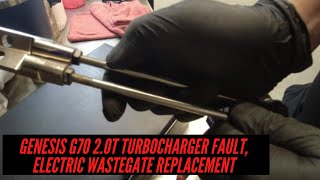
- Replacing the entire turbocharger assembly. While the actuator is attached to the turbo, it can often be replaced separately. Dealers may recommend replacing the whole turbo, as official service procedures state the actuator is not sold separately, but the part is available and the swap is feasible for independent shops or DIY. 🎬 Watch: Step-by-step electric wastegate replacement walkthrough
Most Likely Causes
- Failed Bank 1 (Passenger Side) Electronic Wastegate Actuator (EWGA) 🔴 High Probability → Shop Turbocharger The EWGA is a known pattern failure on the 3.3T platform, likely due to prolonged exposure to high temperatures in the engine bay which degrades the electronic components over time. This is a common issue shared with the Kia Stinger GT.
How to confirm: Listen for a distinct rattle from the passenger-side turbo area when the engine is shut off. Use a multimeter to check the motor coil resistance between the two pins on the actuator; the expected value is approximately 1.44 - 1.96 Ω. A reading of infinite resistance (open) or near-zero (short) indicates failure. An advanced scan tool can also check the actuator's position sensor voltage (Key On, Engine Off), which should be 3.9V - 4.1V when closed; failed units often read 4.5V or higher.
Typical fix: Replace the Bank 1 Electronic Wastegate Actuator. While dealers often recommend replacing the entire turbo assembly, the actuator can be replaced separately.
Est. part cost: $285-$420 - Damaged Wiring or Connector for Wastegate Actuator 🟡 Medium Probability → Shop Turbocharger The engine bay heat can make wiring brittle and connectors fragile over time, leading to breaks or shorts in the circuit. The harness is routed near hot components, increasing the risk of melting or chafing.
How to confirm: Visually inspect the wiring harness and connector going to the passenger-side wastegate actuator for any signs of melting, chafing, corrosion, or broken wires. Perform a continuity test on the wiring between the ECM and the actuator connector to check for opens or shorts to ground.
Typical fix: Repair the damaged section of the wiring harness or replace the connector pigtail.
Est. part cost: $20-$50
Rare But Worth Checking
- Powertrain Control Module (PCM) Failure: → Shop Engine Control Module (ECM) This is very rare, but a faulty driver circuit within the PCM can mimic the symptoms of a failed solenoid or wiring. This should only be considered after the actuator and wiring have been thoroughly tested and ruled out.
Diagnosis Steps
- Verify the code with an OBD-II scanner and check for any other stored codes.
- Listen for a rattling/squeaking noise from the engine bay immediately after turning off the engine. If present, it strongly suggests a failing EWGA.
- Locate the Bank 1 (passenger side) turbocharger and its electronic wastegate actuator.
- Carefully inspect the actuator's electrical connector and wiring harness for any visible damage, such as melted plastic, corrosion, or broken wires.
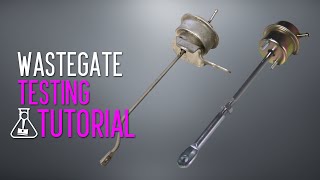
- If the wiring appears intact, disconnect the actuator and use a multimeter to test its internal resistance across the two motor pins. The specification is 1.44 - 1.96 Ω. An open circuit (infinite resistance) or a dead short (near zero resistance) indicates a failed actuator. 🎬 See: How to test a wastegate actuator
- With the ignition on (engine off), use a scan tool to read the 'Adaptation value for the lower mechanical stop of EWGA'. The target voltage is between 3.9V and 4.1V. A reading significantly outside this range, like 4.5V or higher, points to a faulty actuator or misadjusted rod.
- Check for 12V reference power and ground at the actuator's connector with the ignition on to ensure the circuit from the PCM is intact.
- If an advanced scan tool is available, attempt to command the wastegate actuator to open and close while observing its operation or position sensor data to confirm it is unresponsive.
Parts You'll Likely Need
- Electronic Wastegate Actuator (Bank 1 / Passenger Side)
(OEM #39400-3L100)— This is the most common failure point for code P0245 on the Genesis G70 3.3T, due to its susceptibility to heat-related electronic failure.
Trusted brands: Genuine Hyundai / Kia
OEM price range: $285-$420
Aftermarket price range: $150-$250
Related Codes That Often Appear With This One
- P0299 — An underboost condition (P0299) can occur if the electrical fault with the wastegate actuator (P0245) causes it to fail in a way that it cannot properly control boost pressure.
- P0234 — An overboost condition (P0234) can occur if the electrical fault causes the wastegate to stick closed, preventing it from bleeding off excess boost pressure.
- P2563 — This code relates to the wastegate actuator's position sensor. A fault in the actuator often triggers codes for both its control circuit (P0245) and its position sensor, confirming the actuator is the root cause.
Platform-Specific Known Issues
- There is a critical safety recall (NHTSA 24V-191 / Genesis Recall 019G) for the LEFT (driver's side, Bank 2) turbocharger oil feed pipe, which can deteriorate and leak oil, posing a fire risk. While this doesn't directly cause a P0245 code on the passenger side, it highlights the extreme heat and stress that components in this area endure, contributing to the likelihood of electronic failures.
Mechanic-Grade Diagnostic Values
- EWGA Motor Coil Resistance (at ECU Connector A, Pins 5 & 6) — expected: 1.44 - 1.96 Ω, with a stable reading while manually moving the actuator rod through its range of motion.. Failure: A resistance reading that jumps to a very high value (kΩ or MΩ) at any point while moving the rod indicates a dead spot on the motor's commutator.
- EWGA Closed Position Voltage Adjustment (Key On, Engine Off, Engine Cold) — expected: 3.9V - 4.1V.. Failure: Voltage outside this range requires physical adjustment of the actuator rod length. This must be done when the engine is cold for an accurate setting.
Scan Tool Commands That Help
- Hyundai GDS (Global Diagnostic System): Actuation Test -> EWGA (Electronic Waste Gate Actuator) — This is the primary bidirectional test to command the actuator through its full range of motion. It allows a technician to verify if the actuator is physically responding to commands from the ECU, helping to isolate a failed actuator from a wiring problem.
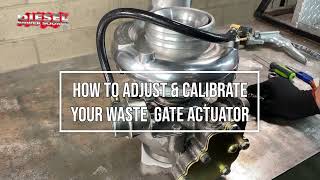
- Hyundai GDS (Global Diagnostic System): Service Function -> Wastegate Voltage Adjustment / Adaptation / Resetting adaptive values — This calibration procedure is mandatory after replacing the EWGA. It performs a 'Voltage Learning' process where the ECU learns the precise voltage signal for the new actuator's fully closed position. Failure to perform this step will likely cause the code to return. 🎬 Watch: Hyundai and Kia wastegate voltage adjustment tutorial
Wiring & Ground Locations
- ECU Connector A (Pins 5 & 6) — The ECU is located in the engine bay on the driver's side, down lower and just ahead of the brake fluid reservoir. Connector A is the front-most connector on the ECU.. Pins 5 and 6 on the harness side of this connector lead directly to the EWGA motor. This provides an accessible point to test the actuator's motor coil resistance without having to physically access the hard-to-reach actuator on the turbocharger.
- EWGA Connector — Directly on the Electronic Wastegate Actuator, which is bolted to the passenger-side turbocharger housing.. This is a 6-position, 5-pin connector and is the primary point for checking power, ground, and signal integrity directly at the component. It is susceptible to heat damage due to its location.
Real Owner Repair Stories
- Go-Parts analysis of forum data (Genesis G70 3.3T (year not specified)) — Overboost condition (related code P0234) and limp mode.
❌ Tried (didn't work) The owner was preparing to replace the actuator or the entire turbo assembly.
✅ What actually fixed it The owner physically adjusted the length of the wastegate actuator rod. This brought the position sensor's voltage back into the correct specification (target was 4.1V-4.3V in this instance), resolving the fault without replacing any parts.
When the Usual Fixes Don't Work
- In at least one owner's experience reported on Reddit, the common 'fix' of replacing the component did not provide a permanent solution. The owner had the entire turbocharger assembly replaced under warranty to address a noisy wastegate actuator (a symptom related to P0245), only for the noise to return a week later. This suggests that even new OEM parts may be susceptible to the same heat-related failures, and the root cause may be the high-heat environment of the engine bay itself.
OEM Part Supersession History
39400-3L100→39400-3L100— No supersession found.
Heads up: The part number has remained consistent across all model years for the 3.3T engine. The lack of a revised part number may suggest the original design, with its known heat-related failure mode, has not been improved by the manufacturer.
Model Year Variations Within This Range
- 2019-2024: While the G70 received a cosmetic facelift for the 2022 model year, the 3.3T Lambda II V6 engine and its turbocharging components, including the electronic wastegate actuators, remained unchanged. The causes and fixes for P0245 are identical across the entire 2019-2024 range for this engine.
Diagnostic Flowchart
Other Known Issues on This Vehicle
Issues unrelated to this code that are worth knowing about as an owner of this generation:
- Left Turbocharger Oil Feed Pipe Leak 🔴 High → Shop Turbocharger — Common enough to warrant a safety recall (NHTSA 24V-191). Affects 2019-2022 models. (Ref: NHTSA 24V-191 / Genesis Recall 019G)
- High-Pressure Fuel Pump (HPFP) Failure 🔴 High — Affects multiple model years and can cause stalling or loss of power. A recall (24V-528) and warranty extension have been issued for some models. (Ref: NHTSA 24V-528 / Genesis Recall 262-023G)
- Intake Valve Carbon Buildup 🟠 Medium — Common on GDI engines, typically becomes noticeable after 60,000+ miles, potentially causing misfires or reduced performance.
- Anti-Lock Brake System (ABS) Module Malfunction 🔴 High — A recall was issued for 2019-2021 models as an internal short circuit could cause an engine compartment fire. (Ref: NHTSA 21V-161 / Genesis Recall 007G)
- Failing Oil Pressure Sensor 🟠 Medium — The sensor itself is a common failure point, but its location under the intake manifolds makes replacement a labor-intensive and expensive job.
- Minor Interior Rattles and Electronic Glitches 🟡 Low — More common on early (2019-2020) models. Owners report rattles from sunglasses holder/mirror area and occasional infotainment or keyless entry glitches.
Used vs. New Parts: Buying Guide for This Vehicle
When a used part is the smart pick: Almost never for the Electronic Wastegate Actuator (EWGA). This is a widely documented high-failure part due to heat and vibration. A used part from a junkyard carries an extremely high risk of premature failure, forcing you to repeat the labor-intensive replacement.
Donor-vehicle mileage cap: roughly under 20000 miles for the part to have meaningful remaining life.
What to inspect on the donor part:
- Must come from a documented low-mileage vehicle (e.g., front-end collision).
- Inspect the plastic housing for any cracks, melting, or signs of extreme heat exposure.
- Ensure the electrical connector pins are straight, clean, and free of any corrosion.
- Manually move the actuator arm; it should move smoothly against spring pressure without any binding or gritty feeling.
OEM-only on this vehicle (don't cheap out):
- Electronic Wastegate Actuator (EWGA)
Brands owners have reported issues with on this vehicle:
- Unbranded, low-cost actuators from online marketplaces should be avoided, as their internal electronics and calibration may not meet OEM specifications, leading to persistent codes or poor performance.
Real Owner Stories
Aggregated from forums and TSBs cited above. Mileages and costs reflect what owners reported in those sources.
2019 Genesis G70 3.3T
Symptoms: Significant loss of power and the vehicle entered limp mode. Noticed a distinct rattling and squeaking noise coming from the engine bay for a few seconds immediately after turning the engine off.
What fixed it: Replacement of the Bank 1 (Passenger Side) Electronic Wastegate Actuator (EWGA).
Source hint: stingerforum.org
2020 Genesis G70 3.3T
Symptoms: Check Engine Light on with no boost pressure shown on the dash display. The car felt extremely sluggish during acceleration.
What fixed it: Replacement of the Electronic Wastegate Actuator (EWGA) after confirming the position sensor was reading 4.5V.
Source hint: genesisg70.com
2019 Genesis G70 3.3T
Symptoms: Experienced a rattle on shutdown which eventually led to a limp mode event and a P0245 code.
What fixed it: Replacement of the failed EWGA unit; owner noted the failure was likely due to heat exposure.
Source hint: Reddit r/GenesisG70
Related OBD-II Codes
Frequently Asked Questions
Does the safety recall for the turbo oil feed pipe cause the P0245 code on my G70?
My dealer says I need to replace the entire turbocharger for my 3.3T. Is there a cheaper fix?
Is the P0245 issue common on the Kia Stinger GT as well?
What should the resistance be when testing the EWGA on my G70 3.3T?
What voltage should I see on my scan tool for the wastegate position sensor?
Are there any other major recalls I should be aware of while fixing this boost issue?
Helpful Videos

We Have This Part in Stock

The information in this article is provided for general reference and educational purposes only. Vehicle specifications, procedures, and part compatibility can vary by production date, trim level, and region. Always consult your vehicle's factory service manual and verify part numbers before purchasing or performing repairs. Safety-critical components such as airbags, seat belts, and braking systems should be installed by a qualified professional.
- Genesis G70:
- 🧭 Diagnostic Flowchart
- 🎬 Helpful Videos
- 🛍️ Shop This Part
- What's Unique About the 2019-2024 Genesis G70
- Symptoms You May Notice
- Most Likely Causes
- Rare But Worth Checking
- Diagnosis Steps
- Parts You'll Likely Need
- Related Codes That Often Appear With This One
- Platform-Specific Known Issues
- Mechanic-Grade Diagnostic Values
- Scan Tool Commands That Help
- Wiring & Ground Locations
- Real Owner Repair Stories
- When the Usual Fixes Don't Work
- OEM Part Supersession History
- Model Year Variations Within This Range
- Other Known Issues on This Vehicle
- Used vs. New Parts: Buying Guide for This Vehicle
- Real Owner Stories
- 2019 Genesis G70 3.3T
- 2020 Genesis G70 3.3T
- 2019 Genesis G70 3.3T
- Related OBD-II Codes
- Frequently Asked Questions
- 🎟️ Get 5% Off