

P0299 on 2008-2010 Chevrolet HHR SS 2.0L Turbo: Underboost Causes and Fixes
On the HHR SS, code P0299 is most often caused by a faulty boost control solenoid, a boost leak from a cracked hose or intercooler, or a misadjusted/faulty wastegate. Check the vacuum lines and solenoids first, as they are a common, inexpensive fix. A faulty solenoid can fail when hot, causing intermittent boost loss that recovers after the car cools down.
- Don't immediately assume the turbo has failed. The most common causes for P0299 on the HHR SS are less expensive and easier to fix.
- Start your diagnosis with the basics: check all vacuum lines and charge pipes for obvious leaks or loose connections.
- The two boost control solenoids are a very common failure point and should be tested early in the diagnostic process.
- Refer to GM Technical Service Bulletins, as known issues like wastegate adjustment and broken actuator nipples have been documented for this engine.
- A smoke test is the most reliable way to find hidden boost leaks in the charge pipes or intercooler.
What's Unique About the 2008-2010 Chevrolet HHR
The LNF engine in the HHR SS is a performance-oriented, direct-injection turbo engine. Unlike some other platforms where P0299 points to complex PCV system failures, on the LNF, the causes are more directly tied to the boost control system itself. The vacuum and boost control solenoids are known failure points, sometimes failing intermittently with heat, causing an internal electrical break in the coil's winding. Additionally, GM has issued service bulletins specifically for the LNF engine regarding misadjusted wastegates (TSB #09-06-93-004) and damaged wastegate actuator nipples (TSB #PIP4520), indicating these are known issues from the factory.
Symptoms You May Notice
- Significant loss of engine power, vehicle feels sluggish.
- Check Engine Light is on.
- Boost gauge showing much lower pressure than normal (e.g., 5-7 PSI instead of 15+ PSI).
- In some cases, boost may be normal when cold and then drop off to 0 PSI as the engine warms up, with boost returning after an ignition cycle.
- Hissing or whistling sounds from the engine bay under acceleration, indicating a boost leak.
- Car may fall 'on its face' during acceleration, with boost dropping to near zero, requiring a restart to temporarily resolve.
- Replacing the entire turbocharger assembly before diagnosing faulty solenoids, boost leaks, or a misadjusted wastegate. The turbo itself is often durable, while the smaller control components are more likely to fail and are much cheaper to replace.
Most Likely Causes
- Faulty Turbocharger Boost Control Solenoid(s) 🔴 High Probability → Shop Turbocharger These solenoids control vacuum/boost pressure to the wastegate and bypass valve. They are a very common failure point. The internal coil winding can develop a break that separates when the solenoid heats up, causing an open circuit. When it cools, the connection can be restored, leading to very intermittent symptoms.
How to confirm: Listen for an audible 'click' from the solenoid when 12V is applied. A definitive test is to use an ohmmeter on the two pins; a faulty solenoid will often show an open circuit (infinite resistance), especially when hot. A working solenoid should have a specific resistance value (consult service manual).
Typical fix: Replace the faulty solenoid. There is one for the wastegate and one for the bypass valve; they are identical parts and often replaced as a pair for good measure.
Est. part cost: $40-$80 - Boost/Vacuum Leak 🟡 Medium Probability Over time, rubber and plastic components in the engine bay can crack or become brittle. Common leak points include the charge pipes, the intercooler end tanks (which are plastic crimped to an aluminum core), and all vacuum lines. Manufacturer Bulletin #PIP5927D notes that a damaged Charge Air Inlet Pipe connection at the Turbocharger can specifically trigger P0299.
How to confirm: Perform a visual inspection of all charge pipes and vacuum hoses for cracks, loose clamps, or disconnections. A disconnected hose is a common find. A smoke test is the most effective way to find small, hard-to-see leaks in the intake and charge pipe system. Owners have reported leaks from the intercooler itself and the diverter valve gasket.
Typical fix: Replace the cracked hose, tighten the loose clamp, or replace the damaged intercooler.
Est. part cost: $20-$300 - Misadjusted or Faulty Wastegate Actuator 🟡 Medium Probability → Shop Turbocharger GM issued TSB #09-06-93-004 for the LNF engine, stating the wastegate can be misadjusted from the factory, causing P0299 or P0234. The actuator arm can also become stiff, bind, or seize, preventing the wastegate from closing properly. Manufacturer Bulletin #PIP6058A also communicates the possibility of P0299 setting due to wastegate binding.
How to confirm: Check the wastegate actuator rod to ensure it moves freely. The adjustment procedure per the TSB involves loosening the jam nuts and turning the adjuster one turn at a time. Shortening the rod (turning nuts toward the actuator) increases boost; lengthening it decreases boost. This is a very fine adjustment.
Typical fix: Adjust the wastegate actuator rod per TSB #09-06-93-004. If the actuator is seized or faulty, it will need to be replaced.
Est. part cost: $100-$200 - Damaged Turbocharger Bypass Valve (BPV) ⚪ Low Probability → Shop Turbocharger The diaphragm in the factory bypass valve can tear, creating a leak that prevents boost from building. On aftermarket valves, the piston can become sticky with dirt and old grease, causing it to not close properly.
How to confirm: Remove the bypass valve from the turbocharger (three 10mm bolts) and inspect the rubber diaphragm for tears or holes. If it's an aftermarket piston-style valve, check for smooth movement.
Typical fix: Replace the bypass valve. Many owners upgrade to more durable aftermarket units like those from Forge or ZZPerformance.
Est. part cost: $60-$180
Rare But Worth Checking
- Cracked Wastegate Actuator Vacuum Nipple: → Shop Turbocharger GM TSB #PIP4520 (which replaced PIP4820) points to a specific issue where the vacuum nipple on the turbo compressor housing for the wastegate actuator can crack or break off, causing a direct loss of boost control and setting a P0299. The solenoid itself is replaceable separately from the turbo.
- Restricted Vacuum Supply Line: Manufacturer Bulletin #PIP5978 indicates that P0299 can set if the vacuum supply line from the vacuum pump to the wastegate solenoid is restricted with adhesive bonding material.
- Clogged Catalytic Converter: → Shop Catalytic Converter A severely restricted exhaust can prevent the turbo from spooling up properly, leading to an underboost condition. This is less common but can happen on higher-mileage vehicles and may be hinted at by an intermittent O2 sensor or catalyst efficiency warning on a scanner.
- Failing Turbocharger: → Shop Turbocharger While often suspected first, complete turbo failure is less common than the supporting components. It should only be considered after all other possibilities have been ruled out. NHTSA ODI #11389578 describes a case where the turbocharger was found to have a crack in the housing. Symptoms include excessive shaft play (in-and-out movement is bad; slight side-to-side is often normal), a seized turbine, or a wastegate flapper that is binding internally.
Diagnosis Steps
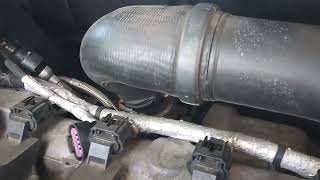
- Read the codes: Use an OBD-II scanner to confirm P0299 and check for any other related codes 🎬 Watch: A helpful guide on diagnosing P0299 underboost issues. like P2261 or P0101.
- Visual Inspection: Carefully inspect all vacuum lines for cracks or disconnection, especially around the boost control solenoids and wastegate actuator. Check all charge pipes between the turbo, intercooler, and throttle body for loose clamps or obvious cracks. A hose that has simply popped off is a common culprit.
- Check Solenoids: Test the boost control solenoids. Check for correct vacuum line routing. Test resistance with a multimeter; a reading of infinite resistance (open circuit) indicates a bad solenoid. This test is most effective when the engine is hot and symptoms are present.
- Perform a Boost Leak Test: Use a smoke machine or a DIY boost leak tester to pressurize the intake system (from the turbo inlet) to 5-10 PSI and listen/look for leaks. Pay close attention to the intercooler end tanks, all pipe connections, and the BPV gasket area.
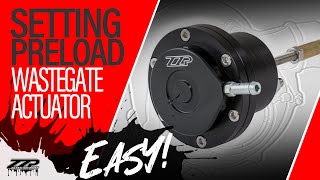
- Inspect Wastegate: Check that the wastegate actuator arm is connected and moves freely without binding. If it's stiff or disconnected, it needs to be addressed. Consider checking the adjustment per TSB #09-06-93-004, making only small, one-turn adjustments at a time. 🎬 See this walkthrough on how to properly set wastegate preload.
- Inspect Bypass Valve (BPV): Remove and inspect the BPV on the turbo (held by three 10mm bolts) for a torn diaphragm or, if aftermarket, a sticking piston.
- Inspect Turbocharger: As a final step, check the turbo for excessive shaft play (in-and-out movement is bad) or signs of a damaged turbine wheel. This is the least likely cause and should be checked last.
Parts You'll Likely Need
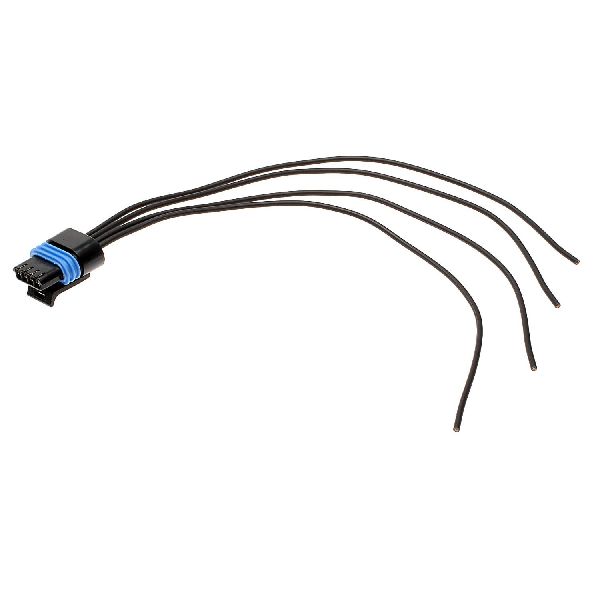
- Turbocharger Boost Control Solenoid / Air Bypass Valve
(OEM #12653854 (replaces 12633354))— This is a very common failure point on the LNF engine that directly causes underboost conditions. They can fail intermittently when hot, making diagnosis tricky without testing.
Trusted brands: ACDelco, Dorman
OEM price range: $50-$70
Aftermarket price range: $30-$50 - Charge Air Cooler Hoses / Charge Pipes — Cracks in the plastic or rubber charge pipes are a common source of boost leaks that trigger P0299. The stock intercooler with plastic end tanks can also leak at the seams.
Trusted brands: ACDelco, Mishimoto, ZZPerformance
OEM price range: $100-$200 per section
Aftermarket price range: $80-$300 for a full kit
Related Codes That Often Appear With This One
- P2261 — This code for 'Turbocharger/Supercharger Bypass Valve - Mechanical' often appears with P0299 because a stuck-open bypass valve directly causes a loss of boost pressure, triggering both codes.
- P0101 — This code for 'Mass Air Flow (MAF) Sensor Circuit Range/Performance' can be set alongside P0299 because a large, unmetered air leak (boost leak) causes a discrepancy between the air measured by the MAF sensor and the air the engine actually ingests. TSB #PIP4520 also lists this as a possible companion code.
Technical Service Bulletins (TSBs) & Recalls
- TSB #09-06-93-004: Details the procedure for adjusting a misaligned wastegate actuator rod to correct either underboost (P0299) or overboost (P0234). It advises making adjustments one turn at a time while the engine is hot.
- TSB #PIP4520: Addresses a low boost condition caused by a cracked or broken vacuum nipple on the turbocharger compressor housing where the wastegate actuator solenoid attaches. It instructs technicians to inspect this specific nipple and replace the solenoid assembly if it is damaged, rather than replacing the entire turbo.
- Bulletin #PIP5927D: Communicates the possibility of reduced power with DTC P0299 due to a damaged Charge Air Inlet Pipe connection at the Turbocharger.
- Bulletin #PIP6058A: Informs dealers of the possibility of DTC P0299 setting due to wastegate binding.
- Bulletin #PIP5978: Notes that P0299 may set as a result of the vacuum supply line from the vacuum pump to the wastegate solenoid being restricted with adhesive bonding material.
Platform-Specific Known Issues
- Heat-Soak Solenoid Failure: A very common scenario for the HHR SS and other LNF vehicles is for a boost control solenoid to function correctly when cold but fail once the engine bay is hot. This creates an intermittent underboost condition that can be difficult to diagnose if the vehicle has cooled down before testing. The fix is replacing the solenoid.
- Wastegate Actuator Nipple Fracture: → Shop Turbocharger As noted in TSB PIP4520, the small plastic nipple on the compressor housing that provides a vacuum/boost signal to the wastegate solenoid can crack or break off entirely, leading to a total loss of wastegate control and a persistent P0299 code.
Mechanic-Grade Diagnostic Values
- Boost Control Solenoid Resistance — expected: 25-35 Ohms. Failure: Infinite resistance (open circuit), especially when hot, indicates a failed solenoid coil.
- MAP Sensor Signal Voltage (Key On, Engine Off) — expected: ~4.5-5.0 Volts. Failure: A reading of 0V can indicate a failed sensor or wiring issue. This reading should be close to the 5V reference supplied by the ECM.
- MAP Sensor Signal Voltage (Engine at Idle) — expected: 1.0 - 2.0 Volts. Failure: Voltage that is unresponsive, stuck high, or does not drop significantly from the KOEO reading suggests a faulty sensor or a major vacuum leak.
- P0299 Trigger Condition (Desired vs. Actual Boost) — expected: Desired boost pressure should closely match actual boost pressure under load.. Failure: The ECM will set P0299 if the actual boost pressure is more than 20 kPa below the desired boost pressure for a continuous period of 4 seconds.
Scan Tool Commands That Help
- GDS2/Tech2: Turbocharger Wastegate Actuator Solenoid Valve Control — This bidirectional control allows a technician to command the wastegate solenoid on and off to verify its operation. The tech can listen for an audible click and observe changes in vacuum/pressure readings, confirming if the solenoid is responding to ECM commands.
- GDS2/Tech2: Turbocharger Bypass Valve Solenoid Valve Control — Similar to the wastegate test, this command cycles the bypass (diverter) valve solenoid. It's used to diagnose a stuck BPV or a faulty solenoid that could be causing boost to be vented improperly, leading to an underboost condition.
- GDS2/Tech2: Turbocharger Learn Procedure — After replacing a turbocharger or wastegate actuator, this service function may be required to allow the ECM to learn the position and operating range of the new components, ensuring accurate boost control.
Wiring & Ground Locations
- G103 — Left front corner of the engine compartment.. This is a primary ground for the Engine Control Module (ECM). A poor connection here can cause erratic behavior from the ECM, including incorrect sensor readings and faulty command signals to the boost control solenoids.
- G105 — Left front of the engine block.. This ground point serves various engine components. While not the primary ECM ground, ensuring it is clean and tight is part of good diagnostic practice to eliminate any potential for electrical interference or voltage drops affecting sensors.
- ECM Connector X1 — The main engine harness connector at the Engine Control Module, located on the left side of the engine compartment in front of the underhood fuse block.. All signals from the MAP sensors and commands to the boost solenoids pass through this connector. Checking for pin corrosion or damage is crucial if sensor readings are erratic or solenoids are unresponsive despite being new.
Real Owner Repair Stories
- Chevy HHR Network, user '1970judge' (2008-2010 HHR SS (specific year not stated)) — Full boost when cold, but after prolonged driving or in hot weather, boost would drop to 0 PSI. P0299 would set.
❌ Tried (didn't work) Visual inspection of charge pipes and intercooler (assumed okay since boost was present when cold)., Checked vacuum hoses and connections., Inspected wastegate linkage.
✅ What actually fixed it The boost control solenoid for the bypass valve was faulty. It would not 'click' when 12V was applied and an ohmmeter showed an open circuit (infinite resistance). The failure was heat-related, explaining the intermittent nature of the problem. Replacing the solenoid resolved the issue. - Chevy HHR Network, user 'WhiskeyshotSS' (2008 HHR SS, 5-speed, recently purchased from auction) — Car would not boost past 5 PSI. After reaching 4500 RPM in 3rd gear, it finally set codes P0299 and a pending P2261. Idle vacuum was normal at 18-20 inHg.
❌ Tried (didn't work) Checked all tubing for cracks or leaks; everything seemed clamped and tight.
✅ What actually fixed it The user suspected the Bypass Valve (BPV) was stuck from sitting at the auction lot for 6 months. The combination of P0299 (underboost) and P2261 (bypass valve mechanical) strongly pointed to the BPV being stuck open, preventing boost from building. The resolution was to inspect and service/replace the BPV. - NHTSA ODI #11509405 — An owner reported a loss of power that was extremely unsafe on the highway. The dealer found code P0299 and initially cleaned the throttle body as a likely fix.
"I Checked Everything" — The Actual Cause
- A common scenario for the LNF engine is a heat-soaked boost control solenoid. A smoke test performed when the engine is cold will show no leaks, and the solenoid may even test fine with a multimeter. However, once the engine bay heats up, the coil winding inside the solenoid separates, creating an open circuit and causing the underboost condition. The problem disappears again once the car cools down. The actual cause is the electrically-failed solenoid, not a physical leak.
OEM Part Supersession History
12633354→12653854— Standard part revision and consolidation by GM.
Heads up: The new part number (12653854) is a direct replacement for the old one. There are no known incompatibility issues.
Model Year Variations Within This Range
- 2008: Early 2008 models featured an analog A-pillar boost gauge. Some early '08s also had an issue with brake assist on startup that was remedied by a dealer-installed auxiliary vacuum pump.
- 2009-2010: The Reconfigurable Performance Display (RPD) became an option in 2009 and was standard in 2010, replacing the analog boost gauge. A USB port for the radio was added in 2009. Performance seats for both driver and passenger became standard in mid-2009.
Diagnostic Flowchart
Real Owner Stories
Aggregated from forums and TSBs cited above. Mileages and costs reflect what owners reported in those sources.
2008-2010 Chevrolet HHR SS 2.0L Turbo
Symptoms: Intermittent P0299 code that only occurred when the engine was hot.
What fixed it: Replaced a faulty bypass solenoid that had an internal wire break, which was confirmed using an ohmmeter.
Source hint: chevyhhr.net thread titled 'P0299 issue solved'
2008-2010 Chevrolet Cobalt SS 2.0L Turbo
Symptoms: Full boost when cold, then partial boost, then no boost after the car was fully warmed up.
What fixed it: Replaced a faulty boost control solenoid.
Source hint: cobaltss.net thread titled 'boost some boost no boost P0299 help'
2008-2010 Chevrolet HHR SS 2.0L Turbo
Symptoms: Persistent underboost condition triggering P0299.
What fixed it: Replaced solenoids, spark plugs, and charge pipes during the troubleshooting process to resolve the issue without replacing the turbocharger.
Source hint: chevyhhr.net thread titled 'P0299 underboost'
2008-2010 Chevrolet Cobalt SS 2.0L Turbo
Symptoms: Underboost condition triggering a P0299 code.
What fixed it: Adjusted the wastegate actuator rod according to the fine-tuning process outlined in TSB #09-06-93-004.
Source hint: cobaltss.net thread titled 'F*ck me... p0299 underboost'
Related OBD-II Codes
Frequently Asked Questions
Does TSB #09-06-93-004 apply to my 2008-2010 HHR SS for code P0299?
Why does my HHR have normal boost when cold, but drops to 0 PSI when it warms up?
What is TSB PIP4520 and how does it relate to my P0299 code?
I hear a hissing sound under acceleration along with the P0299 code. What should I check?
Can a bad bypass valve (BPV) cause a P0299 on the LNF engine?
How do I test the boost control solenoids on my HHR SS?
Helpful Videos
Used OEM Parts in Stock
New Aftermarket Parts Available


The information in this article is provided for general reference and educational purposes only. Vehicle specifications, procedures, and part compatibility can vary by production date, trim level, and region. Always consult your vehicle's factory service manual and verify part numbers before purchasing or performing repairs. Safety-critical components such as airbags, seat belts, and braking systems should be installed by a qualified professional.
- Chevrolet HHR:
- 🧭 Diagnostic Flowchart
- 🎬 Helpful Videos
- 🛍️ Shop This Part
- What's Unique About the 2008-2010 Chevrolet HHR
- Symptoms You May Notice
- Most Likely Causes
- Rare But Worth Checking
- Diagnosis Steps
- Parts You'll Likely Need
- Related Codes That Often Appear With This One
- Technical Service Bulletins (TSBs) & Recalls
- Platform-Specific Known Issues
- Mechanic-Grade Diagnostic Values
- Scan Tool Commands That Help
- Wiring & Ground Locations
- Real Owner Repair Stories
- "I Checked Everything" — The Actual Cause
- OEM Part Supersession History
- Model Year Variations Within This Range
- Real Owner Stories
- 2008-2010 Chevrolet HHR SS 2.0L Turbo
- 2008-2010 Chevrolet Cobalt SS 2.0L Turbo
- 2008-2010 Chevrolet HHR SS 2.0L Turbo
- 2008-2010 Chevrolet Cobalt SS 2.0L Turbo
- Related OBD-II Codes
- Frequently Asked Questions
- 🎟️ Get 5% Off