

P0299 on 2019-2022 Lincoln Nautilus: Turbo Underboost Causes and Fixes
On a 2019-2022 Lincoln Nautilus, code P0299 is almost always caused by a missing e-clip on the turbocharger wastegate actuator or a faulty actuator itself. This is a well-documented issue covered by multiple Ford/Lincoln TSBs. Check the clip first; the fix could cost just a few dollars for the clip or around $100-$400 for an actuator kit, saving you from a costly and unnecessary turbo replacement.
- Before any other diagnosis, visually inspect the turbocharger wastegate actuator for a missing e-clip. This is the most common and cheapest fix.
- If the clip is present, the wastegate actuator itself is the next most likely failure point. A specific service kit is available from Ford/Motorcraft.
- Do not assume the entire turbocharger needs to be replaced. For this specific vehicle and code, that is rarely the case.
- The vehicle is safe to drive in the short term, but performance will be severely limited. Repair the issue promptly to restore power and prevent unnecessary strain.
What's Unique About the 2019-2022 Lincoln Nautilus
For the 2019-2022 Lincoln Nautilus with either the 2.0L or 2.7L EcoBoost engine, this code is very frequently linked to a specific, known failure point. Lincoln has issued multiple Technical Service Bulletins (TSBs) acknowledging that the P0299 code is often triggered by a simple missing e-clip on the turbocharger's wastegate actuator rod, or a failure of the actuator itself. This makes the diagnosis much more direct than on other vehicles, where the cause could be a wide range of boost leaks or sensor issues. Owners should investigate this specific component before suspecting a major turbocharger failure.
🎬 Watch: Why you shouldn't replace the turbo right away.Symptoms You May Notice
- Significant loss of engine power and sluggish acceleration.
- Check Engine Light or Malfunction Indicator Lamp (MIL) illuminated.
- Vehicle may enter 'limp mode' or 'reduced power mode', sometimes with a wrench icon on the dash.
- Whistling, hissing, or 'whooshing' noises from the engine bay, indicating a potential boost leak.
- Rattling noise from the engine bay, which can point to a failing wastegate actuator or linkage. 🎬 See what a failing wastegate rattle sounds like.
- Replacing the entire turbocharger assembly. Manufacturer TSBs for the Nautilus specifically advise against this, as the problem is almost always the inexpensive wastegate actuator or its e-clip.
Most Likely Causes
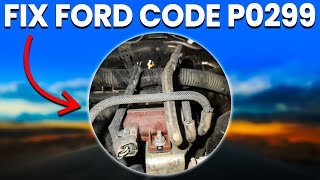
- Missing E-Clip on Turbocharger Wastegate Actuator 🔴 High Probability → Shop Turbocharger This is a widely known issue documented in multiple Lincoln/Ford Technical Service Bulletins (SSM 50171, SSM 50485, SSM 49427) for this specific engine family. The clip can fall off due to vibration, causing the actuator rod to disconnect from the wastegate arm, resulting in a complete loss of boost control.
How to confirm: Visually inspect the turbocharger wastegate actuator rod where it connects to the wastegate lever on the turbo housing. Check if the small e-clip that secures the actuator rod is present. If the rod is loose, disconnected, or hanging freely, the clip is missing.
Typical fix: Replace the missing e-clip. It is a very inexpensive part. Due to the extreme frequency of this issue, it's the first thing to check. The OEM part number for the clip may be W790436-S900 or W719325-S300, but it's best to verify with a VIN.
Est. part cost: $5-$15 - Failed Turbocharger Wastegate Actuator 🔴 High Probability → Shop Turbocharger This is the other primary cause cited in manufacturer TSBs (SSM 50171, SSM 50485) for this specific vehicle and code. The electronic actuator is located in a high-heat environment and can fail internally, either electrically or mechanically. The TSBs also mention 'non-visible damage to the actuator rod' as a possible cause.
How to confirm: If the e-clip is present and the linkage is intact, the actuator itself is the likely problem. A diagnostic scan tool may be able to command the actuator to move, confirming its operation. If it has power but doesn't move, it has failed. This may also be accompanied by other codes like P0243.
Typical fix: Replace the wastegate actuator. Lincoln provides a service kit (Part No. K2GZ-9G488-B for the 2.0L) which includes the actuator, rod, and new clips, explicitly stating that turbo replacement is not necessary.
Est. part cost: $100-$400 - Boost Pressure Leaks (Charge Air Hoses) 🟡 Medium Probability Like any turbocharged vehicle, the charge air cooler (CAC) pipes and hoses can crack, split, or blow off their connections under pressure.
How to confirm: Inspect all air intake hoses and pipes between the turbocharger, intercooler, and throttle body for cracks, loose connections, or split hoses. A loud 'whoosh' of air during acceleration is a key symptom. A smoke test is the most effective way to pinpoint hard-to-see leaks.
Typical fix: Tighten loose clamps or replace the damaged hose or seal. A common failure point on EcoBoost engines is the connection at the intercooler outlet.
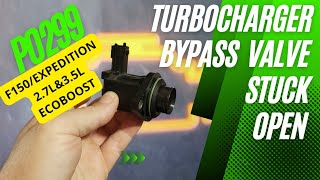
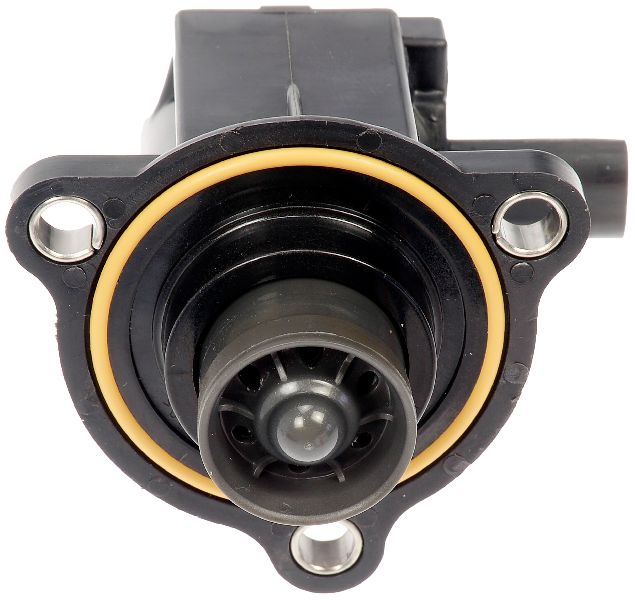
Est. part cost: $20-$150 - Faulty Turbocharger Bypass/Diverter Valve ⚪ Low Probability → Shop Turbocharger The bypass valve (BPV) or diverter valve is a known failure point on many EcoBoost engines. It can get stuck open due to rust on the internal shaft or a torn diaphragm, creating a constant boost leak.
How to confirm: The valve can be removed and inspected. If the internal diaphragm is pulled in on a normally-closed valve, it is stuck open and faulty.
Typical fix: Replace the bypass valve. While some suggest cleaning may work, replacement is the recommended repair. 🎬 Watch: How to identify a faulty bypass valve.
Est. part cost: $50-$100
Rare But Worth Checking
- Faulty Boost Pressure Sensor (MAP Sensor): The sensor that measures boost pressure can fail and send incorrect readings to the PCM, causing it to think there is an underboost condition when there isn't one.
- Restricted Air Filter or Intake: → Shop Air Cleaner Assembly A severely clogged engine air filter can starve the turbocharger of air, preventing it from building the required boost. This should be one of the first and easiest checks.
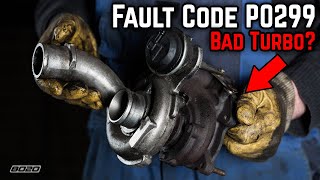
- Damaged Turbocharger: → Shop Turbocharger While possible, this is the least likely cause on this specific platform, given the known wastegate issues. Failure is usually due to worn bearings from oil starvation and is often accompanied by loud whining or grinding noises. Do not assume the turbo has failed without ruling out all other possibilities first.
Diagnosis Steps
- Retrieve the P0299 code using an OBD-II scanner and check for any other related codes.
- Perform a thorough visual inspection of the turbocharger area, which may require removing the airbox or other components for access.
- Specifically, locate the wastegate actuator and check if the e-clip is securing the actuator rod to the wastegate arm. This is the most common point of failure and the first thing to verify.
- If the clip is missing, replace it (Part # W790436-S900 or similar), clear the codes, and test drive the vehicle.
- If the clip is present, check for excessive play in the wastegate arm itself, which can prevent a proper seal.
- If the linkage is intact, the actuator is the next most likely suspect. Test its function with a capable scan tool or proceed with replacement using the service kit (K2GZ-9G488-B for 2.0L).
- If the actuator and linkage are confirmed to be good, perform a smoke test on the charge air system to check for leaks in hoses, clamps, or the intercooler.
- Inspect the engine air filter to ensure it is not clogged.
- Inspect and test the turbocharger bypass valve (diverter valve) for tears or being stuck open.
- As a final step, test the boost pressure sensor (MAP) to ensure it is reading correctly.
Parts You'll Likely Need
- Turbocharger Wastegate Actuator Service Kit
(OEM #K2GZ-9G488-B)— This is the official Ford/Lincoln fix for a failed electronic actuator or damaged linkage on the 2.0L EcoBoost, as documented in TSBs SSM 50171 and SSM 50485. It avoids the need for a full turbo replacement.
Trusted brands: Motorcraft
OEM price range: $150-$400
Aftermarket price range: $100-$250 - Turbocharger Wastegate Actuator E-Clip
(OEM #W790436-S900 or W719325-S300)— This is the single most common cause of P0299 on the Nautilus. The clip can fall off, leading to a complete loss of boost control. It's a very inexpensive part that can solve the entire problem.
Trusted brands: Motorcraft
OEM price range: $5-$15
Aftermarket price range: $1-$5
Related Codes That Often Appear With This One
- P0243 (Turbocharger/Supercharger Wastegate Solenoid 'A' Malfunction): Often set alongside P0299 when the electronic actuator has an electrical failure.
- P02AB, P25B3, P25B4, P2AB7, P2AB8, P2AB9: These are all related to turbocharger boost and wastegate control and are listed in the same TSBs (SSM 50171, SSM 50485) as being caused by the same wastegate actuator/linkage issues.
Technical Service Bulletins (TSBs) & Recalls
- SSM 50485: For 2019-2022 Nautilus/Edge and other models, addresses lack of power and P0299 due to an inoperative wastegate actuator or missing e-clip.
- SSM 50171: Similar to SSM 50485, points to the wastegate actuator or its linkage as the root cause for P0299 and other codes on 2.0L/2.3L EcoBoost engines.
- SSM 49427: Specifically calls out the missing wastegate actuator e-clip as the cause for P0299 and notes that a service kit is available, avoiding full turbo replacement.
Platform-Specific Known Issues
- A series of Special Service Messages (SSMs) and Technical Service Bulletins (TSBs) were released by Lincoln/Ford to address this exact code. SSM 50171, SSM 50485, and SSM 49427 all point directly to the wastegate actuator e-clip or the actuator itself as the primary cause for P0299 on 2.0L EcoBoost engines.
- TSB SSM 50485 explicitly introduces the service kit K2GZ-9G488-B to replace only the actuator, rod, and clips, instructing technicians not to replace the entire turbocharger for this issue.
Mechanic-Grade Diagnostic Values
- Wastegate Actuator/Solenoid Coil Resistance — expected: 5-30 Ω. Some service manuals specify a tighter range, such as 20 Ω ± 5 Ω.. Failure: A reading of infinite resistance (Open Loop) or near-zero resistance (short circuit) indicates a failed solenoid coil.
- Voltage Supply at Actuator Connector (Key On, Engine Off) — expected: ~11-14 Volts (Battery Voltage) on the power supply pin.. Failure: No voltage or significantly low voltage points to a problem in the supply circuit, fuse, or PCM.
- Ground Continuity at Actuator Connector — expected: Near 0 Ω resistance between the ground pin on the harness connector and a known good chassis ground.. Failure: High resistance indicates a poor ground connection, which can cause erratic operation.
Scan Tool Commands That Help
- Ford IDS or FORScan: Output State Control / Actuator Self-Test — This bidirectional command forces the wastegate actuator to cycle through its range of motion with the engine off. It is the definitive way to verify if the actuator is mechanically stuck, slow, has disconnected linkage, or is electrically non-responsive, without having to physically access it under load.
Wiring & Ground Locations
- PCM Grounds — On similar Ford platforms like the F-150, the primary PCM grounds are located on the firewall.. A poor ground for the Powertrain Control Module (PCM) can cause incorrect readings from sensors and faulty commands to actuators like the electronic wastegate, potentially leading to an erroneous P0299 code or erratic turbo control.
Real Owner Repair Stories
- YouTube - 'P0299 Underboost on a 2020 Ford Explorer' (2020 Ford Explorer, 2.3L EcoBoost (platform mate), 14,000 miles) — Check engine light with P0299 code.
❌ Tried (didn't work) Checked for TSBs regarding the wastegate actuator clip (SSM 49427), but the clip was present., Performed a PCM software update per TSB 20-2246.
✅ What actually fixed it A plastic insert/diffuser inside the air inlet tube, leading to the turbocharger, had dislodged and turned sideways. This severely restricted airflow into the turbo, causing the underboost condition. Removing the obstruction resolved the code.
"I Checked Everything" — The Actual Cause
- On some EcoBoost engines, a smoke test of the charge air system may come back clean, but a P0299 can be caused by a cracked exhaust manifold. This allows exhaust gas to leak before it reaches the turbo, reducing the energy available to spin the turbine and create boost. This is a pre-turbo leak that a standard charge pipe smoke test will not find.
- A clogged catalytic converter can also cause P0299. The restriction in the exhaust prevents gases from spinning the turbo's turbine wheel effectively, leading to a lack of boost that is not related to an air leak in the intake system.
Model Year Variations Within This Range
- 2021-2022: For the 2021 model year, the Nautilus received a significant interior refresh, including a new dashboard design, a larger 13.2-inch touchscreen with SYNC 4, and a new 'piano-key' shifter. The powertrain and the common causes for P0299 remained the same.
Diagnostic Flowchart
Other Known Issues on This Vehicle
Issues unrelated to this code that are worth knowing about as an owner of this generation:
- Harsh Shifting / Transmission Faults (8F57) 🟠 Medium — Common complaint on 2019-2020 models, particularly harsh engagements or clunks when shifting. Can sometimes be improved with a software update, but some owners have required torque converter or full transmission replacement. (Ref: TSB 20-2190, TSB 19-2313: Addresses harsh engagements and shifts with a PCM reprogram.)
- Electrical Glitches and Module Failures 🟠 Medium — Owners report a variety of electrical problems, including infotainment system freezing, blank instrument clusters, failing driver-assist sensors (like blind spot monitoring), and issues with auto start-stop. Some issues have been linked to a weak battery.
- Sunroof Leaks and Rattles 🟡 Low — Some owners have experienced water leaks from the panoramic sunroof due to clogged drain tubes. Rattles and other noises from the sunroof assembly are also reported.
- 2.7L V6 Cam Phaser Rattle 🟠 Medium — While more famous on the F-150's 3.5L, the 2.7L can also suffer from cam phaser issues, typically causing a brief rattle on cold starts. It is a known issue across Ford's V6 EcoBoost lineup.
- Rear Drive Unit (RDU) Lubrication Failure 🔴 High — A recall was issued for some 2020 models due to an inadequate amount of lubricant in the rear drive unit, which could lead to seizure, loss of drive, and loss of vehicle control. (Ref: Recall 20V693000)
Used vs. New Parts: Buying Guide for This Vehicle
When a used part is the smart pick: For this specific repair, buying used parts is generally not recommended. The primary failure components are a very inexpensive e-clip and an electronic actuator located in a high-heat environment. A used actuator carries a high risk of having the same wear or impending failure as the part being replaced. Structural components like charge pipes or the intercooler could be sourced from a low-mileage donor vehicle if a visual inspection confirms they are free of cracks or damage.
Donor-vehicle mileage cap: roughly under 40000 miles for the part to have meaningful remaining life.
What to inspect on the donor part:
- For charge pipes, inspect all mounting points and clamp surfaces for cracks or warping.
- Check rubber or silicone couplers for any signs of dry rot, swelling, or cracking.
- For an intercooler, inspect the end tanks (especially plastic ones) for hairline cracks and ensure the cooling fins are not significantly damaged or blocked.
OEM-only on this vehicle (don't cheap out):
- Turbocharger Wastegate Actuator: Given that this is an electronic component in a high-stress, high-heat environment and is the subject of multiple TSBs, using the official OEM service kit (K2GZ-9G488-B) is strongly recommended to ensure compatibility and longevity.
- Turbocharger Wastegate Actuator E-Clip: While aftermarket clips exist, the cost of the OEM part is negligible, and using the specified part (e.g., W790436-S900) ensures correct fit and material properties.
Brands owners have reported issues with on this vehicle:
- Unbranded/generic wastegate actuators from online marketplaces. These often have high failure rates and may not be calibrated correctly for the vehicle's PCM.
Real Owner Stories
Aggregated from forums and TSBs cited above. Mileages and costs reflect what owners reported in those sources.
2020 Lincoln Nautilus 2.0L EcoBoost
Symptoms: The owner reported getting codes P0299 and P0243 simultaneously.
What fixed it: The dealer diagnosed a faulty 'wastegate solenoid' and replaced the electronic actuator under warranty.
Source hint: Ford Edge Forum - User with 2020 2.0L EcoBoost
2012 Ford Edge EcoBoost
Symptoms: P0299 code appeared after a long trip; the owner found excessive play in the wastegate arm even when the actuator was closed.
What fixed it: The internal component was worn, requiring a full turbo replacement to ensure the wastegate could seal properly.
Source hint: Ford Edge Forum - '2012 Ecoboost - P0299 - After long trip'
2015-2020 Ford F150 2.7L EcoBoost
Symptoms: The owner experienced a P0299 code accompanied by a 'rushing air' sound.
What fixed it: Found a charge air cooler (CAC) pipe had blown almost completely off its connection.
Source hint: Ford F150 Forum - 'P0299 - Under Boost 2.7L (With Fix?)'
Related OBD-II Codes
Frequently Asked Questions
My 2020 Lincoln Nautilus 2.0L has a P0299 code; does SSM 50485 apply to my vehicle?
The dealer says I need a whole new turbocharger for my Nautilus. Is there a cheaper alternative mentioned by Lincoln?
What is the specific part number for the small clip that often falls off the Nautilus turbocharger?
I hear a rattling noise from the engine bay of my 2.7L EcoBoost along with the P0299 code. What is that?
Could a 'whooshing' sound during acceleration on my Nautilus be related to P0299?
Helpful Videos

Used OEM Parts in Stock
New Aftermarket Parts Available


The information in this article is provided for general reference and educational purposes only. Vehicle specifications, procedures, and part compatibility can vary by production date, trim level, and region. Always consult your vehicle's factory service manual and verify part numbers before purchasing or performing repairs. Safety-critical components such as airbags, seat belts, and braking systems should be installed by a qualified professional.
- Lincoln Nautilus:
- 🧭 Diagnostic Flowchart
- 🎬 Helpful Videos
- 🛍️ Shop This Part
- What's Unique About the 2019-2022 Lincoln Nautilus
- Symptoms You May Notice
- Most Likely Causes
- Rare But Worth Checking
- Diagnosis Steps
- Parts You'll Likely Need
- Related Codes That Often Appear With This One
- Technical Service Bulletins (TSBs) & Recalls
- Platform-Specific Known Issues
- Mechanic-Grade Diagnostic Values
- Scan Tool Commands That Help
- Wiring & Ground Locations
- Real Owner Repair Stories
- "I Checked Everything" — The Actual Cause
- Model Year Variations Within This Range
- Other Known Issues on This Vehicle
- Used vs. New Parts: Buying Guide for This Vehicle
- Real Owner Stories
- 2020 Lincoln Nautilus 2.0L EcoBoost
- 2012 Ford Edge EcoBoost
- 2015-2020 Ford F150 2.7L EcoBoost
- Related OBD-II Codes
- Frequently Asked Questions
- 🎟️ Get 5% Off