

P0335 on 2013-2016 Dodge Dart: Crank Sensor, Stalling, and Fixes
On a 2013-2016 Dodge Dart, P0335 means the crankshaft position sensor signal is lost, often causing stalling or a no-start condition. Before replacing the sensor, check for TSBs; a PCM software update is a very common fix, especially if other codes are present. If the sensor is bad, expect to pay $40-$75 for an aftermarket part. Always check engine oil level first, as low oil is a chronic issue with this engine and can cause erratic behavior.
- P0335 on a 2013-2016 Dart indicates a loss of signal from the crankshaft position sensor, which is a critical safety issue that can cause the engine to stall without warning.
- Before buying any parts, check for other stored codes. If codes like P0340, P0128, or U1424 are present, a PCM software update from a dealer is the most likely fix.
- If no other codes are present or a software update doesn't apply, the most probable cause is a failed crankshaft position sensor.
- The sensor is located in a tight spot on the back of the engine, making replacement a moderately difficult DIY job.
- Do not drive the vehicle. An unexpected stall in traffic is a significant safety risk.
What's Unique About the 2013-2016 Dodge Dart
On the Dodge Dart with the 2.4L MultiAir engine, P0335 is frequently triggered by a software glitch in the Powertrain Control Module (PCM) rather than a hardware failure. Manufacturer Technical Service Bulletins (TSBs) confirm that in many cases, especially when P0335 appears with other codes like P0340 or U1424, the correct fix is a dealership-performed software update, not a new sensor. This is a well-documented issue for this platform and its cousins that share the same engine, such as the Chrysler 200, Jeep Cherokee, and Jeep Renegade. Furthermore, this engine is known for high oil consumption, and low oil levels can affect the MultiAir system, potentially leading to timing-related codes and stalling.
Symptoms You May Notice
- Engine cranks but will not start
- Engine stalls unexpectedly, especially when warm or coming to a stop
- Check Engine Light is on
- Long crank time before the engine starts
- Rough idle or engine stumbling
- Reduced engine power and increased fuel consumption
- Electronic Throttle Control (ETC) light may illuminate
- Replacing the crankshaft position sensor when a PCM software update was the actual required fix.
- Replacing the starter motor due to a no-start condition when the issue is a lack of crank signal.
- Ignoring other stored DTCs that point towards a software update being the necessary solution.
Most Likely Causes
- Outdated Powertrain Control Module (PCM) Software 🔴 High Probability → Shop Engine Control Module (ECM) Dodge released multiple TSBs to fix faulty logic in the PCM that incorrectly triggers P0335, often along with a cluster of other seemingly unrelated codes. This is the most common cause when codes like P0340, P0128, P050D, or U1424 are also present.
How to confirm: Contact a Dodge dealer with your VIN to see if TSB #18-022-17 REV. A or #18-023-16 REV. D are open for your vehicle. This is the first step before replacing any parts.
Typical fix: Have the dealer perform a PCM software update (reflash) using a wiTECH scan tool. The TCM may also require an update at the same time.
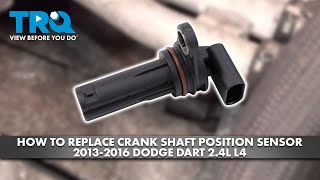
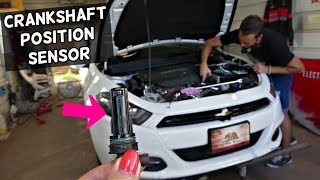
Est. part cost: $0 - Failed Crankshaft Position Sensor 🟡 Medium Probability → Shop Engine Crankshaft Position Sensor The sensor is located on the rear of the engine block, below the exhaust manifold, 🎬 Watch: Step-by-step guide to replacing the crankshaft position sensor. where it is exposed to significant heat which can cause internal electronics to fail over time.
How to confirm: With a scan tool, check for an RPM signal while cranking the engine. If the RPM reads 0, the sensor or its circuit is likely at fault. Visually inspect the sensor and its wiring for melting or damage. The sensor can also be tested with a multimeter.
Typical fix: Replace the crankshaft position sensor and perform a crankshaft variation relearn procedure with a capable scan tool. Using an OEM Mopar sensor is highly recommended as aftermarket sensors have a high failure rate on this platform.
Est. part cost: $40-$120 - Damaged Wiring or Connector ⚪ Low Probability The sensor's wiring is routed near the hot exhaust manifold, making it susceptible to melting, chafing, or heat damage, leading to brittle insulation. A recall (S89 / NHTSA 16V-907) was issued for some 2016 models for an intermittent connection at the sensor connector.
How to confirm: Visually inspect the wiring harness leading to the crankshaft position sensor for any signs of melting, chafing, or brittle insulation. Wiggle the connector and harness with the engine running (if possible) to see if it causes a stall. Check the connector for corrosion or loose pins.
Typical fix: Repair the damaged section of the wiring harness or replace the connector pigtail.
Est. part cost: $15-$50 - Low Engine Oil Level ⚪ Low Probability The 2.4L Tigershark engine is notorious for excessive oil consumption. The MultiAir valve actuation system uses engine oil pressure to function. Critically low oil levels can cause erratic engine behavior, including stalling, which may indirectly trigger timing-related fault codes.
How to confirm: Physically check the engine oil dipstick. Do not rely on the oil pressure light, which may only illuminate after the engine has already stalled or been damaged.
Typical fix: Top up the engine oil to the correct level using the manufacturer-specified oil type and monitor consumption closely. Address the root cause of oil consumption if necessary.
Est. part cost: $10-$20
Rare But Worth Checking
- Failed Powertrain Control Module (PCM): → Shop Engine Control Module (ECM) While a software update is common, outright hardware failure of the PCM is rare but possible. This should only be considered after all other possibilities, including wiring, have been exhaustively checked by a professional.
- Damaged Reluctor Ring: The toothed wheel that the crank sensor reads can get damaged or covered in debris, especially during transmission or engine work. This is uncommon but can cause a persistent P0335 code.
Diagnosis Steps
- Check the engine oil level on the dipstick. If it is low, top it off before proceeding. This is a critical first step for this engine.
- Connect an OBD-II scanner and check for any other codes stored alongside P0335. The presence of codes like P0340, P0128, U1424, or P2610 strongly suggests a software issue.
- Contact a Dodge dealership with your VIN to determine if TSB #18-022-17 REV. A or #18-023-16 REV. D are applicable and have not been performed. If so, a PCM reflash is the most likely fix.
- If no TSBs apply, use the scan tool to monitor engine RPM while cranking. If the RPM reading remains at 0, it confirms the PCM is not receiving a signal from the crank sensor or its circuit.
- Perform a thorough visual inspection of the crankshaft position sensor, its connector, and the wiring harness. The sensor is located on the rear of the engine block, below the exhaust heat shield. 🎬 Watch: How to locate and access the sensor on your engine. Look for any signs of melting, corrosion, or physical damage.
- If the wiring and connector are intact, test the sensor circuit for power (5V reference), ground, and signal using a multimeter and wiring diagram.
- If the sensor and wiring test good, but the problem persists, the issue may be a damaged reluctor ring or a faulty PCM, though these are less common.
Parts You'll Likely Need
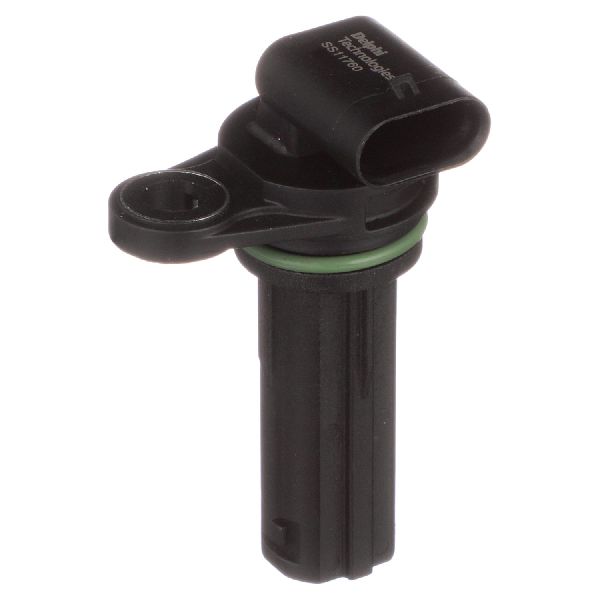
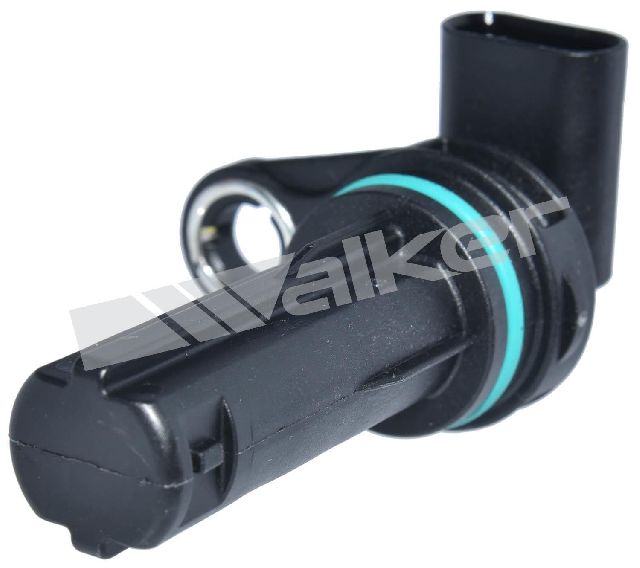
- Crankshaft Position Sensor
(OEM #68079375AD)— This is the most commonly replaced hardware component for P0335 when a software update is not the cause or doesn't resolve the issue. The OEM part is strongly recommended.
Trusted brands: Mopar (recommended), NGK/NTK, Delphi, Standard Motor Products (SMP)
OEM price range: $70-$120
Aftermarket price range: $40-$75
Related Codes That Often Appear With This One
- P0340 — This code for the Camshaft Position Sensor often appears with P0335. TSB #18-022-17 REV. A addresses both codes with a 🎬 See how P0335 and P0340 codes are diagnosed together. single PCM software update.
- P0128 — Thermostat Rationality. This code is also listed in TSB #18-022-17 REV. A as being part of a group of codes fixed by the same software update.
- P050D — Cold Start Rough Idle. TSB #18-023-16 REV. D links this code with P0335, recommending a PCM update for the 2.4L engine.
- U1424 — Implausible Engine Torque Signal. The crankshaft sensor is a primary input for torque calculation, and TSBs link this code to P0335, often being resolved by the same PCM flash.
- P2610 — PCM Internal Engine Off Timer Performance. This code points to a PCM logic error and is listed in TSBs alongside P0335 as being resolved by a software update.
Technical Service Bulletins (TSBs) & Recalls
- 18-022-17 REV. A: Recommends a PCM software update to address P0335 when it appears with codes like U1504, P0128, P0340, and U1424-00.
- 18-023-16 REV. D: Recommends a PCM software update to address P0335 when it appears with codes like P050D, P1607, P0133, and P0456.
- 09-006-20 REV. B: Details the oil consumption test procedure for the 2.4L Tigershark engine, acknowledging the widespread issue.
Platform-Specific Known Issues
- A PCM software update is a very common fix for this code on the 2.4L Dart, per TSBs #18-022-17 REV. A and #18-023-16 REV. D.
- The location of the sensor on the rear of the engine block makes it difficult to access without extensions and swivel sockets.
- Some 2016 models were subject to Recall S89 / NHTSA 16V-907 for a faulty sensor connector that could cause stalling.
- The 2.4L Tigershark engine is known for high oil consumption; always check the oil level first when diagnosing stalling or drivability issues.
Mechanic-Grade Diagnostic Values
- CKP Sensor Connector Pin Test (Key On, Engine Off) — expected: Pin 1 (Supply): ~5 Volts DC. Pin 2 (Ground): < 0.1 Volts DC. Pin 3 (Signal): ~5 Volts DC (pulled high by PCM).. Failure: Absence of the 5V reference on Pin 1 or any voltage on the ground pin (Pin 2) points to a wiring or PCM issue, not a bad sensor.
- Live Data RPM Signal (During Cranking) — expected: A healthy sensor circuit will show an engine RPM of 100-500 RPM on a scan tool.. Failure: A steady reading of 0 RPM while cranking confirms the PCM is receiving no signal.
- CKP Sensor Signal (Oscilloscope) — expected: A clean digital square wave pattern that switches consistently between approximately 0V and 5V while the engine is cranking or running.. Failure: A missing, erratic, or 'noisy' waveform indicates a failing sensor, wiring problem, or damaged reluctor ring.
- CKP Sensor Resistance — expected: Not applicable. This is a 3-wire Hall-effect sensor and should not be tested for resistance between its pins like an older 2-wire inductive sensor.. Failure: Attempting a resistance test can be misleading and does not provide a valid diagnosis for this type of sensor.
Scan Tool Commands That Help
- wiTECH, Autel, Appcar DiagFCA: Cam/Crank Relearn (also called CKP Relearn or Crankshaft Position Relearn) — This procedure is mandatory after replacing the crankshaft position sensor, camshaft position sensor, or any timing components. It synchronizes the PCM to the mechanical tolerances of the reluctor wheel. Failing to perform this step is a common cause for the code to return after a repair.
Wiring & Ground Locations
- Crankshaft Position Sensor Connector — On the rear of the engine block, below the exhaust manifold heat shield, near the transmission bell housing.. The wiring harness in this location is extremely susceptible to heat damage from the exhaust, causing wires to melt, crack, or become brittle. This is a primary cause of intermittent signal loss and the P0335 code.
- Engine Ground Strap — On related 2.4L platforms, a primary ground strap runs from the passenger side of the cylinder head to the strut tower/chassis.. A loose or corroded main engine ground can create an unstable voltage supply and ground reference for the PCM and its sensors, leading to erratic behavior and false codes like P0335. This is often missed in sensor-focused diagnosis.
- CKP Sensor Connector Pinout — At the 3-pin sensor connector.. Knowing the pin functions (Pin 1: 5V Supply, Pin 2: Ground, Pin 3: Signal) is essential for accurately testing the circuit with a multimeter to determine if the fault is in the sensor, wiring, or PCM.
Real Owner Repair Stories
- YouTube channel 'Weakest of Weeks' (Jeep Compass with 2.4L engine (same platform)) — Vehicle would stall out while driving once it reached operating temperature. After cooling down for a period, it would restart and run normally until it got hot again.
❌ Tried (didn't work) Initial diagnosis was uncertain due to the intermittent nature of the problem.
✅ What actually fixed it Replacing the crankshaft position sensor resolved the stalling issue. The failure was classic heat-soak, where the sensor's internal electronics fail when hot but function when cool. - YouTube channel 'NC Auto Diagnostics LLC' (2013 Dodge Dart 2.4L) — Intermittent no-start and stalling. Codes P0335 and P0340 were both present.
❌ Tried (didn't work) Simply reading codes was insufficient due to the intermittent nature.
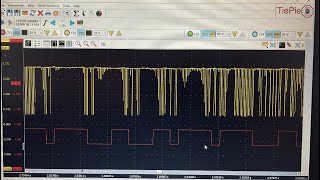
✅ What actually fixed it The technician used an oscilloscope to monitor the crank and cam sensor signals simultaneously. The scope pattern showed a clear, intermittent dropout of the crankshaft sensor signal, confirming the sensor itself was failing intermittently. The fix was to replace the faulty crankshaft position sensor.
OEM Part Supersession History
68079375AB, 68079375AC→68079375AD— Part revision and improvement by the manufacturer.
Model Year Variations Within This Range
- 2014-2016: The 2.4L MultiAir engine, for which the software-related P0335 TSBs are most relevant, became the standard engine on the more common SXT, Limited, and GT trims, making this issue more prevalent in these model years compared to 2013.
- 2016: A specific recall (S89 / NHTSA 16V-907) was issued for some 2016 models to address an intermittent connection at the crankshaft position sensor connector that could cause stalling.
Diagnostic Flowchart
Other Known Issues on This Vehicle
Issues unrelated to this code that are worth knowing about as an owner of this generation:
- Excessive Oil Consumption 🔴 High — Very common across all model years. Can start at any mileage. Caused by faulty piston ring design. (Ref: TSB 09-006-20 REV. B details an oil consumption test, and failure could lead to engine block replacement under warranty. Subject of multiple class-action lawsuits.)
- MultiAir Actuator (Brick) Failure 🔴 High — Common failure, often occurring between 60,000 and 120,000 miles. Can be caused by low oil levels or incorrect oil viscosity.
- Transmission Control Module (TCM) Failure 🟠 Medium — Affects vehicles with the automatic transmission, can cause sudden shifts to neutral. (Ref: Recall R42 / NHTSA 15V-508 was issued for 2013-2015 models to replace the TCM and bracket.)
- Shifter Cable Bushing Detachment 🟠 Medium — Common on vehicles with 6-speed automatic transmissions, can prevent shifting out of park. (Ref: Recall V34 / NHTSA 19V-293 addresses this issue by replacing the shifter cable bushing.)
- Vacuum Pump Oil Seepage into Brake Booster 🔴 High — Affects 2013-2014 models with 2.0L or 2.4L engines, can lead to a loss of braking assist. (Ref: Recall R63 / NHTSA 15V-822 was issued to address this.)
Used vs. New Parts: Buying Guide for This Vehicle
When a used part is the smart pick: A used Powertrain Control Module (PCM) from a reputable salvage yard can be a cost-effective option if the original PCM is diagnosed as faulty, but it will require professional programming to the vehicle's VIN and security information.
Donor-vehicle mileage cap: roughly under 100000 miles for the part to have meaningful remaining life.
What to inspect on the donor part:
- For a used PCM, ensure there is no physical damage, corrosion, or water intrusion on the case or connectors.
- Verify the donor vehicle's engine and transmission configuration matches the recipient vehicle exactly.
- Obtain the VIN of the donor car to assist with potential reprogramming needs.
OEM-only on this vehicle (don't cheap out):
- Crankshaft Position Sensor: It is strongly recommended to use only a genuine Mopar sensor. Aftermarket sensors are widely reported in forums and by technicians to be unreliable, fail out-of-the-box, or have a very short service life on this specific platform.
Aftermarket brands forum-validated for this vehicle:
- NTK (NGK): Often the original equipment manufacturer for Mopar, this brand is considered a reliable alternative to the dealer part.
Brands owners have reported issues with on this vehicle:
- Generic, unbranded, or 'white-box' sensors sold on online marketplaces are frequently cited as causing persistent or immediate-return P0335 codes.
Real Owner Stories
Aggregated from forums and TSBs cited above. Mileages and costs reflect what owners reported in those sources.
2015 Dodge Dart 2.4L
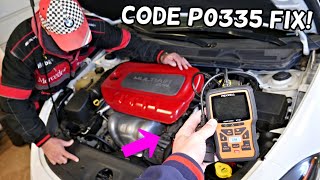
Symptoms: The owner demonstrated the location of the sensor and the process of replacing it specifically to resolve a P0335 fault code.
What fixed it: Replacement of the crankshaft position sensor.
Source hint: YouTube - Electrical Car Repair LIVE: Video titled 'FIX CODE P0335 2.4 DODGE DART...'
2013-2016 Dodge Dart 2.4L Tigershark
Symptoms: Engine stalls when hot and will not restart until the engine has had time to cool down.
What fixed it: Replacement of the crankshaft position sensor.
Source hint: YouTube - Nate's Interactive Auto: Video titled 'P0335 Crankshaft Position Sensor Fix for Jeep, Dodge and Chrysler Vehicles'
2013-2016 Dodge Dart 2.4L Tigershark
Symptoms: Owners reported needing to frequently add oil between scheduled changes to prevent stalling and other drivability issues caused by low oil levels.
What fixed it: Topping up engine oil to the correct level and monitoring consumption; in some cases, engine block replacement per TSB 09-006-20 REV. B.
Source hint: Reddit r/dodgedart threads regarding notorious oil consumption
Related OBD-II Codes
Frequently Asked Questions
My 2013-2016 Dodge Dart 2.4L is stalling when the engine gets warm. Is this a known issue?
Should I replace the sensor immediately if I see code P0335 on my Dart?
Is there a recall for the crankshaft sensor on the 2016 Dodge Dart?
Can low oil levels cause a P0335 code on the Tigershark engine?
What type of replacement sensor should I use for my Dodge Dart?
Do I need any special tools to replace the sensor myself?
Helpful Videos
We Have This Part in Stock


The information in this article is provided for general reference and educational purposes only. Vehicle specifications, procedures, and part compatibility can vary by production date, trim level, and region. Always consult your vehicle's factory service manual and verify part numbers before purchasing or performing repairs. Safety-critical components such as airbags, seat belts, and braking systems should be installed by a qualified professional.
- Dodge Dart:
- 🧭 Diagnostic Flowchart
- 🎬 Helpful Videos
- 🛍️ Shop This Part
- What's Unique About the 2013-2016 Dodge Dart
- Symptoms You May Notice
- Most Likely Causes
- Rare But Worth Checking
- Diagnosis Steps
- Parts You'll Likely Need
- Related Codes That Often Appear With This One
- Technical Service Bulletins (TSBs) & Recalls
- Platform-Specific Known Issues
- Mechanic-Grade Diagnostic Values
- Scan Tool Commands That Help
- Wiring & Ground Locations
- Real Owner Repair Stories
- OEM Part Supersession History
- Model Year Variations Within This Range
- Other Known Issues on This Vehicle
- Used vs. New Parts: Buying Guide for This Vehicle
- Real Owner Stories
- 2015 Dodge Dart 2.4L
- 2013-2016 Dodge Dart 2.4L Tigershark
- 2013-2016 Dodge Dart 2.4L Tigershark
- Related OBD-II Codes
- Frequently Asked Questions
- 🎟️ Get 5% Off