

P0401 on 2004-2011 Audi A6 3.0L TDI: EGR Insufficient Flow Causes and Fixes
On the Audi A6 3.0L TDI, code P0401 is most often caused by a soot-clogged EGR cooler, not the EGR valve itself. Before replacing any parts, inspect the EGR cooler and passages for blockage. Cleaning may work, but replacement of the cooler is often required for a permanent fix. The cooler is located in the 'V' of the engine and is a labor-intensive job.
- For a P0401 on an Audi A6 3.0L TDI, immediately suspect a clogged EGR cooler, not just the EGR valve.
- Do not replace the EGR valve without first confirming the EGR cooler and associated passages are clear of soot.
- Diagnosis and repair require significant disassembly, including removing the intake manifold to access the cooler in the engine valley.
- This is a difficult DIY job (5/5) and is best left to a professional or a very experienced home mechanic.
- Always use new gaskets when reassembling the EGR system and intake to prevent future leaks.
What's Unique About the 2004-2011 Audi A6
On the 3.0L V6 TDI engine, the P0401 code has a very common culprit that is often misdiagnosed. While many technicians might immediately suspect the EGR valve, experienced owners and specialists point to the EGR cooler as the primary point of failure. The fine passages inside the cooler are highly susceptible to clogging with heavy diesel soot, creating a bottleneck that the EGR valve itself cannot overcome. Owners often waste money replacing the EGR valve first, only to find the code returns because the underlying restriction in the cooler was never addressed. A user on Reddit with a 2010 A6 3.0 TDI reported having the code for over three years, and the official Audi dealer quote was for an EGR cooler replacement, confirming this is the recognized fix.
Symptoms You May Notice
- Check Engine Light illuminated is the most common and often only symptom.
- Failed emissions test.
- Potential for reduced engine performance or rough idle, though many drivers report no change in drivability.
- In rare cases associated with EGR system failure, black smoke from the exhaust during acceleration.
- Replacing the EGR valve without inspecting the EGR cooler. This is the most common mistake, as a new valve cannot fix a downstream blockage in the cooler.
- Replacing the DPF pressure sensor. One owner on an Audi forum replaced this sensor in an attempt to fix P0401, but the code returned, as it was not the root cause of the flow restriction.
Most Likely Causes
- Clogged EGR Cooler 🔴 High Probability → Shop Exhaust Gas Recirculation (EGR) Valve The 3.0L TDI engine produces significant soot, and the EGR cooler's design with small internal passages makes it a natural collection point for this soot, leading to blockages that restrict flow.
How to confirm: The cooler must be removed for inspection, which is a significant job. A visual check will show heavy, hard carbon deposits blocking the passages. It is located deep in the engine valley between the cylinder heads.
Typical fix: Replacement of the EGR cooler is the most reliable fix. While cleaning is sometimes attempted, it can be difficult to fully clear the hardened internal passages, and the blockage may return. Many forum users report that cleaning was not a permanent solution.
Est. part cost: $300-$600 - Clogged or Sticking EGR Valve 🟡 Medium Probability → Shop Exhaust Gas Recirculation (EGR) Valve As with any diesel, soot can build up on the valve pintle and seat, preventing it from opening fully or moving freely. This is often a contributing factor but less likely to be the sole cause of a P0401 than the cooler.
How to confirm: Remove the EGR valve and inspect for carbon buildup and free movement of the valve. With a capable scan tool (like VCDS), an output test may be performed to check its electronic function and movement. The valve is often removed along with the cooler.
Typical fix: Thoroughly clean the EGR valve and its mounting surfaces with a dedicated EGR/intake cleaner. If the valve's motor has failed or it remains stuck after cleaning, it must be replaced.
Est. part cost: $150-$400 - Blocked EGR Passages or Intake Manifold 🟡 Medium Probability → Shop Engine Intake Manifold Soot from the EGR system and oil vapor from the crankcase ventilation (PCV) system can combine to form thick sludge in the intake manifold and EGR pipes, restricting flow, particularly where the EGR pipe meets the throttle body.
How to confirm: Visually inspect the EGR pipes and the intake manifold ports where the EGR system connects. The buildup will be obvious upon disassembly.
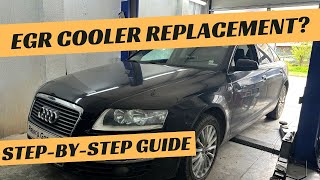
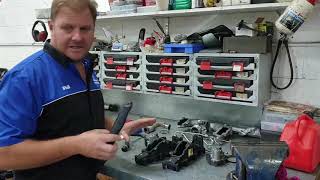
Typical fix: Remove the affected pipes and/or intake manifold for manual cleaning (a process often called 'carbon cleaning'). This is a messy and time-consuming job but critical to do when replacing the EGR cooler. 🎬 See how to properly clean the intake manifold.
Est. part cost: $0 (if cleaning), $40-$100 for new intake manifold gaskets
Rare But Worth Checking
- Faulty EGR Control Solenoid or Vacuum Leak: Some variants of this EGR system use vacuum to actuate the valve. A cracked vacuum line or a failed control solenoid can prevent the valve from opening, mimicking a flow issue. A vacuum pump can be used to test the diaphragm of the EGR valve itself.
- Cracked or Clogged DPF/EGR Filter: TSB 01-18-13 (2034898) points to a related issue on some TDI models where a cracked Diesel Particulate Filter (DPF) leads to heavy soot, which then clogs a smaller, secondary EGR filter located at the DPF connection. While the main cooler is the primary suspect on the A6, this TSB highlights that the entire exhaust system's health is connected. A quick check for soot in the tailpipe can indicate a cracked DPF.
Diagnosis Steps
- Confirm P0401 with an OBD-II scanner like VCDS. Check for any other codes that could provide clues.
- Using VCDS or a similar tool, perform a Basic Settings test of the EGR system (e.g., Group 074) to command the valve to cycle. The ECU detects insufficient flow by observing a smaller-than-expected drop in Mass Air Flow 🎬 Watch: Professional diagnostic tips for P0401 flow issues. (MAF) sensor readings when the EGR valve is commanded open.
- Given the high probability on this engine, assume the primary suspect is a physical blockage. The key is to determine if it's the valve, the cooler, or the passages.
- Start with a visual inspection. Check the tailpipe for excessive black soot, which could indicate a cracked DPF, a related issue mentioned in TSBs.
- The most definitive diagnosis requires disassembly. Plan for EGR cooler removal. This is an advanced repair. It involves draining coolant and removing the intake manifolds to access the cooler in the engine 'V'.
- Once removed, inspect the EGR cooler. If it is heavily clogged with soot, replacement is the recommended and most reliable solution.
- While the system is apart, thoroughly clean the intake manifolds and all associated EGR pipes of carbon buildup.
- During reassembly, use all new gaskets for the EGR valve, cooler, and intake manifolds to prevent future air and coolant leaks.
- After reassembly, clear the codes, refill coolant, and use a tool like VCDS to run the EGR system basic settings/adaptation to confirm proper operation and prime the fuel system if lines were disconnected.
Parts You'll Likely Need
- EGR Cooler
(OEM #059131515FP (or later revisions like 059131515FS))— This is the most common failure point for P0401 on the 3.0L TDI engine due to its tendency to clog with soot. Part numbers are often revised; always check with a dealer for the latest version.
Trusted brands: Genuine Audi/VW, Wahler, Pierburg, Mahle
OEM price range: $450-$650
Aftermarket price range: $300-$500 - EGR Valve
(OEM #7.01106.38.0 (Pierburg))— The second most likely cause, either from being clogged with soot or from electrical/mechanical failure. Often replaced preventatively with the cooler.
Trusted brands: Pierburg, Bosch, Valeo
OEM price range: $300-$500
Aftermarket price range: $150-$300 - Intake Manifold Gasket Kit — All gaskets for the EGR valve, cooler, and intake manifolds must be replaced whenever the components are removed to ensure a proper seal and prevent vacuum or coolant leaks.
Trusted brands: Victor Reinz, Elring
OEM price range: $50-$100
Aftermarket price range: $30-$60
Technical Service Bulletins (TSBs) & Recalls
- 01-18-13 (2034898/20) - MIL ON DTC P0401 Exhaust Gas Recirculation Flow Insufficient.
Platform-Specific Known Issues
- A Technical Service Bulletin (TSB 01-18-13 / 2034898) exists for P0401 on VW/Audi TDI models. It directs technicians to check for soot at the EGR filter connection to the DPF. If soot is present, it indicates a cracked DPF is the root cause, requiring replacement of both the DPF and the EGR filter. While the primary cause on the A6 3.0L TDI is typically the main EGR cooler in the engine 'V', this TSB highlights the systemic nature of soot buildup.
Mechanic-Grade Diagnostic Values
- EGR Valve Solenoid/Coil Resistance — expected: 4 - 12 Ohms. Failure: A reading outside this range (open circuit or short) indicates a faulty coil.
- VCDS EGR Adaptation Correction (Adaptation Channel 3) — expected: Standard value is 0 mg/stroke. Can be adjusted up to 50 mg/stroke.. Failure: This is an adjustment, not a failure indicator. Increasing the value commands the ECU to expect a higher Mass Airflow reading, effectively reducing the amount of EGR flow. This is sometimes used to mitigate soot buildup but is not a fix for a clogged component.
- VCDS EGR Duty Cycle at Idle — expected: 8-15% with 0mg correction; ~1.5% with 50mg correction.. Failure: A duty cycle that doesn't respond to adaptation changes or is stuck at 0% or 100% can indicate a problem with the valve or its control.
- VCDS Mass Air Flow (MAF) during EGR test — expected: When the EGR valve is commanded open, the MAF reading should drop significantly.. Failure: If the MAF reading does not drop as expected, it confirms insufficient flow from the EGR system, pointing to a physical blockage.
Hidden / Shadow Codes Worth Checking
- 4807: This is a VAG-specific fault code number that corresponds to P0401 'EGR System: Insufficient Flow'. (see via VCDS (VAG-COM) or other advanced VAG-specific diagnostic tools.)
- or: These are status bytes or 'freeze frame' identifiers seen in VCDS alongside the P0401/4807 fault code. Variations may indicate different operating conditions at the time of the fault. (see via VCDS (VAG-COM) scan logs.)
Scan Tool Commands That Help
- VCDS (VAG-COM): 01-Engine -> Basic Settings - 04 -> Exhaust Gas Recirculation (EGR) test — To command the EGR system to cycle through its range. This allows a technician to monitor live data (like MAF) to confirm if the flow is actually insufficient or if a sensor is faulty.
- VCDS (VAG-COM): 01-Engine -> Output Tests - 03 -> EGR Valve (N18) — To directly actuate the EGR valve motor. This is used to physically/audibly check if the valve is moving at all, helping to distinguish a stuck valve from a blockage elsewhere.
- VCDS (VAG-COM): 01-Engine -> Login - 11 (Code: 12233) -> Adaptation - 10 -> Channel 03 (EGR) — To perform an adaptation or adjustment of the EGR flow characteristics. This is required after replacing components and can also be used to slightly reduce EGR flow to limit soot buildup, though it won't fix a clog.
- VCDS (VAG-COM): 01-Engine -> Meas. Blocks - 08 -> Group 074 — To view the EGR valve's learned minimum and maximum voltage positions and its current potentiometer voltage, which is essential for diagnosing electrical faults within the valve's position sensor.
Wiring & Ground Locations
- EGR Valve Connector (J884) — On the EGR valve itself, located in the 'V' of the engine. It is a 5-pin connector.. All five wires run directly to the Engine Control Module (ECM). Damage to this harness can cause loss of control or feedback from the valve, triggering faults. The pins provide power, ground, and position sensor feedback.
- Main Engine Ground Strap — Typically runs from the right side (passenger side in LHD) engine mount to a stud on the frame rail.. A poor main engine ground can cause a host of unpredictable electrical issues and incorrect sensor readings, potentially affecting the EGR system's operation and diagnosis.
- Secondary Engine Ground Braid — Runs from the left cylinder head (near the front-most bolt on the coolant pipe) to the ABS module bracket.. This secondary ground is critical for the sensors and modules on the left side of the engine. Corrosion or breakage here can lead to faulty sensor data being sent to the ECM.
- Oil Filter Housing Ground — A small gauge ground wire is often attached to one of the bolts on the oil filter housing.. This ground point is in close proximity to the EGR cooler and other sensors in the engine valley. If left disconnected after service, it can cause erratic behavior of nearby components.
Real Owner Repair Stories
- Reddit user on r/MechanicAdvice (2010 Audi A6 3.0 TDI Quattro) — Persistent P0401 check engine light for over 3 years; no other drivability issues.
❌ Tried (didn't work) Multiple diagnoses by local mechanics., Checking intake manifolds., Checking vacuum lines., Attempting to clean the EGR cooler (found it was a sealed unit).
✅ What actually fixed it The official Audi dealership diagnosed the issue and quoted for an EGR cooler replacement, confirming it was the root cause of the blockage. - YouTube video by a repair shop (Roy's Garage) (Audi SQ5 (with the same 3.0L V6 TDI engine family)) — Engine management light on with P0401 - Insufficient Flow.
❌ Tried (didn't work) ECU remap (and subsequent removal of the remap)., Replacement of throttle bodies., Replacement of the EGR valve., Replacement of other unspecified sensors., DPF clean.
✅ What actually fixed it Replacement of the clogged EGR cooler was the only part that was actually needed to resolve the fault.
OEM Part Supersession History
059131515CS, 059131515DD, 059131515DN, 059131515EG, 059131515EF, 059131515FH→059131515FP— Progressive design revisions by the manufacturer to improve durability or performance.059131515FP→059131515FS— Latest design revision from Audi/VW for this application.
Heads up: Always verify the correct part number for your specific VIN, but FS is the generally accepted latest revision for FP.
Model Year Variations Within This Range
- 2008-2011 (Facelift): The facelift models (from MY 2009) with CDYA/CDYC engines had slightly increased power (240 hp) and torque (500 Nm) compared to earlier 3.0 TDI engines. However, the fundamental EGR system design and its location in the engine 'V' remained consistent, meaning the P0401 diagnosis and common cause (clogged cooler) are the same across the 2004-2011 C6 generation.
Diagnostic Flowchart
Other Known Issues on This Vehicle
Issues unrelated to this code that are worth knowing about as an owner of this generation:
- Intake Manifold Swirl Flap Failure 🟠 Medium → Shop Engine Intake Manifold — Common after 80,000-120,000 miles. The plastic linkage arms wear out or the flaps get stuck with carbon, causing fault codes (e.g., P2015) and potential performance loss.
- Timing Chain Tensioner Wear 🔴 High — Can occur on higher mileage engines (100,000+ miles). A rattling noise on cold startup for a few seconds is the primary symptom. Failure is catastrophic and expensive as the engine is at the back of the engine bay.
- Diesel Particulate Filter (DPF) Clogging 🟠 Medium → Shop Diesel Particulate Filter (DPF) — Common for vehicles used primarily for short trips, which prevents the DPF from completing its regeneration cycle to burn off soot. Leads to warning lights and limp mode.
- Oil Leaks from Oil Filter Housing / Oil Cooler Seals 🟠 Medium — The seals and gaskets for the oil cooler and filter housing, located in the 'V' of the engine, can degrade over time, causing significant oil leaks into the engine valley. Often repaired at the same time as the EGR cooler due to overlapping labor.
Used vs. New Parts: Buying Guide for This Vehicle
When a used part is the smart pick: For this specific P0401 repair, using used parts is highly discouraged for the core components. A used EGR cooler is extremely likely to be partially or fully clogged, leading to a repeat failure. A used EGR valve is also a risk given the high labor cost to access it. Used parts should only be considered for external items like mounting brackets or connector pigtails if needed.
Donor-vehicle mileage cap: roughly under 50000 miles for the part to have meaningful remaining life.
What to inspect on the donor part:
- Not applicable for the EGR cooler, as internal clogging is impossible to verify externally.
- For an EGR valve, check for smooth pintle movement and minimal carbon on the exterior, but internal condition is unknown.
- Best practice is to avoid used core EGR components for this repair.
OEM-only on this vehicle (don't cheap out):
- EGR Cooler: Due to the high failure rate from clogging, using a Genuine VW/Audi part or a direct OEM supplier (like Wahler, Pierburg) is critical for longevity. Cheap aftermarket coolers may use inferior materials or designs that clog even faster.
Aftermarket brands forum-validated for this vehicle:
- Pierburg (often the original supplier for the EGR valve)
- Wahler (often the original supplier for the EGR cooler)
- Mahle
- Victor Reinz (for gaskets)
- Elring (for gaskets)
Brands owners have reported issues with on this vehicle:
- Unbranded, no-name parts from online marketplaces (e.g., eBay, Amazon). These often have poor quality control and can fail prematurely, forcing a repeat of a very labor-intensive job.
Real Owner Stories
Aggregated from forums and TSBs cited above. Mileages and costs reflect what owners reported in those sources.
2011 Audi A6 3.0 TDI (CDYC)
Symptoms: P0401 code present; experts suggested a physical blockage in the EGR cooler was the most probable cause.
What fixed it: Disassembly to confirm and address physical blockage in the EGR cooler.
Source hint: Ross-Tech Forums - A 2011 A6 3.0 TDI (CDYC) with P0401
2010 Audi A6 3.0 TDI
Symptoms: A 3-year struggle with P0401 that stumped local mechanics.
What fixed it: EGR cooler replacement as diagnosed by an Audi dealer.
Source hint: Reddit - A 2010 A6 3.0 TDI owner details a 3-year struggle with P0401
Audi A6 (CDYA engine)
Symptoms: Intermittent P0401 fault code.
What fixed it: A full intake and EGR system clean, specifically targeting the area where the EGR meets the throttle body.
Source hint: Audi-Sport.net - A user with a CDYA engine and an intermittent P0401
Related OBD-II Codes
Frequently Asked Questions
Does TSB 01-18-13 (2034898/20) apply to my Audi A6 3.0L TDI?
Can I just clean the EGR cooler on my CDYA/CDYC engine instead of replacing it?
Where is the EGR cooler located on the 3.0L TDI engine?
Why does the 3.0L TDI engine suffer from P0401 more than other engines?
What tool should I use to confirm the EGR flow issue on my Audi?
Are there other components I should clean while fixing the P0401 code?
Helpful Videos

Used OEM Parts in Stock
New Aftermarket Parts Available



The information in this article is provided for general reference and educational purposes only. Vehicle specifications, procedures, and part compatibility can vary by production date, trim level, and region. Always consult your vehicle's factory service manual and verify part numbers before purchasing or performing repairs. Safety-critical components such as airbags, seat belts, and braking systems should be installed by a qualified professional.
- Audi A6:
- 🧭 Diagnostic Flowchart
- 🎬 Helpful Videos
- 🛍️ Shop This Part
- What's Unique About the 2004-2011 Audi A6
- Symptoms You May Notice
- Most Likely Causes
- Rare But Worth Checking
- Diagnosis Steps
- Parts You'll Likely Need
- Technical Service Bulletins (TSBs) & Recalls
- Platform-Specific Known Issues
- Mechanic-Grade Diagnostic Values
- Hidden / Shadow Codes Worth Checking
- Scan Tool Commands That Help
- Wiring & Ground Locations
- Real Owner Repair Stories
- OEM Part Supersession History
- Model Year Variations Within This Range
- Other Known Issues on This Vehicle
- Used vs. New Parts: Buying Guide for This Vehicle
- Real Owner Stories
- 2011 Audi A6 3.0 TDI (CDYC)
- 2010 Audi A6 3.0 TDI
- Audi A6 (CDYA engine)
- Related OBD-II Codes
- Frequently Asked Questions
- 🎟️ Get 5% Off