

P0401 on 1996 Ford E-150: EGR Flow Insufficient Causes and Fixes
For a 1996 Ford E-150, code P0401 is most often caused by a faulty DPFE sensor, clogged EGR passages, or deteriorated vacuum hoses. Replacing the DPFE sensor and its hoses is a common, effective fix and is a good starting point for diagnosis. Do not replace the EGR valve itself unless it has been tested and confirmed to be faulty.
- For a P0401 on a 1996 Ford E-150, suspect the DPFE sensor or clogged EGR passages before the EGR valve itself.
- A simple test is to apply vacuum to the EGR valve at idle. If the engine stumbles, the passages are clear, and the issue is likely electronic (DPFE sensor). If the idle doesn't change, the passages are clogged.
- Always inspect the two small hoses going to the DPFE sensor for cracks or damage, as this is a common and simple fix.
- When replacing the DPFE sensor, use a quality part (like Motorcraft) as cheap aftermarket versions are known to fail prematurely.
What's Unique About the 1996-1996 Ford E-150
On Ford vehicles from this era, including the E-150, the EGR system uses a Differential Pressure Feedback EGR (DPFE) sensor to measure flow. This specific sensor, and the rubber hoses connected to it, are notoriously high-failure items. While clogged passages or a bad EGR valve can cause P0401 on any vehicle, on this platform, the DPFE sensor itself is a primary suspect and a frequent point of failure, often more so than the EGR valve.
Symptoms You May Notice
- Check Engine Light is on
- Engine pinging or knocking, especially under load.
- Rough idle or stalling.
- Hesitation or bucking during light acceleration.
- Reduced fuel economy.
- Failure to pass an emissions test.
- In some cases, a vacuum leak related to the EGR system can cause the A/C to blow only through the defrost vents during acceleration.
- Replacing the EGR valve first. On this platform, clogged passages and a bad DPFE sensor are more common culprits. Always test the system before replacing the most expensive part.
- Replacing the DPFE sensor without checking the hoses or cleaning the EGR passages. A new sensor will not fix a flow issue caused by a blockage or a pressure leak from a bad hose.
Most Likely Causes
- Faulty DPFE Sensor 🔴 High Probability The original equipment DPFE sensors on these Fords, often with a metal case, were prone to failure from internal corrosion and heat. The sensor is responsible for measuring EGR flow, and when it fails, it sends incorrect voltage signals to the computer, triggering P0401 even if the flow is adequate. Ford later superseded the original metal sensors with more durable plastic designs.
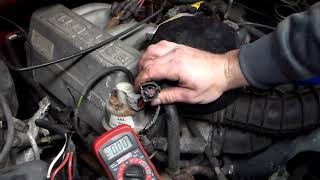
How to confirm: With the key on and engine off (KOEO), backprobe the DPFE sensor's signal wire. The voltage should be within a specific low range (typically 0.8-1.2V, but can be as low as 0.5V). A reading significantly higher than this (e.g., 1.97V), or a reading that doesn't change when vacuum is applied to the EGR valve with the engine running, indicates a failed sensor.
Typical fix: Replace the DPFE sensor and the two small rubber hoses that connect to it. It is critical to use a high-quality OEM (Motorcraft) or equivalent replacement, as cheap aftermarket sensors are known to be unreliable and fail quickly.
Est. part cost: $40-$90 - Clogged EGR Passages 🔴 High Probability Over time, carbon from the exhaust builds up and can completely block the small passages that lead from the EGR valve to the intake manifold. On V8 engines like the 5.0L and 5.8L, these ports are often located in the throttle body elbow or intake manifold itself.
How to confirm: With the engine warm and idling, apply 10-15 inHg of vacuum to the EGR valve with a hand pump. If the engine stumbles, runs rough, or stalls, the passages are clear. If the engine's idle does not change, the passages are clogged.
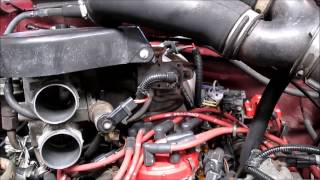
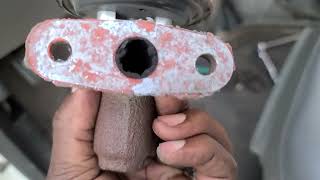
Typical fix: Remove the throttle body and/or EGR valve to gain access to the passages. Use a pick, small screwdriver, wire, and carburetor or brake cleaner to scrape and clean out the carbon buildup until the passages are clear.
Est. part cost: $5-$20 for gaskets - Cracked or Leaking DPFE Hoses 🟡 Medium Probability The two small rubber hoses connecting the EGR tube to the DPFE sensor are exposed to intense exhaust heat and can become brittle, cracked, burned through, or mushy. This causes a pressure leak, leading to an inaccurate reading by the sensor.
How to confirm: Visually inspect the hoses for any signs of cracks, holes, swelling, or loose connections. They are often made of high-temperature silicone and may feel soft or swollen when they fail.
Typical fix: Replace both hoses. This is typically done at the same time as replacing the DPFE sensor. Ensure you use high-temperature rated silicone hoses.
Est. part cost: $10-$25 - Faulty EGR Valve ⚪ Low Probability → Shop Exhaust Gas Recirculation (EGR) Valve The EGR valve itself can fail, either by its diaphragm rupturing (so it can't hold vacuum) or by getting stuck closed with carbon. However, this is less common than DPFE sensor failure or clogged passages on this platform.
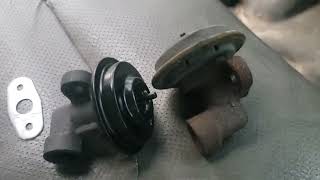
How to confirm: Use a hand vacuum pump to apply vacuum to the valve's port. It should hold the vacuum without leaking down. If it doesn't, the diaphragm is bad. If it holds vacuum but doesn't affect the idle when tested (and passages are known to be clear), the valve may be stuck or not opening.
Typical fix: Replace the EGR valve and gasket. Access can be difficult, often requiring removal of the interior engine cover ('doghouse') inside the van. The nut connecting the exhaust tube to the valve can be very difficult to remove.
Est. part cost: $50-$150
Rare But Worth Checking
- Faulty EGR Vacuum Regulator (EVR) Solenoid: This solenoid controls the vacuum supply to the EGR valve. If it fails, it won't supply the vacuum needed to open the valve, which can cause a P0401. It can be tested for proper electrical and vacuum-switching function. A user on Ford-Trucks.com found that a cracked plastic vacuum line leading to the EVR was the ultimate cause of their P0401 after replacing many other parts.
- Leaking Vacuum Lines or Reservoir: General vacuum leaks in the system can prevent the EVR from supplying enough vacuum to the EGR valve. One owner found a hole in the plastic vacuum reservoir behind the battery was the cause of their P0401 code.
Diagnosis Steps
- Visually inspect all vacuum lines connected to the EGR system, especially the two small high-temperature hoses going to the DPFE sensor. Look for cracks, brittleness, or burn marks.
- With the engine warm and idling, use a hand vacuum pump to apply 10-15 inHg of vacuum to the EGR valve's vacuum port.
- If the engine stumbles, runs rough, or stalls, the EGR valve is opening and the passages are clear. The problem is likely the DPFE sensor, its hoses, or the EVR control solenoid.
- If the engine idle does not change, the EGR passages are clogged or the EGR valve is not opening.
- To differentiate, remove the EGR valve and check if it holds vacuum with a hand pump. If it does, the passages are clogged and need cleaning. If it doesn't hold vacuum, the valve's diaphragm is ruptured and the valve needs replacement.
- If the passages and valve are good, test the DPFE sensor. Check the Key On, Engine Off (KOEO) voltage of the sensor's signal wire. A high voltage (e.g., over 1.2V when spec is lower) points to a failed sensor.
- Check for vacuum supply at the EGR Vacuum Regulator (EVR) solenoid and test the solenoid's function to ensure it's sending vacuum to the EGR valve when commanded.
Parts You'll Likely Need
- DPFE Sensor
(OEM #F77Z-9J460-AB)— This is the most common point of failure in the Ford EGR system of this era, directly causing code P0401. This part number is the plastic-body sensor that superseded earlier, less reliable metal-cased versions.
Trusted brands: Motorcraft, Standard Motor Products
OEM price range: $60-$90
Aftermarket price range: $25-$50 - EGR Valve
(OEM #E7TE9D475C2A)— Replaced if the internal diaphragm fails and can no longer hold vacuum, or if it is seized shut with carbon. This is a base part number; a specific application number may vary.
Trusted brands: Motorcraft, Delphi, Standard Motor Products, Dorman
OEM price range: $70-$150
Aftermarket price range: $50-$100 - Throttle Body and EGR Gaskets — Required if you need to remove the throttle body or EGR valve to clean out clogged carbon passages. Gaskets are not reusable.
Trusted brands: Motorcraft, Fel-Pro
OEM price range: $10-$20
Aftermarket price range: $5-$10 - DPFE Hoses — The original hoses are prone to heat damage and cracking, causing a pressure leak that triggers P0401. They should be replaced with the DPFE sensor as a set.
Trusted brands: Motorcraft, Dorman
OEM price range: $15-$30
Aftermarket price range: $10-$20
Technical Service Bulletins (TSBs) & Recalls
- While no specific TSB number was found directly for the 1996 E-150 in the search, Ford issued multiple TSBs for P0401 on similar vehicles in this era (like TSB 01-4-7) which often pointed to faulty DPFE sensors or the need for a PCM reflash after repair.
Platform-Specific Known Issues
- Access to the EGR components on E-Series vans is notoriously difficult and often requires removing the interior engine cover ('doghouse').
- The original metal-cased DPFE sensors were particularly prone to failure; Ford later superseded them with more durable plastic designs which should be used for replacement.
- On V8 models, the EGR passages are inside the throttle body elbow, which must be removed for a thorough cleaning.
Mechanic-Grade Diagnostic Values
- DPFE Sensor Signal Voltage (KOEO) — expected: 0.5V to 1.2V. Some sources specify 0.8V to 1.2V.. Failure: A voltage significantly higher than 1.2V (e.g., 1.97V) or near 0V indicates a failed sensor.
- DPFE Sensor Reference Voltage (VREF) — expected: ~5.0 Volts on the Brown/White wire with the key on.. Failure: No voltage indicates a wiring problem or a fault in the PCM.
- EGR Vacuum Regulator (EVR) Solenoid Resistance — expected: 20 to 70 ohms between the two electrical pins.. Failure: A reading outside this range, or a dead short, indicates a faulty solenoid coil.
- DPFE Sensor Live Data Voltage (Engine at 1500 RPM, EGR commanded open) — expected: Should rise to approximately 3.0V or higher.. Failure: Voltage does not increase when the EGR valve is opened, indicating a blockage or failed sensor.
Scan Tool Commands That Help
- Professional Scan Tool (e.g., Snap-on, Autel): EGR Active Command / Solenoid On/Off Test — This bidirectional control allows a technician to command the EVR solenoid to open and close while monitoring the DPFE sensor voltage and engine RPM. It's used to verify the electrical control side of the EGR system is working without having to manually apply vacuum.
Wiring & Ground Locations
- DPFE Sensor Connector — On the DPFE sensor itself, typically mounted near the throttle body.. This is the primary test point. For a 1996 F-150 5.0L (similar to E-150), Pin 1 (Brown/White) is 5V VREF, Pin 2 is the signal wire, and Pin 3 (Gray/Red) is the ground. The signal wire (DPFEGR) goes to Pin 66 on the PCM.
- G101 — Right front of engine compartment, on the front of the fender apron or near the battery.. This is a primary power ground for the PCM. A poor connection here can cause erratic sensor readings and PCM behavior, potentially leading to incorrect EGR codes.
- G104 — Rear of the left-hand fender apron, near the hood hinge and EEC Test Connector.. This is the case ground for the Powertrain Control Module (PCM). A faulty ground here can lead to a variety of electrical issues, including a burned-out computer.
- EVR Solenoid Connector — On the EGR Vacuum Regulator (EVR) solenoid, which is a small black plastic part with two vacuum lines and a 2-pin electrical connector.. One pin should have +12V with the key on from the EEC relay. The other pin is the control, which is grounded by the PCM to activate the solenoid. Testing here confirms power supply and allows for checking the solenoid's resistance.
Real Owner Repair Stories
- F150online Forums ('02 F-150 4.6L with 214k miles) — P0401 code, then a sudden crank-no-start condition.
❌ Tried (didn't work) Replacing the fuel pump, Replacing the PCM (computer)
✅ What actually fixed it A cheap, generic aftermarket DPFE sensor installed 7 months prior had short-circuited internally, causing the no-start. Replacing it with a quality part resolved the issue. - Ford F150 Forum (1996 F-150 4.6L) — P0401 code and A/C blowing through defrost vents on acceleration.
❌ Tried (didn't work) Replacing the DPFE sensor, Replacing the EGR valve
✅ What actually fixed it A pinhole leak was found in the black vacuum line that supplies both the EGR system and the A/C vent controls. Repairing the vacuum line fixed both the P0401 code and the A/C issue. - F150online Forums ('98 F-150 4.6L with 135k miles) — P0401 and P1401 codes.
❌ Tried (didn't work) Replacing the original metal DPFE sensor with a new aftermarket (NAPA) sensor, which resulted in a different code (P1410) and did not fix the problem.
✅ What actually fixed it The owner disassembled the original metal-cased Ford DPFE sensor, cleaned out the internal corrosion and blocked ports with a vinegar solution, and reassembled it using bolts instead of the original rivets. This 'fixed' original sensor worked correctly and cleared the codes.
When the Usual Fixes Don't Work
- While the vast majority of P0401 codes on these vans are caused by the DPFE sensor or clogged passages, there are documented cases where the root cause was a simple vacuum leak. In one instance, a user replaced the DPFE and EGR valve only to find the true cause was a tiny pinhole in a vacuum line that was shared with the HVAC system, which also caused their A/C vents to malfunction during acceleration. This highlights the importance of a thorough visual inspection of all related vacuum hoses before replacing expensive components.
OEM Part Supersession History
F4ZZ-9J460-B (and others, often metal-cased)→F77Z-9J460-AB (plastic-cased)— The original metal-cased sensors were highly prone to internal corrosion from exhaust moisture, leading to premature failure. The plastic-cased design is more durable.
Heads up: F77Z-9J460-AB is the correct service replacement for the earlier parts. It also replaces other numbers like F7UZ-9J460-AA and 1L3Z-9J460-AA.
Diagnostic Flowchart
Other Known Issues on This Vehicle
Issues unrelated to this code that are worth knowing about as an owner of this generation:
- Cracked Exhaust Manifolds 🟠 Medium — Common on the 5.8L V8 engine due to heat cycles causing the cast iron to crack over time, resulting in an exhaust leak and ticking noise.
- Heater Core Leaks 🟠 Medium — The heater core is prone to leaking coolant into the passenger-side footwell. This is a common failure on older E-Series vans.
- Front Suspension Wear (Ball Joints) 🟠 Medium — The front-end components, particularly the upper and lower ball joints, wear out, causing rattling noises over bumps and potential handling issues.
- Transmission Fluid Leaks 🟠 Medium — Leaks from the front pump seal of the transmission are a noted problem, as are issues with the E4OD transmission in general for some owners.
- Timing Cover Coolant Leaks 🟡 Low — The gasket for the timing cover on 5.8L Windsor engines can deteriorate, causing coolant to leak from the front of the engine block.
Used vs. New Parts: Buying Guide for This Vehicle
When a used part is the smart pick: Hard parts like the EGR-to-exhaust tube, mounting brackets, or the throttle body elbow (if needed for cleaning) are excellent candidates for used parts from a junkyard. A used EGR valve itself is a gamble but can be an option if you can test it with a vacuum pump before purchase to ensure the diaphragm holds vacuum.
Donor-vehicle mileage cap: roughly under 80000 miles for the part to have meaningful remaining life.
What to inspect on the donor part:
- For EGR valves, look for minimal carbon buildup in the ports.
- Check for rust, especially on the exhaust tube fittings, which can make removal impossible without damage.
- Inspect any attached rubber or silicone hoses for cracks, swelling, or brittleness.
OEM-only on this vehicle (don't cheap out):
- DPFE Sensor: This is the most critical part to buy new and from a reputable source. Forum users consistently report that cheap aftermarket DPFE sensors from online marketplaces or discount auto parts stores fail quickly, sometimes in a matter of months, or are dead on arrival. Some have even caused catastrophic failures by shorting out the PCM.
Aftermarket brands forum-validated for this vehicle:
- Motorcraft (OEM)
- Standard Motor Products (SMP)
- Ultra-Power
Brands owners have reported issues with on this vehicle:
- Generic, unbranded sensors from online marketplaces like Amazon or eBay are frequently cited as problematic and should be avoided.
Real Owner Stories
Aggregated from forums and TSBs cited above. Mileages and costs reflect what owners reported in those sources.
1996 Ford F-150 4.9L I6
Symptoms: Owner experienced a persistent P0401 code and performed extensive troubleshooting, replacing the EGR solenoid, DPFE sensor, and EGR valve without immediate resolution.
What fixed it: The owner's investigation pointed toward a potential control or wiring problem after standard part replacement failed.
Source hint: https://www.ford-trucks.com/forums/953599-96-f150-4-9-code-p0401-insufficient-egr-flow.html
1996 Ford F-150 5.0L V8
Symptoms: Code P0401 present; diagnostic advice focused on checking for a vacuum-induced stumble and inspecting DPFE hoses.
What fixed it: Proper diagnostic procedure: checking for vacuum-induced stumble, inspecting DPFE hoses, and testing the valve itself before replacing parts.
Source hint: https://www.ford-trucks.com/forums/964955-egr-code-401-96-f150.html
1996 Ford F-150 5.8L V8
Symptoms: P0401 code; owner replaced multiple parts but the code remained.
What fixed it: Cleaning the carbon buildup out of the EGR ports, which had been overlooked during the initial parts replacement.
Source hint: https://www.f150forum.com/f10/1996-5-8-liter-p0401-egr-code-92429/
1997 Ford F-150 4.6L
Symptoms: Long-term battle with P0401; owner replaced the DPFE, EGR valve, and regulator.
What fixed it: Cleaning clogged passages in the EGR pipe/manifold.
Source hint: https://www.ford-trucks.com/forums/20236-code-p0401-egr-insufficient-flow-1997-f150-4-6l.html
Related OBD-II Codes
Frequently Asked Questions
Why is it so difficult to access the EGR valve on my 1996 E-150?
Does TSB 01-4-7 apply to my P0401 code?
Should I replace my metal-cased DPFE sensor with the same part?
Why does my A/C only blow through the defrost vents when I accelerate?
I have a V8 model; where are the EGR passages located?
Can I use a cheap aftermarket DPFE sensor to fix P0401?
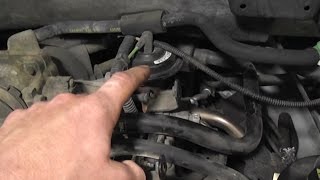
Helpful Videos
We Have This Part in Stock


The information in this article is provided for general reference and educational purposes only. Vehicle specifications, procedures, and part compatibility can vary by production date, trim level, and region. Always consult your vehicle's factory service manual and verify part numbers before purchasing or performing repairs. Safety-critical components such as airbags, seat belts, and braking systems should be installed by a qualified professional.
- Ford E-150:
- 🧭 Diagnostic Flowchart
- 🎬 Helpful Videos
- 🛍️ Shop This Part
- What's Unique About the 1996-1996 Ford E-150
- Symptoms You May Notice
- Most Likely Causes
- Rare But Worth Checking
- Diagnosis Steps
- Parts You'll Likely Need
- Technical Service Bulletins (TSBs) & Recalls
- Platform-Specific Known Issues
- Mechanic-Grade Diagnostic Values
- Scan Tool Commands That Help
- Wiring & Ground Locations
- Real Owner Repair Stories
- When the Usual Fixes Don't Work
- OEM Part Supersession History
- Other Known Issues on This Vehicle
- Used vs. New Parts: Buying Guide for This Vehicle
- Real Owner Stories
- 1996 Ford F-150 4.9L I6
- 1996 Ford F-150 5.0L V8
- 1996 Ford F-150 5.8L V8
- 1997 Ford F-150 4.6L
- Related OBD-II Codes
- Frequently Asked Questions
- 🎟️ Get 5% Off