

P0420 on 2005-2012 Porsche 911: Catalyst Efficiency Causes and Fixes
For a 2005-2012 Porsche 911 (997 generation), code P0420 most often indicates a failing catalytic converter on Bank 1 (cylinders 1-3, the driver's side in the US). While an oxygen sensor or exhaust leak is possible, the converter itself is the most frequent culprit. This is a costly repair, often exceeding $2,000 for parts and labor, because the catalytic converter is integrated into the exhaust manifold.
- P0420 on a 2005-2012 Porsche 911 almost always points to a failing catalytic converter on Bank 1 (cylinders 1-3).
- Before spending thousands on a new converter, rule out cheaper possibilities like exhaust leaks and faulty oxygen sensors.
- A proper diagnosis involves graphing the O2 sensor signals with a scan tool. If the downstream sensor signal mimics the upstream one, the converter is bad.
- If you have any misfire codes (P030x), you must fix that problem first, or you will destroy the new catalytic converter.
- Due to the high cost of OEM parts, many owners opt for high-quality aftermarket sport catalytic converters from brands like Fabspeed or Soul Performance.
What's Unique About the 2005-2012 Porsche 911
On the 997 generation of the Porsche 911, the catalytic converters are integrated directly with the exhaust manifolds, making replacement more complex and expensive than on many other vehicles. While the code's meaning is standard, owner experiences on forums like Rennlist suggest that these high-performance engines can lead to premature catalyst failure. The problem is common enough that a robust aftermarket of high-flow catalytic converters exists from brands like Fabspeed and Soul Performance, though these can sometimes cause the same codes if not paired with appropriate ECU tuning or O2 sensor spacers.
Generation note: This range covers the entire Porsche 911 997 generation, which includes two distinct series: the 997.1 (2005-2008) with port-injected M96/M97 engines and the 997.2 (2009-2012) with Direct Fuel Injection (DFI) 9A1 engines. While the P0420 code applies to both, the underlying causes leading to catalyst failure (like fuel system or combustion issues) may differ slightly. For example, 997.1 models are susceptible to bore scoring which can foul cats with oil, while 997.2 models have a high-pressure fuel pump (HPFP) that can fail and affect the air/fuel mixture.
Symptoms You May Notice
- Check Engine Light is on
- Failed emissions test
- A rattling noise from the exhaust if the internal catalyst structure has broken apart.
- Reduced engine power if the converter is clogged.
- A 'rotten egg' or sulfur smell from the exhaust, indicating the converter is not processing sulfur in the fuel correctly.
- Immediately replacing the oxygen sensor without verifying it is faulty. While cheaper, forum users frequently report that replacing the O2 sensor does not fix the code, leading to replacing the catalytic converter later anyway.
- Using O2 sensor spacers or 'mini-cats'. These devices pull the downstream O2 sensor out of the direct exhaust stream to trick the ECU. While this may extinguish the light, it masks the underlying problem and will cause the car to fail a visual emissions inspection.
Most Likely Causes
- Failing Catalytic Converter 🔴 High Probability → Shop Catalytic Converter High-performance engines generate significant heat, which contributes to catalyst wear over time. The internal ceramic 'brick' can also become loose from vibration or break down from age, a failure mode reported by owners on forums.
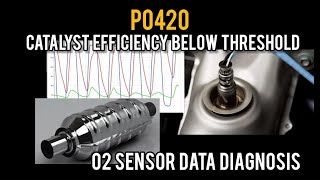
How to confirm: Use a scan tool to graph O2 sensor data; 🎬 Watch: How to diagnose catalyst efficiency using O2 sensor data. if the downstream (post-cat) sensor voltage mimics the upstream (pre-cat) sensor, the converter is not working. An infrared thermometer can also be used; the outlet of a working converter should be significantly hotter (at least 100°F) than the inlet after the engine is fully warmed up. Tapping the converter with a rubber mallet may reveal a rattle from a broken internal brick.
Typical fix: Replace the Bank 1 catalytic converter/exhaust manifold assembly.
Est. part cost: $1500-$2500+ - Faulty Downstream (Post-Cat) Oxygen Sensor 🟡 Medium Probability → Shop Oxygen Sensor Oxygen sensors are wear items and can become 'lazy' or contaminated over time, sending incorrect data to the DME. While often suspected, they are less commonly the root cause than the converter itself on this platform, a fact frequently lamented in forum discussions after a needless sensor replacement.
How to confirm: The best method is to swap the downstream O2 sensors between Bank 1 and Bank 2. Clear the codes and drive the car. If the trouble code changes to P0430 (Bank 2), the sensor is faulty. A capable scan tool can also graph the sensor's response time.
Typical fix: Replace the Bank 1 downstream oxygen sensor.
Est. part cost: $100-$250 - Exhaust Leak ⚪ Low Probability Leaks can occur at gaskets or welds, especially on older, high-mileage cars. A leak between the upstream and downstream O2 sensors can allow outside air into the exhaust stream, skewing the downstream sensor's reading and triggering the code. Check the flange gaskets where the manifold/cat assembly bolts to the rest of the exhaust.
How to confirm: Perform a visual inspection of the exhaust system from the cylinder head to the post-cat sensor. Look for black soot marks or listen for audible hissing or ticking sounds. A smoke test is the most effective way to find small leaks.
Typical fix: Replace the leaking gasket or repair the cracked component.
Est. part cost: $20-$100 - Worn Spark Plugs or Ignition Coils ⚪ Low Probability → Shop Ignition Coil A weak spark from worn plugs or cracked ignition coils (a known 997 issue) can lead to incomplete combustion. This allows unburnt fuel to enter the exhaust, which can overheat and damage the catalytic converter over time, eventually leading to a P0420 code.
How to confirm: Check service records for spark plug and coil pack replacement intervals. If they are overdue, they should be replaced. A persistent misfire will usually trigger its own codes (P0300-P0306).
Typical fix: Replace spark plugs and/or ignition coils.
Est. part cost: $200-$600
Rare But Worth Checking
- Engine running conditions (rich/lean): Problems like a faulty Mass Airflow (MAF) sensor, vacuum leaks, or leaking fuel injectors can alter the air/fuel mixture. A chronic rich condition will overheat and destroy a catalytic converter. On 997.1 models, a failing Air-Oil Separator (AOS) can introduce oil into the intake, fouling plugs and cats. On 997.2 models, a failing High-Pressure Fuel Pump (HPFP) can cause fuel control issues. These issues will typically set other codes first but are important to address to prevent repeat converter failure.
Diagnosis Steps
- Read all stored fault codes. If any misfire (P030x), fuel trim (P017x), or fuel pressure (P102x) codes are present, address them first.
- Inspect the exhaust system for any leaks between the engine and the downstream O2 sensor. Pay close attention to manifold and flange gaskets. A smoke test is definitive.
- With a capable OBD-II scanner (like a Durametric for Porsche), view the live data graph for the Bank 1 upstream (Sensor 1) and downstream (Sensor 2) oxygen sensors.
- At a steady 2500 RPM, observe the graphs. The upstream sensor should show rapid fluctuation between ~0.2V and ~0.8V. A healthy downstream sensor should show a relatively flat, steady voltage, typically above 0.6V.
- If the downstream sensor's graph mirrors the upstream sensor's fluctuations, the catalytic converter has failed.
- If the downstream sensor's reading is flat but stuck low (near 0V) or high (near 1V), or responds very slowly, the sensor itself may be faulty.
- To confirm a bad sensor, swap the downstream sensors from Bank 1 and Bank 2. Clear codes and drive. If the code changes from P0420 to P0430, you have confirmed the sensor is the problem.
- If you suspect a clogged converter, use an infrared temperature gun. After a 20-minute drive, the outlet of the converter should be at least 100°F (38°C) hotter than the inlet. If it's not, the converter is likely clogged or inactive.
- Consider fuel quality. Some owners on forums report that switching to a Top Tier gasoline and using a fuel system cleaner like Techron can sometimes resolve borderline cases, though this is not a fix for a physically failed converter.
Parts You'll Likely Need
- Catalytic Converter / Exhaust Manifold Assembly (Bank 1)
(OEM #997-113-035-AX (997.1); 997-113-009-AX (997.2 Turbo); 9A160617702 (997.2). Note: Verify with VIN, many variations exist.)— This is the most common cause of P0420 on the 997 platform. The original part fails due to age, heat, and potential upstream engine issues.
Trusted brands: Porsche (OEM), Fabspeed Motorsport, Soul Performance Products, DesignTek
OEM price range: $2000-$3000
Aftermarket price range: $1500-$2500 - Downstream Oxygen Sensor (Bank 1, Sensor 2)
(OEM #997-606-168-01 (997.1); 9A1-606-178-02 (997.2). Note: Verify with VIN.)— This sensor is responsible for monitoring catalyst efficiency. While less common to fail than the cat itself, it can become 'lazy' or contaminated, sending false signals. It's often replaced as a preventative measure during a cat replacement.
Trusted brands: Bosch (OEM supplier), NTK
OEM price range: $150-$250
Aftermarket price range: $100-$180
Related Codes That Often Appear With This One
- P0430 — This is the identical 'Catalyst System Efficiency Below Threshold' code but for Bank 2 (cylinders 4-6). Seeing P0420 and P0430 together suggests a systemic issue like fuel quality, engine age, or a problem affecting both banks, rather than two independent failures.
- P0300-P0306 — These are misfire codes (P0300 for random, P0301-P0306 for specific cylinders). A misfire allows unburnt fuel to enter the exhaust, which rapidly destroys the catalytic converter. Misfire codes must be diagnosed and fixed before addressing the P0420 code to avoid damaging the new converter.
- P1023, P1026 — On 997.2 models, these codes relate to the high-pressure fuel system. A failing HPFP can cause an incorrect air/fuel mixture, leading to conditions that can damage the catalytic converters over time.
Mechanic-Grade Diagnostic Values
- Downstream (Post-Cat) O2 Sensor Voltage (Port Injected 997.1) — expected: Relatively steady and constant voltage around 0.7V.. Failure: Voltage fluctuates and 'follows' the pattern of the upstream sensor, or is stuck at 0V or 1V.
- Upstream (Pre-Cat) O2 Sensor Voltage (Port Injected 997.1) — expected: Rapidly oscillating voltage between approximately 0.2V (lean) and 0.8V (rich) once per second.. Failure: Slow or no fluctuation, or voltage stuck at a specific level.
- Long-Term Fuel Trim (LTFT) — expected: Close to 0%, typically within +/- 5%.. Failure: Consistently high positive trims (e.g., > +10%) suggest a vacuum leak or unmetered air entering the system, which can lead to cat failure over time. Consistently high negative trims (e.g., < -10%) suggest a rich condition.
Hidden / Shadow Codes Worth Checking
- P0421 / P0431 (Permanent DTC): These are 'Permanent Diagnostic Trouble Codes' (pDTCs) that are stored in non-volatile memory. Even after clearing the active Check Engine Light, these codes remain until the vehicle's own diagnostic monitors run and confirm that the underlying fault has been repaired. (see via A standard OBD-II scanner can read permanent codes. They will not be cleared by a simple 'Clear Codes' command and are a major issue for passing emissions tests in states like California.)
Scan Tool Commands That Help
- Porsche PIWIS (Dealer Tool): Guided Fault Finding / Catalyst Test Plan — When diagnosing a P0420, the dealer tool runs a specific test plan. This function may command engine speeds and loads while monitoring O2 sensor response and catalyst temperature. A technician noted being 'unable to perform test due to catalytic converters going above specified temperature range,' which indicates the test automatically aborts if it detects a dangerous condition like a clogged cat.
- Durametric: Actual Values / Live Data Graphing — To diagnose P0420, a technician will use this function to graph the voltage of the upstream and downstream O2 sensors for Bank 1 simultaneously to see if the downstream sensor is mimicking the upstream sensor, which confirms a bad catalyst.
Wiring & Ground Locations
- O2 Sensor Connectors (997.2) — In the engine bay, located behind the motor mounts. There are two connectors on each side.. The pre-cat sensor uses a blue cable and the post-cat sensor uses a black cable, preventing mix-ups during replacement. Accessing these connectors is required for testing or replacing the sensors.
- O2 Sensor Connectors (997.1) — In the engine bay, accessible after removing the airbox.. On the 997.1, the pre-cat sensors have a blue sheath and the post-cat sensors have a grey sheath. Knowing the location and color-coding is critical for correct diagnosis and replacement.
- Main Engine Ground Point (GP) — The primary engine ground points are detailed in the factory wiring diagrams on 'Sheet 17. Ground Points LHD'. While the exact location varies slightly, a common location for main DME grounds on Porsches is a ground post on an intake runner in the engine compartment.. A poor ground connection for the DME or its sensors can cause erratic sensor readings, including from the O2 sensors, potentially leading to false codes. Verifying grounds is a key step in advanced electrical diagnosis.
Real Owner Repair Stories
- Rennlist forum user (Porsche 997 (unspecified model/year)) — P0420 code started occasionally in damp conditions and progressed to appearing every 3 days over a 2-year period. Also developed an uneven idle.
❌ Tried (didn't work) Clearing the code repeatedly, Changing ignition coils
✅ What actually fixed it Replacing the spark plugs (which had 50,000 miles on them) and cleaning the throttle body resolved the P0420 code and the uneven idle. - Reddit user u/poofybruno (High-mileage (150k+) 2009-2012 Porsche 997.2) — CEL with P0421 and P0431 codes appeared two weeks after purchase. Car runs and drives perfectly.
❌ Tried (didn't work) The previous owner replaced all four O2 sensors and cleared the active codes, but permanent codes remained.
✅ What actually fixed it The final fix was determined to be replacing the catalytic converters. The story highlights that replacing O2 sensors did not fix the issue and that the presence of 'permanent' codes (pDTCs) was the key indicator that the cats were truly bad, a fact missed during the pre-purchase inspection. - Rennlist forum user (2007 997.1 C2S with 63k miles) — P0420 code appeared. No rattling noises.
❌ Tried (didn't work) Tapping cat with a mallet (no noise), Considering high-ZDDP oil as a cause (dismissed), Hoping it was just the O2 sensor
✅ What actually fixed it After graphing the O2 sensors with a Durametric scanner, the user confirmed the post-cat sensor was mirroring the pre-cat sensor. The final fix was replacing the catalytic converter with a used OEM unit.
"I Checked Everything" — The Actual Cause
- While no specific stories matched this pattern exactly, an underlying issue causing incorrect fuel mixture is a common cause of P0420 that a standard exhaust smoke test would miss. For a 997.1, a failing Air-Oil Separator (AOS) can cause oil to enter the intake, fouling the cats. For a 997.2, hairline cracks in the aluminum intake manifold runners can allow unmetered air, creating a lean condition that damages the cats over time. In both cases, the exhaust system itself has no leaks, but the conditions leading to catalyst failure originate upstream in the engine.
When the Usual Fixes Don't Work
- While the catalytic converter is the most common failure, it is often a symptom rather than the root cause. Multiple owner accounts confirm that underlying issues must be addressed first to prevent repeat failure of a new, expensive converter. One owner on Rennlist chased a P0420 for two years, only to find that worn spark plugs and a dirty throttle body were the true cause; replacing them solved the code without touching the cats. Another common misstep is replacing O2 sensors, which rarely fixes the problem on its own but is often tried first due to lower cost. The most successful long-term repairs involve a full diagnosis of fuel trims, ignition health, and potential air/oil induction issues before condemning the converter.
OEM Part Supersession History
99711300930→997-113-009-AX— Part revision or update by Porsche.
Heads up: Applies to 997.2 Turbo models, Bank 1 (Cylinders 1-3).99711301030→997-113-010-AX— Part revision or update by Porsche.
Heads up: Applies to 997.2 Turbo models, Bank 2 (Cylinders 4-6).Multiple (e.g., 99711303500, 99711303501, etc.)→997113035AX— Consolidation of multiple previous part numbers into a final revision for 997.1 models.
Heads up: Numerous part numbers exist for the 997.1 catalytic converters; always verify the latest correct part number with a VIN.
Model Year Variations Within This Range
- 2005-2008 (997.1 with M96/M97 engine): These models are more susceptible to P0420 being caused by oil contamination from a failing Air-Oil Separator (AOS) or from high oil consumption related to bore scoring. The oil fouls the catalyst substrate, leading to failure.
- 2009-2012 (997.2 with 9A1 DFI engine): These models are not prone to the same AOS/bore scoring issues. However, they have unique failure modes that can lead to P0420, such as a failing High-Pressure Fuel Pump (HPFP) causing mixture problems, or, in rare cases on high-mileage cars, hairline cracks in the aluminum intake manifold creating a lean condition.
Diagnostic Flowchart
Other Known Issues on This Vehicle
Issues unrelated to this code that are worth knowing about as an owner of this generation:
- IMS Bearing Failure (997.1) 🔴 High — Affects 2005-2008 models with M96/M97 engines. The 2005 model year is considered higher risk. Failure can be catastrophic, requiring a full engine rebuild or replacement. (Ref: No recall, but subject of a class-action lawsuit. Aftermarket solutions are widely available and recommended.)
- Cylinder Bore Scoring (997.1) 🔴 High — Affects M96/M97 engines, particularly the larger 3.8L in Carrera S models and cars used in colder climates. Symptoms include a ticking noise, increased oil consumption, and a sooty tailpipe on Bank 2 (driver's side in LHD).
- Air-Oil Separator (AOS) Failure 🟠 Medium — Common across all 997 models. A failed AOS causes a large cloud of white/blue smoke on startup, rough idle, and high vacuum in the crankcase. If it fails completely, it can hydrolock the engine with oil.
- High-Pressure Fuel Pump (HPFP) Failure (997.2) 🟠 Medium → Shop Fuel Pump — Specific to the 2009-2012 DFI engines. Failure leads to long crank times, rough idle, and a 'Reduced Engine Power' warning. It's a relatively common failure item for this generation. (Ref: A service campaign existed for some 2009-2010 models, but not all VINs were covered.)
- Cracked Ignition Coils 🟡 Low → Shop Ignition Coil — A common maintenance item. Over time, the plastic bodies of the coil packs can crack due to heat, leading to misfires (which can in turn damage catalytic converters).
Used vs. New Parts: Buying Guide for This Vehicle
When a used part is the smart pick: A used OEM catalytic converter is a widely recommended and cost-effective option for this repair. Many owners upgrade to aftermarket sport exhausts on low-mileage cars and sell their perfectly good original converters.
Donor-vehicle mileage cap: roughly under 60000 miles for the part to have meaningful remaining life.
What to inspect on the donor part:
- Ask for the mileage of the donor vehicle.
- Shake the converter vigorously to ensure there is no rattling, which indicates a broken internal monolith.
- Visually inspect the honeycomb structure from both ends. Look for any signs of melting, blockage, or physical damage.
- Ensure it is a genuine Porsche part, as this is critical for passing visual emissions inspections in some states.
OEM-only on this vehicle (don't cheap out):
- Catalytic Converter (in emissions-strict states like California). Inspectors may fail a vehicle during the visual check if a non-OEM or non-CARB-approved aftermarket converter is installed.
Aftermarket brands forum-validated for this vehicle:
- Fabspeed Motorsport (for high-flow sport cats)
- Soul Performance Products (for high-flow sport cats)
- AWE Tuning (for high-flow sport cats)
- Bosch (for OEM-quality Oxygen Sensors)
Brands owners have reported issues with on this vehicle:
- Unbranded or exceptionally cheap 'universal' catalytic converters. These often lack the precious metal loading required to function correctly on a high-performance engine, leading to the P0420 code returning quickly.
- Be cautious with brands that lack significant positive reviews on Porsche-specific forums like Rennlist.
Real Owner Stories
Aggregated from forums and TSBs cited above. Mileages and costs reflect what owners reported in those sources.
2006 Porsche 997 Carrera Cabriolet
Symptoms: The Check Engine Light appeared immediately after a coolant tank replacement.
What fixed it: The discussion focused on determining if it was a coincidental catalyst failure or a sensor issue related to the recent repair.
Source hint: Rennlist thread titled '2006 Porsche 997 Cab Check Engine P0420 - Rennlist'
2005-2012 Porsche 911 (997) — 63000 miles
Symptoms: Owner questioned if the catalyst could fail at this mileage; the code P0420 'Catalyst System Efficiency Below Threshold' was triggered.
What fixed it: Diagnosis confirmed via O2 sensor voltage graphs that the internal honeycomb can break from vibration regardless of mileage.
Source hint: Rennlist thread titled 'P0420 Error Code - "Catalyst System Efficiency Below Threshold" - Rennlist'
2005-2012 Porsche 911 (997)
Symptoms: Check Engine Light with code P0420; discussion of O2 sensor aging and potential loose catalyst bricks.
What fixed it: Standard diagnostic procedure including checking for O2 sensor aging codes and listening for a loose catalyst brick.
Source hint: Rennlist thread titled 'Po420 code - Rennlist'
Related OBD-II Codes
Frequently Asked Questions
Can I use a fuel system cleaner like Techron to fix a P0420 code on my 997?
Is there a TSB or service campaign for the High-Pressure Fuel Pump (HPFP) on my 2009-2012 911 (997.2)?
My 997.1 has a P0420 code and a ticking noise; could this be related to the cylinder bores?
Should I replace my oxygen sensors first to fix the P0420 code?
Can cracked ignition coils cause my catalytic converter to fail?
How can I tell if the internal 'brick' of my 911's catalytic converter has actually broken?
Helpful Videos
We Have This Part in Stock


The information in this article is provided for general reference and educational purposes only. Vehicle specifications, procedures, and part compatibility can vary by production date, trim level, and region. Always consult your vehicle's factory service manual and verify part numbers before purchasing or performing repairs. Safety-critical components such as airbags, seat belts, and braking systems should be installed by a qualified professional.
- Porsche 911:
- 🧭 Diagnostic Flowchart
- 🎬 Helpful Videos
- 🛍️ Shop This Part
- What's Unique About the 2005-2012 Porsche 911
- Symptoms You May Notice
- Most Likely Causes
- Rare But Worth Checking
- Diagnosis Steps
- Parts You'll Likely Need
- Related Codes That Often Appear With This One
- Mechanic-Grade Diagnostic Values
- Hidden / Shadow Codes Worth Checking
- Scan Tool Commands That Help
- Wiring & Ground Locations
- Real Owner Repair Stories
- "I Checked Everything" — The Actual Cause
- When the Usual Fixes Don't Work
- OEM Part Supersession History
- Model Year Variations Within This Range
- Other Known Issues on This Vehicle
- Used vs. New Parts: Buying Guide for This Vehicle
- Real Owner Stories
- 2006 Porsche 997 Carrera Cabriolet
- 2005-2012 Porsche 911 (997) — 63000 miles
- 2005-2012 Porsche 911 (997)
- Related OBD-II Codes
- Frequently Asked Questions
- 🎟️ Get 5% Off