

P0463 on 2014-2018 Chevrolet Silverado 1500: Fuel Level Sensor Causes and Fixes
On a 2014-2018 Silverado, P0463 almost always means the fuel level sensor inside the gas tank has failed. The fix is to replace the entire fuel pump module, which is a labor-intensive job. Expect to pay $450-$900 at a shop, or $150-$400 for an OEM-quality part for a DIY repair.
- P0463 on a 2014-2018 Silverado is overwhelmingly caused by a failed fuel level sensor.
- You can continue to drive the vehicle, but you must manually track fuel consumption to avoid running out of gas.
- The most reliable, long-term repair is to replace the entire fuel pump module, not just the sensor, due to the high labor involved.
- The repair requires either lifting the truck bed or dropping the fuel tank, making it a challenging but manageable DIY project for those with the right tools and space.
What's Unique About the 2014-2018 Chevrolet Silverado 1500
The 2014-2018 Silverado (K2XX generation) continues a trend from the previous generation of being prone to fuel level sensor failures. This isn't a complex software issue but a common mechanical wear-and-tear problem where the sensor's electrical contacts inside the fuel tank wear out or corrode from factors like sulfur in the fuel. The result is an open circuit that triggers the P0463 code. Owners should be aware that this is a very common and well-documented issue for this truck platform and its platform-mates.
Symptoms You May Notice
- Check Engine Light is on
- Fuel gauge reads empty, even with a full tank
- Fuel gauge reads full, regardless of the actual fuel level
- Fuel gauge fluctuates erratically or is stuck on full
- Low fuel warning light is constantly on or flashing
- In some cases, the engine may hesitate or stall if you run out of fuel unexpectedly
- Replacing the instrument cluster when the fuel level sensor is the actual problem.
- Replacing the fuel pump for a no-start condition without realizing the truck is simply out of gas due to an inaccurate gauge.
Most Likely Causes
- Failed Fuel Level Sensor (Sending Unit) 🔴 High Probability → Shop Fuel Tank Sending Unit This is a very common failure item on this generation of Silverado, often due to wear and corrosion of the sensor's resistor contacts inside the fuel tank. Contaminants in fuel, particularly sulfur, can accelerate this wear, leading to an open circuit.
How to confirm: Access the fuel pump electrical connector and test the resistance of the fuel level sensor circuit with a multimeter. As the fuel level changes (by rocking the vehicle or adding fuel), the resistance should change smoothly. An open circuit (infinite resistance) or a reading that doesn't change confirms a bad sensor. Some owners have noted that running a fuel system cleaner like Techron can sometimes temporarily restore function by cleaning the contacts, but this is not a permanent fix if the sensor is worn.
Typical fix: Replace the entire fuel pump module assembly. While the sensor can sometimes be purchased separately, the labor to access it is significant, making a complete module replacement the most reliable and cost-effective repair in the long run.
Est. part cost: $150-$400 - Damaged Wiring or Corroded Connector ⚪ Low Probability The wiring harness leading to the fuel tank is exposed to the elements, making it susceptible to corrosion or physical damage from road debris. The main connector on top of the fuel pump module is a common spot for moisture intrusion.
How to confirm: Visually inspect the wiring harness from the frame rail to the top of the fuel tank. Pay close attention to the main connector on the fuel pump module for any signs of green or white corrosion, chafing, or broken wires. Perform a continuity test on the signal and ground wires from the ECM to the fuel pump connector.
Typical fix: Repair the damaged section of the wiring harness or clean/replace the corroded connector. Use dielectric grease upon reassembly to prevent future corrosion.
Est. part cost: $10-$50
Rare But Worth Checking
- Poor Ground Connection: The fuel pump module relies on a solid ground to the vehicle's frame. A corroded or loose ground strap can cause high resistance in the circuit, mimicking a sensor failure. Always check the ground connection at the frame rail before dropping the tank. 🎬 See how to safely remove the fuel tank This is a common point of failure on trucks used in regions with road salt.
- Faulty Instrument Panel Cluster (IPC): → Shop Instrument Cluster In rare cases, the stepper motor or internal circuitry of the fuel gauge itself can fail. This is less common than a sensor failure and would typically not set a P0463 code by itself, but it can be a contributing factor to incorrect gauge readings.
Diagnosis Steps
- Confirm the P0463 code is present using an OBD-II scanner.
- Check for any Technical Service Bulletins (TSBs) related to fuel gauge issues for your specific year and model. TSBs 17-NA-204 and 18-NA-365 are relevant.
- Visually inspect the fuel pump wiring harness and the connector on top of the fuel tank for any obvious signs of damage or corrosion.
- Check the ground strap for the fuel tank, which is typically attached to the frame rail. Ensure it is clean, tight, and free of corrosion.
- Using a multimeter, test the resistance of the fuel level sensor at the fuel pump connector. The reading should be between approximately 40 ohms (empty) and 250 ohms (full). An open circuit (OL) indicates a failed sensor.
- If the sensor resistance seems plausible, have a helper rock the vehicle side-to-side while you watch the multimeter. The resistance reading should fluctuate. If it doesn't, the float may be stuck or the sensor is bad.
- If the sensor and wiring test good, the issue may lie with the instrument cluster or the ECM, but this is highly unlikely.
Parts You'll Likely Need
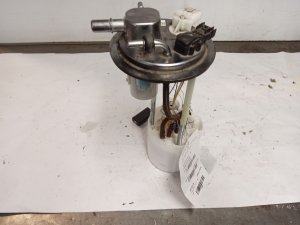
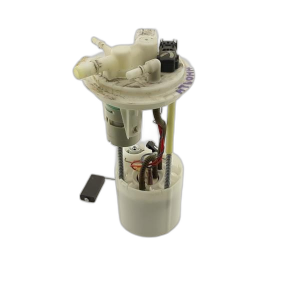
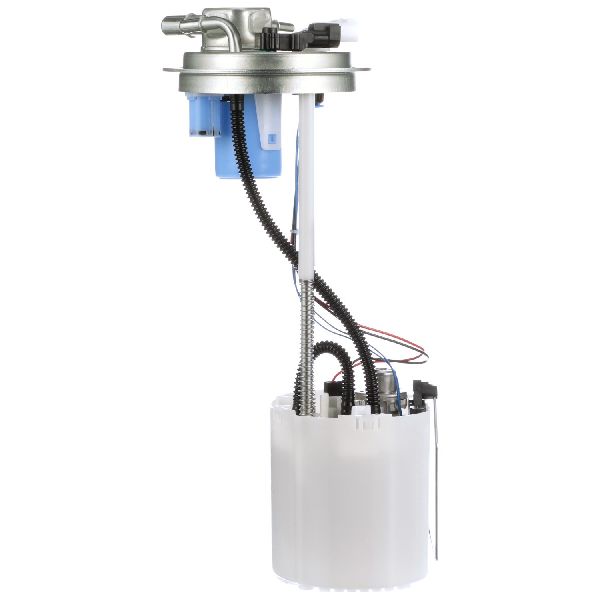
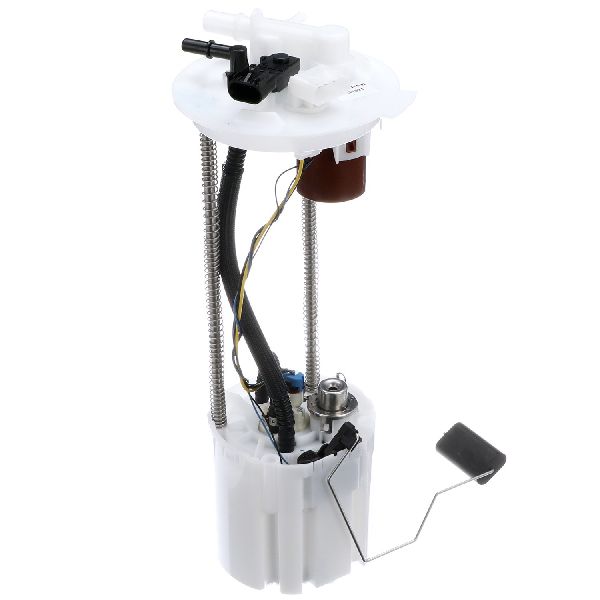
- Fuel Pump Module Assembly
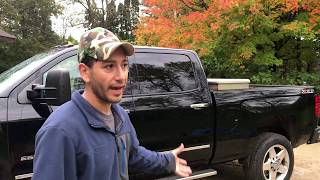
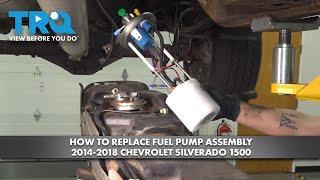
(OEM #ACDelco MU2103 (GM 19370831) is a commonly cited part number, but always verify with VIN.)— This is the most common failure. The assembly includes the fuel pump, fuel level sensor (sending unit), and housing. Replacing the entire module is the recommended repair 🎬 Watch: Quick 10-minute fuel pump replacement walkthrough to avoid future failures of the pump itself after performing the difficult labor of accessing it.
Trusted brands: ACDelco, Delphi
OEM price range: $250-$400
Aftermarket price range: $150-$250
Related Codes That Often Appear With This One
- P0461: Fuel Level Sensor 'A' Circuit Range/Performance
- P0462: Fuel Level Sensor 'A' Circuit Low Input
- P0464: Fuel Level Sensor 'A' Circuit Intermittent
Technical Service Bulletins (TSBs) & Recalls
- TSB 17-NA-204: Addresses inaccurate fuel gauge readings, fuel leaks, or noise from under the vehicle. It notes that a failing front level sender can cause the fuel tank to expand and contact the driveshaft. The fix involves replacing the front fuel tank, shield, pump, and level sender.
- TSB 18-NA-365: Mentions a list of fuel system codes including P0463, P0461, P0462, and others. The cause may be a blocked transfer jet in the primary fuel pump module, preventing fuel transfer from the secondary side of the tank on AWD models. The fix is to replace the primary fuel pump module.
Platform-Specific Known Issues
- Voluntary Emission Recall 13370 was issued for some 2014 Silverado 1500 models due to an incorrect fuel pump pressure regulator inside the fuel pump module, which could cause a check engine light and stalling. While not directly for P0463, it involves the same core component.
- Cross-manufacturer data from other Chevrolet models highlights the persistence of this circuit issue; for instance, NHTSA ODI #10407281 describes a "crazy" fuel gauge reading empty regardless of actual level, specifically triggering P0463 for high fuel input.
- Similarly, NHTSA ODI #10759346 notes that the condition can worsen over time until the fuel gauge simply reads empty with an active P0463 code.
Mechanic-Grade Diagnostic Values
- Fuel Level Sensor Resistance — expected: Approximately 40 Ohms (Empty) to 250 Ohms (Full).. Failure: An 'OL' or infinite resistance reading indicates an open circuit in the sensor, which is the direct cause of P0463.
- Fuel Level Sensor Signal Voltage at BCM — expected: Approximately 0.5V (Empty) to 4.5V (Full).. Failure: A reading of 4.8V or higher for more than a few seconds will trigger the P0463 code. This high voltage reading is what the BCM interprets as an open circuit.
- Fuel Pump Module Connector Pin Voltage (Key On) — expected: The Dark Blue wire (signal) should show a voltage between 0.5V and 4.5V depending on fuel level. The Black wire should show near 0V (good ground).. Failure: If the signal wire shows 5V, it indicates an open circuit between the connector and the sensor. If the ground wire shows voltage, there is a bad ground connection.
Scan Tool Commands That Help
- GDS2 (GM Factory Scan Tool): Instrument Panel Cluster -> Gauge Sweep or Output Control -> Fuel Gauge Command — Use this command to test the functionality of the physical fuel gauge in the dashboard. You can command the gauge to 0%, 50%, and 100%. If the gauge responds correctly, it proves the Instrument Panel Cluster (IPC) is working, isolating the fault to the sensor, wiring, or BCM.
Wiring & Ground Locations
- Fuel Pump Module Connector — On top of the fuel tank, accessible after dropping the tank or lifting the truck bed.. This is the primary connection point for the fuel level sensor. It is highly susceptible to corrosion and damage. The signal wire (typically Dark Blue) and ground wire (typically Black) must be tested here.
- G401 — On the left (driver's side) frame rail, typically near the fuel tank.. This is a common chassis ground point for the fuel system. A loose or corroded connection at G401 can create high resistance in the fuel level sensor's ground circuit, causing erratic readings or a P0463 code.
- X409 — Connector located along the frame rail, connecting the main body harness to the fuel tank harness.. This is another potential point of failure for corrosion or wire damage between the BCM and the fuel tank.
Real Owner Repair Stories
- gm-trucks.com forum member (2015 Chevrolet Silverado 1500) — Check Engine Light on with P0463, fuel gauge stuck on empty, low fuel light on constantly.
❌ Tried (didn't work) Clearing the code (it returned immediately), Adding fuel system cleaner (no change)
✅ What actually fixed it The owner replaced the entire fuel pump module assembly with a new ACDelco unit. This required lifting the truck bed for access. After replacement, the code was cleared and did not return, and the fuel gauge functioned correctly. - SilveradoSierra.com forum member (2014 Chevrolet Silverado 1500, ~90,000 miles) — P0463 code, fuel gauge intermittently dropping to empty then returning to normal before finally getting stuck on empty.
❌ Tried (didn't work) Initially suspected a wiring issue but couldn't find any visible damage.
✅ What actually fixed it After dropping the tank, the owner found that a wire in the harness connector right on top of the fuel pump module had corroded and broken internally, though it looked fine from the outside. Instead of replacing the whole pump, they repaired the single broken wire in the pigtail connector. This resolved the P0463 code. - NHTSA Report Anecdote — In a similar Chevrolet fuel system failure (NHTSA ODI #11615682), an owner reported that replacing the fuel pump module did not immediately resolve the P0463 and P0452 codes, suggesting that deeper circuit diagnosis is sometimes required. Another report, NHTSA ODI #11399819, mentions a vehicle having two fuel level sensors installed with no luck in keeping the check engine light from returning with codes P0463, P069E, and C0045.
OEM Part Supersession History
Varies by configuration→Varies by configuration— Standard part evolution and improvements.
Heads up: There are multiple fuel pump modules for this truck platform based on cab style, bed length, and tank size (26 vs 34 gallon). Using the wrong module can result in incorrect fuel level readings even if it physically fits. Always confirm the correct part number using the vehicle's VIN.
Diagnostic Flowchart
Other Known Issues on This Vehicle
Issues unrelated to this code that are worth knowing about as an owner of this generation:
- AFM/DFM Lifter Failure 🔴 High — Common, especially on higher mileage 5.3L and 6.2L engines. Can occur as early as 60,000 miles but more common over 100,000. Often leads to misfires (P0300) and ticking noises. (Ref: Multiple TSBs exist, and a class-action lawsuit was filed regarding this issue.)
- Transmission Shudder/Hard Shifting (8-Speed 8L90) 🟠 Medium — Very common on 2015-2018 models equipped with the 8-speed automatic. Owners report a shudder or vibration feeling like driving over rumble strips, especially under light throttle. (Ref: TSB 18-NA-355 recommends a specific transmission fluid flush with Mobil 1 Synthetic LV ATF HP.)
- A/C Condenser Leak 🟠 Medium — A widespread problem where the A/C condenser cracks, typically on the side, causing a loss of refrigerant and no cold air. The part was later updated to address the cracking issue.
- Brake Booster Vacuum Pump Failure 🔴 High — The engine-driven vacuum pump can fail, resulting in a hard brake pedal and significantly reduced braking power. This requires immediate attention.
- Intermediate Steering Shaft Clunk 🟡 Low — A clunking noise or feeling in the steering column, especially when turning or going over bumps. Caused by wear in the intermediate steering shaft.
Used vs. New Parts: Buying Guide for This Vehicle
When a used part is the smart pick: For this specific repair, a used part is almost never recommended. The labor involved in accessing the fuel pump module (either by dropping the tank or lifting the bed) is significant. The risk of a used part failing prematurely far outweighs the cost savings.
Donor-vehicle mileage cap: roughly under 40000 miles for the part to have meaningful remaining life.
What to inspect on the donor part:
- Verify the part came from a vehicle that was not wrecked in the rear, to avoid damage to the tank and module.
- Inspect the electrical connector pins for any signs of corrosion, melting, or damage.
- If possible, ask for the donor vehicle's VIN to confirm compatibility.
OEM-only on this vehicle (don't cheap out):
- Fuel Pump Module Assembly
Aftermarket brands forum-validated for this vehicle:
- ACDelco (OEM)
- Delphi (Often the OEM supplier)
Brands owners have reported issues with on this vehicle:
- Unbranded, low-cost units from online marketplaces like eBay or Amazon. Forum users frequently report premature failures within months, requiring the entire labor-intensive job to be redone.
Real Owner Stories
Aggregated from forums and TSBs cited above. Mileages and costs reflect what owners reported in those sources.
2014-2018 Chevrolet Silverado 1500
Symptoms: The fuel gauge reads empty even when the tank is full, or it stays stuck on full regardless of the actual level. The check engine light is illuminated with code P0463.
What fixed it: Replacement of the fuel pump module assembly.
Source hint: gm-trucks.com thread titled 'Code P0463'
2018 Chevrolet Silverado 1500
Symptoms: The fuel transfer pump malfunctioned, causing the fuel gauge to read inaccurately and the engine to stop running unexpectedly. The service engine light displayed codes P2068 and P0463.
What fixed it: Repair of the fuel transfer pump system which moves fuel between tanks.
Source hint: CarComplaints.com
Documented NHTSA Reports
An owner reported that their check engine light came on and the code P0463 was found at an auto parts store (NHTSA ODI #10691136). In another instance, a driver noted that the fuel gauge began acting erratically before eventually just reading empty with an active P0463 code (NHTSA ODI #10759346).
Related OBD-II Codes
Frequently Asked Questions
My 2014 Silverado 1500 is stalling and has a check engine light; could this be related to a recall?
Does TSB 17-NA-204 apply to my Silverado if my fuel gauge is inaccurate?
I have an AWD model and my fuel gauge is acting up along with code P0463. What does TSB 18-NA-365 suggest?
Can I just clean the sensor on my 2014-2018 Silverado instead of replacing the whole pump?
Why is the fuel level sensor failing so often on this generation of Silverado?
Are there other K2XX platform vehicles that share this fuel gauge problem?
Helpful Videos

Used OEM Parts in Stock
New Aftermarket Parts Available


The information in this article is provided for general reference and educational purposes only. Vehicle specifications, procedures, and part compatibility can vary by production date, trim level, and region. Always consult your vehicle's factory service manual and verify part numbers before purchasing or performing repairs. Safety-critical components such as airbags, seat belts, and braking systems should be installed by a qualified professional.
- Chevrolet Silverado 1500:
- 🧭 Diagnostic Flowchart
- 🎬 Helpful Videos
- 🛍️ Shop This Part
- What's Unique About the 2014-2018 Chevrolet Silverado 1500
- Symptoms You May Notice
- Most Likely Causes
- Rare But Worth Checking
- Diagnosis Steps
- Parts You'll Likely Need
- Related Codes That Often Appear With This One
- Technical Service Bulletins (TSBs) & Recalls
- Platform-Specific Known Issues
- Mechanic-Grade Diagnostic Values
- Scan Tool Commands That Help
- Wiring & Ground Locations
- Real Owner Repair Stories
- OEM Part Supersession History
- Other Known Issues on This Vehicle
- Used vs. New Parts: Buying Guide for This Vehicle
- Real Owner Stories
- 2014-2018 Chevrolet Silverado 1500
- 2018 Chevrolet Silverado 1500
- Documented NHTSA Reports
- Related OBD-II Codes
- Frequently Asked Questions
- 🎟️ Get 5% Off