

P0480 on 2003-2012 Saab 9-3: Cooling Fan Control Circuit Fixes
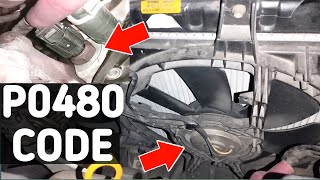
On a 2003-2012 Saab 9-3, code P0480 is most often caused by a failed cooling fan control module located on the fan shroud. Replacing this module is the most common fix, with parts costing between $130 and $320 for an OEM or aftermarket unit. DIY difficulty is 2/5.
- P0480 on a Saab 9-3 almost always points to a problem with the cooling fan system, not a sensor.
- The most likely culprit is the fan control module mounted on the fan shroud. Test this before buying a whole new fan assembly.
- A scan tool that can command the fans on is the most valuable diagnostic tool for this issue.
- Do not drive the car extensively with this code, as engine overheating can occur quickly in traffic, leading to major engine damage.
What's Unique About the 2003-2012 Saab 9-3
The Saab 9-3 of this generation uses a specific fan control module (sometimes called a relay unit) mounted directly to the fan shroud. This module, rather than simple individual relays in a fuse box, is the heart of the system and a very common failure point. Diagnostics often focus on testing the power, ground, and command signal wires directly at this module's connector to determine if it has failed. Many owners successfully diagnose this issue by observing if the fans fail to run at specific speeds commanded by a scan tool. A key diagnostic step is to verify power on pins 3 & 6, ground on pins 2 & 5, and the ECM's ground signal on pins 1, 4, or 7 (depending on speed) at the module's connector.
Symptoms You May Notice
- Engine temperature gauge rising above normal, especially in traffic 🎬 Watch: Understanding the P0480 code and common fixes or at idle.
- Check Engine Light is on.
- Air conditioning (A/C) performance is poor or blows warm air, as the fan is required to cool the A/C condenser.
- Cooling fan does not turn on when the engine gets hot or when the A/C is on.
- Cooling fan runs constantly, even when the engine is cold (less common).
- Fans may be heard kicking on and off rapidly in quick succession.
- Replacing the entire fan assembly when only the less expensive fan control module has failed.
- Replacing the coolant temperature sensor when no other codes are present and sensor data appears normal on a scan tool.
Most Likely Causes
- Failed Cooling Fan Control Module/Relay Unit 🔴 High Probability → Shop Engine Cooling Fan Blade This module is exposed to heat and vibration on the fan shroud, leading to internal electronic failure over time. It is the most frequently cited point of failure in owner forums and diagnostic videos for this specific vehicle.
How to confirm: Use a scan tool to command the fan on. If it doesn't run, access the module on the fan shroud. Use a multimeter or test light to confirm it's receiving battery power (pins 3 & 6) and good ground (pins 2 & 5). Then, check if the ECM is sending the ground signal to the command pins (pins 1, 4, or 7, depending on speed). If all inputs are good but the fan doesn't run (and the fan motor is good), the module is faulty.
Typical fix: Replace the fan control module. It is held to the fan shroud by a single T20 screw.
Est. part cost: $130-$320 - Failed Cooling Fan Motor 🟡 Medium Probability → Shop Engine Cooling Fan Blade Electric motors wear out over time. The brushes can fail or the motor can seize. Often one of the two fans will fail first, which can be confirmed by swapping fan motors if one is known to be good.
How to confirm: After confirming fuses are good, disconnect the fan motor connector and apply 12V power directly from a battery. 🎬 Watch: How to test and replace a failed fan motor If the fan does not spin, the motor is dead. A healthy motor should have a resistance of around 1 Ohm; a reading that is erratic or significantly higher indicates a faulty motor.
Typical fix: Replace the individual fan motor or the entire cooling fan assembly, as motors are not always sold separately. This involves removing the fan shroud from the radiator.
Est. part cost: $125-$250 (used/aftermarket), $900+ (OEM) - Blown Fuse ⚪ Low Probability
How to confirm: Check the large maxi-fuses (e.g., 30A or 40A) for the cooling fan circuit in the underhood fuse box (UEC). A blown fuse often indicates a deeper problem, like a seized fan motor drawing too much current.
Typical fix: Replace the blown fuse after diagnosing the underlying cause of the overcurrent condition.
Est. part cost: $5-$15 - Damaged Wiring or Connectors ⚪ Low Probability The main connector at the fan control module is exposed and can accumulate dirt or corrosion, leading to a poor connection. Wiring can also become damaged or corroded in the loom between the fuse box and the fan assembly.
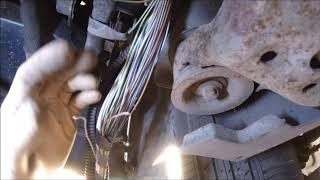
How to confirm: Visually inspect the wiring harness and the pins inside the connector for the fan control module and fan motors. Look for any signs of corrosion (green crust), melted plastic, or broken wires. One owner found a corroded wire inside the loom near the fuse box that prevented the A/C relay from getting its signal.
Typical fix: Clean the connector terminals or repair the damaged section of the wiring harness.
Est. part cost: $10-$50 (for repair materials)
Rare But Worth Checking
- Faulty Engine Coolant Temperature (ECT) Sensor: While a bad ECT sensor can prevent the fan from turning on, it will usually trigger other specific fault codes (like P0117 or P0118) in addition to or instead of P0480.
- Faulty Engine Control Module (ECM): This is extremely rare. The ECM should only be considered after all other possibilities—module, fan motor, fuses, and wiring—have been definitively ruled out.
Diagnosis Steps
- Read the fault codes with an OBD-II scanner.
- Check the cooling fan fuses (typically large 30A or 40A maxi-fuses) in the fuse box located in the engine bay (UEC).
- Visually inspect the wiring and connector going to the fan control module on the radiator fan shroud for any obvious damage, corrosion, or looseness.
- Use a scan tool with bidirectional control to command the cooling fan ON at low and high speeds (e.g., 25%, 50%, 75%, 100%). Note whether the fan runs at any speed.
- If the fan does not run at all, test the fan motor directly. Disconnect its electrical connector and carefully apply 12V and ground from the vehicle's battery. If the fan spins, the motor is good. If not, the fan motor has failed.
- If the fan motor is good, the fan control module is the primary suspect. With the ignition on, access the module connector. Use a multimeter to test for battery voltage at pins 3 and 6, and for a good ground connection at pins 2 and 5.
- If power and ground are present, test the ECM's command signal. Connect a test light to battery positive and probe the signal pins. Command the fan speeds with a scan tool. The test light should illuminate when probing pin 7 (Speed 1), pin 4 (Speed 2), or pin 1 (Speeds 3/4), indicating the ECM is sending the ground signal. If signals are present but the fan doesn't run, the fan control module is defective.
- If no command signal is coming from the ECM, check for a wiring issue between the ECM and the module before suspecting a faulty ECM.
Parts You'll Likely Need
- Cooling Fan Control Module
(OEM #24418357 (supersedes 12761749))— This is the most common component to fail for this code on the Saab 9-3. It controls all fan speeds and is subjected to significant heat and vibration.
Trusted brands: Genuine Saab/Orio, Proparts, AHE, Behr, Vemo
OEM price range: $250-$320
Aftermarket price range: $130-$200 - Radiator Cooling Fan Assembly
(OEM #12801549)— If a fan motor has seized or burned out, the entire assembly (which includes the shroud and both fans) typically needs to be replaced.
Trusted brands: Genuine Saab/Orio, Dorman, Four Seasons, TYC
OEM price range: $900-$1200
Aftermarket price range: $200-$400
Related Codes That Often Appear With This One
- P0481 — P0481 refers to 'Cooling Fan 2 Control Circuit Malfunction.' Since the Saab 9-3 system uses a single control module for multiple fan speeds/fans, a fault in the module or its wiring can trigger both codes.
- P0691 — P0691 refers to 'Fan 1 Control Circuit Low'. This code can appear alongside P0480 and points to a short to ground or other issue causing low voltage in the control circuit, often related to the same common causes like a faulty module or wiring.
Technical Service Bulletins (TSBs) & Recalls
- eSaabParts Technical Note: '2003-11 4 Cylinder B207 Cooling Fan Relay Box 24418357 is superseded to fit 2006-09 V6 B284'. This document outlines the procedure for swapping connector housings on the fan control module to adapt it for use on V6 models.
Platform-Specific Known Issues
- Fan Control Module Swap for V6 Models: When replacing the fan control module on a 2.8L V6 (B284) model, the commonly available part is 24418357, which was originally for the 4-cylinder (B207). This part can be used, but it requires a modification. The left and right electrical connector housings on the module must be swapped, as they are keyed differently for the V6 harness. This involves carefully de-pinning the wires from each connector housing and re-inserting them into the opposite housing.
Mechanic-Grade Diagnostic Values
- Fan Control Module Power Supply — expected: Battery voltage (at least 11.5V) on pins 3 and 6 of the module connector.. Failure: Low or no voltage indicates a problem with the fuses or wiring from the UEC.
- Fan Control Module Ground — expected: Good ground continuity (near 0V when testing to ground) on pins 2 and 5 of the module connector.. Failure: High resistance or an open circuit indicates a bad ground connection at G30B.
- ECM Command Signal to Module — expected: When commanding speeds with a scan tool, the ECM should ground specific pins. A test light connected to battery positive should light up when probing: Pin 7 (Speed 1), Pin 4 (Speed 2), Pin 1 (Speeds 3 & 4).. Failure: If the test light does not illuminate when a speed is commanded, the fault lies in the wiring from the ECM or the ECM itself.
- Fan Motor Resistance — expected: Approximately 1.0 Ohm.. Failure: An open circuit (OL) or erratic, high resistance readings indicate a worn or failed fan motor.
- Fan Speed 1 Activation (Temperature) — expected: Fan engages at 100°C (212°F) and disengages at 96°C (205°F).. Failure: Fan does not engage within this temperature range.
- Fan Speed 2-4 Activation (Temperature) — expected: Speed 2 at 108°C, Speed 3 at 114°C, Speed 4 at 120°C.. Failure: Fan does not step up in speed as temperature thresholds are crossed.
- Fan Speed 1 Activation (A/C Pressure) — expected: Fan engages above 1100 kPa and disengages below 800 kPa.. Failure: Fan does not engage when A/C pressure exceeds the threshold.
Scan Tool Commands That Help
- Tech 2 or equivalent professional scanner: Fan Speed Control / Active Test — This is a critical first diagnostic step after checking fuses. It allows you to command each of the four fan speeds (often shown as 25%, 50%, 75%, 100%) independently. This helps determine if the failure affects all speeds (likely module power/ground) or a specific speed (points to a specific control circuit wire or internal module fault).
Wiring & Ground Locations
- 706a / 706b — The relay unit/control module for the radiator fans, located directly on top of the radiator fan shroud/cover.. This is the central control unit for the fans and the most common failure point. All power, ground, and signal wires for the fan system converge at this component's 7-pin connector, making it the primary test location.
- G30B — Rear grounding point on the side plate above the left (driver's side in LHD) wheel housing.. This is the specific grounding point for the fan control module (pins 2 and 5). A corroded or loose connection here will cause a complete failure of the fan system and can set a P0480 code.
- 342 (UEC) — Underhood Electrical Centre, located next to the battery.. This fuse and relay box supplies the main battery voltage to the fan control module via large maxi-fuses. It is also where the ECM's control signals are routed through on their way to the fan module.
Real Owner Repair Stories
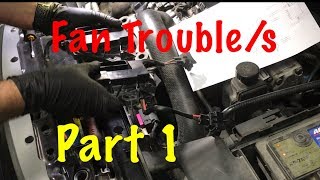
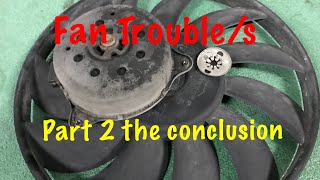
- YouTube - The Flying MechanicDIY, 'SAAB 93 COOLING FANS ISSUES' Parts 1 & 2 (Saab 9-3 (2003-2012 generation)) — Fans would kick on and off rapidly; fan speed 1 was completely inoperative when commanded by a scan tool, but speeds 2, 3, and 4 worked.
❌ Tried (didn't work) Initially suspected the fan control module was the sole cause. Replacing it with a used unit did not resolve the speed 1 issue.
✅ What actually fixed it After confirming the replacement module was receiving the correct signals, the mechanic tested the fan motor's resistance and found it was faulty (erratic readings). Replacing the bad fan motor resolved the issue. The final repair required replacing BOTH the control module and one of the fan motors. - YouTube - FixYourRide13, 'Saab 9-3 2007 A/C Electric Problem/Cooling Fan Motor Problem' (2007 Saab 9-3) — A/C not working and issues with cooling fan speed.
❌ Tried (didn't work) Checking fuses and relays, which were all good. Manually jumping the A/C compressor relay showed the A/C system itself was functional.
✅ What actually fixed it The problem was traced to a corroded wire (brown-yellow) in the wiring harness near the engine ECU. This wire provides the signal connection between the ECU and the fan control unit. Repairing this corroded section of wire restored function to both the A/C and the cooling fans.
"I Checked Everything" — The Actual Cause
- A common scenario is for a technician to test the inputs to the fan control module (power, ground, ECM signal) and find they are all correct, leading to the conclusion that the module is bad. However, as one detailed repair showed, a faulty fan motor can also be the cause, even if the module is also bad. After replacing the module, the problem may persist if the fan motor itself has a high-resistance failure. It is critical to test the fan motors directly for resistance or by applying 12V power, not just stopping after diagnosing a bad module.
OEM Part Supersession History
12761749→24418357— Standard part update/revision by the manufacturer.
Heads up: The newer part 24418357 is used for both 4-cylinder (B207) and V6 (B284) engines, but requires modification for the V6. The electrical connector housings must be swapped from the old module to the new one to match the V6 wiring harness.
Model Year Variations Within This Range
- 2003-2012: While the system is functionally the same, the exact fan speed percentages commanded by the ECM can vary by engine type (designated as 55A, 65A, 75A). For example, at Speed 1, one engine variant might run the fans at 45% and 60% of max speed, while another runs them at 50% and 55%. This does not affect diagnosis but is a technical difference in operation.
- 2003-2007 vs 2008-2012: The vehicle underwent a major facelift for the 2008 model year, changing most exterior body panels. However, the core cooling system components, including the fan assembly, control module, and common failure patterns for P0480, remained consistent across the pre-facelift and post-facelift second-generation models.
Diagnostic Flowchart
Other Known Issues on This Vehicle
Issues unrelated to this code that are worth knowing about as an owner of this generation:
- Column Integrated Module (CIM) Failure 🔴 High — Very common. Can occur at any mileage but is more frequent on cars over 80,000 miles. Symptoms include horn, steering wheel controls, and turn signals not working, plus 'Steering Lock Malfunction' or 'Immobilizer Failure' messages preventing the car from starting.
- Rear Coil Spring Fracture/Sag 🟠 Medium — Extremely common, especially in regions with harsh weather or salted roads. Springs can crack or break, causing a noticeable sag in the rear suspension and a clunking noise over bumps.
- Fuel Level Sender Malfunction 🟡 Low — Very common across all model years. The fuel gauge becomes erratic, reads empty when full, or gets stuck. It is caused by wear or contamination on the sender's resistor contacts inside the fuel tank.
- Intake Valve Carbon Buildup (2.0T B207 Engine) 🟠 Medium — Common on direct-injected 2.0T engines, particularly from 2007-2009. Leads to gradual power loss, rough idle, and misfire codes (P0300-P0304). Requires media blasting (e.g., walnut blasting) to clean. (Ref: A TSB exists for this issue on the 2.0L engine, but not the 2.8L V6.)
- Stretched Timing Chains (2.8T V6 B284 Engine) 🔴 High — A significant and expensive potential failure on the V6 engine, often occurring after 100,000 miles. Can be exacerbated by infrequent oil changes or issues with the PCV system. Symptoms include a rattling noise and timing-related fault codes.
Used vs. New Parts: Buying Guide for This Vehicle
When a used part is the smart pick: A used cooling fan assembly from a junkyard or parts car can be a very cost-effective choice, especially if only one of the fan motors has failed. These motors are generally robust, and even units from high-mileage donors can provide a viable repair if tested first.
Donor-vehicle mileage cap: roughly under 150000 miles for the part to have meaningful remaining life.
What to inspect on the donor part:
- Test the fan motors directly by applying 12V power to ensure they spin freely and quietly.
- Measure the resistance of the fan motors; it should be low and stable, around 1 Ohm.
- Inspect the plastic fan shroud for any cracks or broken mounting tabs, which are common.
- Check the electrical connectors for any signs of melting, heavy corrosion, or broken locking tabs.
OEM-only on this vehicle (don't cheap out):
- While not strictly 'OEM-only', the Cooling Fan Control Module is a high-failure-rate electronic part. A new OEM or high-quality aftermarket unit (e.g., Behr, Vemo) is strongly recommended over a used one. Used modules carry a high risk of being faulty or having a very limited remaining lifespan.
Aftermarket brands forum-validated for this vehicle:
- Behr
- Vemo
- Proparts
Brands owners have reported issues with on this vehicle:
- No specific brands are consistently cited as problematic, but be wary of unbranded, generic modules from online marketplaces, as their internal electronics may not be as durable as OEM-spec parts.
Real Owner Stories
Aggregated from forums and TSBs cited above. Mileages and costs reflect what owners reported in those sources.
Saab 9-3
Symptoms: Cooling fan would not turn on when commanded by a scan tool, leading to the engine temperature rising in traffic.
What fixed it: Diagnostics using a multimeter confirmed power and signal were reaching the fan control module, but the fan would not run. Replacing the faulty fan control module resolved the issue.
Cost: $130-$320
Source hint: YouTube - The Flying MechanicDIY - 'SAAB 93 COOLING FANS ISSUES .. Part 1'
Saab 9-3
Symptoms: The cooling fan would not engage when the A/C was turned on.
What fixed it: A corroded wire was discovered inside the wiring loom near the underhood fuse box. Repairing this damaged section of the harness restored the signal to the A/C relay and fixed the fan operation.
Source hint: Owner report cited in diagnostic information
2006-2009 Saab 9-3 2.8L V6 (B284)
Symptoms: Check Engine Light with code P0480 and cooling fans were inoperative.
What fixed it: Replaced the fan control module with part 24418357, which required swapping the left and right electrical connector housings to adapt the 4-cylinder part to the V6 harness.
Source hint: eSaabParts Technical Note: '2003-11 4 Cylinder B207 Cooling Fan Relay Box 24418357 is superseded to fit 2006-09 V6 B284'
Related OBD-II Codes
Frequently Asked Questions
What is the most common part that fails on a 2003-2012 Saab 9-3 to cause a P0480 code?
My A/C is blowing warm air in traffic. Could this be related to the P0480 code?
I have a V6 Saab 9-3. The replacement fan control module I found (part 24418357) is listed for the 4-cylinder model. Can I use it?
How can I test the fan motor directly to rule it out as the cause?
What are the specific pins I need to test with a multimeter at the fan control module connector?
The cooling fan fuse in my Saab 9-3 keeps blowing. What does this mean?
Helpful Videos
We Have This Part in Stock

The information in this article is provided for general reference and educational purposes only. Vehicle specifications, procedures, and part compatibility can vary by production date, trim level, and region. Always consult your vehicle's factory service manual and verify part numbers before purchasing or performing repairs. Safety-critical components such as airbags, seat belts, and braking systems should be installed by a qualified professional.
- Saab 9-3:
- 🧭 Diagnostic Flowchart
- 🎬 Helpful Videos
- 🛍️ Shop This Part
- What's Unique About the 2003-2012 Saab 9-3
- Symptoms You May Notice
- Most Likely Causes
- Rare But Worth Checking
- Diagnosis Steps
- Parts You'll Likely Need
- Related Codes That Often Appear With This One
- Technical Service Bulletins (TSBs) & Recalls
- Platform-Specific Known Issues
- Mechanic-Grade Diagnostic Values
- Scan Tool Commands That Help
- Wiring & Ground Locations
- Real Owner Repair Stories
- "I Checked Everything" — The Actual Cause
- OEM Part Supersession History
- Model Year Variations Within This Range
- Other Known Issues on This Vehicle
- Used vs. New Parts: Buying Guide for This Vehicle
- Real Owner Stories
- Saab 9-3
- Saab 9-3
- 2006-2009 Saab 9-3 2.8L V6 (B284)
- Related OBD-II Codes
- Frequently Asked Questions
- 🎟️ Get 5% Off