

P0501 on 2006-2011 Kia Rio: Vehicle Speed Sensor Range/Performance Explained
This code typically points to a faulty vehicle speed sensor (VSS) or its wiring. On non-ABS models, this is the front right wheel speed sensor. On models with ABS, it's the sensor on the transmission. A new sensor costs between $20-$60. Confirming which system your car has is the first step.
- The first and most critical step is to identify if your 2006-2011 Rio has ABS. This determines which sensor is responsible for the P0501 code.
- For non-ABS models, the problem is with the front right wheel speed sensor (OEM Part: 95671-1G100) or its circuit.
- For ABS-equipped models, the problem is likely the vehicle speed sensor on the transmission (OEM Part: 964204A600).
- Before replacing any sensor, always perform a thorough visual inspection of the wiring and connector for damage, as this is a common and cheaper fix.
- An incorrect air gap between the sensor and tone ring, often caused by rust buildup or damage during a brake or axle repair, can also trigger this code.
What's Unique About the 2006-2011 Kia Rio
For the 2006-2011 Kia Rio (JB generation), the source of the speed signal depends on whether the car has an Anti-lock Braking System (ABS). Non-ABS models use the front right wheel speed sensor as the primary vehicle speed sensor ('VSS A') to send speed data to the ECU. Models equipped with ABS use a separate VSS located on the transmission housing to provide the primary speed signal. This distinction is critical for correct diagnosis, as a P0501 code on a non-ABS car points directly to a wheel speed sensor issue, not a transmission-mounted one.
Symptoms You May Notice
- Check Engine Light is on
- Inaccurate or non-functional speedometer
- Erratic or harsh shifting on automatic transmission models
- Cruise control not working
- ABS light may be illuminated (on ABS-equipped models)
- Odometer may not function properly
- Replacing the wrong sensor. Owners of non-ABS models might mistakenly replace a transmission sensor when the fault is with the front right wheel speed sensor, or vice-versa for ABS models.
- Replacing an ABS wheel speed sensor on a different wheel. On non-ABS models, only the front right sensor provides the vehicle speed signal to the ECU for this code.
Most Likely Causes
- Faulty Vehicle Speed Sensor (VSS) 🔴 High Probability → Shop Drive Shaft Sensor The sensor, whether on the wheel hub or transmission, is exposed to heat, moisture, and vibration, leading to failure over time. Some owner accounts suggest the transmission-mounted sensor can fail due to overheating, sometimes melting the connector.
How to confirm: Use a scan tool with live data to monitor vehicle speed while driving. If the reading is zero, erratic, or doesn't match a GPS-based speed, the sensor is likely bad. You can also test the sensor's resistance and signal output with a multimeter or oscilloscope according to factory service manual specifications.
Typical fix: Replace the faulty speed sensor. For non-ABS models, this is the front right wheel speed sensor. For ABS models, it is the VSS on the transmission.
Est. part cost: $20-$60 - Damaged Wiring or Connector 🟡 Medium Probability The wiring harness to the wheel speed sensor is susceptible to damage from road debris, improper repairs, or corrosion. Wires can become frayed, shorted, or the connector pins can corrode, leading to a poor or intermittent signal. In some cases, the connector itself can melt from a shorted sensor.
How to confirm: Visually inspect the entire length of the wiring harness from the sensor to the main loom. Check for breaks, chafing, or corrosion. Unplug the connector and check for bent, corroded, or melted pins. Perform a continuity test on the wires with a multimeter.
Typical fix: Repair the damaged section of the wire or replace the connector pigtail.
Est. part cost: $10-$30 - Incorrect Sensor Air Gap or Damaged Tone Ring ⚪ Low Probability This often occurs after front-end work like replacing a wheel bearing or CV axle shaft. If the sensor is not seated correctly due to rust buildup or improper installation, the air gap between it and the tone ring will be too large to generate a signal. The tone ring itself can also be damaged, packed with debris, or frozen onto the axle, leading to damage during removal.
How to confirm: Visually inspect the tone ring (the toothed ring on the axle or hub) for damage, rust, or debris. Ensure the speed sensor is fully seated in its mounting hole and that the air gap is minimal. A user on a forum noted they had to replace a new axle because the tone ring was damaged during a previous repair.
Typical fix: Clean the tone ring and sensor mounting surface. If the tone ring is damaged, the CV axle shaft or wheel hub assembly may need to be replaced.
Est. part cost: $5 (cleaning) - $150+ (axle/hub replacement)
Rare But Worth Checking
- Faulty Powertrain Control Module (PCM): → Shop Engine Control Module (ECM) This is very uncommon. Before condemning the PCM, all other possibilities (sensor, wiring, tone ring) must be exhaustively ruled out. A Reddit user with a 2006 non-ABS Rio reported suspecting a bad ECM after replacing the sensor and verifying the wiring and tone ring were good. A technician can use a signal generator to feed a test signal to the PCM to confirm it can process speed data correctly.
Diagnosis Steps
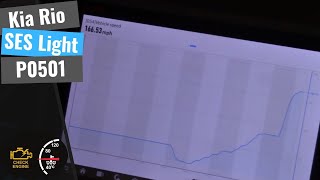
- Connect an OBD-II scanner and confirm P0501 is present. 🎬 Watch: A professional walkthrough for diagnosing the P0501 code. Note if any ABS-specific codes are also stored, which would point towards an ABS system fault.
- Use the scanner's live data function to monitor 'Vehicle Speed'.
- Safely drive the vehicle (or raise the drive wheels). Observe if the speed reading on the scanner is 0 mph, erratic, or does not match the actual vehicle speed (verified by GPS).
- Determine if your Rio is an ABS or non-ABS model. An ABS light on the dash during startup indicates an ABS model. This will dictate which sensor to inspect.
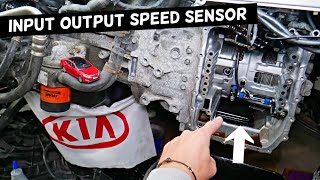
- For non-ABS models, focus on the front right wheel speed sensor. For ABS models, locate the VSS on the transmission housing. 🎬 See this video to find the exact speed sensor location.
- Raise and safely support the vehicle. Visually inspect the relevant sensor and its wiring harness for any signs of damage, corrosion, or loose/melted connections.
- Inspect the tone ring (on the CV axle for front sensors) for damage, heavy rust, or debris. Ensure the sensor is seated correctly with the proper air gap.
- If no visual faults are found, use a multimeter to test the sensor and circuit. For the transmission VSS, a specific bench test can be performed. For the wheel speed sensor circuit, a continuity test between the sensor connector and the PCM should show low resistance (close to 1 ohm).
- If the sensor and wiring test good, the issue may be with the instrument cluster or, rarely, the PCM. This step often requires professional diagnosis with advanced tools like an oscilloscope or signal generator.
Parts You'll Likely Need
- Vehicle Speed Sensor (Transmission-mounted, for ABS models)
(OEM #964204A600)— This is the primary speed sensor for models with ABS. It is a common failure point. Note that this part number is also used on many other Hyundai/Kia models and has been superseded.
Trusted brands: Genuine Kia/Hyundai, Standard Motor Products (SC347), Beck/Arnley
OEM price range: $40-$60
Aftermarket price range: $20-$45 - Front Right Wheel Speed Sensor (for non-ABS models)
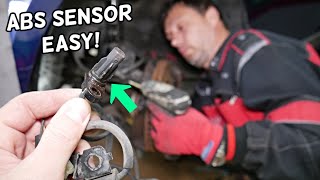
(OEM #95671-1G100)— On non-ABS models, this sensor provides the vehicle speed signal to the ECU. It is the sole cause of P0501 on these specific vehicles. 🎬 Watch: How to remove and replace the wheel speed sensor.
Trusted brands: Duralast (SU12280), Delphi (SS20514), Holstein (2ABS0222)
OEM price range: $50-$75
Aftermarket price range: $25-$50
Platform-Specific Known Issues
- A user on 2CarPros.com with a 2008 Rio confirmed that P0501 was triggered after a difficult wheel bearing replacement damaged both the original wheel speed sensor and the tone ring on the axle shaft, requiring replacement of both the sensor and the CV axle.
Mechanic-Grade Diagnostic Values
- Transmission VSS (ABS Models) Bench Test — expected: With battery voltage applied to pins 1 and 2, the signal on pin 3 should pulse between approx. 0V and 11V+ as the sensor shaft is rotated. It should produce 4 pulses per revolution.. Failure: No voltage change or an inconsistent signal indicates a faulty sensor.
- VSS Signal Wire Continuity (to PCM) — expected: Less than 1.0 ohm of resistance between the signal wire pin at the sensor connector and the corresponding pin at the PCM connector.. Failure: High resistance (OL or 'over limit') indicates an open circuit in the harness.
- Transmission VSS (ABS Models) Live Voltage Check — expected: The signal wire should show approximately 10-11.5V with the key on. When the sensor operates, it pulls this voltage down to ground, creating a square wave signal.. Failure: Voltage that is stuck high or low and does not pulse when the wheels are turning indicates a fault in the sensor or circuit.
Scan Tool Commands That Help
- Kia GDS (or equivalent professional scanner): Live Data Monitoring for 'WHEEL SPD SENSOR-FR' — This is the primary diagnostic step for non-ABS models to see if the ECU is receiving a signal from the front right wheel speed sensor. The reading should match the vehicle's actual speed.
- Signal Generator: Feed Test Signal to PCM — After confirming the sensor is bad but before replacing the PCM. By feeding a known-good square wave signal (e.g., 400 Hz) into the signal wire at the PCM, a technician can verify the wiring from that point is good and the PCM can correctly interpret the signal and display a speed on the scan tool. This definitively rules out a PCM failure.
Wiring & Ground Locations
- Front Right Wheel Speed Sensor Connector (Non-ABS) — The sensor is on the right front wheel hub assembly. The wire runs up into the fender well and the connector is typically located behind the plastic splash shield.. This is the primary signal source for P0501 on non-ABS models. The harness in this area is exposed to road debris and potential damage from previous repairs or accidents.
- Vehicle Speed Sensor Connector (ABS Models) — Located on the top or side of the transmission housing.. This is the primary signal source for P0501 on ABS-equipped models. Its location exposes it to significant heat from the transmission, which can lead to the connector melting or wires becoming brittle.
Real Owner Repair Stories
- 2CarPros Forum User 'iceman94954' (2008 Kia Rio) — P0501 code present after other front-end work.
❌ Tried (didn't work) Replacing the front right wheel speed sensor., Clearing the code.
✅ What actually fixed it The root cause was damage sustained during a prior wheel bearing replacement. The hub was frozen to the axle, and in the process of removal, both the original speed sensor and the tone ring on the CV axle were damaged. The final fix required replacing both the front right wheel speed sensor and the entire CV axle shaft to get a new, undamaged tone ring. - YouTube User 'TweekerDan1984' (2005 Kia Rio 1.6L (First generation, but demonstrates an identical failure mode)) — Melted speed sensor connector, smoking from the area, transmission shifting problems.
✅ What actually fixed it The vehicle speed sensor on the transmission had shorted internally, causing it to overheat and completely melt the plastic connector and wiring. The fix required replacing the sensor and sourcing a replacement connector pigtail from a vehicle at a wrecking yard, then splicing it into the existing harness. - NHTSA ODI #10632998 — An owner of a related Kia model reported that after dash warning lights appeared and code P0501 was stored, replacing the front right sensor did not immediately clear the code, suggesting further diagnostic complexity in the wheel speed sensor circuit.
OEM Part Supersession History
964204A600→96420A7000— Standard part revision/update by the manufacturer.
Heads up: The new part number is a direct replacement for the old one.95671-1G100→N/A— This part is listed as discontinued by some OEM suppliers but is still widely available in the aftermarket and as new old stock.
Diagnostic Flowchart
Other Known Issues on This Vehicle
Issues unrelated to this code that are worth knowing about as an owner of this generation:
- Interference Engine Timing Belt Failure 🔴 High — The 1.6L Alpha II engine is an interference design. The timing belt has a recommended replacement interval of 60,000 to 100,000 miles. If it breaks, catastrophic engine damage (bent valves, piston damage) is highly likely.
- Erratic Transmission Shifting / Control Module Issues 🟠 Medium → Shop Transmission Assembly — Some owners report issues with automatic transmission behavior, such as harsh shifting or confusion between gears. In some cases, this has been linked to a faulty transmission control computer, which can also cause false check engine lights.
- Engine Misfires and Rough Idle 🟡 Low — Often attributed to rapid wear of spark plugs or failing ignition coils. This can occur after 40,000-50,000 miles and may present as hesitation, rough idle, and a check engine light.
- Suspension Noise 🟡 Low — Complaints of squeaks, rattles, and clunks from the suspension are noted by some owners, often indicating worn components like struts or bushings.
- Occupant Classification System (OCS) Sensor Mat Failure 🟠 Medium — A recall was issued for 2006-2008 models because the front passenger seat sensor mat could crack, preventing the system from correctly identifying an occupant and potentially disabling the passenger airbag. (Ref: NHTSA RECALL 11V432000)
Used vs. New Parts: Buying Guide for This Vehicle
When a used part is the smart pick: A used part from a junkyard is an excellent choice for sourcing a connector pigtail if yours has melted or been damaged. A used sensor can be a budget-friendly option, but its remaining lifespan is unknown.
Donor-vehicle mileage cap: roughly under 100000 miles for the part to have meaningful remaining life.
What to inspect on the donor part:
- For a connector pigtail, ensure the plastic is not brittle, there are no signs of melting or charring, and the locking tab is intact.
- For a sensor, check that the mounting point is not cracked and the plastic housing is free of damage.
- Inspect the donor vehicle for signs of a major front-end collision (for wheel speed sensors) or transmission failure.
OEM-only on this vehicle (don't cheap out):
- No parts for this specific repair are strictly OEM-only; quality aftermarket sensors are widely available and effective.
Aftermarket brands forum-validated for this vehicle:
- Standard Motor Products
- Duralast
- Delphi
- Beck/Arnley
Brands owners have reported issues with on this vehicle:
- No specific brands are consistently reported as problematic, but ultra-low-cost, unbranded parts from online marketplaces may have questionable quality control.
Real Owner Stories
Aggregated from forums and TSBs cited above. Mileages and costs reflect what owners reported in those sources.
2008 Kia Rio
Symptoms: The P0501 code appeared immediately after a difficult wheel bearing replacement.
What fixed it: The owner had to replace both the wheel speed sensor and the entire CV axle because the tone ring on the axle was damaged during the initial repair.
Source hint: 2CarPros Forum: 'Code P0501 - 2008 KIA RIO'
2006 non-ABS Kia Rio
Symptoms: Check Engine Light with code P0501.
What fixed it: The owner had already replaced the front right wheel speed sensor and tested the circuits per the shop manual without success, leading them to suspect a rare ECM fault was the cause.
Source hint: Reddit r/MechanicAdvice: '2006 kia rio vehicle speed sensor'
non-ABS Kia Rio
Symptoms: P0501 code was present and the speedometer was not working.
What fixed it: A technician used an oscilloscope and signal generator to confirm the wiring and PCM were good, which isolated the fault to the sensor. Replacing the right front wheel speed sensor resolved the issue.
Source hint: South Main Auto Repair (YouTube): 'Kia Rio: Diagnosing P0501'
Kia Sportage (Cross-Model Reference)
Symptoms: Dash warning lights illuminated and the vehicle stored code P0501 for a wheel speed sensor malfunction.
What fixed it: As reported in NHTSA ODI #10632998, the owner replaced the front right sensor but the code remained, highlighting that a sensor replacement alone may not resolve the underlying circuit or signal issue.
Source hint: NHTSA ODI #10632998
Related OBD-II Codes
Frequently Asked Questions
On my 2006-2011 Kia Rio, where is the vehicle speed sensor located? Is it on the wheel or the transmission?
I just replaced a wheel bearing on my Kia Rio and now the Check Engine Light is on with code P0501. What could have happened?
Can a bad speed sensor cause my automatic transmission to shift weirdly?
My ABS light is on along with the Check Engine Light. What does that mean?
Is there a recall for the P0501 speed sensor issue on my 2007 Kia Rio?
The connector to my speed sensor looks melted. Is this a known problem on the Kia Rio?
Helpful Videos
We Have This Part in Stock

The information in this article is provided for general reference and educational purposes only. Vehicle specifications, procedures, and part compatibility can vary by production date, trim level, and region. Always consult your vehicle's factory service manual and verify part numbers before purchasing or performing repairs. Safety-critical components such as airbags, seat belts, and braking systems should be installed by a qualified professional.
- Kia Rio:
- 🧭 Diagnostic Flowchart
- 🎬 Helpful Videos
- 🛍️ Shop This Part
- What's Unique About the 2006-2011 Kia Rio
- Symptoms You May Notice
- Most Likely Causes
- Rare But Worth Checking
- Diagnosis Steps
- Parts You'll Likely Need
- Platform-Specific Known Issues
- Mechanic-Grade Diagnostic Values
- Scan Tool Commands That Help
- Wiring & Ground Locations
- Real Owner Repair Stories
- OEM Part Supersession History
- Other Known Issues on This Vehicle
- Used vs. New Parts: Buying Guide for This Vehicle
- Real Owner Stories
- 2008 Kia Rio
- 2006 non-ABS Kia Rio
- non-ABS Kia Rio
- Kia Sportage (Cross-Model Reference)
- Related OBD-II Codes
- Frequently Asked Questions
- 🎟️ Get 5% Off