

P0502 on 2010-2014 Hyundai Sonata: Vehicle Speed Sensor Circuit Low Causes and Fixes
On a 2010-2014 Sonata, P0502 is almost always caused by a faulty ABS wheel speed sensor at one of the four wheels. Expect to pay $190-$450 for a shop to diagnose and replace a single sensor; a DIY replacement is straightforward and the part can cost between $40 and $200.
- P0502 on a 2010-2014 Sonata points to a problem in the ABS system, not the transmission.
- The most likely cause is a single failed ABS wheel speed sensor or its wiring.
- Diagnosis must start with a scanner that can read ABS codes to identify which wheel is the source of the fault.
- This is a DIY-friendly repair for those comfortable with removing a wheel and basic hand tools.
- Do not ignore this code, as it disables important safety features like ABS and traction control.
What's Unique About the 2010-2014 Hyundai Sonata
Unlike older vehicles that used one speed sensor on the transmission, the 2010-2014 (YF generation) Sonata relies on the ABS wheel speed sensors for its primary vehicle speed data. Therefore, a P0502 code is almost always an issue within the ABS system—typically a single faulty wheel speed sensor or its wiring—rather than a problem with the transmission itself. This means diagnosis should begin with the ABS system, not by looking for a traditional Vehicle Speed Sensor (VSS) on the transmission case.
Symptoms You May Notice
- Check Engine Light is on
- ABS warning light is on
- Traction Control / Electronic Stability Control (ESC) warning light is on
- Speedometer reads 0 MPH or is erratic
- Cruise control will not engage
- Automatic transmission may shift harshly or at the wrong times
- Replacing a transmission-mounted speed sensor. On this vehicle, the P0502 code is related to the wheel speed inputs to the ABS module, not the input/output sensors on the transmission.
Most Likely Causes
- Faulty ABS Wheel Speed Sensor 🔴 High Probability → Shop ABS Wheel Speed Sensor These sensors are exposed to the elements at the wheel hubs and can fail due to moisture, corrosion, or internal electronic faults over time. The wiring leading to the sensor is also susceptible to damage from suspension movement and road debris.
How to confirm: Use an OBD-II scanner capable of reading ABS codes. The ABS module will typically store a specific code (e.g., C0040 for front right wheel speed sensor) pointing to the exact sensor that has failed. You can also use the scanner's live data function to monitor the speed of all four wheels while driving; the faulty sensor will read 0 MPH or have an erratic signal.
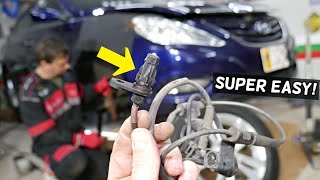
Typical fix: Replace the faulty wheel speed sensor. The sensor is typically held in by a single bolt on the wheel hub/knuckle assembly. 🎬 Watch: How to replace a front wheel speed sensor
Est. part cost: $40-$210 - Damaged Wiring or Connector to a Wheel Speed Sensor 🟡 Medium Probability → Shop ABS Wheel Speed Sensor The wiring harness leading to each wheel is subject to damage from road debris, corrosion (especially in salt-belt regions), and stress from suspension movement. Over time, wires can chafe, break internally, or the connector pins can corrode, causing a low or no signal condition.
How to confirm: Visually inspect the wiring harness leading from the frame to the wheel speed sensor for any signs of chafing, breaks, or corrosion at the connector. Perform a continuity test on the wires between the sensor connector and the ABS module connector. Wiggle the harness while testing to check for intermittent breaks.
Typical fix: Repair the damaged section of wiring or replace the connector pigtail. Ensure the repair is sealed against moisture using heat-shrink tubing.
Est. part cost: $10-$50 - Damaged or Debris-Covered Tone Ring ⚪ Low Probability The tone ring, which is part of the wheel hub or CV axle, can become cracked or contaminated with metallic debris (often from brake wear), preventing the sensor from getting a clean reading. On the YF Sonata, the tone ring is integrated into the wheel bearing/hub assembly.
How to confirm: After removing the wheel speed sensor, visually inspect the tone ring through the sensor mounting hole. Look for broken teeth, cracks, or heavy rust/debris. A borescope can be helpful for a clearer view.
Typical fix: Clean the tone ring with a brush and brake cleaner. If the ring is cracked or damaged, the entire wheel hub and bearing assembly must be replaced.
Est. part cost: $100-$250 (for a new hub or axle if needed)
Rare But Worth Checking
- Faulty ABS Control Module: → Shop ABS Control Module This is uncommon, but if all wheel speed sensors and wiring have been tested and are confirmed to be good, the ABS module itself could be the source of the problem.
- Faulty Powertrain Control Module (PCM): → Shop Engine Control Module (ECM) This is extremely rare. All other possibilities, especially within the ABS system, should be exhausted before considering a PCM failure.
Diagnosis Steps
- Connect an OBD-II scanner and check for codes in both the Engine (PCM) and ABS control modules. Prioritize any ABS codes found, as they will point to the specific wheel causing the issue.
- If an ABS code points to a specific wheel speed sensor, proceed to that corner of the vehicle.
- Use the scanner's live data feature to monitor the speed reported by all four wheels while driving slowly. Confirm that one sensor is not reporting speed or is reporting erratically compared to the others.
- Raise and safely support the vehicle. Remove the wheel corresponding to the faulty sensor.
- Visually inspect the wheel speed sensor and its wiring harness for any obvious damage, corrosion, or loose connections. Pay close attention to the harness routing and any potential chafe points.
- If the wiring looks good, remove the sensor (typically one 10mm or 12mm bolt) and inspect the magnetic tip for metal debris and the tone ring for damage through the mounting hole.
- If no visible issues are found, test the sensor's circuit. Disconnect the sensor and use a multimeter to check for resistance across the sensor's two pins. Compare the reading to the manufacturer's specification (if available) or to a known-good sensor on another wheel. An open (OL) or shorted (0 ohms) reading indicates a failed sensor.
- Check for proper voltage and ground at the sensor connector (harness side) with the key on, according to the vehicle's service manual.
- If the sensor or wiring is confirmed to be faulty, replace the necessary component.
- Clear all codes from the PCM and ABS modules and perform a test drive to ensure the speedometer works and the warning lights do not return.
Parts You'll Likely Need
- ABS Wheel Speed Sensor
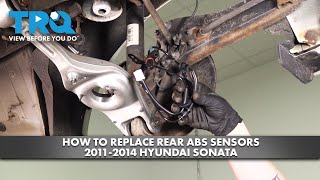
(OEM #Front Left: 59810-3S300, Front Right: 59830-3S300, Rear Left: 95680-3V100, Rear Right: 95681-3V100)🎬 See this step-by-step rear ABS sensor replacement guide — This is the most common failure point for a P0502 code on this platform. The vehicle uses four of these sensors (one at each wheel) to determine vehicle speed. Part numbers can vary slightly by production date and specific options, so always verify with a VIN.
Trusted brands: Hyundai (OEM), Mando, Duralast, Standard Motor Products (SMP), WVE
OEM price range: $150-$370
Aftermarket price range: $35-$200
Related Codes That Often Appear With This One
- C0035 to C0050 — These are ABS-specific codes that pinpoint which wheel speed sensor circuit is having a fault. A P0502 in the engine computer is often a direct result of one of these codes being present in the ABS computer.
Platform-Specific Known Issues
- A thread on Hyundai-Forums.com titled 'ABS/ESC/Check Engine Lights On, Speedometer not working' details a user's 2011 Sonata with these exact symptoms. The community correctly pointed towards a faulty wheel speed sensor, which the owner confirmed was the fix after a dealer diagnosis revealed a code for the right rear wheel speed sensor.
Mechanic-Grade Diagnostic Values
- ABS Wheel Speed Sensor Internal Resistance — expected: 1000-1500 Ohms (1.0-1.5 kΩ).. Failure: An open circuit (infinite resistance/OL) or a short circuit (near 0 Ohms) indicates a failed sensor.
- ABS Wheel Speed Sensor AC Voltage Output — expected: A fluctuating AC voltage that increases in frequency and amplitude as the wheel is spun by hand. Should be at least 200mV (0.2V) AC when spinning the wheel at about one revolution per second.. Failure: No voltage or an erratic, non-linear voltage signal while spinning the wheel points to a faulty sensor or a problem with the tone ring/air gap.
Wiring & Ground Locations
- ABS Control Module (HECU) — Located in the engine bay, attached to the ABS pump/valve body. It is typically found near the brake fluid reservoir.. This is where the signals from all four wheel speed sensors are processed. The main wiring harness connector to this module is a critical point for checking power, grounds, and individual sensor inputs.
- Rear Wheel Speed Sensor Connector — The connectors for the rear wheel speed sensors are located inside the cabin, under the rear seat bottom cushion. Access requires removing the cushion and nearby trim panels.. Technicians may mistakenly look for the connector in the wheel well. Knowing it is inside the cabin is crucial for efficiently testing the rear sensor circuits without unnecessary disassembly.
- Front Wheel Speed Sensor Connector — The connectors for the front sensors are typically located in the engine bay near the inner strut towers.. Provides a dry, accessible point to test the front sensor and its harness without having to lift the vehicle initially.
Real Owner Repair Stories
- Hyundai-Forums.com user (Sonata (year not specified, but symptoms match YF generation)) — ABS and traction control lights were going 'nuts'.
❌ Tried (didn't work) Initial diagnosis was uncertain.
✅ What actually fixed it The user found a corroded wiring harness connection at the ABS control unit. Cleaning the connector with electrical contact cleaner and ensuring a secure reconnection resolved the issue and the warning lights went away. - YouTube video by 'elvrolet' (Hyundai Sonata (YF Generation)) — Random loss of power while driving, with ABS and Traction control lights coming on and off intermittently. Also burned through three tail light bulbs.
❌ Tried (didn't work) The owner spent a long time trying to figure out the electrical issue.
✅ What actually fixed it The root cause was a disintegrated rubber stopper on the brake pedal arm. This small rubber piece presses the brake light switch. When it fails, the switch plunger can over-travel or not make proper contact, confusing the ABS/TCS system. The fix was replacing the small rubber stopper.
Model Year Variations Within This Range
- 2011-2014 Hybrid Models: Sonata Hybrid models may use a different rear wheel speed sensor, part number 59930-3S000. It is critical to verify the correct part number with the vehicle's VIN before ordering.
Diagnostic Flowchart
Other Known Issues on This Vehicle
Issues unrelated to this code that are worth knowing about as an owner of this generation:
- Theta II Engine Seizure/Failure 🔴 High — Widespread across 2.0L and 2.4L GDI engines. Manufacturing debris could lead to connecting rod bearing failure, often resulting in engine seizure. (Ref: Multiple recalls (e.g., NHTSA 15V568000) and a class-action settlement led to extended lifetime warranties for the engine short block for affected vehicles.)
- Steering Coupler Degradation 🟠 Medium — Extremely common. The flexible rubber coupler in the Motor-Driven Power Steering (MDPS) column disintegrates over time, causing a distinct clicking or clunking noise when turning the wheel. (Ref: Hyundai issued TSB #17-ST-002 and extended the warranty on the coupler (Part No. 56315-2K000-FFF) to 10 years/100,000 miles.)
- Faulty Brake Pedal Stopper / Stop Lamp Switch 🟠 Medium — Common on 2011-2012 models. The brake pedal stopper pad can deteriorate, causing the brake lights to stay on, or the switch itself can fail, preventing brake lights from illuminating and potentially causing issues with shifting out of park and cruise control. (Ref: Hyundai issued recalls for both the stopper pad (NHTSA 15V759000) and the stop lamp switch (NHTSA 13V113000).)
- Timing Chain Tensioner Failure 🟠 Medium — Reported by owners, causing a rattling noise on startup. If ignored, it can lead to timing chain slack and potential engine damage. Hyundai later released an improved tensioner part.
Used vs. New Parts: Buying Guide for This Vehicle
When a used part is the smart pick: A used wiring harness pigtail from a junkyard is a viable option if only the connector is damaged. The ABS Control Module could also be sourced used, but it must be an exact part number match and may require 'variant coding' by a dealer or specialized shop to function correctly.
Donor-vehicle mileage cap: roughly under 100000 miles for the part to have meaningful remaining life.
What to inspect on the donor part:
- For wiring, check for any signs of corrosion on the pins, brittleness in the plastic, or previous repairs (splices).
- For an ABS module, ensure the donor vehicle was not in a major front-end collision and that the module has no physical damage.
- Verify the part number on the used module matches the original exactly.
OEM-only on this vehicle (don't cheap out):
- While not strictly required, using an OEM or OE-supplier (like Mando) ABS wheel speed sensor is highly recommended for fit and signal accuracy. Some cheap aftermarket sensors can have incorrect resistance or signal output, leading to persistent problems.
Aftermarket brands forum-validated for this vehicle:
- Mando (often the Original Equipment supplier)
- Standard Motor Products (SMP)
- Duralast
- Timken (for hub assemblies)
- MOOG (for hub assemblies)
Brands owners have reported issues with on this vehicle:
- Unnamed, no-brand sensors from online marketplaces can be a gamble, with reports of incorrect fitment or premature failure.
Real Owner Stories
Aggregated from forums and TSBs cited above. Mileages and costs reflect what owners reported in those sources.
2011 Hyundai Sonata
Symptoms: ABS/ESC/Check Engine Lights On, Speedometer not working.
What fixed it: Replacement of the right rear wheel speed sensor after a dealer diagnosis confirmed the fault.
Source hint: Hyundai-Forums.com thread titled 'ABS/ESC/Check Engine Lights On, Speedometer not working'
Related OBD-II Codes
Frequently Asked Questions
My 2011 Sonata has the ABS, ESC, and Check Engine lights on, and the speedometer is at zero. Is there a specific part I should check?
Can I use a used ABS module from a junkyard for my Sonata?
Is there a specific brand of wheel speed sensor recommended for the YF Sonata?
My brake lights are staying on and I can't shift out of Park; is this related to P0502?
Does the steering clunking noise I hear have anything to do with the speed sensor code?
Can a damaged tone ring cause P0502 on a 2010-2014 Sonata?
Helpful Videos

We Have This Part in Stock


The information in this article is provided for general reference and educational purposes only. Vehicle specifications, procedures, and part compatibility can vary by production date, trim level, and region. Always consult your vehicle's factory service manual and verify part numbers before purchasing or performing repairs. Safety-critical components such as airbags, seat belts, and braking systems should be installed by a qualified professional.
- Hyundai Sonata:
- 🧭 Diagnostic Flowchart
- 🎬 Helpful Videos
- 🛍️ Shop This Part
- What's Unique About the 2010-2014 Hyundai Sonata
- Symptoms You May Notice
- Most Likely Causes
- Rare But Worth Checking
- Diagnosis Steps
- Parts You'll Likely Need
- Related Codes That Often Appear With This One
- Platform-Specific Known Issues
- Mechanic-Grade Diagnostic Values
- Wiring & Ground Locations
- Real Owner Repair Stories
- Model Year Variations Within This Range
- Other Known Issues on This Vehicle
- Used vs. New Parts: Buying Guide for This Vehicle
- Real Owner Stories
- 2011 Hyundai Sonata
- Related OBD-II Codes
- Frequently Asked Questions
- 🎟️ Get 5% Off