

P0506 on 2016-2020 Jeep Compass 2.4L: Low Idle Causes and Fixes
On a 2016-2020 Jeep Compass with the 2.4L engine, code P0506 is most often caused by a dirty electronic throttle body. Carbon buildup restricts airflow, causing a low or rough idle. Cleaning the throttle body is a common and inexpensive first step that usually resolves the issue. If that doesn't work, suspect a vacuum leak or the need for a PCM software update.
- P0506 on your Jeep Compass almost always points to an airflow problem at idle.
- Start with the cheapest and most likely fix: thoroughly clean the electronic throttle body.
- If cleaning doesn't work, perform a smoke test to check for hard-to-find vacuum leaks.
- After cleaning or replacing the throttle body, you may need to perform an idle relearn procedure.
- If you own a 2018 model, check if your vehicle is affected by Safety Recall U87 for a potential PCM issue.
What's Unique About the 2016-2020 Jeep Compass
The 2.4L MultiAir 'Tigershark' engine, used across both the first-generation (MK) and second-generation (MP) Compass, is known for developing carbon buildup in the electronic throttle body. This buildup restricts airflow when the throttle is nearly closed at idle, directly causing the P0506 code. While vacuum leaks are a possible cause on any vehicle, the high probability of a dirty throttle body makes it the go-to first check for this specific Jeep powertrain. Additionally, this engine family is subject to class-action lawsuits concerning excessive oil consumption, which can exacerbate carbon buildup in the intake system.
Generation note: The 2016-2020 year range covers two generations: the first-generation (MK) for the 2016 model year, and the second-generation (MP) from 2017-2020. However, since both generations in this range use the 2.4L MultiAir engine, the causes and diagnostic procedures for P0506 are largely identical.
Symptoms You May Notice
- Engine idle is lower than normal or feels rough.
- Engine stalls when coming to a stop or at idle.
- Difficulty starting the engine.
- Illuminated Check Engine Light.
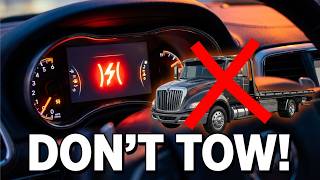
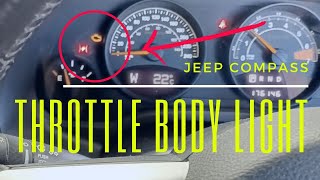
- Flashing Electronic Throttle Control (ETC) light (a lightning bolt symbol on the dash) in some cases 🎬 Watch: Troubleshooting the lightning bolt warning light and throttle faults.
- Poor acceleration from a stop.
- Engine may idle erratically.
- Replacing spark plugs or ignition coils. While these can cause a rough idle, they typically set misfire codes (P0300-P0304) and are less likely to be the primary cause for P0506 alone.
- Replacing oxygen sensors. O2 sensors will report the symptoms of an incorrect air/fuel mixture caused by the low idle or vacuum leak, but they are rarely the root cause of a P0506 code.
Most Likely Causes
- Dirty or Sticking Electronic Throttle Body 🔴 High Probability → Shop Fuel Injection Throttle Body The PCV (Positive Crankcase Ventilation) system routes oil vapors and combustion byproducts back into the intake. On the 2.4L MultiAir, this, combined with potential oil consumption issues, can cause a gummy black carbon ring to form on the throttle plate and bore, restricting the precise airflow needed for idle.
How to confirm: Remove the air intake hose connected to the throttle body and visually inspect the throttle plate and bore for a ring of black carbon buildup. The plate may feel sticky when moved by hand (with the engine off).
Typical fix: Remove the throttle body and clean it thoroughly 🎬 See this walkthrough on how to clean or replace the assembly. with a dedicated throttle body cleaner and a soft, non-abrasive brush or microfiber towel. Do not use overly abrasive materials, as this can damage the precise seal. Reinstall and perform an idle relearn procedure.
Est. part cost: $5-$15 for cleaner - Vacuum Leak 🟡 Medium Probability Hoses and gaskets become brittle with age and heat cycles. Common leak points on this engine include the PCV hose, intake manifold gaskets, and the brake booster line. A leaking brake booster vacuum pump is also a known, specific failure point on the 2.4L engine.
How to confirm: A mechanic can perform a smoke test, which involves feeding pressurized smoke into the intake system to see where it escapes. You can also sometimes hear a hissing sound at idle or find cracked hoses with a visual inspection. Spraying brake cleaner near suspected areas and listening for a change in idle RPM is another common diagnostic trick.
Typical fix: Replace the leaking hose, gasket (e.g., intake manifold gasket), or component (e.g., brake booster).
Est. part cost: $10-$150 depending on the source of the leak - Faulty PCV Valve or Hose ⚪ Low Probability → Shop PCV Valve The PCV valve can get stuck open, creating a constant vacuum leak, or the hose connected to it can crack or collapse. A stuck PCV valve is a known issue on the 2.4L MultiAir engine family.
How to confirm: Inspect the PCV valve and its connecting hoses for cracks, blockages, or a valve that is stuck open. A good valve should rattle when shaken; if it doesn't, it's likely stuck.
Typical fix: Replace the PCV valve and/or hose. The Mopar PCV valve for this engine family is part number 5047063AA.
Est. part cost: $20-$50
Rare But Worth Checking
- Failed Powertrain Control Module (PCM) or Outdated Software: A specific recall (Safety Recall U87 / NHTSA 18V-524) was issued for some 2018 Jeep Compass models due to a faulty voltage regulator in the PCM that could cause stalling. Separately, TSBs for platform mates with the same engine indicate that PCM software updates are a common fix for P0506/P0507, suggesting the factory idle control logic can be faulty. Manufacturer service bulletins, such as TSB Bulletin #1801320, note that technicians may find P0506 set alongside P0607 (ECU Internal Performance).
- Defective Electronic Throttle Body Assembly: → Shop Fuel Injection Throttle Body If cleaning the throttle body does not resolve the issue and there are no vacuum leaks, the internal motor or position sensor may have failed. This will often be accompanied by other throttle-related codes.
- Excessive Oil Consumption: The 2.4L Tigershark engine is subject to class-action lawsuits for excessive oil consumption. Low oil levels can affect the MultiAir valve actuation system, and the increased oil blow-by contributes to faster carbon buildup on the throttle body, indirectly causing P0506. It's critical to maintain the correct oil level with 0W-20 synthetic oil.
Diagnosis Steps
- Read the codes: Use an OBD-II scanner to confirm P0506 and check for any other related codes like P0507 or P0171.
- Visually inspect the air intake: Check the air filter and intake tube for any blockages, restrictions, or cracks.
- Inspect the throttle body: Remove the intake duct from the throttle body. Look for heavy carbon buildup around the throttle plate and in the bore.
- Clean the throttle body: If dirty, remove the throttle body from the intake manifold. Clean it carefully using throttle body cleaner and a soft cloth or nylon brush. Do not spray cleaner directly into the electronic components.
- Reinstall and perform idle relearn: After cleaning, reinstall the throttle body with a new gasket. Perform a throttle relearn procedure. A common method for Chrysler/Jeep is to turn the ignition to 'ON' (engine off), wait 10 seconds, then slowly press the accelerator pedal to the floor and slowly release it. Turn the ignition 'OFF' for 10 seconds, then start the engine and let it idle.
- Check for vacuum leaks: If the problem persists, the next most likely cause is a vacuum leak. Listen for hissing sounds around the engine bay at idle. For best results, have a professional perform a smoke test to pinpoint the leak.
- Inspect the PCV system: Check the PCV valve and its hoses for cracks, damage, or blockages. Shake the valve to ensure it rattles.
- Check for recalls and TSBs: Use your VIN to check for open recalls, specifically Safety Recall U87 for the PCM on 2018 models. Ask a dealer if any PCM software updates related to idle performance are available for your vehicle.
Parts You'll Likely Need
- Electronic Throttle Body
(OEM #Mopar 04892855AC (Verify by VIN))— If cleaning the throttle body doesn't fix the issue, the unit's internal electronics may have failed, requiring a full replacement.
Trusted brands: Mopar, Bosch, Hitachi
OEM price range: $250-$350
Aftermarket price range: $100-$200 - Intake Manifold Gasket — This gasket can fail and create a vacuum leak, which is a common cause of idle issues if the throttle body is clean.
Trusted brands: Fel-Pro, Mahle, Mopar
OEM price range: $20-$40
Aftermarket price range: $10-$25 - PCV Valve
(OEM #Mopar 5047063AA)— A stuck PCV valve is a common source of vacuum leaks on this engine platform and can cause idle control codes.
Trusted brands: Mopar, Standard Motor Products
OEM price range: $20-$35
Aftermarket price range: $10-$20
Related Codes That Often Appear With This One
- P0507 — This code for 'Idle RPM Higher Than Expected' can be caused by the same root problems, particularly vacuum leaks or a sticking throttle body, which the PCM may over-correct for in the other direction.
- P2172 — This code for 'High Airflow/Vacuum Leak Detected' often appears with P0506, strongly suggesting an un-metered air leak is the root cause of the idle problem. TSB Bulletin #1805322 notes that P0506 and P2172 may be set together.
- P0171 — This code for 'System Too Lean (Bank 1)' points to a vacuum leak, as the extra, unmetered air creates a lean condition and can also cause the idle to be unstable.
Technical Service Bulletins (TSBs) & Recalls
- Safety Recall U87 / NHTSA 18V-524: Powertrain Control Module may have a faulty voltage regulator chip that can cause engine stalling.
- While not specific to the Compass, TSBs for the Ram ProMaster City with the same 2.4L engine (e.g., TSB 18-061-16) address code P1185 with a PCM update, indicating a history of software-related sensor correlation issues that could affect idle control logic.
- TSB Bulletin #1807023 indicates that P0506 may be found alongside P0441 (EVAP Purge System Performance) and P2172, and the customer may see a "Performance Limited Service Fuel System" message.
- TSB Bulletin #1801922REVA and TSB Bulletin #1805322REVA document that P0506 can occur in conjunction with ECU internal performance codes (P0607) and injector circuit performance issues.
Platform-Specific Known Issues
- Safety Recall U87 / NHTSA 18V-524 affects some 2018 Jeep Compass models. A faulty PCM can cause engine stalling, which may present with a P0506 code.
- The 2.4L MultiAir engine in the Compass is part of a wider group of 'Tigershark' engines with documented oil consumption issues, which can accelerate the carbon buildup that causes P0506. Owners should monitor oil levels closely.
Mechanic-Grade Diagnostic Values
- Throttle Body Connector: 5V Reference Pin — expected: ~5.0V with key on, engine off.. Failure: Voltage significantly lower than 5.0V or 0V indicates a wiring or PCM issue.
- Throttle Body Connector: Sensor Ground Pin — expected: ~0.0V (good ground connection).. Failure: Voltage significantly above 0V indicates a bad ground connection, which can cause erratic sensor readings.
- Throttle Body Connector: TP Sensor 1 Signal — expected: A specific voltage that changes smoothly as the throttle plate is manually opened and closed (e.g., ~0.5V at closed throttle to ~4.5V at wide-open throttle).. Failure: Voltage that is stuck, jumps erratically, or doesn't change with throttle movement indicates a failed sensor.
- Freeze Frame Data: Target vs. Actual Idle RPM — expected: The 'Actual Idle RPM' PID should be within ~25-50 RPM of the 'Target Idle RPM' PID.. Failure: When P0506 is set, the 'Actual Idle RPM' will be consistently 100-200 RPM below the 'Target Idle RPM'. This confirms the PCM is commanding a higher idle but the engine is not achieving it.
Scan Tool Commands That Help
- wiTECH (or equivalent professional scan tool): Throttle Body Relearn / ETC Relearn — This function is mandatory after cleaning or replacing the electronic throttle body. It forces the PCM to learn the new closed and wide-open positions of the throttle plate. Failing to perform this step is a common reason for the P0506 code to return even after a successful physical repair.
Wiring & Ground Locations
- Throttle Body Connector — Plugged directly into the electronic throttle body, located between the air intake hose and the intake manifold.. This 6-pin connector provides power, ground, and signal lines for the throttle plate motor and the dual throttle position sensors. A loose connection, corrosion, or damaged wire at this specific point will directly cause idle control and throttle performance codes. A wiring diagram for a 2016 Compass shows the key pins at the PCM connector (C2) are: Pin 67 (5V Supply), Pin 66 (Sensor Ground), Pin 89 (TP1 Signal), and Pin 90 (TP2 Signal).
- G300 / G301 — On older Jeep platforms, these are major chassis grounds located under the front seats. On the first-gen Compass (MK), wiring diagrams show G301 on the left side of the luggage compartment. Their exact location on the second-gen (MP) may be under the center console.. The PCM and its sensors rely on clean ground connections. A corroded or loose main body ground can introduce electrical noise and voltage drops, causing the PCM to receive incorrect data from sensors and potentially mismanage idle speed.
Real Owner Repair Stories
- YouTube channel 'Getting it done' (2014 Jeep Compass (MK generation, but same 2.4L powertrain family)) — Flashing throttle control light (lightning bolt), check engine light, traction control light on, clicking noise from throttle body, no accelerator response.
❌ Tried (didn't work) Initial diagnosis pointed to a failed throttle body.
✅ What actually fixed it A new throttle body was installed, but it initially threw a code because the new throttle plate was stuck. The mechanic had to manually push the butterfly valve to free it up. After being freed, a throttle relearn procedure was performed, and all codes were cleared, resolving the issue. - YouTube channel 'World Mechanics' (2017 Jeep Compass (MP generation) with 2.4L MultiAir) — Engine light on with codes P0506 and P0507.
✅ What actually fixed it The video identifies the two most common causes as a dirty/sticking throttle body due to carbon buildup and vacuum leaks. The primary fix demonstrated is removing and thoroughly cleaning the throttle body.
OEM Part Supersession History
Varies by year→Varies by year— Design change
Heads up: On some related models like the Jeep Patriot, the factory replacement throttle body may come with a different electrical connector than the original harness. The new part should include a kit with a new pigtail connector and instructions for cutting the old plug and splicing the new one on, requiring careful matching of wire colors/positions.
Diagnostic Flowchart
Real Owner Stories
Aggregated from forums and TSBs cited above. Mileages and costs reflect what owners reported in those sources.
Jeep Compass
Symptoms: Experienced a rough idle and received a P0506 'idle control system RPM lower than expected' code.
What fixed it: Cleaning the throttle body and Idle Air Control (IAC) valve.
Source hint: Reddit r/askcarguys - Thread titled 'Got a P0506 code -"idle control system RPM lower than expected"?'
Jeep Compass / Renegade 2.4L MultiAir
Symptoms: Idle speed performance issues triggering P0506 and P0507 codes.
What fixed it: Cleaning a dirty throttle body and repairing vacuum leaks.
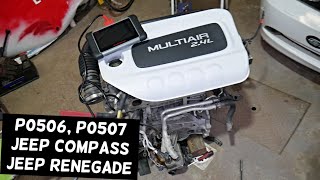
Source hint: YouTube - 'JEEP COMPASS RENEGADE CODE P0506 P0507 IDLE SPEED PERFORMANCE' by Auto Repair Guys
2018 Jeep Compass
Symptoms: Engine stalling issues that can present alongside a P0506 code.
What fixed it: Replacing or updating the Powertrain Control Module (PCM) due to a faulty voltage regulator chip.
Source hint: Safety Recall U87 / NHTSA 18V-524
Related OBD-II Codes
Frequently Asked Questions
Does Safety Recall U87 apply to my Jeep Compass for code P0506?
Why is my 2.4L MultiAir engine so prone to throttle body carbon buildup?
What is the correct PCV valve part number for the 2016-2020 Compass 2.4L?
How do I perform an idle relearn on my Jeep Compass after cleaning the throttle body?
My Electronic Throttle Control (ETC) light is flashing with a lightning bolt symbol. Is this related to P0506?
Could a brake booster issue cause a P0506 code on my 2.4L Compass?
Helpful Videos
We Have This Part in Stock

The information in this article is provided for general reference and educational purposes only. Vehicle specifications, procedures, and part compatibility can vary by production date, trim level, and region. Always consult your vehicle's factory service manual and verify part numbers before purchasing or performing repairs. Safety-critical components such as airbags, seat belts, and braking systems should be installed by a qualified professional.
- Jeep Compass:
- 🧭 Diagnostic Flowchart
- 🎬 Helpful Videos
- 🛍️ Shop This Part
- What's Unique About the 2016-2020 Jeep Compass
- Symptoms You May Notice
- Most Likely Causes
- Rare But Worth Checking
- Diagnosis Steps
- Parts You'll Likely Need
- Related Codes That Often Appear With This One
- Technical Service Bulletins (TSBs) & Recalls
- Platform-Specific Known Issues
- Mechanic-Grade Diagnostic Values
- Scan Tool Commands That Help
- Wiring & Ground Locations
- Real Owner Repair Stories
- OEM Part Supersession History
- Real Owner Stories
- Jeep Compass
- Jeep Compass / Renegade 2.4L MultiAir
- 2018 Jeep Compass
- Related OBD-II Codes
- Frequently Asked Questions
- 🎟️ Get 5% Off