

P0513 on 2018-2022 Mitsubishi Outlander PHEV: Immobilizer Key Causes and Fixes
This code means your Outlander PHEV's anti-theft system doesn't recognize the key. The most likely cause is a dead battery in your key fob (a CR2032), which is a simple $5-$10 fix. If a new battery or your spare key doesn't work, the key may be damaged or require reprogramming by a dealer or locksmith, which can be more costly.
- P0513 means your car's anti-theft system has locked you out, almost always causing a no-start condition.
- Always try your spare key first. If it works, the problem is your primary key.
- The easiest and most common fix is replacing the CR2032 battery in your key fob.
- If a new battery doesn't help, the issue requires professional diagnosis with a specialized scan tool.
- Do not immediately assume a major component has failed; follow the diagnostic steps from simplest to most complex.
What's Unique About the 2018-2022 Mitsubishi Outlander PHEV
The Outlander PHEV uses a keyless operation system (KOS) with an immobilizer module known as the OSS-ECU. This system communicates with the PHEV-ECU over the vehicle's network. A failure can occur not just in the key, but in the communication link between these modules. While key fob issues are common on all cars, some Mitsubishi models have shown a tendency for the immobilizer module itself (OSS-ECU) to fail, which can be a specific point of failure on this platform. A related TSB for the Outlander Sport confirms that communication errors between the OSS-ECU and the main ECU can cause a no-start and trigger immobilizer warnings.
Symptoms You May Notice
- Engine cranks but will not start, or the vehicle will not enter 'Ready' mode.
- Flashing security indicator light on the dashboard (often looks like a key or a car with a lock).
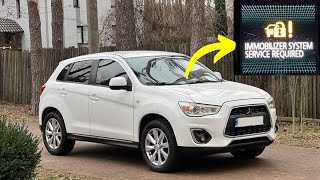
- "Immobilizer System Service Required" message may appear on the multi-information display.
- Key fob may not lock or unlock doors, and its indicator light may blink rapidly or not at all when a button is pressed.
- Replacing the 12V battery without testing it first. While a weak battery can be a cause, it's often not the root problem for a persistent P0513.
- Assuming the starter motor or hybrid system is faulty, when it's the security system preventing them from engaging.
Most Likely Causes
- Weak or Dead Key Fob Battery 🔴 High Probability → Shop Vehicle Battery Key fob batteries have a finite life of 2-4 years. This is a common maintenance item for all keyless entry vehicles.
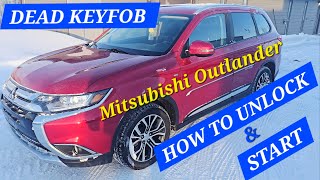
How to confirm: Try using your spare key fob. If the vehicle starts, the issue is with the primary key. You can also try holding the key fob directly against the start button while pressing it, which can sometimes work with a very weak battery. 🎬 Watch: How to start your Outlander with a dead key fob A "Low Key Battery" warning may also appear on the dash.
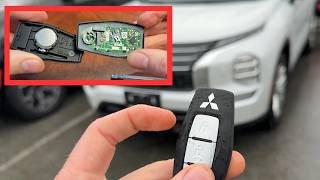
Typical fix: Replace the CR2032 battery inside the key fob. The positive (+) side should face down in the casing. 🎬 Watch: How to replace your key fob battery
Est. part cost: $5-$10 - Damaged or Faulty Key Fob 🟡 Medium Probability → Shop Keyless Entry Transmitter The internal transponder chip can be damaged if the key is dropped, exposed to water, or subjected to strong magnetic fields. This is a common failure mode for all modern electronic keys.
How to confirm: If the spare key works and replacing the battery in the original key does not solve the problem, the key itself is likely damaged. A locksmith or dealer can test the transponder's signal.
Typical fix: The key fob must be replaced and programmed to the vehicle by a Mitsubishi dealer or a qualified automotive locksmith.
Est. part cost: $150-$400 - Radio Frequency (RF) Interference ⚪ Low Probability This can affect any vehicle with a keyless system. Mitsubishi service documents explicitly note this as a possible cause.
How to confirm: Remove other keys, fobs, cell phones, and electronic devices from the vicinity of the vehicle's start button and try again. If the car starts, RF interference was the likely issue.
Typical fix: Isolate the correct key fob from other electronic devices when starting the vehicle.
Est. part cost: $0 - Faulty Immobilizer Module (OSS-ECU) ⚪ Low Probability A related Technical Service Bulletin (TSB-21-54A-001) for the Outlander Sport points to failures of this module, particularly due to communication errors that can be fixed with a software reflash or module replacement. This indicates a known weakness in the component family.
How to confirm: A professional scan tool is needed to check for specific diagnostic trouble codes (DTCs) stored in the OSS-ECU, such as B1157, B2417, or B1139. The absence of communication with the module also points to its failure. A Reddit user with a P0513 code was told by a mechanic they needed to have the immobilizer exchanged.
Typical fix: Depending on the specific DTCs, the OSS-ECU may need to be reprogrammed with updated software or replaced entirely. This must be done by a dealer or specialist.
Est. part cost: $300-$600
Rare But Worth Checking
- Faulty Immobilizer Antenna: → Shop Antenna The antenna ring around the start button reads the key's signal. If it fails or its connection is loose, the key won't be detected. This is less common than key or module failure but is a possible point of failure in the system.
- Weak 12V Vehicle Battery: → Shop Vehicle Battery A low main 12V battery can cause a wide range of electronic issues, including communication errors between security modules. Owners on forums for the Outlander PHEV note that the 12V battery can fail every 2-3 years and cause various electrical gremlins. Before diagnosing complex components, ensure the 12V battery is fully charged and healthy. 🎬 See this step-by-step guide to safely replacing the 12V battery
- PHEV-ECU Malfunction: This is the least likely cause. The PHEV-ECU is a robust component, and Mitsubishi's own diagnostic procedure for P0513 lists it as a final possibility after checking the OSS-ECU and key. All other possibilities should be exhausted before considering it as the point of failure.
Diagnosis Steps
- Try to start the vehicle with your spare key. If it works, the problem is isolated to your primary key fob.
- If the spare key also fails, replace the battery (a CR2032) in one of the key fobs as a low-cost first step. Ensure the positive side faces down.
- Remove any other keys, fobs, or powerful electronics from near the start button to eliminate radio frequency interference.
- Check the vehicle's main 12V battery. Ensure it is fully charged (above 12.4V) and the terminals are clean and tight. A weak 12V battery is a known cause of various electronic issues on the PHEV.
- If the vehicle still won't start, it requires professional diagnosis. A technician will use a scan tool (like the Mitsubishi M.U.T.-III) to read codes directly from the Immobilizer (OSS-ECU) and PHEV-ECU.
- Specific codes like B2417 and B1139 may point to a software issue correctable by a reflash, as described in TSB-21-54A-001 for a similar model.
- If a code like B1157 is present, or if there is no communication with the OSS-ECU, the module itself is likely faulty and requires replacement.
- If a component is replaced (key, OSS-ECU, or PHEV-ECU), it must be programmed to the vehicle using specialized tools.
Parts You'll Likely Need
- Key Fob Battery
(OEM #CR2032)— This is the most frequent failure point and the easiest and cheapest to fix.
Trusted brands: Panasonic, Energizer, Duracell
OEM price range: $5-$10
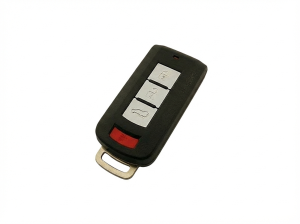
Aftermarket price range: $2-$8 - Keyless Operation Key Fob
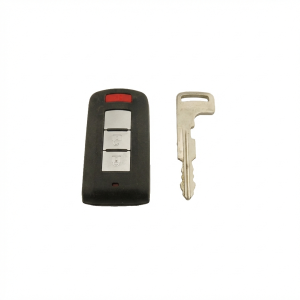
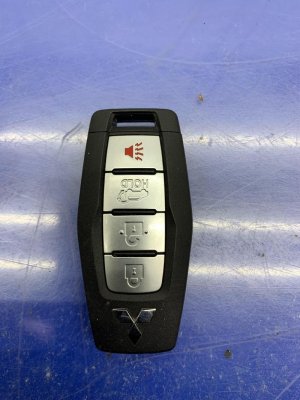
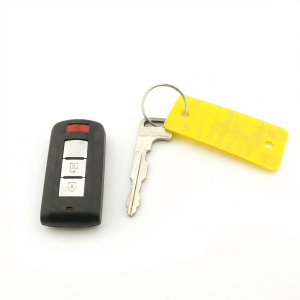
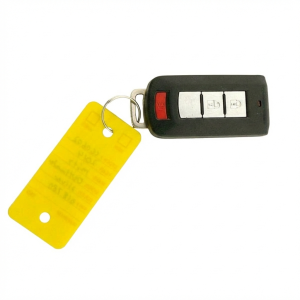
(OEM #8637B665 (for 2018-2020 models))— If the internal transponder chip is damaged, the entire key fob must be replaced and programmed.
Trusted brands: OEM Mitsubishi
OEM price range: $200-$400
Aftermarket price range: $100-$250 - Immobilizer Control Module (OSS-ECU)
(OEM #8670A068 (Example for related Outlander Sport, specific PHEV P/N may vary))— This module can fail, preventing communication with the key and the main ECU. A TSB for related models suggests this is a known issue requiring a reflash or replacement.
Trusted brands: OEM Mitsubishi
OEM price range: $300-$600
Related Codes That Often Appear With This One
- B1139 (KOS authenticate timeout)
- B2417 (OSS authenticate error)
- B1157 (OSS-ECU internal malfunction)
Technical Service Bulletins (TSBs) & Recalls
- TSB-21-54A-001 (for non-PHEV Outlander/Outlander Sport): While not directly for the PHEV, this TSB is highly relevant as it addresses 'Immobilizer System Service Required' warnings caused by a faulty OSS-ECU. It details a fix involving either reprogramming the module's software or replacing the unit if specific DTCs (B2417, B1139, B1157) are present, providing a clear diagnostic path for the same components used in the PHEV.
Platform-Specific Known Issues
- A user on a Reddit forum for Mitsubishi vehicles reported getting a P0513 code and being advised by their mechanic that the entire immobilizer module needed to be exchanged along with getting new keys.
- On the 'MyOutlanderPHEV.com' forum, multiple threads discuss the rapid failure and draining of the 12V auxiliary battery, which can cause a host of electronic problems. Owners state that replacing the battery every 2-3 years is almost a preventative maintenance item.
Mechanic-Grade Diagnostic Values
- KOS-ECU Ground Continuity — expected: Continuity to ground (2 Ω or less). Failure: Resistance greater than 2 Ω indicates a poor ground connection.
- CAN Bus Voltage at ETACS-ECU Connector — expected: 4.0 V or less on both CAN_H and CAN_L lines to body ground.. Failure: Voltage greater than 4.0 V on either line indicates a short to power in the CAN bus, which can disrupt communication between the PHEV-ECU and OSS-ECU.
- OSS-ECU (IG1) Signal Voltage at ECM Connector — expected: 12V (starter battery positive voltage). Failure: No voltage or low voltage indicates a power supply issue to the immobilizer system, potentially from the MFI relay or related wiring.
Hidden / Shadow Codes Worth Checking
- B2352: Antenna Fail. This code is set by the KOS-ECU if an open or short to ground is detected in the immobilizer antenna circuit. It points directly to a faulty antenna or its wiring, which is a more specific diagnosis than the general P0513. (see via Mitsubishi M.U.T.-III or a professional scan tool capable of reading Mitsubishi-specific body codes (B-codes) from the KOS/OSS-ECU.)
- B1A10 - B1A13: Keyless/KOS key [1-4] low battery. The KOS-ECU sets these codes if it receives a low battery voltage signal from a specific registered key five consecutive times. This can confirm a key battery issue before the P0513 is set. (see via Mitsubishi M.U.T.-III or equivalent professional scan tool accessing the KOS-ECU.)
Scan Tool Commands That Help
- Mitsubishi M.U.T.-III: ID Codes Registration — This function is required after replacing a keyless operation key, the OSS-ECU, or the PHEV-ECU to register the encrypted codes and allow the components to communicate.
- Mitsubishi M.U.T.-III: Read OSS-DTC — This is a critical first step when diagnosing P0513. The generic P0513 is set by the engine ECU, but the OSS-ECU will store more specific codes (like B2352 for antenna failure) that pinpoint the root cause within the immobilizer system.
- Mitsubishi M.U.T.-III: KOS antenna communication status check — This active test can be used to verify if the various antennas in the Keyless Operation System are communicating correctly with the KOS-ECU, helping to diagnose a faulty antenna.
Wiring & Ground Locations
- OSS-ECU Connector C-10 — The OSS-ECU is typically located behind the dashboard, often near the steering column or center console.. This is the main connector for the immobilizer module. Checking for power, ground, and CAN bus signals at this connector is a key diagnostic step. A poor connection here can cause a total loss of immobilizer function.
- Joint Connector (CAN5) — Located within the dashboard harness, serving as a junction for the CAN-C-Mid bus.. A fault at this joint connector can interrupt communication between the OSS-ECU, ETACS-ECU, and PHEV-ECU, leading to a P0513 code. Diagnostic procedures involve checking voltage at this point to isolate shorts.
- Key Slot Connector C-116 — This is the connector for the emergency key slot, used when the key fob battery is dead.. A fault in the wiring between this connector and the KOS-ECU (at connector C-10) can set antenna-related fault codes (like B2352) and prevent the emergency start procedure from working.
OEM Part Supersession History
8637B665→8637C815— Standard part revision or update by the manufacturer.
Heads up: The parts are cross-compatible for the specified 2018-2020 model years. Always verify with VIN.
Model Year Variations Within This Range
- 2018-2020 vs 2021-2022: The user prompt specifies the 4B11 2.0L engine. This engine was used in the 2018-2020 Outlander PHEV. For the 2021 model year, the vehicle was updated with a larger 2.4L (4B12) engine and a higher capacity drive battery. While the immobilizer system functions similarly, part numbers for the PHEV-ECU and related software may differ. This article's focus is on the 2.0L 4B11 models.
Diagnostic Flowchart
Other Known Issues on This Vehicle
Issues unrelated to this code that are worth knowing about as an owner of this generation:
- Cabin Heater Failure 🔴 High — Common issue, especially on 2.0L models. Can occur at various mileages. Many forum and Reddit threads discuss this.
- Premature 12V Auxiliary Battery Failure 🟠 Medium → Shop Vehicle Battery — Frequently reported by owners on forums, with batteries often lasting only 2-4 years.
- High-Voltage Battery Degradation & Charging Faults 🟠 Medium → Shop Vehicle Battery — Becomes more common as vehicles age, with some owners reporting significant range loss after 5-7 years.
- Faulty OEM Level 1 Charger 🟡 Low — Several owners report issues with the provided 120V charging cable (EVSE).
- Premature Brake Wear 🟠 Medium — Reported by some owners, with pads and rotors needing replacement sooner than expected (e.g., 20,000-40,000 miles).
Used vs. New Parts: Buying Guide for This Vehicle
When a used part is the smart pick: For this specific fault, using used parts is generally not recommended. The key fobs, OSS-ECU, and PHEV-ECU are all security components that are VIN-coded to the original vehicle. While some specialist locksmiths may be able to 'virginize' or unlock a used OSS-ECU, it is a complex and often unsuccessful process. A used key fob cannot be reprogrammed to a different vehicle.
What to inspect on the donor part:
- Not applicable due to the electronic security nature of the parts.
OEM-only on this vehicle (don't cheap out):
- Keyless Operation Key Fob
- Immobilizer Control Module (OSS-ECU)
- PHEV-ECU
Aftermarket brands forum-validated for this vehicle:
- There are no widely validated aftermarket brands for the core security modules (OSS-ECU, PHEV-ECU). For key fobs, only OEM Mitsubishi parts are reliable.
Brands owners have reported issues with on this vehicle:
- Avoid generic online marketplace key fobs and used electronic control modules from junkyards, as they are highly unlikely to be programmable to your vehicle and will result in wasted time and money.
Real Owner Stories
Aggregated from forums and TSBs cited above. Mileages and costs reflect what owners reported in those sources.
2018-2022 Mitsubishi Outlander PHEV 2.0L I4
Symptoms: The owner received a P0513 code and was experiencing a no-start condition.
What fixed it: The mechanic advised that the entire immobilizer module needed to be exchanged and new keys were required to resolve the communication failure.
Source hint: Reddit forum for Mitsubishi vehicles
2018-2022 Mitsubishi Outlander PHEV 2.0L I4 — ~45000 miles
Symptoms: The vehicle experienced unexpected 12V battery drain leading to a no-start condition and various electronic error messages.
What fixed it: Replacing the 12V auxiliary battery. Owners on the forum recommend this as preventative maintenance every 2-3 years due to the short lifespan of the OEM battery.
Source hint: MyOutlanderPHEV.com forum threads regarding '12v battery death'
Related OBD-II Codes
Frequently Asked Questions
Does TSB-21-54A-001 apply to my Outlander PHEV if I see the 'Immobilizer System Service Required' message?
Can a weak 12V auxiliary battery cause a P0513 code on my 2018-2022 Mitsubishi Outlander PHEV?
Which way should the battery face when I replace it in my Outlander PHEV key fob?
Is there a way to start my PHEV if the key fob battery is too weak to be detected?
What specific diagnostic codes should a technician look for in the OSS-ECU regarding P0513?
Can my cell phone interfere with the immobilizer system and cause a P0513?
Helpful Videos

Used OEM Parts in Stock
New Aftermarket Parts Available


The information in this article is provided for general reference and educational purposes only. Vehicle specifications, procedures, and part compatibility can vary by production date, trim level, and region. Always consult your vehicle's factory service manual and verify part numbers before purchasing or performing repairs. Safety-critical components such as airbags, seat belts, and braking systems should be installed by a qualified professional.
- Mitsubishi Outlander PHEV:
- 🧭 Diagnostic Flowchart
- 🎬 Helpful Videos
- 🛍️ Shop This Part
- What's Unique About the 2018-2022 Mitsubishi Outlander PHEV
- Symptoms You May Notice
- Most Likely Causes
- Rare But Worth Checking
- Diagnosis Steps
- Parts You'll Likely Need
- Related Codes That Often Appear With This One
- Technical Service Bulletins (TSBs) & Recalls
- Platform-Specific Known Issues
- Mechanic-Grade Diagnostic Values
- Hidden / Shadow Codes Worth Checking
- Scan Tool Commands That Help
- Wiring & Ground Locations
- OEM Part Supersession History
- Model Year Variations Within This Range
- Other Known Issues on This Vehicle
- Used vs. New Parts: Buying Guide for This Vehicle
- Real Owner Stories
- 2018-2022 Mitsubishi Outlander PHEV 2.0L I4
- 2018-2022 Mitsubishi Outlander PHEV 2.0L I4 — ~45000 miles
- Related OBD-II Codes
- Frequently Asked Questions
- 🎟️ Get 5% Off