

P0601 on 2005-2013 Chevrolet Corvette: ECM Memory Error Causes and Fixes
P0601 on a C6 Corvette indicates a fatal internal memory error in a control module, almost always the Engine Control Module (ECM). The only fix is to replace the ECM and have it professionally programmed, costing between $800 and $1,700. Before replacement, always check all battery and ground connections, as loose terminals or corroded grounds are a known C6 issue that can cause similar symptoms.
- P0601 is a fatal error code for a control module; on a C6 Corvette, this is almost always the Engine Control Module (ECM).
- Do not drive the vehicle. The risk of sudden stalling is high and presents a serious safety hazard.
- Before spending money on a new ECM, you MUST check the battery, charging system, and all major ground connections, as C6 Corvettes are prone to electrical issues from bad grounds and loose battery terminals.
- Use a professional scan tool to confirm if the code is in the ECM or the less-common Transmission Control Module (TCM) to avoid replacing the wrong part, as per TSB PIP4653E.
- Any replacement module is NOT plug-and-play and must be professionally programmed to your car's VIN, which includes a security system relearn.
What's Unique About the 2005-2013 Chevrolet Corvette
For the C6 Corvette, P0601 is not exclusively an ECM code. GM Technical Service Bulletin #PIP4653E highlights that the Transmission Control Module (TCM) can also set this code, which could lead to misdiagnosis if only the engine is considered. Furthermore, the C6 platform is known for having sensitive electronics and can develop electrical issues from poor ground connections, particularly the one located on the frame rail under the battery tray. These grounding issues can sometimes mimic or even contribute to module failure and should always be investigated before condemning an expensive computer.
Symptoms You May Notice
- Check Engine Light illuminated
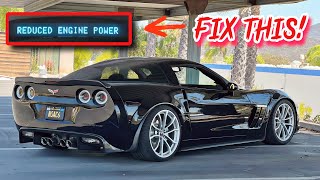
- "Reduced Engine Power" message on the driver information c 🎬 Watch: What to do when your C6 enters reduced engine power mode.enter
- Engine stalls unexpectedly, either while driving or at idle, sometimes only after warming up
- Vehicle may not start, or cranks but fails to fire
- Vehicle may not crank at all, even with a new pre-programmed ECM, if a security relearn procedure is not completed correctly
- Erratic engine performance, such as sputtering or surging, sometimes described as the engine momentarily shutting off and back on
- "Service Active Handling System" message may appear simultaneously
- Automatic transmission shifting problems
- Multiple other warning lights and messages appearing at once
- Replacing the ECM without first confirming with a scan tool that the ECM, and not the TCM, is the source of the code.
- Replacing the ECM without first thoroughly inspecting, cleaning, and tightening all battery connections and chassis grounds. Many owners have reported P0601 symptoms being resolved by simply tightening loose battery terminals.
Most Likely Causes
- Failed Engine Control Module (ECM) 🔴 High Probability → Shop Engine Control Module (ECM) The E40, E38, and E67 ECMs used in the C6 can fail from years of thermal stress and vibration, leading to internal issues like cracked solder joints or memory corruption. This is the most common cause of a true P0601 code.
How to confirm: After verifying all power and ground circuits to the ECM are perfect (stable voltage, low resistance), if the P0601 code persists or immediately returns after clearing, the module is condemned. An advanced scan tool is needed to confirm the code is originating from the ECM.
Typical fix: Replace the Engine Control Module and have the new unit professionally programmed to the vehicle's VIN and security systems.
Est. part cost: $250-$1100 - Low Voltage or Poor Power/Ground Connections 🟡 Medium Probability C6 Corvettes are known to be sensitive to voltage fluctuations. A common trouble spot is the ground block on the frame under the battery tray, which is exposed to corrosion from battery fumes and the elements. Loose battery terminals are also frequently reported by owners as a cause of P0601-like symptoms, including stalling and limp mode.
How to confirm: Test the battery and charging system. With the engine off, battery voltage should be above 12.4V. With the engine running, alternator output should be stable between 13.5-14.5V. Physically disconnect, clean all contact surfaces of the battery terminals and major engine/chassis grounds (especially under the battery and on the engine block near the starter), and re-secure them.
Typical fix: Clean or replace corroded battery terminals and ground straps. Replace a weak battery or failing alternator. Some owners add supplementary ground wires from the engine block to the frame as a preventative measure.
Est. part cost: $20-$600 - Failed Transmission Control Module (TCM) ⚪ Low Probability → Shop Transmission Assembly As noted in GM TSB #PIP4653E, the TCM is a possible, though less common, source for a P0601 code on this platform. This is a documented possibility across many GM vehicles of this era.
How to confirm: Use an advanced scan tool capable of communicating with the TCM to verify if the P0601 code is stored there. The code will be specific to the TCM module.
Typical fix: Replace the Transmission Control Module and have it programmed.
Est. part cost: $300-$900
Rare But Worth Checking
- Aftermarket Engine Tuning: An improper or failed attempt to flash a custom tune to the ECM can corrupt the memory and result in a P0601 code. This can sometimes be fixed by reflashing the stock tune, but may also permanently 'brick' the module.
Diagnosis Steps
- Verify the P0601 code is present using an OBD-II scanner.
- CRITICAL: Use an advanced, professional scan tool to determine WHICH module set the code (e.g., ECM, TCM).
- Thoroughly test the battery's state of health and the alternator's output to ensure stable voltage (13.5-14.5V when running).
- Disconnect the battery. Inspect and meticulously clean the battery terminals and cable ends. C6 terminals can be problematic; ensure they are fully seated and tightened.
- Locate, disassemble, clean, and re-secure the main chassis ground points. Key locations on a C6 include: G102 on the frame rail directly under the battery 🎬 See this walkthrough on locating and cleaning all C6 ground points., G105/G106 on the engine block near the starter, and others on the frame and behind the seats.
- Perform a voltage drop test on the main power and ground circuits to the ECM to check for high resistance under load.
- Inspect the wiring harness and connectors leading to the identified faulty module for any signs of damage, corrosion, or looseness.
- If all wiring, power, and grounds are confirmed to be in perfect condition, the module that stored the code is faulty.
- Replace the faulty module (ECM or TCM).
- Have the new module professionally programmed to the vehicle's VIN. This often includes a Crankshaft Position Variation Relearn and a Vehicle Anti-Theft System (VATS) relearn procedure.
Parts You'll Likely Need
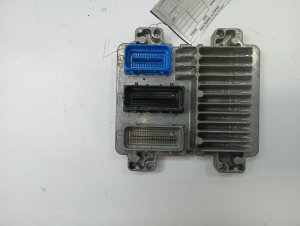
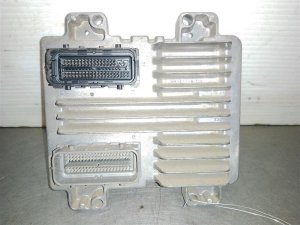
- Engine Control Module (ECM)
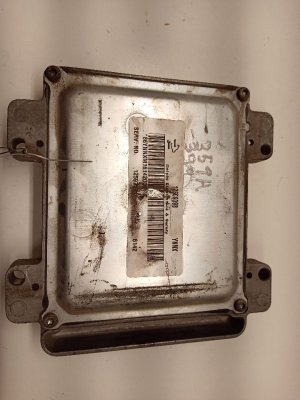
(OEM #E40 (2005 LS2): 19210071, 12597191 (hardware). E38 (2006-13 LS2/LS3): 12612384. E67 (LS7/LS9): 12633238, 12633264.)— This is the most common cause of a P0601 code, indicating a non-repairable internal memory failure. Part numbers vary by year and engine.
Trusted brands: ACDelco
OEM price range: $400-$1100
Aftermarket price range: $250-$600
Technical Service Bulletins (TSBs) & Recalls
- PIP4653E - Warns that DTCs P0601, P0603, P0604, P062F, or P1621 can be stored in the TCM and to verify which module set the code before starting diagnosis.
- Bulletin #05-06-04-060A - Communicates information to technicians regarding control module Diagnostic Trouble Codes including P0601, P0602, P0603, P0604, P0606, P062F, P06F3, and P1621, which can be shared in multiple modules.
Platform-Specific Known Issues
- TSB #PIP4653E: This bulletin warns technicians that P0601, P0603, P0604, P062F, or P1621 can be stored in the Transmission Control Module (TCM), advising them to verify the source module before replacing the ECM.
- C6 Grounding Points: The ground connection (G102) located on the frame rail directly under the battery is a known weak point that can corrode and cause a host of electrical problems, including symptoms that mimic ECM failure. Other key grounds are on the engine block.
Mechanic-Grade Diagnostic Values
- ECM Power and Ground Circuit Voltage Drop — expected: Less than 0.5 Volts. Failure: A reading greater than 0.5V indicates excessive resistance in the power or ground circuit that must be repaired before condemning the ECM.
- Battery Voltage (Static, Unused for several days) — expected: Above 11.1 Volts. Failure: A battery that consistently falls below 11.1V, and especially below 10.8V, after sitting for a few days is weak and can cause spurious module errors.
- CAN Bus Resistance — expected: Approximately 120 Ohms. Failure: With the ECM disconnected, resistance between the two GMLAN bus pins (Pins 6 and 14 on the diagnostic port) should be ~120 Ohms, indicating the terminating resistor in the BCM is intact. An open or shorted reading indicates a network wiring problem.
Hidden / Shadow Codes Worth Checking
- P0601 00: This code with a symptom byte of '00' indicates a generic read-only memory (ROM) failure within the control module. The official GM diagnostic procedure is to clear the code; if it returns immediately, the module is considered faulty and must be replaced. (see via A GM-specific scan tool like a Tech2 or a modern tool running GDS2 software is required to view symptom bytes.)
Scan Tool Commands That Help
- GM Tech2 / GDS2: Service Programming System (SPS) — This function is mandatory after installing a new ECM or TCM. It connects to GM's servers to download the correct VIN-specific software and calibrations and flashes them to the new module.
- GM Tech2 / GDS2 or High-End Bidirectional Scanner: Crankshaft Position Variation Learn (CASE Relearn) — Required after ECM replacement to synchronize the new module with the crankshaft position sensor's signal variations. The procedure is initiated with the scan tool and requires the tech to briefly accelerate to Wide Open Throttle (WOT) until fuel cut-off.
- None (Manual Procedure) or Scan Tool: Vehicle Anti-Theft System (VATS) Relearn — Required after ECM replacement to allow the new module to communicate with the BCM and ignition key. The most common method is the '30-Minute Relearn': turn the key to 'ON' for 10 minutes (until the security light goes out), off for 5 seconds, and repeat this two more times.
Wiring & Ground Locations
- G102 — On the frame rail directly under the battery tray. Requires battery removal to access.. This is a notoriously problematic ground on the C6. Corrosion from battery fumes and weather exposure creates high resistance, causing widespread electrical issues that can mimic or induce module failure.
- G105 / G106 / G107 — On the engine block. G105 and G106 are typically located near the starter motor. G107 is on the driver's side of the block.. These are the primary engine grounds. A loose or corroded connection here can starve the ECM and other critical components of a stable ground reference, leading to unpredictable behavior.
- ECM Power/Ground Pins (E38 ECM) — At the ECM connector. Key pins include C1 Pin 20 (Battery Positive Voltage) and C1 Pin 47 (Ignition 1 Voltage). Grounds are provided through multiple pins and the case.. These specific pins are where a technician performs a voltage drop test to confirm the ECM has a stable power and ground supply under load before condemning the module.
- ECM Power/Ground Pins (2005 E40 ECM) — At the ECM connector. Key pins include C1 Pin 20 (Battery Positive Voltage) and C1 Pin 19 (Ignition 1 Voltage).. Specific pins for the 2005-only E40 ECM used for voltage drop testing to verify power and ground integrity.
Real Owner Repair Stories
- CorvetteForum user 'Ryskin7' (2005 C6 Corvette) — Car went into limp mode with P0601, then began stalling after 10 minutes of idling.
❌ Tried (didn't work) Cleaning ECU connectors, Checking some engine bay grounds
✅ What actually fixed it The owner discovered both the positive and negative battery terminals were extremely loose, able to be removed by hand. After securely tightening the terminals, the stalling and limp mode issues were resolved, preventing an unnecessary ECM replacement. - CorvetteForum user 'The BIG C' (2005 C6 Corvette) — Intermittent 'Reduced Power' mode and engine stalling that became progressively more frequent, accompanied by P0601. Also had a faulty fuel gauge reading after fill-ups.
❌ Tried (didn't work) Disconnecting the battery to reset the system (provided only a temporary fix).
✅ What actually fixed it The owner had the original E40 PCM replaced with a pre-programmed unit from a reputable tuner (Chuck CoW). This permanently fixed the P0601, stalling, and also resolved the unrelated gas gauge issue and a dead battery problem.
OEM Part Supersession History
12597191, 19210071 (For 2005 E40 ECM)→Multiple revisions over the years.— Internal hardware and software updates by the manufacturer.
Heads up: It is critical to use a part number that is specified for the exact year and engine, as part numbers have been superseded many times. Using an incorrect part, even if it physically connects, will not work.
Model Year Variations Within This Range
- 2005 only: The 2005 Corvette uses a unique E40 ECM, which is considered a 'hybrid' or 'bastard child' of GM computers. It was only used for one model year on the Corvette before being replaced by the E38 in 2006, making it distinct for tuning and replacement.
- 2009 and earlier vs. 2010 and later: The ability to reprogram a used ECM may depend on the vehicle year. On pre-2009 models, the older TIS2000 programming software could reportedly overwrite the VIN in a used module. On newer models using the modern SPS2 system, a used module is VIN-locked and cannot be reprogrammed, requiring a new/virgin module or specialized third-party services.
Diagnostic Flowchart
Other Known Issues on This Vehicle
Issues unrelated to this code that are worth knowing about as an owner of this generation:
- Harmonic Balancer Wobble / Failure 🔴 High — Common across all LS2/LS3/LS7 engines. The rubber bonding delaminates, causing the outer ring to wobble, which can throw the serpentine belt or damage the crankshaft oil seal. TSB 05-06-01-001A addressed a loose bolt on early 2005 models. (Ref: TSB 05-06-01-001A)
- LS7 Valve Guide Wear ('Valve Drop') 🔴 High — Specific to 7.0L LS7 engines (Z06). Premature wear of the valve guides, attributed to a machining error, can cause the valve head to break off and destroy the engine. Affects a notable percentage of 2006-2011 models, with many owners proactively replacing or rebuilding the cylinder heads.
- Fuel Level Sender / Fuel Pump Failure 🟠 Medium — Common on later C6 models (approx. 2007+). The fuel level senders can fail, causing an inaccurate or empty fuel gauge reading. In some cases, the plastic on the fuel pump module itself can crack, causing a fuel leak and strong gas smell. (Ref: TSB #15682)
- Removable Roof Panel Delamination 🔴 High — Common on 2005-2007 models. The adhesive bonding the roof panel to its frame fails, causing noise, water leaks, or complete separation of the roof from the vehicle while driving. (Ref: NHTSA Recall #09V493000 (GM Recall #090230))
- 'Service Active Handling' System Errors 🟡 Low — Frequent issue across all years. Often caused by a faulty steering wheel position sensor or its connector in the steering column, but can also be triggered by other electrical issues like bad grounds or low voltage. (Ref: TSB #06-02-35-002B)
Used vs. New Parts: Buying Guide for This Vehicle
When a used part is the smart pick: A used ECM is a potential cost-saving option ONLY if you have a confirmed method for reprogramming it. It is not a plug-and-play part. This is generally more feasible for 2005-2008 models where older programming software might be used, or if you send the used ECM along with your original to a specialist service for cloning.
Donor-vehicle mileage cap: roughly under 120000 miles for the part to have meaningful remaining life.
What to inspect on the donor part:
- Verify the part number exactly matches the compatible number for your year/engine.
- Inspect the module for any signs of physical damage, especially bent pins or corrosion in the connectors.
- Source from a vehicle that was not involved in a flood or fire, as this can damage the internal electronics.
- Ask the seller if the donor vehicle had any electrical issues.
OEM-only on this vehicle (don't cheap out):
- Engine Control Module (ECM)
- Transmission Control Module (TCM)
Aftermarket brands forum-validated for this vehicle:
- ACDelco (Remanufactured)
- Reputable ECM/PCM programming services (e.g., companies that provide pre-programmed or cloned modules)
Brands owners have reported issues with on this vehicle:
- Unknown, no-name brands from online marketplaces without a warranty or programming support.
Real Owner Stories
Aggregated from forums and TSBs cited above. Mileages and costs reflect what owners reported in those sources.
2009 C6 Corvette
Symptoms: Intermittent stalling that progressed to a no-start condition with a P0601 DTC. After replacing the ECM with a pre-flashed unit, the car encountered a no-crank situation.
What fixed it: The owner had to address the complexities of the security relearn procedure after replacing the ECM.
Source hint: CorvetteForum: '2009 C6 Corvette with P0601 DTC code'
2005 C6 Corvette
Symptoms: Classic P0601 symptoms including limp mode and stalling.
What fixed it: Discovered extremely loose battery terminals; tightening them resolved the stalling and limp mode issues.
Source hint: CorvetteForum: 'P0601 …. Fixed?'
2005 C6 Corvette
Symptoms: Stalling and entering limp mode with code P0601.
What fixed it: Tightening very loose battery terminals.
Source hint: Canadian Corvette Forums: 'Help - P0601 2005 C6'
Related OBD-II Codes
Frequently Asked Questions
I have a P0601 on my 2009 C6; could this actually be a transmission issue?
My Corvette is showing 'Reduced Engine Power' and 'Service Active Handling System' along with P0601. Are these related?
Can a bad battery cause a P0601 code on a 2005-2013 Corvette?
Where is the most common ground failure point for electrical codes on the C6?
I replaced my ECM with a pre-programmed unit but now the car won't crank. What did I miss?
Which ECM does my 2005 Corvette LS2 use, and is it prone to this?
Helpful Videos

We Have This Part in Stock

The information in this article is provided for general reference and educational purposes only. Vehicle specifications, procedures, and part compatibility can vary by production date, trim level, and region. Always consult your vehicle's factory service manual and verify part numbers before purchasing or performing repairs. Safety-critical components such as airbags, seat belts, and braking systems should be installed by a qualified professional.
- Chevrolet Corvette:
- 🧭 Diagnostic Flowchart
- 🎬 Helpful Videos
- 🛍️ Shop This Part
- What's Unique About the 2005-2013 Chevrolet Corvette
- Symptoms You May Notice
- Most Likely Causes
- Rare But Worth Checking
- Diagnosis Steps
- Parts You'll Likely Need
- Technical Service Bulletins (TSBs) & Recalls
- Platform-Specific Known Issues
- Mechanic-Grade Diagnostic Values
- Hidden / Shadow Codes Worth Checking
- Scan Tool Commands That Help
- Wiring & Ground Locations
- Real Owner Repair Stories
- OEM Part Supersession History
- Model Year Variations Within This Range
- Other Known Issues on This Vehicle
- Used vs. New Parts: Buying Guide for This Vehicle
- Real Owner Stories
- 2009 C6 Corvette
- 2005 C6 Corvette
- 2005 C6 Corvette
- Related OBD-II Codes
- Frequently Asked Questions
- 🎟️ Get 5% Off