

P0700 on 2007-2014 GMC Yukon: Transmission Control System Fault Guide
The P0700 code on a 2007-2014 GMC Yukon means the Transmission Control Module (TCM) has detected a fault and asked the main computer to turn on the check engine light. It's a general alert, not a specific diagnosis. The actual problem is identified by other transmission-specific codes that must be read with an advanced scan tool capable of communicating with the TCM.
- P0700 is a general alert from your transmission; it's not the root problem.
- You MUST use a scan tool that can read transmission codes to find the specific fault causing the P0700.
- On 2009-2014 Yukons with the 6L80 transmission, a faulty Transmission Control Module (TEHCM) inside the transmission is a very common cause.
- Always check the transmission fluid level and condition first, as low or dirty fluid can cause many shifting problems.
- Do not replace the main engine computer (ECM) for a P0700 code; the problem is within the transmission system.
What's Unique About the 2007-2014 GMC Yukon
The 2007-2014 GMC Yukon (GMT900 platform) used two main automatic transmissions: the 4-speed 4L60E/4L65E (mostly in 2007-2009 models) and the 6-speed 6L80 (common from 2009-2014). While P0700 can appear on both, the underlying causes often differ. The 6L80 is known for issues with its internal Transmission Electronic and Hydraulic Control Module (TEHCM), which combines the TCM, valve body, and solenoids into one unit inside the oil pan. Failures here are common due to heat and vibration and often throw solenoid performance codes (like P0796 or P2723) alongside P0700. The older 4L60E is more known for individual component failures like specific shift solenoids or issues with the valve body causing harsh shifts.
Symptoms You May Notice
- Check Engine Light (MIL) is on
- Harsh or erratic shifting
- Vehicle gets stuck in one gear (limp mode, often 2nd or 3rd)
- Delayed engagement when shifting from Park to Drive or Reverse
- Hesitation or surging during acceleration.
- Reduced fuel economy.
- Transmission may not shift at all
- PRNDL display may be blank or incorrect
- Replacing the Engine Control Module (ECM). A GM service document explicitly states that P0700 is caused by the TCM and does not require ECM replacement.
- Immediately assuming the transmission needs a full rebuild. The P0700 code is often caused by a repairable electronic or hydraulic component, not a catastrophic mechanical failure.
Most Likely Causes
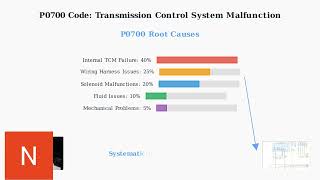
- Faulty Transmission Control Module (TCM/TEHCM) 🔴 High Probability → Shop Transmission Assembly On models with the 6L80 transmission (2009+), the TCM is integrated into the valve body (as a TEHCM) inside the transmission pan. It is constantly exposed to heat, vibration, and contaminated fluid, making it a very common failure point. Forum discussions frequently point to TEHCM failure, especially in hotter weather or after the vehicle is fully warmed up.
How to confirm: A professional scan tool shows a loss of communication with the TCM (e.g., U0101) or specific internal processor fault codes. Often, multiple solenoid 'stuck off' codes like P0796 and P2723 will be present along with P0700, pointing to an internal TEHCM failure. A complete loss of voltage to the TCM, reading as 0 volts on a scan tool's live data, points to a wiring or fuse issue before condemning the module.
Typical fix: Replacement of the TEHCM assembly. This part is located inside the transmission and requires removing the pan and valve body. The new module must be programmed to the vehicle's VIN to function.
Est. part cost: $300-$700 - Failed Shift Solenoid or Valve Body 🔴 High Probability → Shop Transmission Valve Body Solenoids are electro-mechanical valves that control fluid flow for gear changes. They can wear out, fail electrically, or get clogged with contaminated fluid. This is a common issue on both the 4L60E and 6L80 transmissions. On the 4L60E, a worn TCC regulator valve bore in the valve body is a very common cause of code P1870 (a frequent companion to P0700 on that transmission) and harsh 1-2 shifts. NHTSA ODI #11723283 describes a vehicle in limp mode with codes P0700 and P0776 where a mechanic recommended replacing the valve body assembly.
How to confirm: A scan tool will show specific solenoid performance codes (e.g., P0751, P0777, P0796) along with P0700. Solenoids can be tested for correct resistance with a multimeter after removing the transmission pan.
Typical fix: Replace the faulty solenoid(s). They are often sold in kits. If multiple solenoids fail or the valve body is worn, the entire valve body assembly may be replaced. On 6L80 models, the solenoids are part of the TEHCM assembly. For the 4L60E P1870 issue, aftermarket kits are available to repair the worn valve bore without replacing the entire valve body.
Est. part cost: $50-$250 for a solenoid kit, $400-$900 for a valve body assembly. - Damaged Wiring Harness or Connectors 🟡 Medium Probability The main transmission wiring harness is exposed to road debris, exhaust heat, and moisture, which can cause wires to chafe, break, or corrode at the main connector. GM issued TSB 08-07-30-021H for a range of communication issues, including P0700, related to poor terminal connections in the transmission harness connector. NHTSA ODI #11324591 notes an instance where a TCM fuse was burnt out with codes P0700 and P2534 present, requiring a mechanic to inspect the wire bundle for issues.
How to confirm: Visually inspect the external wiring harness for damage, especially near the exhaust and at the large round connector on the transmission. Check for power and ground at the TCM connector using a multimeter. Inspect the internal harness for brittleness or damage after dropping the transmission pan.
Typical fix: Repair the damaged section of wire or replace the faulty connector. TSB 08-07-30-021H provides specific instructions for repairing terminals in the main connector. In some cases, the entire harness may need replacement.
Est. part cost: $20-$300 depending on the extent of the damage. - Low or Degraded Transmission Fluid 🟡 Medium Probability → Shop Transmission Assembly Neglected maintenance can lead to fluid that is low, burnt, or contaminated with debris. This causes poor hydraulic pressure, overheating, and sticking components like solenoids. A leak from the transmission cooler lines is also a known issue on this platform. NHTSA ODI #11412985 reports a transmission fluid temperature sensor failure accompanied by codes P0700 and P0711, resulting in an erratic dash gauge.
How to confirm: Check the transmission fluid level and condition via the dipstick (if equipped) or check plug. The fluid should be bright red and clear, not brown, black, or smelling burnt. If it contains metal shavings, a major internal failure is likely.
Typical fix: Perform a transmission fluid and filter change using the correct fluid (DEXRON-VI for the 6L80). If the fluid is very dark or contains metal, it may indicate a more severe internal failure requiring a rebuild or replacement.
Est. part cost: $75-$150 for fluid and a filter kit.
Rare But Worth Checking
- Faulty Input/Output Speed Sensors: These sensors provide critical data for shift timing. A failure will typically set a specific sensor code (like P0717 or P0722) along with P0700. They are a possible but less frequent cause than solenoid or TCM issues.
- Weak Battery or Alternator: → Shop Vehicle Battery The TCM and its solenoids require stable voltage to operate correctly. Low voltage from a failing battery or alternator can cause erratic behavior, communication codes (U-codes), and trigger a P0700 code. This should be checked early in the diagnosis. NHTSA ODI #11517297 mentions a loss of engine power with codes P2138 and P0700, where replacing sensors did not immediately resolve the issue.
Diagnosis Steps
- Scan for Codes: Use an OBD-II scanner that can access the Transmission Control Module (TCM) to retrieve all stored codes. The P0700 code will be accompanied by more specific codes which are essential for diagnosis.
- Analyze Additional Codes: The other codes are your primary clue. Research their specific meaning for your Yukon's transmission (4L60E or 6L80). Codes like P0796 on a 6L80 strongly suggest a TEHCM issue.
- Check Transmission Fluid: Verify the fluid level is correct and the fluid is in good condition (bright red, not burnt or dirty). Low or dirty fluid is a common cause of transmission problems.
- Inspect Wiring: Visually inspect the main wiring harness going to the transmission for any signs of damage, corrosion, or loose connections, paying close attention to the main connector.
- Check Power and Ground to TCM: Using a multimeter, confirm that the TCM is receiving proper voltage and has a solid ground connection, especially if communication codes (U-codes) are present. A scan tool showing 0 volts input to the TCM is a strong indicator of a power supply circuit failure.
- Address TSBs: Check for any Technical Service Bulletins (TSBs) related to your specific codes and vehicle VIN. TSB 08-07-30-021H is particularly relevant for communication issues.
- Test Specific Components: Based on the codes found, test the suspected components (e.g., check resistance of shift solenoids, test sensor signals). This may require removing the transmission oil pan.
Parts You'll Likely Need
- Transmission Control Module (TEHCM for 6L80)
(OEM #24256861)
Related Codes That Often Appear With This One
- P0796, P2723, P0776, P0777 — These are specific codes for pressure control solenoid performance faults ('Stuck Off' or 'Stuck On'). They are very common companions to P0700 on the 6L80 transmission and point directly to a TEHCM/valve body issue.
- P0711, P0716, P0717, P0721, P0722 — These codes relate to the transmission fluid temperature sensor and input/output speed sensors. Their presence helps narrow the diagnosis to a specific sensor circuit.
- U0073, U0100, U0101 — These indicate a loss of communication between the TCM and other modules on the vehicle's data network (CAN bus), often pointing to a wiring problem, connector issue, or a failed TCM.
Technical Service Bulletins (TSBs) & Recalls
- TSB 08-07-30-021H: Addresses loss of high-speed GMLAN communications which can cause numerous issues including setting P0700. It points to potential repairs in the transmission harness connector.
- TSB 14-07-30-001D: Information on transmission adaptive learn functions for harsh shifting, which can sometimes be a symptom associated with codes that trigger P0700.
- TSB 01-07-30-023B: Pertains to the older 4L60E transmission, addressing a harsh 1-2 shift and DTC P1870 caused by valve body wear, a condition that would be flagged by a P0700.
Mechanic-Grade Diagnostic Values
- 6L80 On/Off Shift Solenoid Resistance — expected: 20-40 Ohms. Failure: A reading outside this range indicates a failed solenoid winding.
- 6L80 PWM Pressure Control & TCC Solenoid Resistance — expected: 3.0-8.0 Ohms. Failure: A reading outside this range indicates a failed solenoid winding. Some sources state a tighter range of 5-6 Ohms.
- 4L60E 1-2 & 2-3 Shift Solenoid Resistance — expected: 20-40 Ohms (often 20-25 Ohms in practice). Failure: A reading outside this range indicates a failed solenoid.
- 4L60E TCC Solenoid Resistance (non-PWM) — expected: 20-40 Ohms. Failure: A reading outside this range indicates a failed solenoid.
- 4L60E EPC (Pressure Control) Solenoid Resistance — expected: 3.5-8.0 Ohms. Failure: A reading outside this range indicates a failed solenoid.
- 6L80 TEHCM Operating Voltage (Scan Tool PID) — expected: System voltage (approx. 12-14.5V). Failure: A reading of 0 volts indicates a complete loss of power to the module, likely from a blown fuse or wiring fault, not a failed TEHCM itself.
Scan Tool Commands That Help
- GDS2 / Techline Connect: Replace and Reprogram — This function is mandatory after installing a new or remanufactured TEHCM. It flashes the module with the correct VIN-specific calibration file from GM's servers.
- GDS2 / Techline Connect: Fast Learn / Reset Adapts — After programming a new TEHCM, this procedure must be performed to establish baseline shift adapt values and clutch volume indexes. Skipping this step will result in poor shift quality and potential damage.
- GDS2: Solenoid Automated Cleaning Process — If a solenoid performance DTC is present, this function can be attempted before replacing the TEHCM. It cycles all solenoids with the vehicle in Park to flush out potential debris.
Wiring & Ground Locations
- Fuse 19 & 14 (Underhood Fuse Block) — Located in the underhood fuse block.. These fuses supply power to the TCM/TEHCM. A scan tool showing 0 volts for TCM input voltage strongly points to one of these fuses being blown, often due to a shorted wire in the harness.
- Main Transmission Harness Connector (X184 on some diagrams) — Large, round connector on the side of the transmission case.. This is the primary interface between the vehicle harness and the transmission's internal components. It is a common point for corrosion, moisture intrusion, and pin fitment issues addressed by TSB 08-07-30-021H.
- Transmission Case Ground — A strap or wire connecting the transmission case to the vehicle's chassis/frame.. A poor or corroded ground connection can cause a wide range of erratic electronic behaviors, including communication faults and incorrect sensor readings that can trigger a P0700.
Real Owner Repair Stories
- Rainman Ray's Repairs on YouTube (Chevy Tahoe (same platform/transmission as Yukon)) — Towed in, stuck in 2nd gear, check engine light on with codes P0700 and P2534 (Ignition 1 Switch Circuit Low Voltage).
❌ Tried (didn't work) Initial thought was a failed TEHCM/valve body, as is common.
✅ What actually fixed it The scan tool showed 0 volts for the TCM input voltage. Diagnosis traced the issue to a power wire in the harness near the underhood fuse block. The protective loom had disintegrated, and the wire had chafed and shorted to ground, blowing the TCM fuse. Repairing the wire and replacing the fuse restored power to the TCM and fixed the issue. - Tahoe Yukon Forum user (2007 GMC Yukon) — Hard shifting, check engine light with codes P0700, P0716, and P0717 (Input Speed Sensor codes).
❌ Tried (didn't work) Replaced throttle body with sensor., Replaced transmission input speed sensor., Replaced accelerator pedal with sensor., Replaced connectors for the sensors.
✅ What actually fixed it After replacing multiple sensors and connectors without success, the final suggested step was to test and likely replace the Transmission Control Module (TCM), as it was the last common component for all the recurring codes. - NHTSA ODI #11320736 — An owner reported that the P0700 code kept turning on the check engine light even after they had it fixed, and noted a rattling noise while the vehicle was at idle.
OEM Part Supersession History
24241350 / 24252114 (Gen 1)→24256861 / 24256863 (Gen 2)— Gen 1 TEHCMs (2007-2009) were prone to pressure switch failures. Gen 2 (2010-2013) featured improved solenoids and an updated pressure manifold gasket.
Heads up: TEHCMs are generally not interchangeable between model year groups due to calibration and logic differences. Installing the wrong year TEHCM can cause immediate limp mode. Always match the part number from the tag on the original unit.24256861 / 24256863 (Gen 2)→24274046 / 24285393 (Gen 3)— Gen 3 TEHCMs (2014+) have integrated calibration changes.
Heads up: Gen 3 modules are not interchangeable with earlier units. The original part number 24256861 has been superseded by multiple numbers over time, including 24275873, 24275259, and others.
Model Year Variations Within This Range
- 2007-2009: These years primarily used the 4-speed 4L60E or the early Gen 1 6L80. For the 4L60E, a common companion code is P1870 caused by valve body wear. For the 6L80, early TEHCMs were more prone to pressure switch failures.
- 2009-2014: This range predominantly features the 6-speed 6L80 transmission. The TEHCM part numbers and internal designs were updated around 2010 and again in 2014, improving reliability but making them non-interchangeable across these breaks. Diagnosis for these years almost always centers on the TEHCM and its integrated solenoids.
Diagnostic Flowchart
Other Known Issues on This Vehicle
Issues unrelated to this code that are worth knowing about as an owner of this generation:
- Cracked Dashboard 🟠 Medium — Extremely common, especially on 2007-2009 models. Cracks typically appear above the instrument cluster and passenger airbag regardless of sun exposure. (Ref: No recall was ever issued; it is considered a cosmetic defect by GM.)
- Excessive Oil Consumption (5.3L V8) 🔴 High — Common on 5.3L engines with Active Fuel Management (AFM). Often caused by issues with the PCV system or piston rings, leading to oil burning. (Ref: Multiple TSBs exist, including 19-NA-036, which outlines an oil consumption test and potential piston/ring replacement.)
- Active Fuel Management (AFM) Lifter Failure 🔴 High — A well-documented problem where the specialized AFM lifters can collapse or get stuck, causing misfires (P0300), a ticking noise, and potential camshaft damage.
- Broken Interior/Exterior Door Handles 🟡 Low — The plastic door handles, particularly the interior ones, are known to break or have the chrome plating peel, creating sharp edges.
- Throttle Body Failure / Reduced Engine Power 🟠 Medium — Failure of the throttle position sensor within the throttle body can cause the vehicle to enter 'Reduced Engine Power' mode, limiting speed.
Used vs. New Parts: Buying Guide for This Vehicle
When a used part is the smart pick: For external components like wiring harnesses or sensors, a used part from a low-mileage donor can be a cost-effective option. For the 4L60E, a complete used valve body can be viable. However, for the 6L80 TEHCM, buying used is extremely risky and generally not recommended.
Donor-vehicle mileage cap: roughly under 80000 miles for the part to have meaningful remaining life.
What to inspect on the donor part:
- Check for a clean, bright red fluid color in the donor transmission if possible.
- Inspect wiring harnesses for any signs of brittleness, cracking, or previous repairs.
- Verify the part number on a used TEHCM exactly matches the one being replaced.
OEM-only on this vehicle (don't cheap out):
- Transmission Electro-Hydraulic Control Module (TEHCM) for 6L80. While remanufactured units are a good option, used (junkyard) units are a major gamble. They are VIN-locked and require specialized tools to clone the original module's data or must be reprogrammed by a dealer/specialist shop using GM's SPS2 service, which adds cost and complexity. An incorrect or failed programming attempt can render the module useless.
Aftermarket brands forum-validated for this vehicle:
- Sonnax (For remanufactured TEHCMs and 4L60E valve body repair kits).
- TransGo (For 4L60E valve body/shift kits to fix P1870 wear).
- ACDelco (GM's Original Equipment brand for new TEHCMs and solenoids).
Brands owners have reported issues with on this vehicle:
- Unbranded, no-name TEHCMs from online marketplaces. These often have high failure rates, may be un-programmable, or could be used units sold as 'remanufactured' without proper testing.
Real Owner Stories
Aggregated from forums and TSBs cited above. Mileages and costs reflect what owners reported in those sources.
2008 Yukon Denali
Symptoms: The vehicle went from shifting smoothly to suddenly entering limp mode with a P0700 code.
What fixed it: Discussion and diagnosis pointed toward TCM/TEHCM failure.
Source hint: Tahoe Yukon Forum: 'From smooth to limp mode and P0700 code'
2017 Yukon (6L80 Transmission)
Symptoms: Multiple solenoid codes (P0796, P2723) appeared alongside the P0700 code.
What fixed it: Replacement of the TEHCM or valve body assembly.
Source hint: Tahoe Yukon Forum: '2017 Yukon P0700/P0796/P2723'
2007-2014 GMC Yukon
Symptoms: P0700 code present but the owner reported no immediate drivability issues.
What fixed it: Community advised checking the battery and performing a full transmission scan for hidden codes.
Source hint: Tahoe Yukon Forum: 'P0700 code BUT!'
Related OBD-II Codes
Frequently Asked Questions
My 2009 Yukon with the 6L80 transmission is stuck in limp mode. Is there a specific TSB for communication issues?
I have a 2007 Yukon with the 4L60E transmission and a harsh 1-2 shift. Is this related to P0700?
Why does my 2010 Yukon's TEHCM fail so often compared to older models?
Can I fix the harsh shifting on my Yukon without replacing the whole transmission?
Do I need to program a new Transmission Control Module for my GMC Yukon?
What should I check first if my Yukon shows P0700 but has no drivability issues?
Helpful Videos


We Have This Part in Stock

The information in this article is provided for general reference and educational purposes only. Vehicle specifications, procedures, and part compatibility can vary by production date, trim level, and region. Always consult your vehicle's factory service manual and verify part numbers before purchasing or performing repairs. Safety-critical components such as airbags, seat belts, and braking systems should be installed by a qualified professional.
- GMC Yukon:
- 🧭 Diagnostic Flowchart
- 🎬 Helpful Videos
- 🛍️ Shop This Part
- What's Unique About the 2007-2014 GMC Yukon
- Symptoms You May Notice
- Most Likely Causes
- Rare But Worth Checking
- Diagnosis Steps
- Parts You'll Likely Need
- Related Codes That Often Appear With This One
- Technical Service Bulletins (TSBs) & Recalls
- Mechanic-Grade Diagnostic Values
- Scan Tool Commands That Help
- Wiring & Ground Locations
- Real Owner Repair Stories
- OEM Part Supersession History
- Model Year Variations Within This Range
- Other Known Issues on This Vehicle
- Used vs. New Parts: Buying Guide for This Vehicle
- Real Owner Stories
- 2008 Yukon Denali
- 2017 Yukon (6L80 Transmission)
- 2007-2014 GMC Yukon
- Related OBD-II Codes
- Frequently Asked Questions
- 🎟️ Get 5% Off